Replacing a roof usually begins with a price estimate. Early research on synthetic slate roof cost often reveals a surprisingly wide national range, even for houses with nearly identical square footage.
The material delivers the appearance of natural slate without reaching the same purchase price, making it an attractive option for larger roofing projects. Budget planning starts here.
Published synthetic slate roofing cost averages give homeowners a practical reference, although no national figure can replace an on-site proposal.
Two roofs measuring the same size may still produce very different roof cost estimates after measurements, layout, and construction details are reviewed.
Online roofing shingles prices rarely include everything found in a complete roofing quote, so direct comparisons often create unrealistic expectations.
Anyone preparing for a future roof replacement cost can use the pricing ranges presented in this article as an early budgeting reference before requesting estimates from local roofing contractors.
Average Synthetic Slate Roof Cost

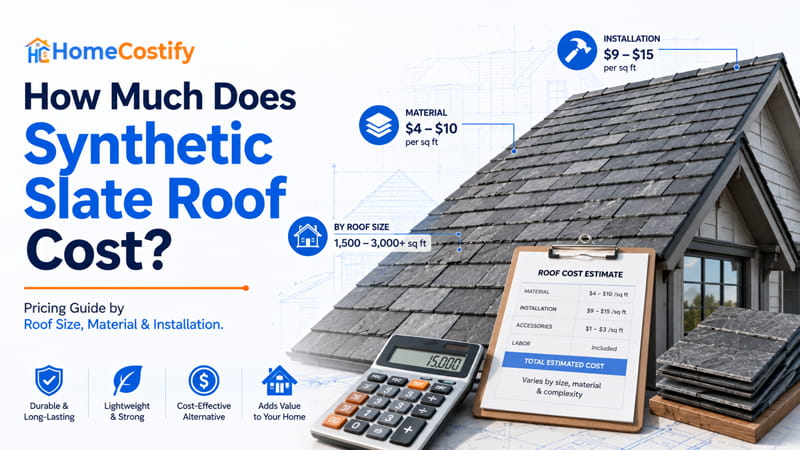
The average synthetic slate roof cost ranges from $9 to $15 per square foot for a fully installed roof, with premium projects reaching $20 or more per square foot.
Material prices usually fall between $4 and $10 per square foot, and a typical roofing square costs $900 to $1,500 before premium upgrades are added.
| Cost Type | National Average |
|---|---|
| Material Only | $4–$10/sq ft |
| Installed Cost | $9–$15/sq ft |
| Premium Installation | Up to $20+/sq ft |
| Cost Per Roofing Square | $900–$1,500 |
| Premium Per Square | $1,500–$2,000+ |
A national average gives buyers a useful starting point. Local proposals often move above or below that range once measurements are completed and project details are reviewed on site.
Material delivery, regional labor rates, and roof geometry all leave a noticeable mark on the final synthetic slate roof cost.
Early estimates work best as a budgeting tool, leaving room for adjustments after a contractor completes a full inspection.
Online pricing frequently creates false expectations because short price lists rarely include everything found in a complete roofing proposal.
Flashing details, preparation work, waste allowance, and new underlayment may already be included in one estimate yet appear as separate line items in another.
Two quotes can look far apart at first glance even though both cover nearly the same scope of work. Reading beyond the headline price usually paints a much clearer picture of the expected roof cost.
Two houses with the same footprint can receive very different pricing once roof lines, valleys, intersecting sections, or difficult access enter the equation, even before premium materials are selected.
That variation appears across every region of the country and remains a common reason why the final synthetic slate roofing cost rarely matches a simple online calculator. Published averages should always be treated as planning figures, not as a guaranteed contract price.
Price comparisons become more meaningful after using the same unit across every estimate. Contractors commonly calculate projects by the roofing square, so comparing the synthetic slate roof cost per square often produces a clearer picture than comparing whole-project totals from different companies.
Material-only pricing can serve a similar purpose because the synthetic slate roof cost per square foot becomes easier to evaluate once labor, tear-off work, and optional upgrades are separated.
That extra context gives the national synthetic slate roofing cost range far greater value during the early stages of planning a future roof replacement.
Synthetic Slate Roof Cost by Roof Size
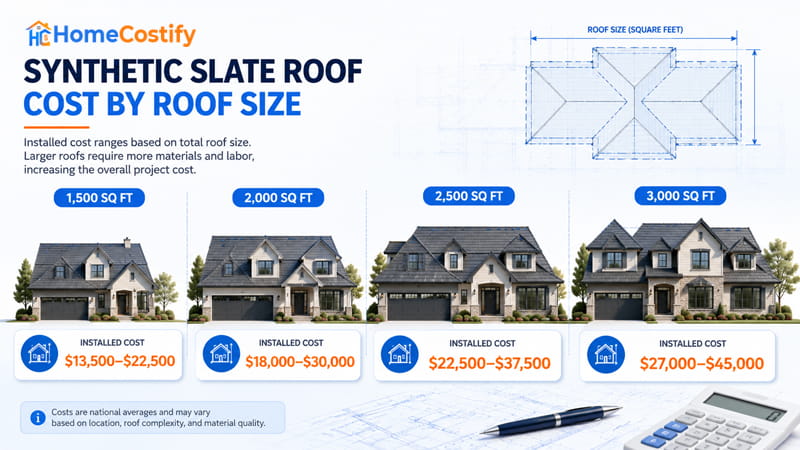
Roof size sets the foundation for every roofing estimate, although surface area never tells the full pricing story. A larger roof requires more materials, longer installation time, and a higher project budget from the start.
Even so, identical square footage does not guarantee identical pricing. Local conditions on the roof often change the final synthetic slate roof cost long before installation begins.
Average Cost by Roof Size
| Roof Size | Installed Cost |
|---|---|
| 1,500 sq ft | $13,500–$22,500 |
| 2,000 sq ft | $18,000–$30,000 |
| 2,500 sq ft | $22,500–$37,500 |
| 3,000 sq ft | $27,000–$45,000 |
A roof measuring around 2,000 square feet frequently appears in national pricing examples. Quotes near the lower end often involve simple roof lines with open access and fewer cuts across the field of the roof.
Extra valleys, steep sections, large dormers, or premium synthetic slate profiles can move pricing toward the upper end without adding a single square foot. Material delivery can raise costs as well, especially where staging space or equipment access is limited.
Roof layout changes the amount of material that never reaches the finished roof. Long valleys, intersecting roof planes, and decorative edges create more offcuts during installation.
Premium tiles often require extra trimming around transitions, leaving less opportunity to reuse cut pieces. Material orders usually account for that waste before work begins, adding another layer to the synthetic slate roofing cost.
Roof pitch enters the estimate long before the first tile is fastened. Gentle slopes allow crews to move across the roof more freely, whereas steeper sections demand slower progress and additional safety equipment.
Time spent moving materials across difficult roof surfaces grows quickly on larger projects. A higher estimate does not always reflect a larger roof.
Why Roof Size Doesn’t Tell the Whole Story
Square footage establishes material quantities, but pricing rarely stops there. Roof geometry changes the amount of cutting required across ridges, valleys, hips, and edge details.
Complex layouts create more waste, even when the total area matches another project. Extra cutting affects material consumption before labor is calculated in detail.
Roof geometry becomes more noticeable as the design moves beyond a simple gable roof. Curved sections, multiple elevations, and intersecting planes increase measuring accuracy and tile layout requirements.
Small adjustments repeated across hundreds of tiles can change the final synthetic slate roof cost without changing the home’s footprint. Simple layouts usually leave far fewer unused pieces after installation.
Estimating by the roofing square creates a consistent way to compare projects, although each roofing square can carry a different installation burden. A basic roof may require little trimming from one end to the other.
Complex architecture introduces more transitions and cut lines across the same measured area. Roof size remains a valuable reference, yet a roof inspection often reveals pricing details that drawings and satellite measurements cannot capture.
Early budgeting should account for roof dimensions without treating square footage as the final answer. Contractors often verify measurements before preparing proposals for a replacement project, especially if older roofing materials hide damaged decking or unusual framing details.
Careful planning at this stage produces a more dependable synthetic slate roofing cost estimate and reduces surprises during a future synthetic slate roof replacement cost project. It also creates a stronger basis for comparing estimates tied to the same scope of work.
Synthetic Slate Roof Cost by Material Type
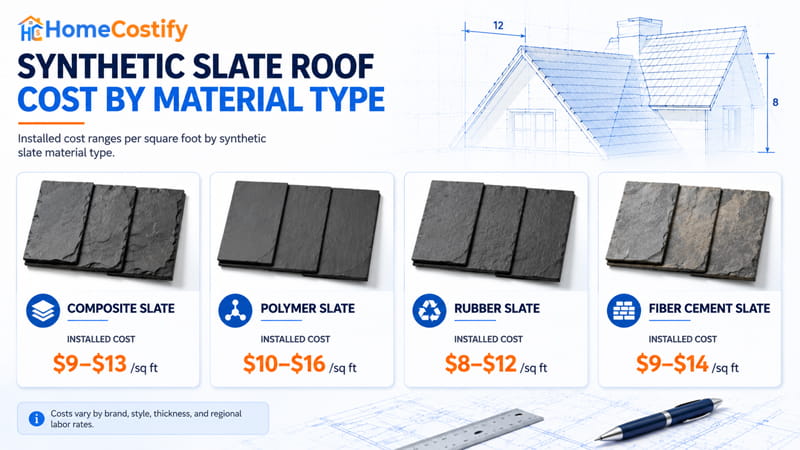
Synthetic slate products may appear similar from the curb. The material inside each tile creates noticeable differences in price, weight, weather resistance, and long-term appearance.
Material selection has a direct impact on the synthetic slate roof cost long before installation begins. One product may fit a modest budget, whereas another targets premium residential projects.
Average Cost by Material
| Material | Installed Cost |
|---|---|
| Composite Slate | $9–$13/sq ft |
| Polymer Slate | $10–$16/sq ft |
| Rubber Slate | $8–$12/sq ft |
| Fiber Cement Slate | $9–$14/sq ft |
Material pricing reflects far more than appearance. Manufacturing methods, raw ingredients, color technology, and product testing all contribute to retail pricing before the first pallet reaches a roofing supplier.
A tile molded from premium polymers follows a different production process than one made with recycled materials. Those differences appear in today’s synthetic slate roofing cost, even though every product aims to replicate natural slate.
Polymer Slate
Polymer slate usually carries the highest price within the synthetic slate category. Manufacturers invest heavily in precision molds, detailed surface textures, and color systems that retain a consistent appearance after years of sun exposure.
UV stabilizers become part of the production process instead of being added as a surface coating. Premium collections often include a broader selection of synthetic slate roof colors, pushing material prices above other options.
Higher pricing does not come from appearance alone. Premium polymer products often receive longer warranty coverage and tighter dimensional tolerances, producing cleaner roof lines after installation.
Uniform tile sizing reduces visible irregularities across large roof sections. Premium construction commonly raises the synthetic slate roofing cost before labor enters the estimate.
Composite Slate
Composite slate occupies the middle of the market for a reason. Multiple materials are blended to balance manufacturing cost, finished appearance, and product weight without reaching premium pricing.
Builders and remodeling projects frequently land in this category because the price remains competitive across a broad range of house styles. The result is a practical balance between cost and appearance.
Composite products fit a wide range of climates and architectural designs. Buyers searching for attractive roofing without entering the premium tier often begin their comparison here.
Product availability is also broader across many suppliers. Competitive pricing keeps the synthetic slate roof cost within reach for more renovation budgets.
Rubber Slate
Products manufactured with recycled rubber continue to attract attention across hail-prone regions. Flexible tiles absorb impacts differently from rigid materials, lowering the chance of cracked pieces after severe storms.
Weather patterns often influence product demand as much as purchase price. Rubber slate remains a familiar choice across parts of the Midwest and Mountain West.
Lower pricing creates another advantage. Material costs frequently remain below premium polymer collections, giving larger roofs additional room within the budget.
Buyers still receive a slate-inspired appearance without moving into the highest price bracket. Regional weather often carries as much weight as appearance during product selection.
Fiber Cement Slate
Fiber cement delivers a traditional slate profile with moderate pricing. Crisp edges and familiar proportions complement colonial, craftsman, and traditional home styles.
Product weight generally exceeds rubber alternatives, creating a different balance between appearance and handling. Finished roofs maintain a classic look that appeals to buyers seeking timeless architecture.
Fiber cement occupies a comfortable position between entry-level and premium products. Pricing usually lands near the middle of the market, avoiding the highest material costs without sacrificing curb appeal.
Product selection often depends on architectural style, local availability, and long-term ownership plans. Material choice remains one of the biggest drivers behind synthetic slate roofing materials pricing.
Key Takeaways
- Polymer — Premium appearance with strong long-term color retention.
- Composite — Balanced pricing for a broad range of residential projects.
- Rubber — Flexible material favored in regions with frequent hail.
- Fiber Cement — Traditional slate styling with moderate material pricing.
Synthetic Slate Roof Cost by Brand
Brand choice can move a roofing estimate in either direction, even after roof measurements have been finalized.
The synthetic slate roof cost often reflects more than the tile itself because manufacturing standards, finish quality, warranty terms, and product consistency vary from one manufacturer to another.
Average Cost by Manufacturer
| Brand | Material Cost per Square | Estimated Installed Cost |
|---|---|---|
| DaVinci Roofscapes | $400–$1,200 | $10–$16/sq ft |
| Brava Roof Tile | $700–$1,150 | $11–$16/sq ft |
| EcoStar | $300–$800 | $9–$14/sq ft |
| Euroshield | $400–$800 | $9–$13/sq ft |
| Inspire Roofing | $600–$1,050 | $10–$15/sq ft |
| CertainTeed Symphony | $400–$900 | $9–$14/sq ft |
Premium brands earn higher price tags through manufacturing consistency as much as appearance.
DaVinci Roofscapes and Brava Roof Tile are widely recognized for molded profiles with deeper shadow lines, realistic slate edges, and broad color blending that closely resembles quarried stone.
Production tolerances remain tight across large orders. Finished roofs often display a more uniform appearance from ridge to eave.
Warranty coverage can separate products that appear similar at first glance. Longer warranty periods usually accompany stricter manufacturing controls, giving buyers additional confidence over decades of exposure to sun, rain, and seasonal temperature changes.
Surface texture, molded edges, and fade resistance all require extra production steps before tiles reach distributors.
Premium collections frequently include a wider range of synthetic slate roof colors, adding another element to the total synthetic slate roofing cost.
Mid-range products continue to attract steady demand across the United States. EcoStar, Euroshield, and CertainTeed Symphony generally balance purchase price with appearance, making them attractive for projects that place equal weight on budget and curb appeal.
Product lines within each brand still vary, so published price ranges should be viewed as broad estimates instead of fixed numbers.
Brand selection remains a meaningful part of the total synthetic slate roof cost, though material specifications deserve equal attention before a purchase decision.
Does Choosing a Premium Brand Always Cost More?
Premium products make sense for houses where architectural detail stands out from the street. Historic-style homes, luxury custom builds, and high-value neighborhoods often benefit from richer textures, broader color variation, and extended warranty coverage that align with long-term ownership goals.
A higher purchase price can be justified if resale value and exterior appearance carry equal weight alongside the roofing budget. Long service life may further strengthen that value over time.
Mid-range brands fit plenty of projects without feeling like a compromise. Clean manufacturing quality, dependable weather resistance, and attractive finishes remain available across numerous product lines at a lower synthetic slate shingles cost than premium collections.
Budget priorities, expected years in the home, and neighborhood housing values usually guide the final decision more effectively than brand reputation alone.
Viewed across decades of ownership, the right selection often delivers stronger value than simply chasing the lowest synthetic slate roofing cost or assuming the highest synthetic slate roof cost always produces the best return.
Factors That Affect Synthetic Slate Roof Cost
Published estimates provide a useful reference, yet no roofing proposal follows exactly the same path. The final synthetic slate roofing cost grows from site conditions that only become clear after measurements and a full evaluation.
Roof shape, preparation work, and supporting components all contribute to the quoted price. Small details often carry a larger financial impact than expected.
Roof Complexity
Simple roof layouts move faster from one section to the next. Valleys, hips, dormers, and skylights interrupt that rhythm because every transition demands additional measuring, trimming, and tile fitting.
A roof filled with architectural details leaves fewer full-size pieces across each slope. Material waste naturally rises, and the roofing labor cost follows the same direction.
Roof Pitch
Steeper roofs slow every stage of installation. Crews spend more time positioning equipment, moving materials, and securing each tile safely across the roof surface. Extra safety precautions remain part of the daily routine on high-pitch roofs.
Labor hours continue to grow even if the measured square footage stays unchanged.
Tear-Off Requirements
Removing an aging roof often uncovers conditions hidden for decades. Multiple roofing layers require additional demolition, heavier debris removal, and larger disposal loads before new materials arrive.
Dump fees can rise quickly once extra weight enters the containers.
Older roofs occasionally reveal damage that changes the scope of a planned roof replacement cost project.
Underlayment, Flashing, and Roof Components
| Additional Item | Typical Cost |
|---|---|
| Underlayment | $10–$80 per square |
| Roof Deck Repair | $2–$5/sq ft |
| Roof Vent | $200–$700 |
| Drip Edge | $1.50–$3/LF |
| Permit | $100–$500 |
New underlayment, replacement flashing, repairs to the roof deck, fresh drip edge, updated pipe boots, and permit fees often appear as separate items after a contractor completes a roof inspection.
Those additions can raise the synthetic slate roofing cost well beyond material prices listed online. Detailed proposals usually reveal far more work than the roofing tiles alone.
- Steeper roofs require slower installation.
- More roof penetrations increase flashing work.
- Existing damage raises preparation costs.
- Premium accessories improve long-term performance.
Synthetic Slate Roof Material Cost vs. Installation Cost
Material prices attract plenty of attention during the early planning stage.
Premium products paired with a complex roof can push labor close to, or even beyond, the material portion of the estimate. A balanced review of both categories produces a far more accurate view of the synthetic slate roof cost.
Material Cost
| Item | Average Cost |
|---|---|
| Material | $4–$10/sq ft |
| Premium Materials | $10–$15+/sq ft |
Premium synthetic slate products command higher prices for reasons that extend beyond appearance. Polymer formulations with tighter manufacturing tolerances create tiles that maintain consistent dimensions across large production runs.
Deep surface texture requires more detailed molds, adding another layer to the manufacturing process.
Long warranty periods often reflect higher production standards and more demanding quality control before products leave the factory.
Color stability carries real value on roofs exposed to decades of sunlight. UV stabilizers become part of the material during manufacturing, reducing fading that can appear after years of intense sun exposure.
Rich color blends and molded slate edges call for additional production steps before each tile reaches the job site.
Premium collections often include those features, raising the synthetic slate roof material cost beyond standard product lines.
Surface appearance can change material pricing long before installation begins. Profiles with thicker edges, molded shadow lines, and more natural slate variation require greater manufacturing precision than flatter designs.
Small production differences spread across hundreds or thousands of tiles during a roof replacement project. Material selection remains one of the largest contributors to the final synthetic slate roofing cost.
Roofing Labor Cost
| Labor Type | Average Cost |
|---|---|
| Installation Labor | $5–$7/sq ft |
| Complex Roof Labor | Higher than average |
A synthetic slate roof rarely goes down as quickly as standard asphalt shingles cost. Installers position and fasten each tile with close attention to alignment, exposure, and spacing across the roof surface.
Valleys demand extra cutting, and every piece surrounding flashing requires careful fitting before the next course continues. Installation time grows steadily across roofs filled with architectural detail.
Preparation extends beyond fastening the tiles themselves. New underlayment, a properly installed starter strip, and clean ridge transitions all require time before the visible roofing layer begins to take shape.
Finishing work around a ridge vent follows the same pattern because accurate placement affects both appearance and weather resistance. Much of that effort remains hidden once the project is complete, yet it becomes part of the final roofing labor cost.
Labor often represents close to half of the total project budget because synthetic slate installation leaves little room for rushed workmanship. Every valley, roof intersection, and penetration adds more layout work before another tile can be secured in place.
Faster production is common on simple roof layouts, though architectural designs filled with cuts and transitions demand a slower pace.
Labor charges and material selections ultimately combine to shape the final synthetic slate roof installation cost, making the completed synthetic slate roof cost much different from material pricing alone and adding another layer to the national synthetic slate roofing cost range.
Synthetic Slate Roof Replacement Cost

Replacing an existing roof usually costs more than installing synthetic slate on new construction. Most synthetic slate roof replacement cost projects include tear-off work, debris disposal, and repairs that remain hidden until the old roofing system has been removed.
Conditions beneath aging roofing materials often change the final contract amount. Replacement estimates should always leave room for unexpected findings.
| Replacement Item | Typical Cost |
|---|---|
| Roof Tear-Off | $2–$5/sq ft |
| Disposal | Included / Varies |
| Deck Repair | $1,000–$3,000 |
| Structural Reinforcement (if needed) | $1,000–$10,000 |
National averages provide a budgeting reference, yet replacement projects rarely follow identical repair requirements. Existing roof conditions determine how much work comes before new synthetic slate installation begins.
Hidden damage can remain concealed for decades beneath older roofing materials. A complete proposal often grows after demolition starts.
Roof Tear-Off and Disposal
Removing an old roof takes more than lifting shingles into a dumpster. Crews separate roofing materials, pull thousands of fasteners, clear old underlayment, and prepare the surface for new installation.
Extra roofing layers create additional labor and heavier disposal loads. Landfill charges can increase quickly once debris volume begins to grow.
Roof Deck Repairs
The roof deck receives a close inspection after tear-off is complete. Soft plywood, moisture damage, delaminated panels, or deteriorated boards usually require replacement before synthetic slate can be installed.
Covering damaged decking with new roofing materials only transfers the problem beneath a new roof. Repairs at this stage often add more to the synthetic slate roof cost than homeowners originally expected.
Structural Reinforcement
Older houses sometimes reveal framing that no longer meets current loading requirements. Previous alterations, aging lumber, or local code requirements may call for additional carpentry before roofing work continues.
Structural reinforcement does not appear on every proposal. Projects requiring that work often carry substantially higher replacement costs.
Why a Roof Inspection Matters Before Replacement
A professional roof inspection identifies visible warning signs before demolition begins. Flashing defects, drainage problems, sagging roof sections, and moisture stains frequently indicate areas needing closer attention after tear-off.
Hidden damage may still appear once the old roof has been removed, although early findings usually produce a more accurate proposal.
Careful inspection reduces surprises and gives a stronger foundation for estimating the final synthetic slate roof cost.
Synthetic Slate Roof Repairs Cost
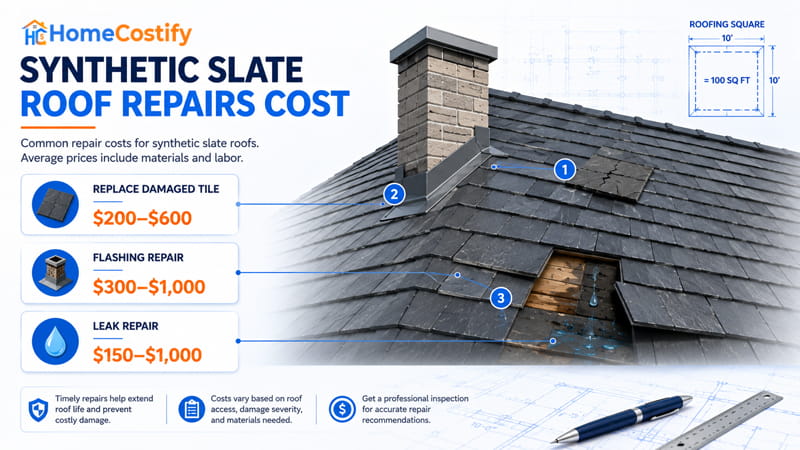
Damage does not always lead to a full roof replacement. Localized repairs often restore roof integrity without replacing every tile, keeping the synthetic slate roof repairs cost well below the price of a new roofing system.
Repair bills vary according to the damaged area and the amount of labor required. Early repairs usually limit additional damage.
| Repair Type | Average Cost |
|---|---|
| Replace Damaged Tile | $200–$600 |
| Flashing Repair | $300–$1,000 |
| Leak Repair | $150–$1,000 |
Broken tiles usually result from falling tree limbs, wind-driven debris, or foot traffic during service work. Synthetic slate stands up well to normal weather exposure, so isolated damage tends to affect only a small section of the roof.
Replacing a limited number of tiles often restores the original appearance without disturbing surrounding areas. Repair costs remain relatively predictable unless hidden water damage is discovered.
Flashing repairs appear more frequently than tile replacement. Metal flashing expands and contracts through years of seasonal temperature changes, gradually opening small gaps around chimneys, skylights, roof walls, and plumbing penetrations.
Water often enters through those joints long before synthetic slate itself shows visible damage. Repair crews commonly spend more time tracing the leak than replacing the flashing material.
Leaks rarely begin in the middle of an intact tile field. Water usually follows the path of least resistance around roof penetrations, aging sealants, or damaged flashing details before reaching the interior.
Prompt repairs prevent moisture from spreading into roof decking and insulation. Small repair bills can quickly grow into a much larger synthetic slate roof cost if leaks remain unnoticed for long periods.
Synthetic Slate Roof Cost vs Natural Slate
Synthetic slate and natural slate often appear in the same roofing estimates because both deliver a slate-style appearance from the ground.
Purchase price, expected service life, structural requirements, and long-term ownership costs create a much wider gap than appearance alone suggests.
The published synthetic slate roof cost reflects a different ownership profile from natural slate. Budget planning becomes more meaningful after considering how long the roof is expected to remain in service.
| Category | Synthetic Slate | Natural Slate |
|---|---|---|
| Installed Cost | $9–$15/sq ft | $10–$30/sq ft |
| Lifespan | 40–60 years | 75–200 years |
| Structural Reinforcement | Usually No | Often Required |
| Weight | Lightweight | Heavy |
Natural slate remains one of the longest-lasting roofing materials available in residential construction. That extended service life comes with higher acquisition costs, heavier weight, and, in some cases, structural reinforcement before installation can begin.
Those added expenses do not appear in every project, yet they can substantially increase the total contract value. Initial pricing tells only a portion of the financial picture.
Synthetic slate follows a different cost pattern. Lower weight removes structural upgrades from numerous reroofing projects, reducing expenses that frequently accompany natural stone.
Material handling is simpler, and transportation costs are often lower because the roofing system weighs far less. Those differences contribute to a lower synthetic slate roofing cost across much of the U.S. market.
Ownership horizon changes how those numbers are interpreted. A roof expected to remain in place for 15 or 20 years produces a different annual ownership cost than one intended to remain for half a century or longer.
Purchase price becomes only one element once expected service life enters the calculation. Comparing cost over years of ownership often produces a more balanced financial evaluation than comparing installation quotes alone.
Long service life does not automatically create the lowest lifetime cost, just as a lower purchase price does not always produce the highest long-term value. Annualized ownership costs, structural requirements, and future replacement timing all deserve space in the calculation.
Viewing both roofing systems across the same ownership period places the published synthetic slate roof cost and synthetic slate roofing cost into a more meaningful financial context.
Is Synthetic Slate Worth the Cost?
The purchase price tells only part of the financial story. Expected service life, repair frequency, insurance incentives, and years of ownership all affect long-term value. A roof with a higher upfront price can produce a lower annual ownership cost over time.
Long-term planning often reveals a different financial picture than the installation quote alone.
Cost Per Year of Ownership
| Roof Type | Example Installed Cost | Expected Life | Approx. Cost Per Year |
|---|---|---|---|
| Synthetic Slate | $28,000 | 50 Years | ≈$560/year |
| Natural Slate | $60,000 | 100 Years | ≈$600/year |
Annual ownership cost places installation expenses into a broader financial perspective. A roof lasting five decades spreads its purchase price across far more years than a roofing system expected to remain in service for only twenty or thirty years.
Small differences in yearly ownership cost often carry greater financial meaning than a large gap in the original proposal.
The published synthetic slate roof cost becomes much easier to evaluate after comparing cost across the expected service life.
A long synthetic slate roof lifespan can reduce the frequency of future replacement projects. Fewer replacement cycles may lower lifetime roofing expenses even if the initial purchase price exceeds asphalt shingles.
Repair needs, local weather, and installation quality continue to influence long-term ownership costs. The expected synthetic slate roof life expectancy deserves a place beside the installation price during budget planning.
Insurance Discounts and FORTIFIED Programs
Roofs installed under the IBHS FORTIFIED Roof™ standard follow enhanced installation practices intended to improve resistance against high winds and severe weather.
Insurance incentives vary by state and carrier, although qualifying roofing systems may receive premium reductions where those programs are available.
Impact-resistant roofing products carrying a Class 4 rating can strengthen eligibility under certain policies. Local insurance requirements ultimately determine available savings.
Choosing the Right Synthetic Slate Roofing System
Roofing products that appear similar from the street can differ considerably after the specification sheets are opened. Manufacturing quality, testing standards, warranty coverage, and installation practices all contribute to long-term value.
Product appearance should never stand alone during the selection process. Technical information deserves equal attention.
According to the National Roofing Contractors Association (NRCA), synthetic roofing products are manufactured to replicate traditional materials such as slate, although product specifications and testing results differ by manufacturer. Impact ratings, weather testing, and published technical data provide a stronger basis for comparison than appearance by itself.
Careful product research often reveals meaningful differences between competing brands. Installation quality remains just as important as the roofing product selected.
- Compare warranty coverage.
- Review impact ratings.
- Verify certified installers.
- Evaluate total ownership cost.
Brand reputation, published specifications, and installation quality work as a complete package during product selection. A premium product installed incorrectly may never deliver the service life printed in the warranty documents.
Careful workmanship and verified product testing carry lasting value long after the installation crew leaves the property. Taking time to compare those details often leads to a more confident roofing decision.
Conclusion
Budget planning becomes far more reliable when pricing is viewed as a range instead of a fixed number.
Material quality, roof design, replacement work, and installation details all contribute to the final synthetic slate roof cost, leaving plenty of room for variation from one proposal to another.
Published averages provide useful direction. Local measurements complete the picture.
A written quotation carries far more value than a simple price per square foot. Itemized proposals reveal material allowances, labor, tear-off work, permits, and roofing components that may never appear in online price estimates.
Reviewing those details side by side often reveals where one contractor includes work that another lists as an additional charge. Careful comparison produces a stronger basis for evaluating value, not simply the lowest bid.
Use the pricing ranges in this guide to prepare a realistic budget before contacting local roofing contractors. Enter each estimate with a clear understanding of national averages, expected cost ranges, and common project items that affect pricing.
Consistent comparisons reduce confusion during the bidding process. Better preparation usually leads to better decisions.
FAQs About Synthetic Slate Roof Cost
How much does synthetic slate roof cost?
The average synthetic slate roof cost ranges from about $9 to $15 per square foot installed. Premium products and complex roof designs can raise pricing beyond $20 per square foot.
What is the average synthetic slate roofing cost per square foot?
National averages place synthetic slate roofing cost between $9 and $15 per square foot for complete installation. Material-only pricing commonly falls between $4 and $10 per square foot.
How much does a 2,000-square-foot synthetic slate roof cost?
A 2,000-square-foot roof typically costs between $18,000 and $30,000. Final pricing depends on roof layout, material selection, tear-off work, and local labor rates.
Why is synthetic slate more expensive than asphalt shingles?
Synthetic slate uses thicker molded materials, more detailed manufacturing, and longer installation time than asphalt shingles. Those factors raise both material pricing and installation expenses.
Does roof pitch increase synthetic slate roofing cost?
Yes. Steeper roofs require slower installation, additional safety equipment, and more labor hours. Higher roof pitch commonly increases the total synthetic slate roofing cost, even when roof size remains unchanged.