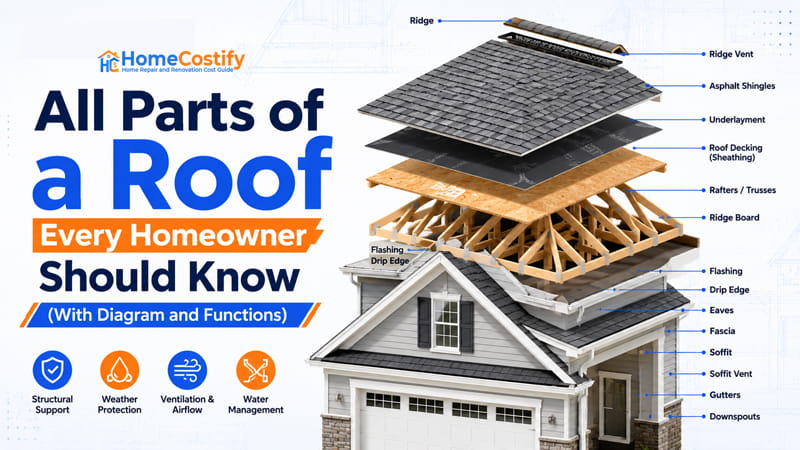
The parts of a roof systems found on modern American homes extend far beyond shingles and gutters. What appears to be a single exterior surface is actually a layered assembly built to carry structural loads, shed water, regulate airflow, and protect the living space below.
Every board, vent, flashing detail, and drainage component contributes to that job. Remove one element from the equation and the entire system becomes more vulnerable to leaks, moisture damage, premature wear, or energy loss.
A roof that looks perfectly fine from the street can still hide issues beneath the surface. A deteriorated underlayment may allow water intrusion. Blocked ventilation can trap heat and humidity inside the attic.
Damaged flashing around a chimney or roof penetration often becomes the starting point for expensive repairs. Spotting those problems early is much easier when you know what each component does and where it belongs.
According to the National Roofing Contractors Association (NRCA), a residential roof is not a single layer but an integrated system of structural, protective, and drainage components that work together to shield a home from weather and moisture intrusion. That definition reflects how roofing professionals evaluate a roof—not as one material, but as a collection of interconnected systems.
The parts of roof assemblies generally fall into four categories: structural framing, weather protection, ventilation, and drainage. Within those categories are dozens of individual roof components, each designed for a specific purpose.
Some provide strength. Others block moisture, improve airflow, or direct runoff away from the home. A clear grasp of this roof anatomy makes inspection reports easier to read, helps homeowners make informed repair decisions, and provides a practical foundation for understanding how an entire roof structure functions over time.
What Are the Parts of a Roof?
The parts of roof systems include structural framing, protective layers, ventilation features, roof-edge components, and drainage elements. Each category performs a different task, yet all of them depend on one another to keep a house protected from rain, wind, temperature extremes, and moisture buildup.
At the structural level, trusses, rafters, ridge boards, ceiling joists, and roof decking create the framework that supports the entire assembly. Above that framework sit the protective layers, including underlayment, shingles or tiles, flashing, and drip edge materials. Around the perimeter are edge components such as eaves, fascia boards, soffits, and rakes. Ventilation and drainage systems complete the assembly by moving air through the attic and directing water away from the roof and foundation.
Structural Roof
Structural components also known as Roof Framing is the framework of the roof and support the weight of roofing materials, weather loads, and other forces acting on the structure.
- Trusses
- Rafters
- Ridge Board
- Ceiling Joists
- Roof Decking
Roof Protection
Roof protection materials create the roof’s weather-resistant barrier and help prevent water intrusion.
- Underlayment
- Shingles
- Tiles
- Flashing
- Drip Edge
Roof Edge
Roof Edges located around the perimeter of the roof, these components protect exposed edges and contribute to the overall performance of the roofing system.
- Eaves
- Fascia
- Soffit
- Rake
Roof Ventilation
Roof Ventilation components help maintain airflow through the attic and roof assembly.
- Ridge Vent
- Soffit Vent
Roof Drainage
Roof Drainage components collect and direct rainwater away from the roof and foundation.
- Gutters
- Downspouts
Roof Parts Overview
| Roof Part | Category | Main Function |
|---|---|---|
| Truss | Structure | Supports roof loads |
| Rafter | Structure | Forms the roof slope |
| Roof Decking | Structure | Provides a base for roofing materials |
| Underlayment | Protection | Adds a secondary moisture barrier |
| Shingles | Protection | Protects against weather exposure |
| Flashing | Protection | Helps prevent leaks around roof joints |
| Fascia | Roof Edge | Supports gutters and protects roof edges |
| Soffit | Roof Edge | Covers roof overhangs and promotes airflow |
| Ridge Vent | Ventilation | Allows warm attic air to escape |
| Gutters | Drainage | Collects rainwater from the roof |
| Downspouts | Drainage | Carries water away from the home |
People searching for roof parts names are usually trying to identify a component shown on a contractor estimate, inspection report, or maintenance checklist. Others want to know which roof parts called by professionals are responsible for leaks, ventilation issues, or drainage problems.
Regardless of roof style, the same basic principles apply: framing provides support, protective materials resist moisture, ventilation manages heat and humidity, and drainage systems control runoff. This straightforward breakdown offers a practical roof structure explained in homeowner-friendly terms without requiring construction expertise.
Parts of a Roof Diagram Explained
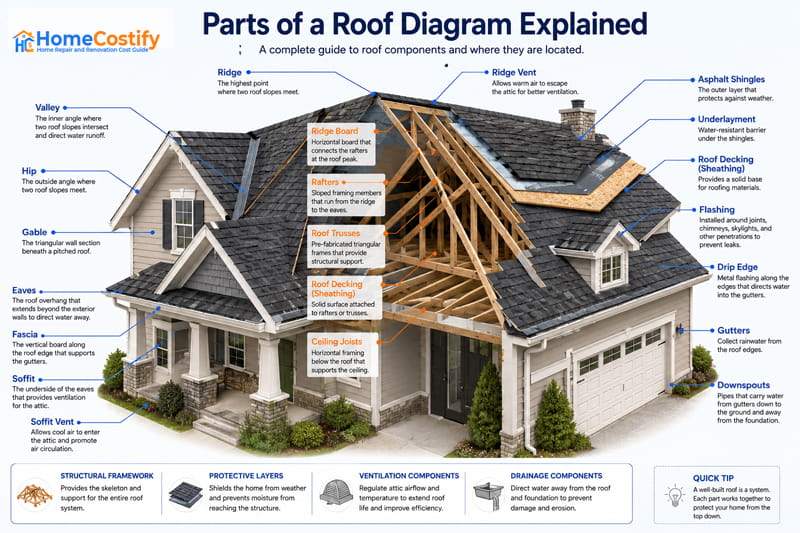
A well-labeled roof parts diagram shows more than the roofing material visible from the ground. It identifies the structural framework beneath the surface, the protective layers that resist moisture, and the exterior features responsible for ventilation and drainage. Reading one of these diagrams becomes much easier once you recognize how the major components are organized.
At the highest point sits the roof ridge, where two roof slopes meet. Moving downward, many diagrams highlight the roof valley, the channel formed when intersecting roof sections direct water toward the drainage system.
Homes with intersecting roof planes often include a roof hip, an outside angle that adds rigidity to the overall structure. Another common feature is the roof gable, the triangular wall section located beneath a pitched roof.
Beneath those visible features lies the structural framework. Trusses or rafters form the skeleton of the roof. Ridge boards connect framing members near the peak, while ceiling joists help stabilize the structure below. Roof decking, often called sheathing, creates the solid surface that supports roofing materials.
Protective layers are installed above the decking. These typically include underlayment, roof covering materials such as shingles, metal panels, or tiles, flashing around joints and penetrations, and drip edge metal along exposed edges.
A typical roof diagram with labels also identifies perimeter components such as eaves, fascia boards, soffits, and rakes. Ventilation and drainage features—including ridge vents, soffit vents, gutters, and downspouts—appear near the outer sections of the assembly.
Common Roof Parts and Their Locations
| Roof Part | Typical Location | Primary Function |
|---|---|---|
| Ridge | Highest point of roof | Connects roof slopes |
| Valley | Between roof slopes | Channels water runoff |
| Hip | Outside roof angle | Strengthens roof structure |
| Gable | End wall below roof | Supports roof shape |
| Rafters/Trusses | Roof frame | Structural support |
| Decking | Above framing | Base for roofing materials |
| Underlayment | Beneath roof covering | Moisture protection |
| Flashing | Around joints/openings | Leak prevention |
| Eaves | Roof overhang | Directs water away |
| Fascia | Roof edge | Supports gutters |
| Soffit | Under eaves | Provides ventilation |
| Gutters | Roof perimeter | Collects rainwater |
| Downspouts | Connected to gutters | Moves water away |
18 Parts of a Roof With Their Functions
The parts of roof systems found on residential homes are often grouped according to the job they perform. Some components provide structural support and carry the weight of the roof itself. Others keep water out, improve attic ventilation, or direct rainwater away from the house.
For example, framing members create the skeleton of the roof, protective materials shield the home from weather exposure, ventilation features regulate airflow, and drainage components manage runoff. Although each section has a different function, all of them work together as a single system.
A problem affecting one area can influence the performance of the entire roof, which is why roofing professionals evaluate every component rather than focusing on a single material or feature.
Structural Framing Components of a Roof
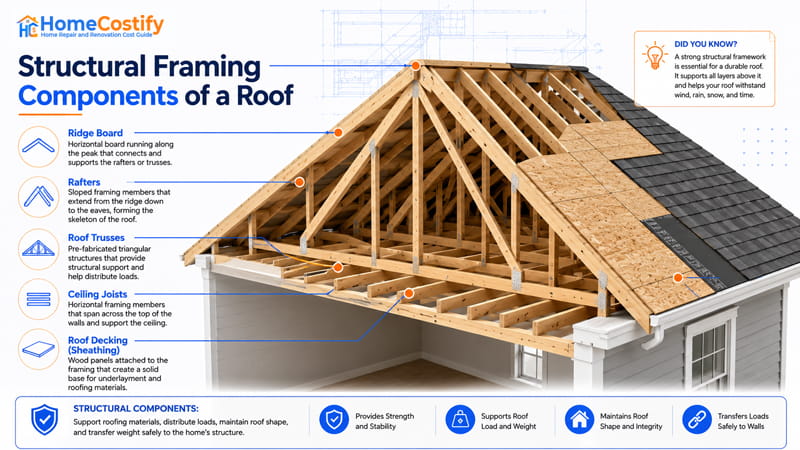
Every roof begins with its structural framework. Before shingles, flashing, vents, or gutters are installed, a network of framing members creates the shape and strength needed to support the entire assembly. These structural elements carry dead loads from roofing materials as well as live loads generated by wind, rain, snow, maintenance traffic, and changing weather conditions.
Without a properly built frame, even the highest-quality roofing materials cannot perform as intended. The structural section of a roof distributes weight across walls and load-bearing supports while maintaining the slope required for water runoff. Several key framing members make up this portion of the parts of roof system.
Roof Trusses
Roof trusses are engineered framing assemblies manufactured off-site and delivered to a construction project as prefabricated units. They consist of interconnected wood members arranged in triangular patterns that efficiently distribute weight throughout the structure.
Modern residential construction relies heavily on trusses because they can span long distances without requiring extensive interior support walls. Their design allows loads from roofing materials, wind pressure, and snow accumulation to be transferred evenly to the exterior walls below.
Compared with traditional framing methods, trusses reduce installation time and provide consistent structural performance. For many new homes, they serve as the primary support system within the parts of roof structure responsible for carrying the roof’s overall load.
Rafters
Before prefabricated trusses became common, roofs were typically built using individual roof rafters cut and assembled on-site. Rafters remain widely used today, particularly in custom homes, renovations, and projects that require more flexible attic space.
Each rafter extends from the ridge area down to the exterior walls, creating the roof slope visible from the outside. Working together, multiple rafters form a framework capable of supporting decking and roofing materials installed above them.
One of their primary functions is transferring loads downward through the building structure. Wind forces, precipitation, and the weight of roofing products move through the rafters before reaching supporting walls and foundations. Because they help define the overall shape of the roof, rafters remain one of the most recognizable parts of roof framing systems.
Ridge Board
The ridge board is a horizontal framing member installed along the highest point of a pitched roof. Located at the roof peak, it provides a central attachment point where opposing rafters meet.
Although it does not typically carry the same loads as structural beams, the ridge board plays an important role in maintaining alignment during construction. It establishes the roof’s centerline and helps ensure rafters are positioned consistently across the structure.
Many homeowners hear contractors mention the roof ridge during inspections or repairs. In practical terms, the ridge board forms the backbone of that upper connection point and contributes to the stability of the overall roof frame.
Ceiling Joists
Ceiling joists are horizontal framing members that run between opposing walls beneath the roof structure. While they often support ceiling finishes inside the home, they also perform an important structural function.
As roof loads push outward against exterior walls, ceiling joists help resist that force and reduce the risk of wall spreading. This stabilizing effect helps maintain the intended geometry of the roof over time.
In traditional framing systems, ceiling joists work together with rafters to create a balanced structural assembly capable of handling seasonal loading conditions without excessive movement or deformation.
Roof Decking (Sheathing)
Installed directly above the framing system, roof decking—often referred to as roof sheathing—creates the solid surface that supports every roofing layer above it. Most residential roofs use plywood or oriented strand board (OSB) panels for this purpose.
Decking spans across trusses or rafters and provides a stable platform for underlayment, flashing, shingles, metal panels, or other roofing materials. It also contributes to overall structural rigidity by tying framing members together and distributing loads more evenly across the roof.
Because every protective layer depends on a sound substrate, the condition of the decking directly affects roof performance. Soft spots, rot, water damage, or delamination can compromise multiple parts of roof systems at the same time and often require prompt repair.
Building Science Corporation explains that roof performance depends on properly integrated layers—including sheathing, underlayment, flashing, ventilation pathways, and roof coverings—that work together to manage water, air movement, and heat transfer.
Collar Ties
Collar ties are horizontal members installed between opposing rafters near the upper portion of the roof. Their primary purpose is to provide additional reinforcement against forces that attempt to separate roof sections during high-wind events.
In regions exposed to strong storms or seasonal weather extremes, collar ties help improve resistance to wind uplift by strengthening the connection between rafters. They also contribute additional rigidity to the overall roof frame.
Although smaller than many other structural members, collar ties play an important supporting role within a residential roof structure. Their presence helps maintain stability under changing environmental conditions and provides another layer of protection against structural movement.
Together, trusses, rafters, ridge boards, ceiling joists, decking, and collar ties form the framework that supports all other parts of roof assemblies. Every protective layer installed later depends on this structural foundation, making framing one of the most critical categories within any roofing system.
Exterior Weather Protection Components
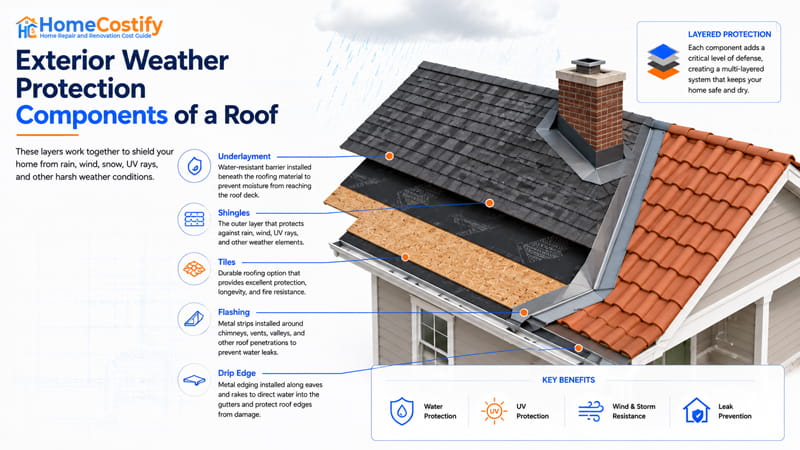
A roof frame can support thousands of pounds, but structural strength alone does not keep a home dry. Water, snow, UV radiation, and wind-driven rain constantly attack the outer surface of a roof. The materials installed above the decking absorb that punishment first. Their job is simple: keep moisture out and protect the structure underneath.
Several parts of roof systems belong to this protective layer. Some stop water before it reaches the deck. Others reinforce vulnerable areas where leaks are more likely to develop. Each material addresses a different exposure point, creating multiple barriers between the weather and the living space below.
Underlayment
Shingles are only one layer in a roofing system. Directly beneath them sits the roof underlayment, a protective sheet installed over the decking before the visible roofing material is applied.
Older homes commonly used asphalt-saturated felt. Today, many contractors install synthetic underlayment because it resists tearing, sheds water effectively, and handles job-site exposure better than traditional felt products.
If wind-driven rain slips beneath shingles or flashing, the underlayment provides another layer of protection before moisture reaches the decking. Although homeowners rarely see it after installation, this material often plays a major role in preventing water damage during storms and severe weather events.
Ice and Water Shield
Certain areas of a roof face higher moisture exposure than others. Valleys, eaves, skylights, chimneys, and roof penetrations collect significant amounts of runoff throughout the year.
An ice and water shield is a self-adhering waterproof membrane installed in those high-risk locations. Unlike standard underlayment, it seals tightly around fasteners and forms a watertight barrier directly against the deck.
In colder regions, melting snow can refreeze near roof edges and create ice dams. Water trapped behind those dams may work its way beneath shingles. Ice and water shield membranes help block that intrusion before it reaches the underlying structure. Even in moderate climates, many contractors use this protection around vulnerable roof details where leaks frequently occur.
Roof Covering (Shingles or Tiles)
The roof covering is the outermost layer visible from the ground. It receives direct exposure to rain, hail, sunlight, snow, and temperature swings year after year.
Across the United States, asphalt shingles remain the most common roof covering because they offer a balance of cost, durability, and appearance. Architectural shingles have become particularly popular due to their thicker profile and longer service life.
Other materials serve the same purpose through different designs. Metal roofing systems provide exceptional longevity and strong resistance to severe weather. Clay tiles and concrete tiles appear frequently in warm-weather regions where heat resistance and durability are valued.
Among all visible parts of roof assemblies, the roof covering has the greatest impact on curb appeal. More importantly, it acts as the primary barrier against the elements, protecting every layer installed beneath it.
Flashing
Roof leaks rarely start in the middle of a large shingle field. Most develop around transitions, joints, penetrations, and intersecting roof sections where water naturally concentrates.
Roof flashing consists of metal components installed around those vulnerable areas to redirect water away from openings and seams. Common examples include vent pipes, skylights, dormers, wall intersections, and chimneys.
A properly installed chimney flashing system prevents water from entering where masonry meets roofing materials. Valley flashing protects channels that handle large volumes of runoff during heavy rain. Without flashing, water can work its way into gaps that may appear insignificant from the exterior but lead to substantial interior damage over time.
For roof inspectors, flashing is often one of the first items examined during a leak investigation because failures in these locations are common and usually easier to identify than hidden moisture pathways elsewhere.
Drip Edge
Along the perimeter of the roof sits a narrow metal component known as drip edge. Despite its modest size, it performs an important job every time rainwater flows off the roof surface.
Water naturally follows surfaces. Without proper edge protection, runoff can curl underneath roofing materials or contact exposed wood along the roof perimeter. Over time, that repeated moisture exposure may contribute to rot, deterioration, and premature material failure.
Drip edge flashing directs water into the gutter system instead of allowing it to reach vulnerable edges. It also helps protect the roof deck and improves the finished appearance of the roofline. Modern building codes frequently require drip edge installation because of its effectiveness in managing runoff at the roof’s most exposed edges.
Protective Roof Components
| Component | Protects Against |
|---|---|
| Underlayment | Moisture |
| Ice Shield | Ice dams |
| Shingles | Weather |
| Flashing | Leaks |
| Drip Edge | Edge rot |
No single material prevents every roofing problem. Underlayment provides backup moisture protection, ice shield reinforces high-risk areas, roof coverings absorb direct weather exposure, flashing secures vulnerable transitions, and drip edge manages runoff along the perimeter.
Roof Edges and Overhang Components
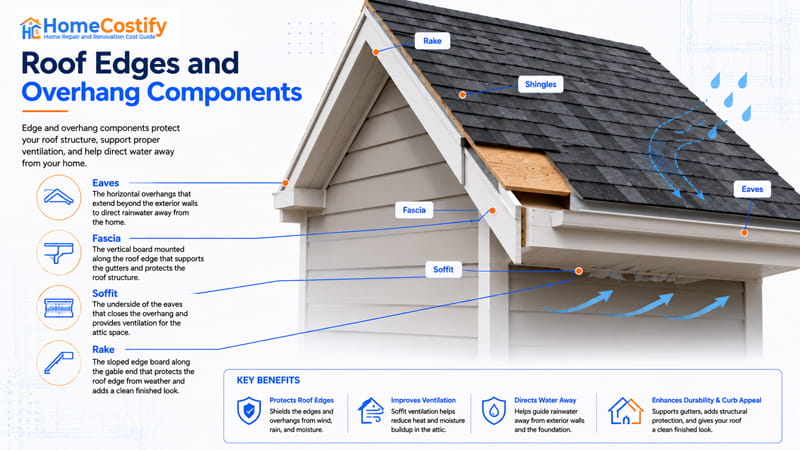
The outer edges of a roof do more than create a finished appearance. They control water runoff, protect exposed framing, support ventilation, and provide attachment points for other roofing elements. Damage along the perimeter often leads to problems that spread beyond the roof itself, affecting siding, fascia boards, soffits, and even foundation areas below.
Several parts of roof systems are located along these edges. Although they receive less attention than shingles or flashing, they play an important role in long-term roof performance.
Eaves
Roof eaves are the portions of a roof that extend beyond the exterior walls of a home. This overhang helps direct rainwater away from siding, windows, and the building foundation.
Without adequate eaves, water runoff would fall closer to exterior walls, increasing the likelihood of moisture-related deterioration. The overhang also provides shade, which can help reduce solar heat gain during warmer months.
Many ventilation systems begin at the eaves because this location allows outside air to enter the attic through intake vents positioned beneath the roof edge.
Fascia Board
The fascia board is the vertical finishing board attached along the lower edge of the roof. It creates a clean transition between the roof structure and the gutter system.
One of its primary responsibilities is supporting gutters. During heavy rainfall, gutters may hold a substantial amount of water, placing continuous stress on the fascia. For that reason, deterioration in this area can eventually affect drainage performance.
Fascia boards also protect exposed framing members from weather exposure and contribute to the finished appearance of the roofline.
Soffit
Located beneath the eaves, the soffit covers the underside of the roof overhang. While it improves appearance, its function extends well beyond aesthetics.
Many soffits contain ventilation openings that allow fresh outside air to enter the attic space. This incoming airflow works alongside ridge vents to regulate attic temperature and moisture levels.
Proper soffit ventilation can help reduce heat buildup during summer and limit condensation issues during colder periods. Because of that role, soffits are often considered a key part of a balanced attic ventilation system.
Rake Board
A roof rake refers to the sloped edge found along the gable end of a roof. The rake board covers and protects this exposed edge.
Its primary function is shielding framing materials from weather exposure while creating a finished appearance along the roof perimeter. Depending on the roof design, rake boards may also support trim components and contribute additional protection against wind-driven rain.
Many homeowners notice rake boards only when paint begins peeling or wood deterioration becomes visible, yet they remain an important part of roof-edge protection.
Roof Ventilation and Drainage Components
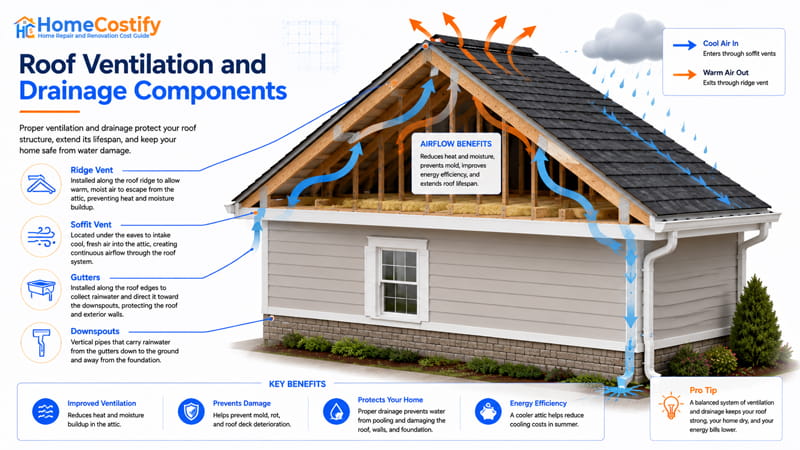
Water management and airflow have a direct impact on roof longevity. Excess heat trapped inside an attic can accelerate material aging, while poor drainage allows water to accumulate where it should not. Ventilation and drainage components address both concerns by moving air through the attic and directing runoff away from the structure.
Roof ventilation components help regulate attic temperature and moisture levels by creating continuous airflow through the roof assembly. Proper ventilation reduces heat buildup during summer, limits condensation during colder months, and supports the long-term performance of roofing materials.
Roof drainage components manage rainwater after it leaves the roof surface. By collecting and directing runoff away from the home’s exterior walls and foundation, these components help reduce the risk of erosion, standing water, moisture intrusion, and other water-related damage.
Several parts of roof systems focus specifically on these functions.
Ridge Vent
A ridge vent is installed along the peak of a roof and serves as an exhaust outlet for warm attic air. Because heat naturally rises, the highest point of the roof provides an ideal location for removing excess heat and moisture.
During warm weather, attic temperatures can climb well above outdoor conditions. A properly functioning ridge vent allows hot air to escape rather than becoming trapped beneath the roof deck.
This continuous airflow can help improve attic conditions, reduce moisture accumulation, and support the overall performance of the roofing system.
Soffit Vent
While ridge vents release air, soffit vent systems bring fresh air into the attic. These vents are typically located beneath the eaves and act as intake vents for the ventilation cycle.
As cooler outside air enters through the soffit area, warmer attic air rises and exits through the ridge vent. This natural airflow pattern helps maintain balanced ventilation throughout the attic space.
Blocked or insufficient intake ventilation can reduce the effectiveness of the entire system, even when exhaust ventilation is present at the ridge.
Gutters
Gutters collect rainwater as it leaves the roof surface and channel it toward designated drainage points. Without them, runoff would fall directly around the perimeter of the home.
Over time, uncontrolled water can contribute to soil erosion, foundation settlement, basement moisture problems, and damage to landscaping. Properly installed rain gutters reduce those risks by controlling the path of water after it leaves the roof.
Regular cleaning is equally important. Leaves, debris, and sediment can restrict water flow and cause gutters to overflow during heavy rainfall.
Downspouts
After water enters the gutter system, downspouts carry it safely toward ground level. They serve as the vertical component of the roof drainage network.
A properly positioned downspout moves runoff away from foundations, walkways, and exterior walls. Extensions, splash blocks, or underground drainage connections may be added to improve water dispersal further.
Within a complete roof drainage system, downspouts provide the final step in moving water away from the building envelope and reducing moisture-related risks around the property.
Ventilation and Drainage Functions
| Component | Function |
|---|---|
| Ridge Vent | Exhaust hot air |
| Soffit Vent | Intake fresh air |
| Gutters | Collect runoff |
| Downspouts | Move water away |
Airflow and drainage rarely attract the same attention as roofing materials, yet their impact on roof performance is substantial. Ridge vents and soffit vents help regulate attic conditions, while gutters and downspouts manage thousands of gallons of runoff throughout the year.
These parts of roof systems support the durability of the structure above and help protect the home below from heat, moisture, and water-related damage.
How All Roof Parts Work Together
Every roof component has a specific job, but long-term performance depends on how those elements function together rather than individually.
Structural Layer: The Foundation of the Roof
The parts of roof systems begin with the structural layer. Trusses and rafters create the framework that carries the weight of roofing materials while transferring loads safely to the walls below. Attached above that framework is the roof decking, which provides the solid surface needed for every roofing layer installed later.
This foundation affects everything above it. If decking begins to deteriorate or framing members weaken, shingles may no longer sit evenly, flashing connections can loosen, and water may find pathways into areas that were originally protected. A stable structure allows the rest of the roof assembly to perform as intended.
Protection Layer: Keeping Water Out
The next layer focuses on weather resistance. Underlayment covers the deck before the visible roofing material is installed, adding a secondary barrier against moisture intrusion. Shingles, metal panels, or tiles then absorb direct exposure from rain, snow, hail, and sunlight.
Flashing protects the most vulnerable transitions where water naturally concentrates, including chimneys, skylights, valleys, vent pipes, and wall intersections. These roofing system components work together to prevent moisture from reaching the structural deck below. A roof covering alone cannot provide complete protection without support from the surrounding weatherproofing materials.
Ventilation Layer: Managing Heat and Moisture
Airflow plays a major role in roof performance. A ridge vent installed near the roof peak allows warm attic air to escape, while soffit vents located beneath the eaves draw cooler air into the attic.
This continuous movement helps regulate attic temperature and reduces excess moisture accumulation. During summer, proper ventilation limits heat buildup beneath the roof deck. During colder months, it helps reduce condensation that can damage wood framing, insulation, and other hidden materials. Balanced airflow supports both energy efficiency and roof longevity.
Drainage Layer: Moving Water Away From the Home
Once rainwater leaves the roof surface, the drainage system takes over. Gutters collect runoff along the roof edge and direct it toward downspouts. From there, water is discharged away from foundations, landscaping, and exterior walls.
Without effective drainage, even a properly installed roof can experience moisture-related problems. Overflowing gutters, standing water, and persistent wetness around the structure increase the risk of deterioration in nearby building materials.
Roof System Workflow
| Roof System Layer | Key Components | Primary Role | What Happens If It Fails? |
|---|---|---|---|
| Structural Layer | Trusses, Rafters, Roof Decking | Supports roofing materials and distributes structural loads | Sagging rooflines, weakened support, potential structural damage |
| Protection Layer | Underlayment, Shingles, Flashing | Blocks water intrusion and shields the roof from weather exposure | Leaks, deck deterioration, interior water damage |
| Ventilation Layer | Ridge Vent, Soffit Vent | Promotes attic airflow and controls heat and moisture buildup | Excess attic heat, condensation, mold growth, shorter shingle lifespan |
| Drainage Layer | Gutters, Downspouts | Collects and redirects rainwater away from the home | Overflowing gutters, fascia rot, foundation moisture problems |
| Integrated Roofing System | All roof components working together | Maintains structural stability, weather resistance, ventilation, and water management | Reduced roof performance and accelerated material deterioration |
Common Signs That Roof Components Need Attention
Roofing problems rarely appear overnight. Small warning signs often emerge long before a major leak or structural issue develops. Spotting those clues early can prevent costly repairs and extend the service life of critical parts of roof systems.
Structural issues frequently reveal themselves through visible changes in the roofline. A section that appears uneven, dips noticeably, or sags between supports may indicate weakened framing members or deteriorated decking. Water damage is a common contributor because prolonged moisture exposure can gradually reduce the strength of wood components.
Protective layers also show signs of wear. Missing shingles expose underlying materials to weather. Cracked, loose, or corroded flashing may allow water to enter around penetrations and roof transitions. Granule loss on aging shingles can signal that the outer surface is reaching the end of its useful life.
Ventilation problems often become apparent inside the attic rather than on the roof itself. Excess attic heat during summer months may indicate restricted airflow. Condensation on framing members, damp insulation, or signs of mold growth can point to inadequate ventilation and trapped moisture.
Drainage issues are often the easiest to identify from ground level. Overflowing gutters during rainfall, standing water near foundations, soil erosion beneath roof edges, or visible pooling around downspout discharge points suggest that runoff is not being directed away from the property effectively.
Roof Problem Diagnostic Guide
| Symptom | Possible Component |
|---|---|
| Roof Leak | Flashing |
| Sagging Area | Rafters or Decking |
| Mold Growth | Soffit Vent |
| Water Overflow | Gutters |
| High Attic Temperature | Ridge Vent |
Regular inspections help homeowners identify developing issues before they spread. Addressing damaged flashing, blocked gutters, deteriorated decking, or ventilation restrictions early often prevents larger problems that can affect multiple parts of roof assemblies at the same time.
Key Takeaways
The roof above a home is far more than a layer of shingles. It is a coordinated system made up of structural framing, weather-resistant materials, ventilation features, and drainage components.
Key points to remember:
- A roof functions as a complete system rather than a single material layer.
- Trusses, rafters, decking, and related framing members support structural loads.
- Underlayment, flashing, and roofing materials help defend against weather exposure.
- Ventilation components regulate attic temperature and moisture levels.
- Gutters and downspouts manage runoff and help protect foundations.
- Damage affecting one component can influence nearby sections of the roof assembly.
- Familiarity with the parts of roof layout makes inspection reports easier to understand and can help homeowners recognize developing issues before repairs become significantly more expensive.
FAQs About Roof Parts
What are the main parts of a roof?
The primary parts of roof systems include structural framing, roof decking, underlayment, roofing materials, flashing, edge components, ventilation features, and drainage systems. These categories contain the major roof parts names commonly referenced during inspections and repairs.
What is the most important structural roof component?
There is no single most important structural component. Trusses, rafters, decking, ridge boards, and ceiling joists all contribute to roof stability. Each element supports different loads and helps maintain the integrity of the overall structure.
What is the difference between a rafter and a truss?
A rafter is an individual framing member installed on-site to create a roof slope. A truss is a prefabricated engineered assembly consisting of multiple connected members designed to distribute structural loads efficiently across the building.
What part of a roof prevents leaks?
Several components contribute to leak prevention. Flashing protects vulnerable transitions, underlayment provides secondary moisture protection, and shingles or other roof coverings serve as the primary weather barrier. Effective protection depends on multiple roof components and functions working together.
Why are soffit vents and ridge vents important?
Soffit vents supply fresh intake air while ridge vents allow warm attic air to escape. This airflow helps reduce heat buildup, limits moisture accumulation, and supports healthier attic conditions throughout the year.