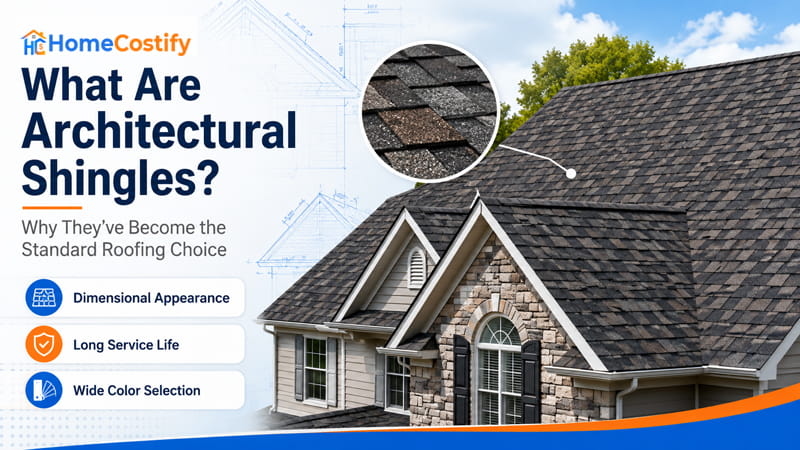
Architectural shingles have become the standard roofing choice for many homes across the United States. Walk through almost any suburban neighborhood built or reroofed within the last two decades, and there is a good chance the roof overhead uses this style of asphalt roofing.
Their popularity did not happen by accident. A combination of appearance, service life, and cost has pushed them ahead of many older roofing products.
The shift became more noticeable as traditional strip shingles began losing market share. Builders, contractors, and homeowners increasingly favored products that delivered more visual depth without moving into the price range of slate, clay tile, or metal roofing.
That demand created a strong market for architectural roof shingles, which today dominate residential reroofing projects throughout the country.
Color selection also plays a role. Manufacturers offer dozens of shades ranging from charcoal and weathered wood to slate-inspired blends, giving roofs a more customized appearance. Lifespan is another factor. Many products remain in service for decades when installed correctly and paired with suitable attic conditions.
Dimensions, materials, and construction methods vary by manufacturer, yet most dimensional shingles follow the same basic concept: multiple layers working together to create a thicker and more textured roof covering.
Before comparing products or exploring lifespan expectations, it helps to understand exactly what these roofing shingles are and what sets them apart from older asphalt options.
What Is an Architectural Roof Shingles?
Architectural shingles are a type of asphalt roofing product made from multiple layers bonded together to create a thicker and more textured profile. The category is often referred to by several names, including dimensional shingles and laminated shingles.
While the terminology varies, the basic concept remains the same. Additional layers create depth across the roof surface rather than the flat appearance commonly associated with traditional strip shingles.
According to the Asphalt Roofing Manufacturers Association (ARMA), architectural shingles are laminated asphalt roofing products made with multiple layers that create additional thickness and a more dimensional appearance than traditional strip shingles.
That layered construction changed the look of residential roofing. Earlier generations of asphalt products often produced a uniform pattern that repeated from one course to the next. Laminated products introduced shadow lines, varied contours, and a profile that more closely resembled cedar shake or slate from the ground.
Another distinction involves material distribution. Traditional strip shingles generally use a single visible layer. Architectural shingles contain additional material in selected areas, creating sections that appear raised or recessed. The roof no longer looks perfectly flat when sunlight moves across it during different times of the day.
The category sits between basic strip products and premium designer roofing. Some architectural roof shingles focus on affordability, while others use heavier construction, specialized granules, or impact-resistant formulations. Despite those differences, the dimensional profile remains the defining characteristic across the entire category.
Why Are They Called Architectural Shingles?
The word “architectural” comes from the visual effect created by the finished roof rather than the raw materials themselves. A dimensional profile creates depth, texture, and shadow patterns that make the roof appear more complex when viewed from the street.
Layer placement plays a large role in that appearance. Certain portions of the shingle are thicker than others, producing subtle elevation changes across each course. Sunlight interacts differently with those surfaces throughout the day. The result is a roof that appears less uniform and more detailed.
Some products mimic the look of wood shake. Others resemble natural slate. The roof shingles architectural category became popular largely because it offered those visual characteristics without requiring the weight, cost, or maintenance associated with many traditional roofing materials.
Manufacturers also use varied tab shapes, granule blends, and contour patterns. Combined together, these features create the dimensional look commonly associated with dimensional roofing shingles today.
How Architectural Shingles Are Made
Production begins with a fiberglass mat that serves as the foundation of the shingle. That mat passes through a manufacturing process where asphalt coatings and surface materials are applied in layers. Individual sections are then laminated together, creating the thicker profile associated with architectural products.
Based on manufacturer specifications published by CertainTeed, architectural shingles are commonly made from a fiberglass mat core, water-resistant asphalt, and ceramic-coated mineral granules that help improve durability and weather resistance.
The lamination stage separates these products from many traditional asphalt options. Instead of relying on a single visible layer, manufacturers bond additional material to selected sections of the shingle. Thickness increases in targeted areas, creating the dimensional profile visible after installation.
Weight also changes. A laminated product generally contains more raw material than a comparable strip product. That added mass contributes to the solid appearance many buyers prefer when evaluating different roofing systems.
Main Components of Architectural Shingles
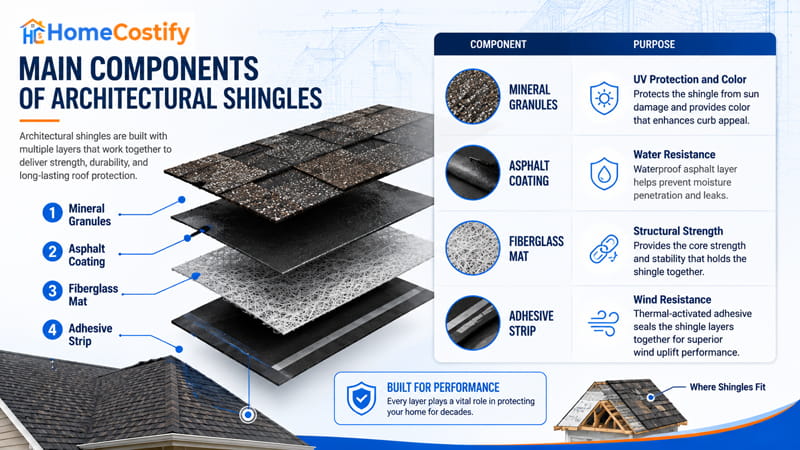
Fiberglass Mat
The fiberglass mat forms the structural backbone of the shingle. It provides stability and helps the product retain its shape after years of exposure to weather, temperature swings, and seasonal expansion.
Asphalt Coating
Asphalt surrounds and saturates portions of the fiberglass core. This layer serves as the primary water-shedding component and contributes much of the shingle’s overall mass.
Ceramic-Coated Mineral Granules
Mineral granules cover the visible surface. They determine color, influence appearance, and shield underlying materials from prolonged ultraviolet exposure.
| Component | Purpose |
|---|---|
| Fiberglass Mat | Structural strength |
| Asphalt Coating | Water resistance |
| Mineral Granules | UV protection and color |
| Adhesive Strip | Wind resistance |
Many people searching for information about architectural shingles made of are often surprised by how much engineering goes into what appears to be a simple roofing product. Modern architectural asphalt shingles combine several materials, each performing a different role once installed on the roof.
Characteristics of Architectural Shingles
Certain features appear consistently across most architectural roofing shingles regardless of manufacturer. Thickness is one of them. Visual depth is another.
Multi-Layer Construction
Multiple bonded layers form the foundation of the design. Rather than presenting a flat profile from edge to edge, laminated construction creates areas of varying thickness throughout each shingle.
That difference becomes easier to notice after architectural shingle installation. Roof planes often display more texture because light interacts with raised and recessed sections differently.
Dimensional Appearance
The dimensional appearance is often the first thing people notice. Shadow lines develop naturally between thicker and thinner sections, creating contrast across the roof surface.
From a distance, the effect can resemble materials traditionally associated with higher-end homes. Cedar shake and slate are common comparisons.
Heavier Weight
A dimensional asphalt shingles product generally weighs more than a basic strip product. Additional layers increase architectural shingles material, volume, resulting in a denser finished shingle.
Weight alone does not determine quality. Even so, the thicker profile contributes to the substantial appearance many buyers prefer.
Enhanced Wind Resistance
Extra material creates a stronger profile than many single-layer alternatives. Wind moving across the roof encounters a thicker assembly with more material anchored beneath each fastener location.
Performance varies by manufacturer and product line. Higher-end products frequently carry stronger wind ratings than entry-level options.
Improved Curb Appeal
Roofs occupy a large percentage of a home’s visible exterior. Small differences in texture become surprisingly noticeable from the street.
Shadow patterns, granule blends, and contour variations create visual interest that flat strip products often lack.
Wide Design Variety
The category includes dozens of styles, textures, and color combinations. Some products lean toward slate-inspired aesthetics. Others favor the appearance of weathered wood.
That variety explains why dimensional shingles continue to dominate residential roofing projects throughout the United States.
| Characteristic | Benefit |
|---|---|
| Multi-layer design | Greater durability |
| Dimensional profile | Enhanced appearance |
| Heavier construction | Better wind performance |
| Laminated build | Longer service life |
Architectural Shingles Dimensions
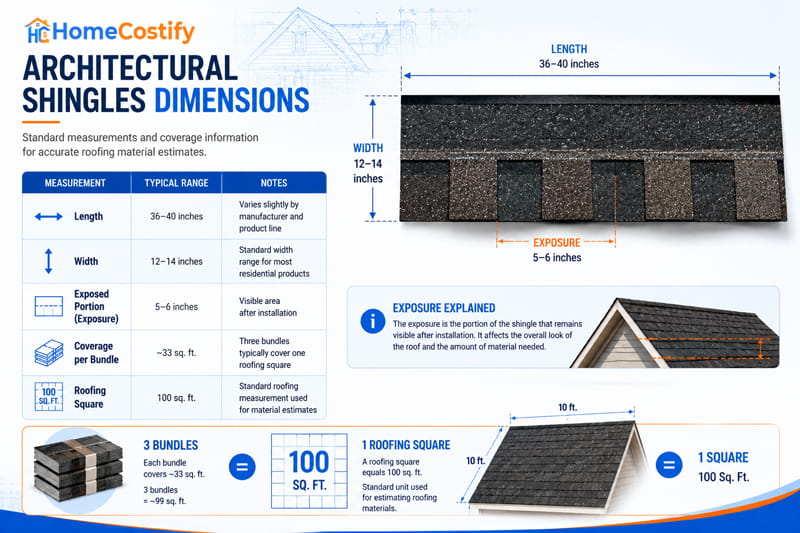
Most architectural shingles used in residential roofing follow similar sizing standards. Exact measurements vary by manufacturer, but the differences are usually small enough that installation methods remain largely the same across major product lines.
A typical shingle measures between 36 and 40 inches long and roughly 12 to 14 inches wide. Once installed, part of each shingle is covered by the course above it. The visible portion generally falls within a range of 5 to 6 inches.
Those measurements influence how the finished roof looks from the ground. Some products create deeper shadow patterns between courses. Others produce a more uniform appearance with less visible contrast across the roof surface.
Material estimates rely on these dimensions as well. Roofers normally calculate coverage using roofing squares rather than individual shingles. One roofing square covers 100 square feet of roof area, while a standard bundle typically covers about 33 square feet.
Architectural shingle dimensions may vary slightly between brands, but the overall format remains consistent throughout the industry. That consistency simplifies layout, material calculations, and architectural roof replacement planning when a roof eventually requires repairs.
| Measurement | Typical Range | Notes |
|---|---|---|
| Length | 36–40 inches | Varies slightly by manufacturer and product line |
| Width | 12–14 inches | Standard width range for most residential products |
| Exposed Portion (Exposure) | 5–6 inches | Visible area after installation |
| Coverage per Bundle | ~33 sq. ft. | Three bundles typically cover one roofing square |
| Roofing Square | 100 sq. ft. | Standard roofing measurement used for material estimates |
Architectural Shingles Colors and Design Options
Color choices influence the appearance of a roof long before anyone notices construction details. Two neighboring houses may use the same product line, yet a change in color can create a completely different visual impression from the street.
Architectural shingles colors have expanded considerably over the last two decades. Earlier asphalt products often relied on limited gray or brown palettes. Current product lines include blended granules, contrasting tones, and multi-shade combinations that create more depth across the roof surface.
The relationship between siding, trim, brick, stone, and roofing material also deserves attention. A dark roof paired with light siding creates a different effect than a roof that closely matches the surrounding exterior colors. Neither approach is automatically right or wrong. Architectural style often determines which combination looks most balanced.
Popular Architectural Shingles Colors
Certain color families continue to appear across nearly every major roofing brand. Their popularity has remained relatively steady because they work well with a wide range of exterior finishes.
| Color Family | Typical Appearance |
|---|---|
| Charcoal | Modern |
| Weathered Wood | Traditional |
| Slate Gray | Classic |
| Barkwood | Warm Neutral |
| Black | Bold |
| Brown | Rustic |
Charcoal and black remain common on contemporary homes. Slate gray occupies a middle ground, blending well with brick, fiber cement, and painted exteriors. Weathered wood continues to attract attention because the mix of tones creates visual texture without appearing overly dark.
Roof shingles colors can also affect how architectural details stand out. Dormers, gables, and roof transitions often appear more pronounced when paired with darker color schemes.
How to Choose the Right Shingle Color
A good starting point is the exterior itself. Brick colors, siding materials, stone accents, and trim should work together rather than compete for attention.
Large roofs deserve extra consideration. Dark roofing shingles colors can appear dramatic on smaller structures but may dominate the appearance of a larger home if used without contrast elsewhere. Lighter blends often create a softer look while still preserving visual depth.
Regional preferences also influence selection. Homes in coastal areas frequently use lighter palettes, while darker shingles colors appear more often in regions where traditional brick architecture dominates.
Architectural shingles are available in dozens of color combinations today, making it easier to match the roof to nearly any design style. Roof shingle colors may seem like a cosmetic choice at first glance, yet they often shape the overall appearance of the house more than many exterior upgrades.
Architectural Shingles Lifespan
Questions about lifespan appear almost every time someone researches a new roof. Material appearance matters, but service life often carries greater weight because roof replacement represents a substantial expense.
Architectural shingles generally remain in service longer than traditional strip products. Most standard product lines fall within a range of 20 to 30 years under normal conditions. Premium versions frequently reach 30 to 40 years, and some roofs remain intact for even longer when weather exposure, ventilation, and installation quality align favorably.
The architectural shingles lifespan advertised by manufacturers does not always match real-world outcomes. Climate conditions, roof design, attic temperatures, and maintenance practices all influence what happens after installation day.
| Category | Typical Lifespan |
|---|---|
| Standard Architectural Shingles | 20–30 Years |
| Premium Products | 30–40 Years |
| Ideal Conditions | Up to 50 Years |
The question “how long do architectural shingles last” rarely has a single answer. A roof exposed to hail, high winds, intense sun, and freeze-thaw cycles will age differently than one located in a milder climate. Two identical products installed in different regions may follow very different timelines.
Architectural shingles life expectancy is often highest when attic temperatures remain controlled and moisture does not accumulate beneath the roof deck. Small differences in roof design can influence aging patterns over decades.
Warranty Length vs Actual Roof Life
Warranty labels create confusion for many buyers. A 30 year architectural shingles product does not automatically remain in service for exactly three decades. The same principle applies to 40 year architectural shingles and 50 year architectural shingles.
Warranty periods describe manufacturer coverage terms. Actual roof life depends on conditions that occur after installation. Severe weather, inadequate ventilation, installation errors, and environmental exposure can alter the timeline considerably.
Lifetime warranties create even more misunderstanding. A lifetime architectural shingles warranty does not mean the roof will last forever. Coverage terms vary by manufacturer, and the definition of “lifetime” often depends on ownership status and specific warranty provisions.
Architectural shingles continue to earn strong market acceptance because many products deliver decades of service without approaching the cost of premium slate, tile, or metal systems. The gap between warranty language and actual roof life simply requires realistic expectations.
What Affects the Lifespan of Architectural Shingles?
Two roofs installed during the same month can age at very different rates. Material quality matters, yet conditions surrounding the roof often shape the final outcome.
Installation Quality
Installation errors may remain hidden for years before symptoms appear. Misplaced fasteners, improper flashing details, and alignment issues can create weak points that accelerate wear.
Even premium architectural shingles depend on accurate installation practices. Small mistakes near penetrations and roof transitions frequently create larger problems later.
Roof Ventilation
Attic conditions influence roof temperatures throughout the year. Excess heat can accumulate beneath the roof deck during summer, while trapped moisture may linger during colder seasons.
Balanced airflow plays a major role in long-term roof behavior. This is one reason roof ventilation receives so much attention during reroofing projects.
Climate and Weather Exposure
Climate affects every roofing material. Intense ultraviolet exposure, hail, heavy snowfall, coastal conditions, and repeated freeze-thaw cycles each create different aging patterns.
A product that performs well in one region may face very different challenges elsewhere.
Roof Drainage
Water should move off the roof efficiently after rainfall. Areas where water repeatedly lingers often experience faster deterioration than sections that dry quickly.
Roof drainage becomes especially important around valleys, transitions, and other locations where water naturally concentrates.
Maintenance Practices
Roofs rarely fail overnight. Many issues begin as small defects that expand gradually over time.
Routine inspections can identify missing shingles, damaged flashing, granule loss, or debris accumulation before those conditions spread to larger sections of the roof.
| Factor | Impact on Lifespan |
|---|---|
| Installation | High |
| Ventilation | High |
| Climate | High |
| Drainage | Moderate |
| Maintenance | Moderate |
How Much Do Architectural Shingles Cost?
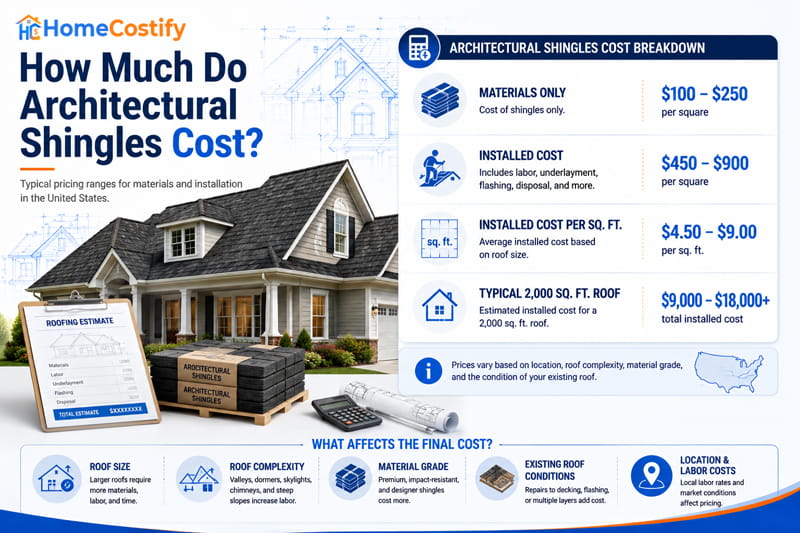
Architectural shingles cost varies from one project to another, but architectural shingles generally sit above traditional 3-tab products and below premium roofing materials such as slate, clay tile, and many metal roofing systems. The additional layers used in their construction increase manufacturing costs, which is reflected in both material pricing and total installation costs.
Material prices are commonly quoted by the roofing square. One square covers 100 square feet of roof area. Depending on the product line, architectural shingles often fall within a range of roughly $100 to $250 per square for materials alone.
Installation costs are higher because labor, tear-off work, underlayment, flashing, disposal fees, and local market conditions all contribute to the final price. Across many U.S. markets, installed costs frequently range from about $450 to $900 per square. On a square-foot basis, that works out to approximately $4.50 to $9.00 per square foot.
A roof measuring around 2,000 square feet may fall somewhere between $9,000 and $18,000 or more, depending on the design of the roof and the materials selected. A simple roof with few penetrations usually costs less to replace than one with multiple valleys, dormers, skylights, or steep slopes.
| Cost Category | Typical Range |
|---|---|
| Materials Only | $100–$250 per square |
| Installed Cost | $450–$900 per square |
| Installed Cost Per Sq. Ft. | $4.50–$9.00 |
| 2,000 Sq. Ft. Roof | $9,000–$18,000+ |
What Affects Architectural Shingles Cost?
Several variables can influence the final price of an architectural shingle roof:
- Roof Size: Larger roofs require more materials, more labor, and longer installation times, which increases overall project costs.
- Roof Complexity: Valleys, dormers, skylights, chimneys, and steep roof sections often require additional cutting, fitting, and installation work. Complex roof designs typically cost more than simple gable roofs.
- Material Grade: Standard architectural shingles generally cost less than impact-resistant or designer products. Class 4 impact-rated shingles often sit near the upper end of the price range.
- Existing Roof Conditions: Damaged roof decking, multiple layers of old roofing, or deteriorated flashing may require architectural shingles repairs or replacement before new materials can be installed.
- Local Labor Costs: Roofing prices vary by region. Labor rates in major metropolitan areas are often higher than those in smaller markets.
Price alone rarely tells the full story. A roof that lasts 25 to 30 years may deliver a different long-term value than a lower-cost option that requires replacement much sooner.
Pros and Cons of Architectural Shingles
No roofing material fits every situation. Architectural shingles have become the dominant choice in residential roofing, but that does not mean they are automatically the best option for every home, budget, or climate. Looking at both advantages and limitations creates a more realistic picture of what to expect over the long term.
Pros
Durability is one of the reasons architectural shingles continue to dominate the market. The laminated construction contains more material than many traditional strip products, resulting in a thicker profile across the roof surface. In many situations, that extra thickness translates into greater resistance to wear and weather exposure.
Appearance also plays a major role. The layered design creates depth and shadow patterns that are difficult to achieve with basic asphalt products. From the street, the roof often appears more textured and visually interesting.
Service life is another factor. Many architectural shingles remain in place for decades when installation, ventilation, and maintenance conditions align properly. That longer replacement cycle appeals to homeowners who prefer a balance between cost and longevity.
Weather performance contributes to their popularity as well. Different product lines carry different ratings, yet many architectural roofing shingles offer stronger wind resistance roof than older strip-style products.
Color selection remains another advantage. Manufacturers produce a wide range of blends, making it easier to match different architectural styles, exterior finishes, and neighborhood aesthetics.
Cons
Cost is usually the first drawback people notice. Architectural shingles generally cost more than basic strip shingles, both in materials and installation.
Weight can also be a consideration. Because laminated products contain additional material, they are heavier than many entry-level asphalt options.
Installation quality carries significant weight. A premium product installed incorrectly may experience problems much sooner than expected. Fastener placement, flashing details, and ventilation design all influence long-term performance.
Architectural shingles also face limitations when compared with certain premium roofing materials. Metal, slate, and clay tile systems can remain in service considerably longer under the right conditions.
| Pros | Cons |
|---|---|
| Longer lifespan | Higher cost |
| Better appearance | Heavier weight |
| Improved durability | Requires proper installation |
| Strong warranties | Shorter lifespan than metal or slate |
How Architectural Shingles Compare to Other Roofing Materials
Different roofing materials approach durability, appearance, maintenance, and cost in different ways.
- Asphalt Shingles: Usually less expensive, though they often provide a shorter service life than architectural shingles.
- Luxury Shingles: Thicker and more decorative, frequently designed to resemble slate or cedar shake.
- Metal Roofing: Known for longevity and strong weather performance.
- Clay Tile Roofing: Common in certain architectural styles and warm climates.
- Concrete Tile Roofing: Heavier than many roofing systems and often chosen for durability.
- Slate Roofing: Natural stone material with an exceptionally long lifespan.
- Synthetic Slate Roofing: Designed to imitate natural slate while reducing weight.
- Wood Shingles: Traditional wood roofing with a more uniform appearance.
- Wood Shakes: Thicker and more textured than wood shingles.
- Composite Roofing: Manufactured from engineered materials intended to replicate premium roofing products.
- Solar Shingles: Combine roof coverage with energy generation capabilities.
Conclusion
Architectural shingles have become the standard choice for residential roofing across much of the United States for a simple reason. They occupy a middle ground that appeals to a wide range of homeowners.
Compared with basic asphalt products, they offer a more dimensional appearance and a longer expected service life. Compared with premium roofing materials such as slate, tile, or metal, they remain more accessible from a cost perspective.
No roofing material is perfect. Even so, the combination of appearance, durability, product variety, and long-term value continues to make architectural shingles one of the most widely installed roofing systems in modern residential construction.
FAQs About Architectural Roof Shingles
What is the meaning of architectural shingles?
Architectural shingles are laminated asphalt roofing products made from multiple layers that create a thicker and more dimensional appearance than traditional strip shingles.
Are architectural shingles good quality?
Many products offer a strong balance between appearance, lifespan, and cost. Quality varies by manufacturer and product line.
What is better than architectural shingles?
The answer depends on priorities. Slate, tile, and metal roofing may outlast asphalt-based systems, though they generally cost more.
What is the best brand of architectural shingles?
Several manufacturers produce respected product lines, including CertainTeed, Owens Corning, GAF, Atlas, and IKO.
Which is better, architectural shingles or metal roof?
Metal roofing generally lasts longer, while architectural shingles often provide a lower upfront cost and broader design flexibility.