Roofing estimates for wood shingles often surprise buyers long before construction begins. How Much Does Wood Shingles Cost is rarely answered by a single number because two proposals for new installation can end up far apart even with comparable roof sizes.
One quote may already include underlayment, flashing, cleanup, and permit fees. Another may leave those items for later, pushing the final bill well beyond the original figure.
Material quality changes the budget, yet the shingles themselves account for only part of the total. Crew size, roof geometry, installation time, and regional pricing all leave their own footprint on the estimate without appearing in online roofing shingles prices.
A straightforward roof can require fewer labor hours than one filled with valleys, dormers, and intersecting ridges. Small project details often create larger price gaps than expected.
How Much Does Wood Shingles Cost becomes far easier to evaluate after each portion of the estimate is viewed on its own instead of as one lump sum.
Breaking apart material pricing, labor charges, accessories, and project-specific expenses reveals where the money is actually allocated.
That perspective gives a more realistic picture of total roof cost and wood roofing cost before contractor estimates begin to arrive. Better comparisons usually start with better cost visibility.
How Much Does Wood Shingles Cost?

Installing a new wood shingle roof typically costs $7.00 to $14.00 per square foot, with wood shingles material cost averaging $4.00 to $8.00 per square foot before labor and other project expenses are added.
Contractors also estimate pricing by roofing square, where material commonly falls between $400 and $800, and completed installation ranges from $700 to $1,400. A single bundle usually sells for $85 to $150.
| Pricing Metric | Average Cost |
|---|---|
| Material Only | $4.00–$8.00/sq. ft. |
| Installed Cost | $7.00–$14.00/sq. ft. |
| Roofing Square (Material Only) | $400–$800 |
| Roofing Square (Installed) | $700–$1,400 |
| Bundle | $85–$150 |
The gap between material pricing and a completed installation surprises plenty of buyers after collecting contractor estimates.
Shingles account for only one portion of the budget, leaving labor, underlayment, flashing, fasteners, setup, cleanup, and permit fees to fill out the remaining balance.
Roof shape adds another layer of variation because extra cuts and longer installation time increase labor hours even before premium materials enter the project.
That difference often pushes the final wood shingles installation cost well beyond the price of the shingles alone.
Online product listings create another source of confusion because they usually display material pricing without reflecting the full scope of a roofing project.
A pallet of shingles may look affordable until accessory materials and installation charges appear on the estimate.
Comparing product prices against a contractor proposal rarely produces an accurate roof cost because each figure covers a different portion of the project.
Viewing the estimate as a complete package gives a far clearer picture of total wood shingles cost.
Average Wood Shingles Cost by Roof Size

Roof size shapes nearly every part of a new roofing budget, from the number of bundles delivered to the hours a crew spends on the house.
A larger surface requires more shingles, underlayment, fasteners, and trim pieces before installation even begins.
Labor hours usually rise alongside material quantities. The final wood shingles cost reflects far more than square footage alone.
| Roof Size | Material Cost | Installed Cost |
|---|---|---|
| 1,000 sq. ft. | $4,000–$8,000 | $7,000–$14,000 |
| 1,500 sq. ft. | $6,000–$12,000 | $10,500–$21,000 |
| 2,000 sq. ft. | $8,000–$16,000 | $14,000–$28,000 |
| 2,500 sq. ft. | $10,000–$20,000 | $17,500–$35,000 |
| 3,000 sq. ft. | $12,000–$24,000 | $21,000–$42,000 |
Small Roofs (Around 1,000–1,500 Sq. Ft.)
Roofs within this range are common on cottages, compact single-story homes, and smaller cabins. Material costs usually fall between $4,000 and $12,000, with installed totals reaching $7,000 to $21,000 depending on the project scope.
Wood shingles cost generally stays near the lower end of the national range when the roof layout remains simple.
Steep slopes or intricate roof lines can still raise the final bill despite the smaller footprint.
Medium Roofs (Around 2,000 Sq. Ft.)
A roof close to 2,000 square feet often serves as the benchmark for national pricing because it represents a common home size across the United States.
Material expenses generally range from $8,000 to $16,000, and completed installation typically reaches $14,000 to $28,000.
Contractors frequently use projects of this scale when preparing baseline estimates. Published pricing guides often reference similar dimensions for the same reason.
Large Roofs (2,500–3,000+ Sq. Ft.)
Larger homes require more than extra bundles of shingles. Longer roof ridges, additional valleys, extended flashing, and wider roof sections increase both material demand and installation time, placing typical project costs between $17,500 and $42,000 or more.
Waste from cutting shingles often grows as roof layouts become more intricate.
Higher material usage combined with additional labor hours pushes wood roof installation cost upward at a faster pace than square footage alone might suggest, leaving wood shingles cost well above the figures commonly seen on smaller, less complicated roofs.
Wood Shingles Material Cost
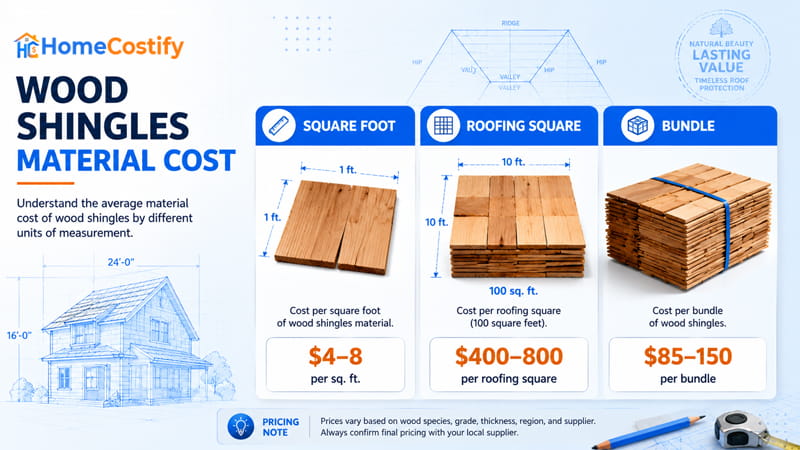
Material pricing for a new wood shingle roof usually falls between $4 and $8 per square foot, although suppliers often sell products by roofing square or bundle instead of listing every order by square footage.
That difference can cause confusion during the early planning stage. Product catalogs and contractor estimates rarely use the same unit.
Wood shingles material cost becomes much clearer once those measurements are converted into the same scale.
| Unit | Average Material Cost |
|---|---|
| Square Foot | $4–8 |
| Roofing Square | $400–800 |
| Bundle | $85–150 |
Wood Shingles Material Cost per Square Foot
Square-foot pricing gives a quick reference for budgeting and makes it easier to compare wood shingles with other roofing materials.
Retail listings, online pricing guides, and planning calculators commonly present costs using this format.
The number works well for rough estimates. Material orders at the supplier level usually follow a different measurement.
Wood Shingles Material Cost per Roofing Square
Roofing contractors purchase and estimate materials by the roofing square, with one square covering 100 square feet of roof area.
A price of $400 to $800 per roofing square lines up with the same $4 to $8 per square foot range after conversion.
Ordering materials this way keeps calculations consistent across larger projects.
Crew members, suppliers, and estimators generally work from the same unit during planning and purchasing.
Wood Shingles Material Cost per Bundle
Bundles provide another pricing reference, especially for smaller purchases or repair work, with typical prices ranging from $85 to $150 each.
The number of bundles required varies by product dimensions and manufacturer specifications.
Roof size alone does not determine the final bundle count. Coverage per bundle should always be confirmed before estimating material quantities.
Wood Shingles Installation Cost
Installing wood shingles involves far more than fastening new shingles across the roof surface. Labor, safety equipment, underlayment, flashing, cleanup, and permit fees all contribute to the final contract price.
Wood shingles cost often reflects those installation expenses just as much as the price of the material itself. Labor frequently accounts for the largest share of the budget on new roofing projects.
| Installation Component | Typical Cost |
|---|---|
| Wood Shingles | $8,000–16,000 |
| Labor | $6,000–10,000 |
| Underlayment | $800–1,800 |
| Flashing | $300–900 |
| Ridge Components | $500–1,200 |
| Ventilation | $300–1,000 |
| Permits | $150–500 |
Roofing Labor Cost
Typical roofing labor cost for a wood shingle installation falls between $6,000 and $10,000, although regional pricing can move that figure well above the national average.
Contractors operating in large metropolitan areas usually face higher payroll expenses, insurance premiums, and operating costs than crews working in smaller communities.
Local demand can change pricing from one season to the next. Higher labor charges often become one of the biggest reasons wood shingles cost rises from one market to another.
Installation Equipment and Accessories
Every installation requires more than shingles and hand tools. Roof jacks, scaffolding, fall-protection equipment, compressors, nail guns, debris containers, and waste hauling all add cost before the first course of shingles is secured.
Underlayment, flashing, ridge materials, and ventilation components appear on the estimate as separate line items in plenty of proposals.
Why Labor Can Cost More Than Materials
Material quantities rise as roof size increases, yet labor follows the pace of the work more closely than the number of bundles delivered to the jobsite.
Steep slopes slow movement across the roof, complex layouts demand extra cutting, and features such as valleys, chimneys, skylights, or dormers extend installation time from start to finish.
A simple roof can move quickly with the same crew.
Extra crew hours can push wood shingles cost well beyond the value of the materials ordered for the project.
Wood Shingles Cost by Material Type

Wood species can add thousands of dollars to a roofing budget before installation begins. Availability, milling quality, grain consistency, and natural resistance all shape supplier pricing long before materials arrive at the jobsite.
Two roofs with identical dimensions can receive very different material quotes simply because they use different wood. Wood shingles cost often starts changing at the supplier level, long before labor enters the estimate.
| Material | Material Only | Installed Cost | Availability | Best For |
|---|---|---|---|---|
| Western Red Cedar | $4–6/sq. ft. | $8–12/sq. ft. | Excellent | Most Homes |
| Eastern White Cedar | $4–5/sq. ft. | $7–11/sq. ft. | Regional | Budget Premium |
| Alaskan Yellow Cedar | $6–8/sq. ft. | $10–14/sq. ft. | Limited | Wet Climates |
| Teak | Quote Only | Quote Only | Limited | Luxury Projects |
| Wallaba | Quote Only | Quote Only | Limited | Tropical / Specialty |
Western Red Cedar
Western Red Cedar serves as the pricing reference for a large share of residential projects across the United States.
Material prices commonly range from $4 to $6 per square foot, with installed costs reaching $8 to $12 per square foot.
Broad availability keeps supply relatively stable than harder-to-source species.
As a result, wood shingles cost based on Western Red Cedar frequently becomes the benchmark used across the residential market.
Eastern White Cedar
Eastern White Cedar usually enters the market at $4 to $5 per square foot for material, with completed installation averaging $7 to $11 per square foot. Supply is stronger across parts of the Northeast, so pricing often reflects regional distribution.
Shipping can add noticeable expense outside those markets. Buyers searching for a premium appearance without moving into the highest price range often select this species.
Alaskan Yellow Cedar
Alaskan Yellow Cedar generally falls between $6 and $8 per square foot for material alone, with installed projects reaching $10 to $14 per square foot.
Limited production keeps prices above cedar products commonly stocked by local suppliers.
Freight charges can add another layer to the estimate, especially in regions located far from major distribution centers.
Higher transportation costs frequently push wood shingles cost beyond comparable projects using Western Red Cedar.
Teak
Teak occupies the luxury end of the market, and suppliers usually prepare custom quotations instead of publishing standard retail prices.
Imported inventory, limited availability, and premium milling create a pricing structure that differs from domestic cedar products.
Material costs vary widely between suppliers. Large residential projects using teak often require longer lead times before installation can begin.
Wallaba
Wallaba appears far less often than cedar products across the U.S. residential market. Pricing is commonly available only through specialty distributors because supply remains limited.
Transportation expenses can represent a noticeable share of the purchase price. Custom architectural projects account for much of the demand for this material.
According to the Insurance Institute for Business & Home Safety (IBHS), long-term roof performance depends heavily on material quality rather than wood species alone.
Premium edge-grain products with minimal defects generally offer better dimensional stability, reducing the risk of warping, splitting, and premature deterioration over time.
Western Red Cedar continues to serve as the baseline for market pricing because contractors, suppliers, and buyers can usually source it without much difficulty.
Premium species certainly command higher prices, yet the added expense does not automatically translate into stronger value for every project.
Climate, material availability, and installation quality often carry just as much weight after the roof is in service.
What Affects Wood Shingles Cost?
Two roofing projects can share nearly the same square footage and still receive estimates that differ by thousands of dollars. Material selection is only one piece of the calculation.
Roof geometry, crew productivity, site conditions, and regional pricing all change how long the installation takes and how much material reaches the roof.
Wood shingles cost can vary substantially even before optional upgrades appear in the proposal.
| Roof Design | Estimated Cost Impact |
|---|---|
| Simple Gable | Baseline |
| Hip Roof | +10–15% |
| Multiple Valleys | +15–25% |
| Dormers | +10–20% |
| Steep Roof (8:12+) | +15–30% |
Roof Size
A larger roof requires more roofing squares, increasing material quantities across the project. Extra shingles, underlayment, flashing, ridge components, and fasteners all add to the purchase order.
Installation crews remain on site longer as the roof area expands. Material usage and labor hours usually rise side by side, although they rarely follow the same pace.
Roof Pitch
Walking across a low-slope roof is very different from working on an 8:12 or steeper surface. Crews often move more carefully, safety equipment becomes more extensive, and material handling takes additional time.
Production slows even with an experienced crew. Extra labor hours frequently appear long before additional material costs do.
Roof Complexity
Simple roof layouts move much faster than roofs filled with valleys, dormers, skylights, chimneys, and intersecting ridges. Every transition creates extra measuring, trimming, and fitting before each course of shingles can continue.
Waste increases as more cuts are required across the roof surface. Labor time usually climbs with every architectural feature added to the layout.
Material Grade
Wood shingles sold under premium grades often carry tighter manufacturing tolerances and cleaner grain selection than economy products. Edge-grain pieces with fewer visible defects usually command higher prices at the supplier level.
Material quality affects the invoice before installation starts. Premium products often raise wood shingles cost even if the roof design remains unchanged.
Local Labor Rates
Labor pricing rarely matches from one region to another. Contractors working in large metropolitan areas often face higher operating costs, wages, insurance premiums, and overhead than crews serving smaller towns.
Market demand can push estimates higher during busy construction periods. The same roof design may receive very different bids after crossing state lines.
Accessibility
A one-story house with open access gives crews a much different working environment than a tall home surrounded by fencing, landscaping, or limited staging space. Carrying bundles, moving equipment, and removing debris all require extra time under tighter conditions.
Setup can take longer before installation begins. Crew productivity often drops even though the roof size stays exactly the same.
Price per square foot gives a useful starting point, yet it never captures every detail written into a contractor’s estimate.
Roof complexity and site access regularly create larger price differences than buyers expect after comparing basic online averages. Two proposals can appear far apart even when material quantities remain close.
Comparing the scope of work line by line usually gives a clearer picture of wood shingles cost than relying on the quoted total alone.
What’s Included in a Typical Wood Shingle Installation Estimate?
One contractor may include underlayment, cleanup, and permit coordination from the beginning, while another lists those items as additional charges.
A detailed proposal reveals far more than the final number at the bottom of the page.
Reviewing each line item carefully gives a more accurate picture of wood shingles cost before signing a contract.
| Item | Usually Included | Often Extra |
|---|---|---|
| Wood Shingles | ✔ | |
| Labor | ✔ | |
| Underlayment | ✔ | |
| Flashing | Sometimes | ✔ |
| Deck Repair | ✔ | |
| Permit | ✔ | |
| Roof Inspection | ✔ | |
| Cleanup | ✔ |
Materials Usually Included
Most installation estimates include wood shingles, underlayment, and the fasteners required for installation.
Starter courses, ridge components, and basic roofing accessories may appear within the material allowance depending on the contractor’s pricing method.
Flashing sometimes appears as a separate charge, especially if existing metal components require replacement.
Material lists with clear quantities give buyers a much clearer view of wood shingles cost than proposals showing only a single lump-sum price.
Labor and Installation
Labor charges commonly cover the installation crew, jobsite setup, safety equipment, daily cleanup, and final debris removal.
Equipment such as compressors, nail guns, ladders, roof jacks, and dumpsters often falls within the installation price instead of appearing as separate billable items.
Crew size and installation time vary from one project to another. Daily cleanup is commonly included even when it is not listed on a separate line.
Items That May Cost Extra
Permits, roof inspection, roof deck repairs, flashing replacement, and disposal fees frequently appear as additional charges after the roof has been evaluated more closely.
Hidden decking damage cannot always be identified before the existing roof covering is removed. Local permit requirements vary from one jurisdiction to another.
Small differences in proposal details can change wood shingles cost by thousands of dollars even when two estimates appear almost identical at first glance.
Additional Wood Shingles Costs Homeowners Should Budget For

A roofing proposal rarely stops with shingles and installation alone. Supporting materials and project requirements can add meaningful costs before the job reaches completion.
Some items appear only after the roof is opened, while others are required from the beginning to satisfy local building codes.
Including those expenses in the budget gives a more realistic estimate of wood shingles cost before construction begins.
| Additional Item | Typical Cost Range |
|---|---|
| Synthetic Underlayment | $0.40–$1.00/sq. ft. |
| Flashing Replacement | $300–$1,000 |
| Drip Edge | $2–$5 per linear ft. |
| Ridge Vent / Ventilation | $300–$1,200 |
| Permit | $150–$500 |
Underlayment
Fresh underlayment is commonly installed beneath new wood shingles to create a secondary moisture barrier. Synthetic products typically cost $0.40 to $1.00 per square foot, adding a noticeable amount to larger roofing projects.
Older underlayment rarely remains in suitable condition after roof removal. Material upgrades at this stage can increase wood shingles cost, although they often represent only a small share of the total contract.
Flashing
Metal flashing protects roof transitions around chimneys, valleys, skylights, and wall intersections. Replacement generally ranges from $300 to $1,000, depending on roof layout and the amount of metal required.
Existing flashing sometimes remains in good condition, although aging components frequently require replacement during a new installation.
Custom metal fabrication can raise costs beyond the typical range.
Drip Edge
Drip edge is installed along roof edges to direct water away from the fascia and roof deck. Typical pricing falls between $2 and $5 per linear foot, making roof perimeter length an important part of the calculation.
Larger roofs naturally require more material. Long roof edges can add a noticeable amount to the final invoice.
Ventilation Improvements
Ventilation upgrades often include ridge vents, intake vents, or related airflow improvements, with costs commonly ranging from $300 to $1,200.
Existing ventilation layouts do not always meet current building practices or manufacturer recommendations for a new wood shingle roof.
Extra materials and labor are usually required once ventilation changes become part of the project.
Those additions can raise wood shingles cost beyond the original material estimate.
Permits
Permit fees generally range from $150 to $500, although local requirements differ across cities and counties.
Some jurisdictions calculate permit costs using project value, whereas others apply flat administrative fees.
Inspection schedules and approval requirements may add time before installation begins.
Permit expenses represent a relatively small line item, yet they still belong in the total project budget.
Low-priced proposals do not always deliver the strongest long-term value. Underlayment, flashing, ventilation, and other supporting components protect the roofing system long after installation has finished.
Leaving those items out of the estimate can reduce the initial price without reducing future repair risk.
Comparing complete scopes of work usually gives a far better picture of wood shingles cost than focusing on the lowest bid alone.
Wood Shingles Cost vs. Wood Shakes Cost
Wood shingles and wood shakes both use natural wood, yet they reach the roof through different manufacturing processes.
Sawn shingles produce a more uniform profile, whereas hand-split or split-and-resawn shakes create a thicker, more textured appearance. Those production differences appear in both material pricing and installation costs.
Comparing wood shingles cost with wood shake cost gives a clearer picture of where the extra expense comes from.
| Feature | Wood Shingles | Wood Shakes |
|---|---|---|
| Material Cost | $4–8/sq. ft. | $5–15/sq. ft. |
| Installed Cost | $7–14/sq. ft. | $8–16/sq. ft. |
| Appearance | Uniform | Rustic |
| Thickness | Thin | Thick |
| Installation | Moderate | Complex |
Wood shakes usually cost more because thicker pieces require additional material and take longer to position across the roof.
Wider variations in thickness demand more adjustment during installation, especially around valleys, hips, ridges, and roof transitions.
Labor hours often increase as crews spend more time fitting each course. Material waste can rise as well on roofs with more intricate layouts.
Wood shingles remain the lower-priced option for most residential projects without sacrificing the natural appearance associated with wood roofing.
Thinner profiles allow installation to move more quickly across straightforward roof layouts, keeping labor costs closer to the lower end of the national range.
Wood shingles cost typically stays below comparable shake installations, although a dedicated comparison offers a much deeper breakdown of pricing, material options, and labor differences.
Wood Shingles Cost vs. Asphalt Shingles
Choosing between wood and asphalt usually comes down to more than the price listed in a contractor’s proposal. Installation costs, expected service life, appearance, and long-term ownership all shape the value of the finished roof.
Spending less at the beginning does not always produce the lowest lifetime expense. A side-by-side comparison puts those numbers into better perspective.
| Roofing Material | Installed Cost | Typical Lifespan |
|---|---|---|
| Wood Shingles | $7–14/sq. ft. | 25–40 Years |
| Architectural Asphalt | $4–10/sq. ft. | 25–30 Years |
| Premium Asphalt | $6.5–16+/sq. ft. | 30–40 Years |
Wood shingles cost generally starts above standard architectural asphalt, although premium asphalt products can reach a similar price range once upgraded materials and installation are included.
Visual appearance often becomes part of the decision because natural wood delivers a finish that manufactured products cannot fully replicate.
Service life may also favor higher-grade wood products when installation and maintenance receive proper attention.
Buyers comparing premium roofing materials frequently find the price gap much smaller than expected.
Projects centered primarily on the lowest upfront budget often favor architectural asphalt. Premium asphalt systems narrow that difference, creating meaningful overlap with asphalt shingles cost in the upper pricing range.
Material selection becomes easier once appearance, expected lifespan, maintenance, and long-term ownership costs are evaluated as part of the same decision instead of focusing on installation price alone.
Are Wood Shingles Worth the Cost?
The purchase price tells only part of the story. A roof remains in place for decades, making appearance, expected service life, maintenance, and future resale appeal part of the financial decision.
Higher installation costs can produce stronger value across a longer ownership period. Project goals often determine whether that additional expense fits the budget.
- Natural curb appeal may strengthen resale appeal. Real wood creates a distinctive appearance that continues to attract buyers searching for traditional or high-end architectural styles.
- Premium wood species often remain in service longer with regular maintenance. Higher-grade materials usually justify their added cost only when routine care continues throughout the roof’s service life.
- Installation quality carries as much weight as material selection. Careful installation, accurate flashing details, and sound ventilation practices all shape long-term roof condition.
A wood shingle roof rarely competes on purchase price alone. Long service life, architectural appearance, and premium curb appeal often become the deciding factors once the roof is viewed as a long-term asset instead of a short-term expense.
Projects built around those priorities may deliver stronger value over time.
The lowest proposal is not always the one that produces the best return over the years.
Wood Shingles Lifespan and Cost Per Year of Ownership
The initial contract price reveals only part of the financial picture. A roof that remains in service for decades spreads its installation cost across a much longer period than one requiring earlier replacement.
Viewing expenses on an annual basis often changes the comparison between roofing materials.
Wood shingles cost can appear far more reasonable after expected service life is included in the calculation.
Wood Shingles Lifespan
A typical wood shingles lifespan falls between 25 and 40 years, depending on material quality, climate, installation, and routine maintenance.
Premium cedar products installed under favorable conditions often remain in service longer than lower-grade materials exposed to harsher environments. Weather exposure varies from one region to another.
Long service life spreads wood shingles cost across more years of ownership.
Wood Shingles Life Expectancy
Wood shingles life expectancy depends on the roof system as a whole rather than the shingles alone. Ventilation, flashing details, underlayment, drainage, and routine maintenance all contribute to how long the roof continues performing as intended.
Small installation details can shape long-term results. Material quality alone cannot determine the final outcome.
Estimated Cost Per Year
| Roofing Material | Average Installed Cost | Expected Lifespan | Approx. Cost Per Year* |
|---|---|---|---|
| Wood Shingles | $21,000 | 30 Years | ≈$700/year |
| Premium Wood Shingles | $28,000 | 40 Years | ≈$700/year |
Dividing installation cost by expected service life creates a much different perspective than comparing contract prices alone.
A standard installation averaging $21,000 across 30 years works out to roughly $700 per year, and a premium roof costing $28,000 over 40 years reaches nearly the same annual figure.
Higher purchase prices do not always translate into higher yearly ownership costs.
Wood shingles cost often becomes much more competitive once annual ownership costs enter the comparison.
Based on guidance published by the U.S. Department of Agriculture Forest Service, the long-term performance of a wood shingle roof depends on more than the shingles themselves.
Proper material selection, installation quality, ventilation, finishing, and routine maintenance all contribute to long-term durability and overall ownership costs.
Annual ownership cost often tells a more complete financial story than the installation price alone. Paying more at the beginning does not automatically produce a higher yearly expense if the roof remains in service for a longer period.
Material quality, workmanship, and regular maintenance continue shaping long-term value long after installation has finished. Comparing lifetime ownership costs often produces a more balanced purchasing decision.
Ways to Reduce Wood Shingles Installation Costs
Reducing project costs does not always require choosing the lowest proposal. Better planning and careful comparison often produce stronger value without sacrificing workmanship or material quality.
Small purchasing decisions made before construction begins can affect the final contract price. Managing wood shingles cost starts long before installation day.
- Compare multiple contractor estimates. Reviewing itemized proposals side by side often reveals differences in material allowances, labor, accessories, and optional charges that are easy to miss in a single quote.
- Choose the wood species that fits local climate conditions. Matching the material to regional weather patterns can avoid paying for premium products that offer little added value in a particular location.
- Schedule installation during slower seasons if possible. Contractors may have greater scheduling flexibility outside peak roofing periods, creating opportunities for more competitive pricing.
- Replace damaged decking only where repairs are necessary. Spot repairs often cost far less than replacing large roof deck sections that remain structurally sound.
- Review every line item before signing the contract. Confirming materials, labor, permits, cleanup, and accessory components in advance reduces the chance of unexpected charges later in the project.
The lowest proposal rarely represents the strongest value once the full scope of work is compared. Material quality, installation standards, and complete project documentation often outweigh small price differences.
Careful planning can keep wood shingles cost under control without reducing construction quality. Smart purchasing decisions usually produce better long-term value than chasing the cheapest quote available.
Conclusion
Choosing a wood shingle roof involves far more than comparing material prices from one supplier to another.
Roof design, labor requirements, wood species, installation quality, and supporting components all contribute to the final wood shingles cost.
Small differences across those categories can separate two contractor proposals by thousands of dollars even when the roof size appears similar. Reading the scope of work carefully often reveals where those differences originate.
The strongest purchasing decision usually comes from evaluating the complete project instead of chasing the lowest quote.
Comparing materials, labor, accessories, and optional charges side by side creates a much clearer picture of total wood shingles cost before construction begins.
That extra review takes very little time. It can prevent expensive surprises once the project is underway.
FAQs About Wood Shingles Cost
How much does wood shingles cost per square?
Material pricing usually ranges from $400 to $800 per roofing square, while completed installation commonly falls between $700 and $1,400 per roofing square. Final pricing changes with roof design, labor rates, and material selection.
How much does a bundle of wood shingles cost?
A bundle of wood shingles generally costs $85 to $150. Coverage varies by manufacturer and product dimensions, so the number of bundles required depends on the total roof area and the installation pattern.
Are wood shingles more expensive than asphalt shingles?
In most cases, yes. Wood shingles usually require a larger upfront budget because both material and installation cost more than standard architectural asphalt. Premium asphalt shingles products can narrow that gap, especially in the upper price range.
Do premium wood species always justify the higher cost?
Higher-priced wood species do not always produce the strongest value. Climate, installation quality, and long-term maintenance often carry just as much weight as the material itself when evaluating long-term ownership costs.
Is wood shingles replacement cost different from new installation?
Yes. Wood shingles replacement cost often exceeds the price of a new installation because existing roofing materials must be removed before new shingles can be installed. Tear-off, disposal, and possible roof deck repairs all add to the replacement cost. This article focuses on new installations rather than replacement projects.