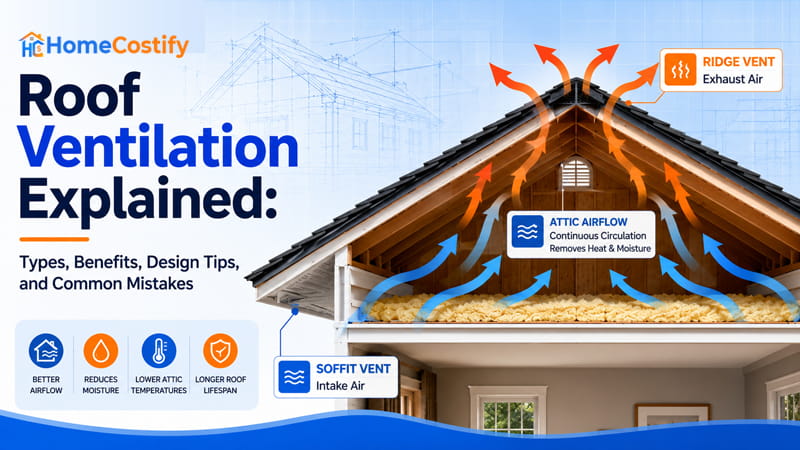
A hot attic does more than make a home uncomfortable during summer. A properly designed roof ventilation setup helps maintain steady airflow, reducing the chance of heat accumulation and moisture-related damage.
Excess heat can spread downward into living spaces, while trapped moisture may linger beneath the roof deck long after outdoor conditions improve. Air movement inside the attic plays a major role in both situations.
Many homeowners pay close attention to shingles, insulation, and HVAC equipment. Ventilation often receives far less attention despite being connected to all three.
Air that enters and exits the attic at the right rate supports healthier building conditions throughout the year. The benefits extend beyond comfort. Moisture control, attic durability, and long-term energy performance are all tied to airflow management.
A well-balanced roof ventilation system works alongside insulation rather than replacing it. Fresh air enters through designated intake openings and exits through exhaust points near the top of the roof.
This continuous cycle supports attic ventilation, helping regulate temperature and humidity levels inside the space.
What Is Roof Ventilation?
Roof ventilation refers to the controlled movement of air through an attic or roof assembly. Outdoor air enters through intake openings positioned near the lower portion of the roof and exits through exhaust openings located higher up. The process creates continuous circulation that helps remove heat, humidity, and stale air from enclosed attic spaces.
In residential construction, a roof ventilation system is designed to maintain airflow without exposing the structure to rain, pests, or debris. The goal is not to cool the attic to outdoor temperatures. Instead, the system reduces extreme temperature swings and limits moisture accumulation that can affect structural materials over time.
Most homes across the United States rely on some form of roof ventilation because weather conditions vary widely throughout the year. Summer heat can build rapidly beneath roof coverings, while colder seasons may create condensation when warm indoor air reaches cooler surfaces in the attic. Consistent airflow helps address both concerns.
The system typically operates through a combination of intake and exhaust openings. These pathways allow air to move naturally as temperatures and pressure levels change. Various types of roof vents may be used depending on roof design, attic size, and climate conditions.
A properly planned roof ventilation system works together with insulation and air sealing strategies. Each component serves a different purpose, yet all contribute to healthier attic ventilation and improved building performance.
Why Roof Ventilation Matters
Heat Buildup in the Attic
Attics often experience temperatures far above outdoor conditions during warm weather. Sunlight striking the roof surface transfers heat into the roofing assembly throughout the day. Without a path for air exchange, that heat remains trapped inside the attic for extended periods.
High attic temperatures place additional stress on roofing materials and increase thermal pressure on the rooms below. Air circulation helps move excess heat out of the space before it reaches damaging levels. Effective roof ventilation reduces stagnant conditions and supports more stable attic environments.
Excess Moisture and Condensation
Water vapor is constantly produced inside a home through cooking, bathing, laundry, and normal daily activities. Some of that moisture eventually migrates upward into the attic. Problems begin when warm, moisture-laden air encounters cooler surfaces.
Tiny droplets can form on framing members, roof sheathing, and other materials. Repeated exposure creates favorable conditions for mold growth, wood deterioration, and roof moisture buildup. Consistent airflow contributes to condensation prevention by helping moisture escape before it settles onto structural surfaces.
Impact on Energy Efficiency
Attic temperatures influence the amount of heat transferred into occupied rooms. When the attic remains excessively hot, cooling equipment may operate longer to maintain indoor comfort.
Air movement alone will not solve every efficiency problem, yet it supports broader strategies aimed at improving energy efficiency. Combined with proper insulation and air sealing, ventilation helps reduce thermal stress throughout the building envelope.
Impact on Roof Longevity
Roofing materials perform best under stable conditions. Persistent heat and moisture can accelerate wear on sheathing, framing, and certain roof coverings.
Good airflow supports attic temperature control and limits environmental conditions that contribute to premature deterioration. The result is a healthier roofing assembly with fewer opportunities for moisture-related damage over time.
Components of a Roof Ventilation System
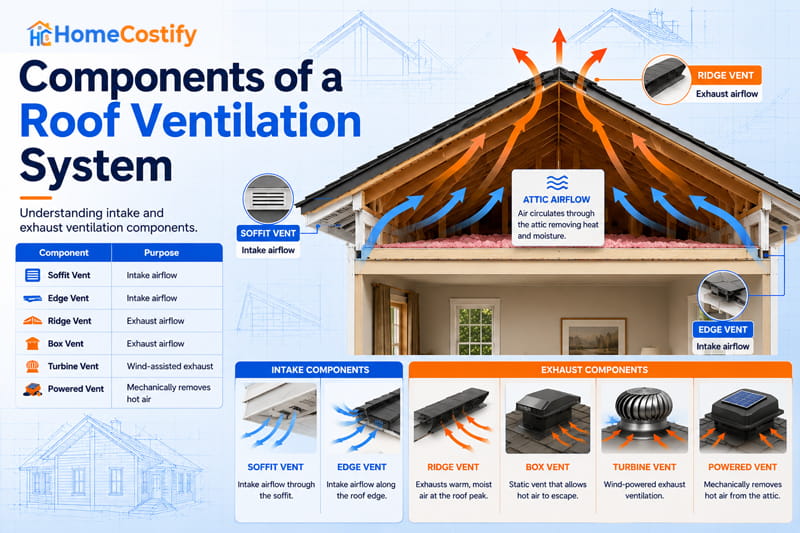
Every roof ventilation system relies on two basic functions: bringing fresh air into the attic and allowing warm, moisture-laden air to leave. Those tasks are performed through intake and exhaust openings positioned at different locations across the roof structure.
Ventilation components are among the most important roof parts because they help regulate airflow and moisture throughout the roofing assembly.
Intake Vents
Intake openings are generally installed near the lower portion of the roof. Their purpose is to introduce cooler outdoor air into the attic, creating the starting point for continuous airflow.
Soffit Vents
Soffit Vents are among the most common forms of Intake Vents used in residential construction. They are typically installed beneath roof overhangs along the underside of the eaves. Air enters through the vent openings and moves upward into the attic space.
Because they run along the roof perimeter, soffit systems often provide consistent air distribution across the entire attic. This placement makes them particularly effective when paired with exhaust openings near the ridge.
Edge Vents
Edge Vents are installed near the lower edge of the roof and serve a similar function when traditional soffits are limited or unavailable. They create an intake pathway without requiring large overhangs, making them useful for certain roof designs.
Drip Edge Vents
Drip Edge Vents integrate ventilation openings into the roof edge profile. The design allows outside air to enter while maintaining roof protection against water intrusion. Retrofit projects sometimes use this option when adding new ventilation pathways to an existing roof.
Exhaust Vents
While intake openings bring fresh air inward, Exhaust Vents release heat and moisture that accumulate near the upper portion of the attic.
Ridge Vents
Ridge Vents are installed along the highest point of the roof. Warm air naturally rises toward the ridge, making this location highly effective for passive exhaust. Many modern homes use ridge systems as their primary exhaust solution.
Box Vents
Box Vents are static openings installed near the upper roof area. Each unit serves a limited section of the attic, so multiple vents may be required to achieve adequate airflow.
Turbine Vents
Turbine Vents use wind movement to assist air extraction. As the turbine rotates, it creates a pressure difference that encourages warm air to leave the attic. Performance often improves in regions with consistent wind patterns.
Powered Vents
Powered Vents use electric motors to actively remove hot air from attic spaces. A powered roof vent may be controlled by temperature settings, humidity levels, or manual operation. Larger homes sometimes use a mechanical roof ventilator when passive airflow alone cannot meet ventilation requirements.
Common Roof Ventilation Components
| Component | Purpose |
|---|---|
| Soffit Vent | Intake airflow |
| Edge Vent | Intake airflow |
| Ridge Vent | Exhaust airflow |
| Box Vent | Exhaust airflow |
| Turbine Vent | Wind-assisted exhaust |
| Powered Vent | Mechanically removes hot air |
How a Roof Ventilation System Works
Air movement inside an attic follows a predictable path. Cooler outdoor air enters near the lower portion of the roof, travels through the attic space, and exits through openings positioned higher on the structure.
The process may seem simple, yet several forces are working together behind the scenes. Temperature differences, air pressure, and natural convection all contribute to continuous circulation.
A properly designed roof ventilation setup does not rely on a single vent. Air must have a clear entry point and an equally effective exit point. When one side of the system is restricted, airflow becomes uneven and performance declines.
The goal is to create steady roof airflow across the entire attic rather than concentrating air movement in one isolated area.
Step 1: Fresh Air Enters Through Intake Vents
The cycle begins at the intake vents. Outdoor air enters through soffit, edge, or drip edge openings located near the eaves. These lower vents introduce cooler air into the attic space and establish the starting point for circulation.
Without adequate intake capacity, exhaust vents have little fresh air to draw from. Air may instead be pulled from unintended locations within the home, reducing overall performance. Strong attic airflow depends on a consistent supply of incoming air.
Step 2: Air Moves Through the Attic Space
After entering the attic, fresh air travels upward through the open space beneath the roof deck. The movement is gradual rather than forceful. Air naturally seeks areas of lower pressure while warmer air continues rising toward the highest portions of the structure.
Insulation baffles and unobstructed pathways help maintain this circulation. Storage items, blocked soffits, or improperly installed insulation can interrupt airflow patterns and reduce effectiveness.
Step 3: Heat and Moisture Rise Naturally
Warm air is less dense than cool air. As temperatures increase inside the attic, heated air begins moving upward toward the roof peak. Moisture carried within that air follows the same path.
This natural movement forms the foundation of passive ventilation. No motors or mechanical equipment are required. Temperature differences alone create enough pressure variation to support air exchange in many residential attics.
Step 4: Exhaust Vents Release Warm Air
Exhaust openings positioned near the roof peak allow accumulated heat and moisture to escape. Ridge vents, box vents, and other exhaust products create a release point that completes the airflow cycle.
As warm air exits, additional fresh air enters through intake openings below. The process continues throughout the day, helping maintain more stable attic conditions. A well-designed roof ventilation layout encourages this continuous exchange without creating dead zones where hot air can remain trapped.
Step 5: Balanced Airflow Supports the Entire Roof System
Performance improves when intake and exhaust capacities are properly matched. This concept is known as balanced ventilation. Excess exhaust without sufficient intake can limit airflow, while excessive intake may reduce the ability of warm air to leave the attic efficiently.
Some homes also incorporate active ventilation products such as powered attic fans. These systems use mechanical assistance to increase air movement under specific conditions. Even with powered equipment, maintaining a balance between intake and exhaust remains important for long-term performance.
Roof Ventilation Workflow
| Step | What Happens |
|---|---|
| 1 | Outdoor air enters intake vents |
| 2 | Air circulates through the attic |
| 3 | Heat and moisture rise upward |
| 4 | Exhaust vents release trapped air |
| 5 | Continuous airflow stabilizes attic conditions |
Roof Ventilation Types and When to Use Them
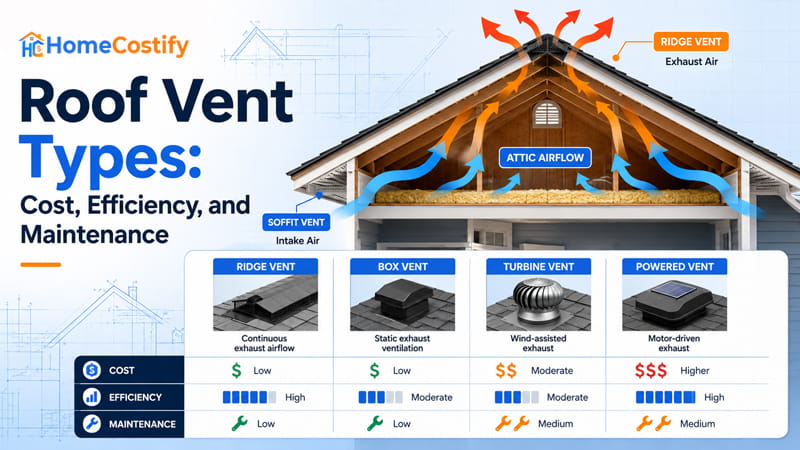
Different homes require different ventilation strategies. Roof design, attic size, climate conditions, and existing construction details all influence product selection. Some systems rely entirely on natural airflow, while others use mechanical assistance to increase air exchange.
Among the many roof ventilation types available today, a handful of options account for the majority of residential installations across the United States.
Ridge Vents
Ridge vents are installed along the peak of the roof and provide continuous exhaust across the highest point of the attic. Warm air naturally rises toward this location, making ridge systems highly effective for passive airflow.
Many roofing professionals consider ridge vents one of the most efficient types of roof vents when paired with adequate intake ventilation. Their low-profile appearance blends into the roofline, and the design provides exhaust along the entire ridge rather than a single location. Homes with conventional sloped roofs often benefit from this arrangement because it encourages uniform air movement throughout the attic.
Box Vents
Box vents are static exhaust openings positioned near the upper portion of the roof. Each unit serves a limited coverage area, which means several vents may be required on larger roofs.
These products are among the most common roof vent types found on older homes. Installation is relatively straightforward, and maintenance requirements are minimal. Box vents can perform well when properly sized, although airflow is typically less uniform than a continuous ridge vent system. Roofs without a long ridge line sometimes use box vents as an alternative exhaust solution.
Turbine Vents
Turbine vents feature a rotating head that spins when exposed to wind. The movement helps draw warm air out of the attic and improves exhaust performance under favorable weather conditions.
Among the various types of roof ventilation, turbines are often associated with regions that experience consistent wind patterns. Their distinctive appearance makes them easy to identify from the ground. Performance can vary depending on local weather conditions, though many homeowners appreciate the additional air movement generated by the spinning mechanism.
Powered Roof Vents
Powered systems use electricity to actively remove heat from attic spaces. These units may operate through thermostats, humidistats, or programmable controls depending on the model.
A roof exhaust fan can move large volumes of air in a relatively short period. Some homeowners install a roof vent fan to address excessive attic temperatures in warmer climates. Other configurations use a dedicated roof ventilation fan connected to automatic controls.
The category also includes products marketed as a powered attic fan or power attic ventilator. Mechanical systems can be useful in specific situations, particularly when passive airflow alone cannot achieve desired results. Proper intake ventilation remains necessary even when powered equipment is installed.
Soffit Vents
Soffit vents serve as intake openings rather than exhaust points, yet they remain one of the most important components in any ventilation design. Air enters through the soffit area before moving upward through the attic.
Many of the best roof ventilation methods depend on a strong intake system. Without adequate incoming air, even high-quality exhaust products struggle to perform efficiently. Continuous soffit ventilation often provides more consistent intake coverage than isolated vent openings placed at a few locations around the roof perimeter.
Which Roof Vent Type Is Best?
There is no single answer that applies to every home. The best roof ventilation approach depends on roof geometry, attic configuration, local weather patterns, and available intake capacity.
For many homes, ridge vents combined with soffit vents create an effective and balanced system. Box vents remain a practical solution for certain roof layouts, while turbine vents can perform well in windy regions. Powered systems may be appropriate when additional air movement is needed.
The best roof vent system is usually the one that provides balanced intake and exhaust airflow while matching the home’s design. Evaluating the available types of roof vents alongside attic conditions often produces better results than focusing on a single product category.
Comparing Roof Vent Types
| Vent Type | Cost | Efficiency | Maintenance |
|---|---|---|---|
| Ridge Vent | Low | High | Low |
| Box Vent | Low | Moderate | Low |
| Turbine Vent | Moderate | Moderate | Medium |
| Powered Vent | Higher | High | Medium |
Benefits of Proper Roof Ventilation
A well-designed roof ventilation strategy affects far more than attic airflow. Temperature, humidity levels, insulation performance, and the lifespan of roofing materials are all influenced by the movement of air beneath the roof deck.
Problems often develop slowly, making ventilation issues difficult to recognize until visible damage appears. Consistent airflow helps create a more stable environment throughout the attic and the roofing assembly.
Reduces Excess Heat
Heat accumulation is one of the most common challenges inside residential attics. During summer, roof surfaces absorb solar radiation throughout the day. Temperatures beneath the roof deck can climb significantly higher than outdoor conditions, especially in warmer regions of the United States.
A properly functioning roof ventilation system provides a pathway for that trapped heat to escape. Fresh air enters through intake openings while warmer air exits through exhaust vents. The cycle reduces excessive temperature buildup and promotes better attic temperature control. Lower attic temperatures can also reduce thermal stress on surrounding building materials.
Helps Control Moisture
Moisture often causes more long-term damage than heat. Everyday activities such as cooking, showering, and laundry release water vapor into the indoor environment. Some of that moisture eventually migrates upward into attic spaces.
When humid air comes into contact with cooler surfaces, condensation can form on roof sheathing, rafters, and fasteners. Repeated exposure may contribute to mold growth, wood decay, and insulation deterioration. Effective roof ventilation supports reliable moisture control by helping humid air leave the attic before it condenses on structural materials.
Supports Energy Efficiency
Ventilation and insulation perform different functions, yet they work best together. Insulation slows heat transfer, while airflow helps regulate attic conditions.
Excessive attic heat can increase the cooling load placed on HVAC systems during warm weather. Air circulation helps limit those temperature extremes and supports better overall energy efficiency. Homes with adequate ventilation and properly installed attic insulation often experience more consistent indoor comfort compared with homes where airflow is restricted.
Extends Roof Life
Roofing materials are exposed to changing temperatures, seasonal weather conditions, and varying moisture levels throughout the year. Those conditions can gradually affect performance.
Steady airflow helps create a healthier environment beneath the roof covering. Reduced heat buildup and lower humidity levels place less stress on sheathing, roof framing, and roofing components. A properly designed roof ventilation system contributes to long-term durability by reducing conditions associated with premature material deterioration.
According to the U.S. Department of Energy, ventilation is one of the most cost-effective ways to reduce heat buildup inside a building. When combined with proper attic insulation and air sealing, a well-designed roof ventilation system helps limit excessive attic temperatures and improve overall energy efficiency.
Roof Ventilation Design Tips
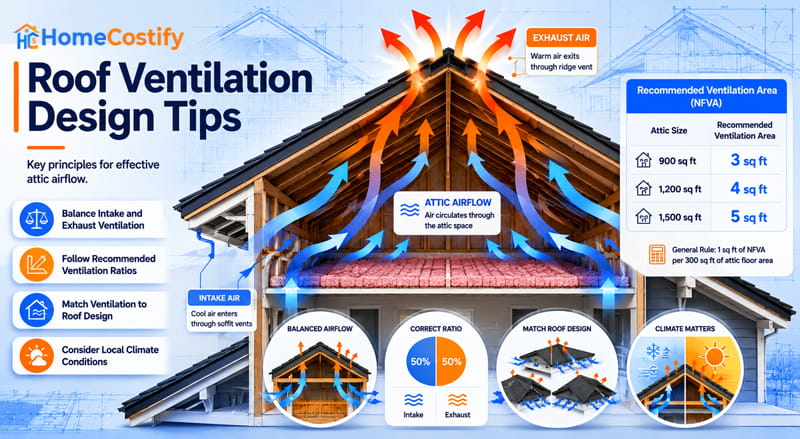
Performance depends on more than installing a few vents. The arrangement, sizing, and placement of intake and exhaust openings all influence how effectively air moves through the attic.
A carefully planned roof ventilation approach creates continuous airflow across the entire roof structure rather than concentrating air movement in isolated areas.
Balance Intake and Exhaust Ventilation
Air entering the attic should have a corresponding path to exit. An imbalance can reduce performance and create uneven airflow patterns.
Many professionals aim for a roughly equal distribution between intake and exhaust capacity. This balanced approach allows fresh air to enter near the eaves while warm air leaves through higher exhaust openings. A successful roof ventilation layout depends on both sides of the system working together.
Follow Recommended Ventilation Ratios
Vent sizing is often based on attic floor area. Building professionals frequently use Net Free Vent Area, commonly referred to as NFVA, to calculate the amount of ventilation needed.
One widely recognized guideline is the 1:300 Rule, which recommends one square foot of net ventilation area for every 300 square feet of attic floor space under qualifying conditions. These calculations help establish baseline ventilation requirements for residential attics.
Match Ventilation to Roof Design
Different roof configurations require different solutions. A simple gable roof may support continuous ridge ventilation, while more complex rooflines may require a combination of exhaust products.
An effective roof ventilation design considers roof geometry, available intake locations, and the overall attic configuration. Product selection should complement the structure rather than follow a one-size-fits-all approach.
Consider Local Climate Conditions
Climate plays a significant role in ventilation planning. Homes in hot southern regions often focus on reducing heat buildup, while colder climates may place greater emphasis on moisture management.
Regional weather patterns should influence vent selection, placement, and sizing decisions. Airflow needs in Arizona differ from those in Minnesota, even when homes have similar roof structures.
According to ventilation guidance based on FHA recommendations, attics should generally provide about one square foot of net ventilation area for every 300 square feet of attic floor space. The ventilation should also be balanced between intake vents and exhaust vents to maintain consistent airflow through the roof system.
Example Ventilation Sizing
| Attic Size | Recommended Ventilation Area |
|---|---|
| 900 sq ft | 3 sq ft |
| 1,200 sq ft | 4 sq ft |
| 1,500 sq ft | 5 sq ft |
Flat Roof Ventilation Considerations
Ventilation becomes more challenging when roof slopes are minimal. Traditional airflow patterns found in steep-slope attics are often absent, requiring a different approach to roof ventilation design.
Moisture management is usually the primary concern. Warm air and water vapor can become trapped beneath roofing membranes, increasing the likelihood of condensation and hidden deterioration.
These risks make flat roof ventilation an important consideration for both residential and commercial structures.
Low-slope roof assemblies present a unique set of ventilation challenges, including:
- Limited natural airflow compared to conventional pitched roofs
- Increased potential for trapped moisture beneath roofing membranes
- Greater dependence on properly positioned exhaust openings
- Ventilation requirements that vary by roof assembly design
- Performance differences among roofing materials types
Common ventilation solutions depend on the roof assembly and available airflow pathways. A flat roof vent creates an outlet for trapped heat and moisture, while multiple flat roof vents may be distributed across larger roof areas to improve air circulation.
Some buildings also use a dedicated flat roof ventilator designed specifically for low-slope applications.
Designers evaluating options for venting flat roof structures often prioritize moisture reduction and long-term roof performance. In some situations, flat roof soffit ventilation may contribute to airflow when the building design allows for intake openings.
Many low-slope assemblies, however, rely on specialized ventilation strategies that differ from those used on traditional sloped roofs.
Common Roof Ventilation Mistakes
Even a well-equipped attic can struggle if ventilation components are installed incorrectly or work against one another. Many airflow issues develop gradually. Homeowners often notice the effects long before identifying the cause.
Too Much Exhaust and Not Enough Intake
A common mistake involves adding more exhaust capacity without increasing intake airflow. Exhaust vents can only remove air that has a replacement source. When intake openings are insufficient, the system may struggle to maintain consistent circulation.
This imbalance often leads to inadequate roof ventilation, especially in larger attics. Instead of creating smooth airflow from the eaves to the ridge, air movement becomes restricted and less effective.
Blocking Soffit Vents
Soffit vents are frequently blocked by insulation, storage items, or debris. The problem often goes unnoticed because the obstruction occurs near the roof edge rather than in open attic areas.
Restricted intake airflow reduces circulation throughout the attic. Warm air may remain trapped for longer periods, increasing the likelihood of attic overheating during hot weather.
Mixing Incompatible Vent Types
Different exhaust products are not always designed to work together. Combining multiple exhaust systems without a clear airflow strategy can create competing pressure zones.
Some vents may pull air from nearby exhaust openings rather than drawing fresh air through intake vents. These ventilation problems can reduce overall performance even when plenty of vent openings are present.
Ignoring Moisture Warning Signs
Moisture issues rarely disappear on their own. Damp insulation, mold growth, water stains, and elevated attic humidity often indicate that airflow is not keeping pace with moisture accumulation.
Early intervention can prevent larger structural problems. Addressing airflow deficiencies before visible damage spreads is usually less expensive than repairing moisture-related deterioration.
Common Mistakes and Consequences
| Mistake | Potential Result |
|---|---|
| Blocked Soffits | Poor airflow |
| Unbalanced Ventilation | Heat buildup |
| Wrong Vent Selection | Reduced efficiency |
| Insufficient Vent Area | Moisture issues |
Conclusion
A well-designed roof ventilation strategy supports airflow, moisture management, and long-term roof performance. Intake and exhaust components work best when they are properly balanced and free from obstructions. A reliable roof ventilation system helps reduce heat buildup, control humidity, and protect structural materials throughout the year.
Regular inspections can identify airflow issues before they become costly repairs. Whether a home relies on ridge systems, soffits, or other roof vents, maintaining consistent air movement remains one of the most effective ways to support comfort, efficiency, and roof durability. Proper roof ventilation delivers benefits that extend far beyond the attic.
FAQs About Roof Ventilation
How do I know if my roof has enough ventilation?
A properly ventilated attic maintains consistent airflow and shows few signs of trapped heat or moisture. Excessive attic temperatures, condensation, mold growth, or unusually high cooling costs may indicate airflow deficiencies.
What are the rules for roof ventilation?
Most residential designs follow ventilation guidelines based on attic floor area. Building codes often reference net free vent area calculations and balanced intake-to-exhaust airflow ratios.
What happens if a roof is not vented properly?
Poor airflow can contribute to heat buildup, moisture accumulation, mold growth, insulation damage, and premature deterioration of roofing materials. Long-term exposure may affect both comfort and structural performance.
What are the signs of poor airflow?
Common indicators include hot attic conditions, persistent condensation, musty odors, damp insulation, mold growth, and uneven indoor temperatures during seasonal weather changes.
What are the signs of a bad roof vent?
Damaged vents may show cracks, corrosion, missing components, water intrusion, loose flashing, or visible blockages. Reduced airflow performance can also signal a vent-related problem.