Asphalt shingle roof replacement cost depends on what is being replaced. An aging roof may have worn shingles, several roofing layers, or materials beneath the surface that need attention once the old covering is removed.
The work begins at the existing roof. Shingles are removed, the exposed surface is checked, and the roof is prepared for new materials. Some projects move quickly through these steps. Others require additional work before installation can begin.
Roof size sets the scale of the project. Roof shape, access, and the condition of the existing roofing affect the work required at that size. The shingles selected for the new roof then determine the material tier used in the replacement.
That combination is what produces a replacement estimate: the roof being removed, the work needed to prepare it, and the new roofing system going back on.
Average Asphalt Shingle Roof Replacement Cost
One estimate starts from a national benchmark, another from roof measurements, and another from material selection.
Each method serves as a practical reference before any house receives its own replacement estimate.
National Average Asphalt Shingle Roof Replacement Cost

For a standard single-family home with one existing layer of shingles, average roof complexity, and no major structural damage, asphalt shingle roof replacement cost falls around the following range.
| Project Level | Average Cost |
|---|---|
| Low-End | $7,500 |
| National Average | $10,900 |
| High-End | $16,000 |
The $10,900 midpoint works out to about $5.45 per square foot, or $545 per roofing square. At that rate, a 2,000-square-foot roof reaches the same $10,900 total.
A property with a larger roof, steeper geometry, difficult access, multiple existing shingle layers, or additional repair work can produce a different estimate. The figures here assume those conditions are not present.
Average Asphalt Shingle Roof Replacement Cost per Square Foot

At $5.45 per square foot, the replacement rate comes to $545 for every 100 square feet.
Roofing contractors refer to 100 square feet as one roofing square. The unit is useful when estimating shingle quantities and replacement work because a roof measuring 2,000 square feet contains 20 roofing squares.
| Measurement | Average Cost |
|---|---|
| Per Square Foot | $5.45 |
| Per Roofing Square (100 sq ft) | $545 |
The conversion is straightforward:
100 sq ft × $5.45 = $545
For a 2,000-square-foot roof:
2,000 sq ft × $5.45 = $10,900
Or, using roofing squares:
20 squares × $545 = $10,900
A 2,000-square-foot home can have a roof area above or below 2,000 square feet. Roof pitch, overhangs, and the number of roof sections change the amount of surface that must be covered.
Average Asphalt Shingle Roof Replacement Cost by Roof Size
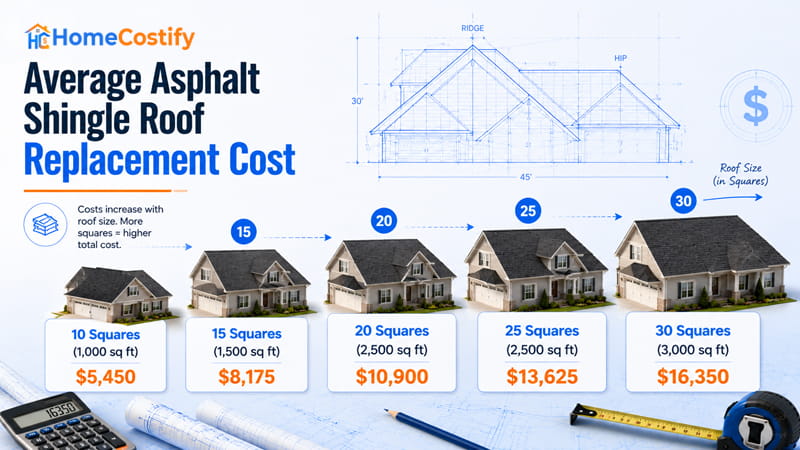
Roof size changes the estimate in direct proportion when the same $545-per-square rate is applied. Moving from 20 squares to 30 squares, for instance, adds 10 roofing squares and increases the calculation by $5,450.
| Roof Size | Estimated Cost |
|---|---|
| 10 Squares (1,000 sq ft) | $5,450 |
| 15 Squares (1,500 sq ft) | $8,175 |
| 20 Squares (2,000 sq ft) | $10,900 |
| 25 Squares (2,500 sq ft) | $13,625 |
| 30 Squares (3,000 sq ft) | $16,350 |
The 20-square example matches the $10,900 national midpoint. At the same rate, a 10-square roof costs half as much in the calculation, while a 30-square roof reaches $16,350.
Roof size is only one part of an actual replacement estimate. A 20-square roof with several steep sections and difficult access can require more labor than a simple 20-square roof with easy access.
Estimated Asphalt Shingle Roof Replacement Cost by Home Size
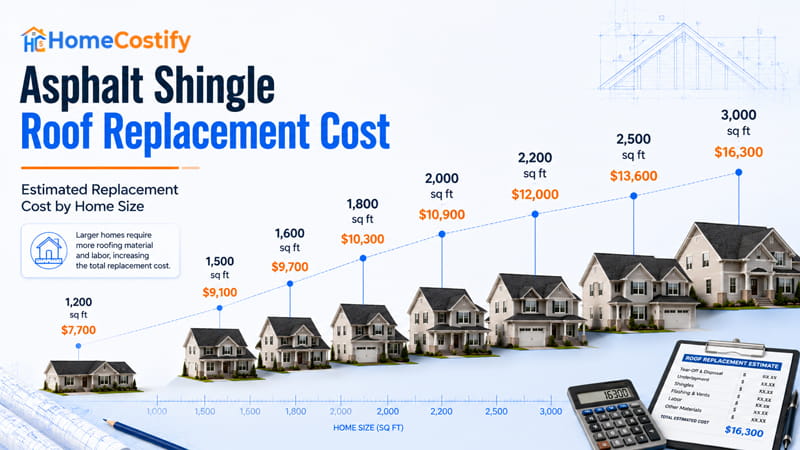
Home size is often the number available before anyone has measured the roof. That makes floor area useful for a rough estimate, but it should not be treated as the roof’s actual square footage.
| Home Size | Estimated Cost |
|---|---|
| 1,200 sq ft | $7,700 |
| 1,500 sq ft | $9,100 |
| 1,600 sq ft | $9,700 |
| 1,800 sq ft | $10,300 |
| 2,000 sq ft | $10,900 |
| 2,200 sq ft | $12,000 |
| 2,500 sq ft | $13,600 |
| 3,000 sq ft | $16,300 |
The estimates do not rise at exactly the same rate as the home’s floor area. Roof shape changes the amount of roofing surface associated with a given house size. A two-story home, for example, can have less roof area than a single-story home with the same total living space, while a design with large overhangs or several roof sections uses more roofing material.
That is why a 2,000-square-foot home appears at $10,900 in this table, while a measured 2,000-square-foot roof also reaches $10,900 in the roof-size calculation above. The two numbers happen to meet at this baseline; they are not interchangeable measurements.
Average Replacement Cost by Asphalt Shingle Grade

Changing the shingle grade changes the material cost even when the roof size stays the same. The difference is visible in the replacement totals below.
| Shingle Grade | Estimated Replacement Cost |
|---|---|
| 3-Tab | $9,800 |
| Architectural | $10,900 |
| Luxury | $14,200 |
The jump from 3-tab to architectural shingles is $1,100 in this baseline. Moving from architectural to luxury adds another $3,300.
The crew still has to remove the existing roof, prepare the surface, install the new shingles, and complete the associated replacement work. The change between these rows therefore comes primarily from the shingle product selected rather than from a different roof size.
More detail on individual product tiers appears in asphalt shingles cost, while best asphalt shingles covers the available grades and product options.
A different shingle grade also changes the amount allocated to materials within the overall replacement estimate. Labor, tear-off, disposal, and other project costs remain separate parts of the job.
What Does an Asphalt Shingle Roof Replacement Estimate Include?
A roof replacement estimate usually separates the job into removal, preparation, installation, and cleanup. Repairs discovered during tear-off, component replacement, permit fees, and code-related requirements may appear as separate line items.
Standard Work Included in Most Roof Replacement Estimates
The existing shingles are removed during roof tear-off, followed by disposal of the roofing debris. Once the roof is exposed, the surface is prepared for the new roofing system.
The new assembly typically includes underlayment, starter shingles, field asphalt shingles, and ridge cap shingles. Asphalt shingles installation covers the installation process for these components.
Flashing is handled separately from the shingle installation. Existing flashing can be inspected during the replacement, while replacement depends on its condition and how it interfaces with the new roof.
Final cleanup covers removal of roofing debris from the property, including loose nails and scraps left around the work area.
| Included Work | Typical Status |
|---|---|
| Remove existing shingles | Included |
| Haul away roofing debris | Included |
| Install new underlayment | Included |
| Install new asphalt shingles | Included |
| Install starter shingles | Included |
| Install ridge cap shingles | Included |
| Inspect existing flashing | Included |
| Replace existing flashing | Depends on condition and scope |
| Jobsite cleanup | Included |
The flashing distinction is worth checking when comparing proposals. Inspection means the existing component is assessed; replacement means new material and installation are priced.
Additional Work That May Be Added After Roof Inspection
Tear-off exposes the roof deck, making some defects easier to identify. Sections with rot, soft spots, or other deterioration can require new OSB sheathing or plywood decking before the shingles are installed.
Other components have their own replacement requirements. Deteriorated step flashing, damaged pipe boot seals, and aging ridge vent assemblies can lead to additional charges. Permit fees and localized structural asphalt shingle repairs can also be listed separately.
| Additional Work | Typical Base-Quote Status |
|---|---|
| Roof deck replacement | Usually extra |
| Flashing replacement | Depends on condition and scope |
| Pipe boot replacement | Depends on scope |
| Ridge vent upgrade | Depends on existing system and design |
| Permit fees | Varies by jurisdiction |
| Structural wood repair | Usually extra |
The timing varies by condition. Some deck problems are visible during an initial inspection, while deterioration hidden beneath the existing shingles becomes apparent during tear-off. The final quantity of damaged material can therefore remain unknown until the roof is opened.
According to the Asphalt Roofing Manufacturers Association (ARMA), deteriorated roof decking should be repaired or replaced before new asphalt shingles are installed. New shingles require a suitable surface for fastening, so damaged decking has to be addressed before installation.
Why Two Roof Replacement Estimates May Include Different Work
Two contractors can write different scopes for the same roof. One proposal might include flashing replacement or ventilation work in the base price, while another lists those items separately.
- Scope of work: The proposals may cover different repair items, disposal services, ventilation work, or flashing replacement.
- Material specifications: Underlayment can be specified as synthetic or felt, while flashing and ventilation components can also vary by product and scope.
- Building code: Requirements adopted by the local jurisdiction can add components or other work to a replacement project.
The International Code Council (ICC) publishes model residential code provisions that local jurisdictions may adopt. The requirements applicable to a roof replacement therefore depend on the code in force where the property is located.
An allowance covers an item whose final quantity or price cannot be established in advance. If the completed work exceeds the allowance, the contract may require a change order before the additional work is performed.
When comparing two proposals, check whether the same work appears under the base price, an allowance, or an additional line item. A difference in the final total may come from the scope rather than the roofing rate.
Roof Replacement vs. Reroof: Which Option Makes More Financial Sense?
Fresh shingles do not always require a full replacement. Some roofs still qualify for another layer, others do not.
Age, roof condition, and local building requirements usually determine which path remains available before any material reaches the roof.
What Is a Full Roof Replacement?
A worn roof leaves little behind once replacement begins. Old roofing comes off, exposing the existing roof and the supporting roof system beneath it. New materials follow only after the old assembly has been removed.
A complete roof replacement creates a clean starting point for another roofing cycle, making asphalt shingle roof replacement cost part of a much larger project than simply replacing visible shingles.
What Is Reroofing?
A second layer sometimes becomes an option before a roof reaches full replacement. Reroof places new shingles over an existing layer that still meets local requirements. No second layer is possible once roof conditions fall outside those limits.
Homeowners searching how much does it cost to reroof a house with asphalt shingles usually compare reroof against full replacement before making a decision.
Roof Replacement vs. Reroof Comparison
| Comparison | Roof Replacement | Reroof |
|---|---|---|
| Existing shingles removed | Yes | No |
| Roof deck inspected | Yes | Limited |
| Hidden damage identified | Yes | Limited |
| Meets current roofing standards | Usually Yes | Depends on existing roof |
| Initial project cost | Higher | Lower |
| Long-term value | Higher | Situation-dependent |
Leaving old shingles in place keeps the first invoice lower. Hidden conditions remain covered at the same time.
Full replacement opens the roof surface for inspection before fresh materials arrive, giving worn decking or aging components a chance to appear before another roof covers them.
Long-term planning often changes the conversation. A roof expected to remain in service for decades usually benefits from starting with a clean surface instead of adding another layer over aging materials.
Readers comparing broader replacement budgets can continue with roof replacement cost. A separate guide covering asphalt shingles installation cost explains how installation pricing differs from replacement work on an existing roof.
How to Compare Asphalt Shingle Roof Replacement Estimates
A roofing proposal can show a lower total because certain tasks, materials, or repairs are priced separately. Read the scope and line items before comparing the final amounts.
Compare the Scope of Work
Look at the actual tasks listed under each price. Removal, disposal, underlayment, flashing, and cleanup should be identifiable in the proposal so the two estimates can be compared on the same basis.
Check for:
- Tear-off scope: Does removal cover every existing shingle layer?
- Disposal responsibility: Who removes the roofing debris from the property?
- Underlayment specification: Which product is named in the proposal?
- Flashing treatment: Is existing flashing being inspected, reused, or replaced?
- Cleanup: What does the contractor include after installation?
A proposal that leaves one of these items unspecified may cover a different scope from another quote that prices the item separately.
Review Allowances and Exclusions
An allowance assigns an amount to work or materials whose final quantity or cost has not been established. An exclusion identifies something outside the quoted price.
Roof deck repairs, structural wood replacement, or other condition-based work may appear in either category. Check the dollar amount attached to an allowance and read the exclusion notes before comparing the totals.
A change order deals with a modification or added item after the contract is in place, subject to the contract terms.
Verify Contractor and Material Documentation
The proposal should identify who is performing the work, which materials are specified, and what the contractor has agreed to provide.
Review:
- Written scope of work: Scheduled tasks should appear in the contract rather than rely on verbal agreement.
- Contractor license: Check the license requirements that apply in the property’s jurisdiction.
- Insurance: Confirm current coverage and the types of coverage required for the project.
- Material specifications: Look for the shingle product, underlayment, flashing, ventilation components, and other specified materials.
- Warranty documentation: Check what the contractor and manufacturer warranties cover and where those terms are documented.
The final price is easier to interpret when the scope, allowances, exclusions, materials, and warranty terms are visible beside it.
Conclusion
An asphalt shingle replacement quote can include much more than the shingles themselves. Tear-off, underlayment, flashing, ridge components, disposal, and cleanup appear in the scope, while damaged decking, structural repairs, permits, or other site conditions can add to the original price.
Roof size and shingle grade establish the starting point for the estimate. The condition of the existing roof can change the scope once the shingles are removed. Contractor proposals can differ in how they handle flashing, allowances, exclusions, and items that are not priced in the base quote.
That is why two quotes should be checked line by line. A $10,000 proposal and an $11,000 proposal are not directly comparable when one includes work that the other leaves as an allowance or excludes from the base price.
FAQs About Asphalt Shingle Roof Replacement Cost
Does homeowners insurance pay for asphalt shingle roof replacement?
A homeowners policy may pay for roof damage caused by a covered event, such as hail, wind, or a fallen tree. Age-related deterioration, worn shingles, poor maintenance, and other gradual damage are generally handled as maintenance expenses rather than covered losses. The policy terms, deductible, cause of damage, and insurer’s claim decision determine whether a replacement is covered.
How long does an asphalt shingle roof replacement usually take?
A straightforward single-family home can often be completed in one to three days. Larger roofs, complex layouts, rain, high winds, material delivery problems, and repairs discovered during tear-off can add time to the project.
Can roof decking stay in place if it’s still in good condition?
Yes. Decking that remains structurally sound can stay beneath the new roofing. Damaged sections are removed and replaced where the wood has rot, moisture damage, soft spots, or inadequate structural integrity.
Is flashing always replaced during roof replacement?
No. Existing flashing can remain when it is in usable condition and works with the new roofing system. Damaged, corroded, poorly installed, or incompatible flashing is more likely to be replaced during the project.
Can only one section of an asphalt shingle roof be replaced?
A localized repair or partial replacement is possible when the problem is confined to a specific area and the surrounding roof remains serviceable. The repair becomes harder to match when the existing shingles are older, discontinued, or visibly weathered. The condition of the surrounding roof also matters when deciding whether repairing one section makes sense.