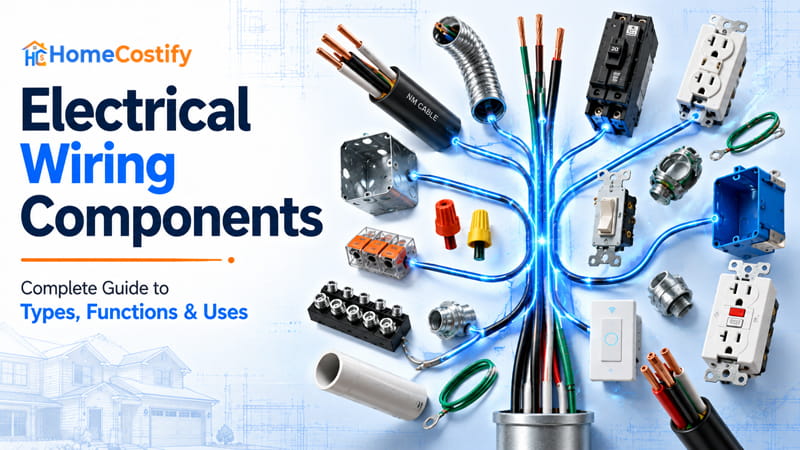
Electrical wiring components form a network that carries power from one point to another inside a home electrical system. Each part occupies a specific position within an electrical circuit.
Power moves from the electrical service panel through multiple components before reaching electrical loads. A missing or mismatched part can interrupt electrical flow even if surrounding equipment appears normal.
Clear terminology matters before learning product names. Residential wiring consists of groups with different jobs along a electrical power distribution path, from the service panel to outlets and connected equipment.
Misunderstanding those relationships can lead to confusion even when every component has been identified.
What Are Electrical Wiring Components
Electrical wiring components include conductors, protective materials, control devices, and connection points that carry, interrupt, direct, or distribute electrical flow inside a house. Product selection, installation, and safety standards fall outside this section.
Definition of Electrical Wiring Components
Electrical wiring components refer to physical items that move electrical current through a circuit. Conductors, insulation, protective devices, and connection points all fall within this category. Focus stays on electrical distribution infrastructure, not equipment powered by electricity.
What Counts as a Wiring Component?
Wires, cables, breakers, conduits, junction boxes, connectors, outlets, and switches are electrical components used for residential power distribution. Electricity travels through these items before reaching a point of use.
A refrigerator, lamp, ceiling fan, television, or washing machine does not belong in this category. Those products consume electricity after power reaches them. Distribution ends before electricity enters end-use equipment.
| Components Included in Electrical Wiring Components | Not Included |
|---|---|
| Electrical wires | Refrigerator |
| Electrical cables | Television |
| Circuit breakers | Washing machine |
| Conduits | Air conditioner |
| Junction boxes | Microwave |
| Switches | Portable appliances |
| Receptacles | Ceiling fan motor |
| Wire connectors | Lighting fixtures as end-use devices |
Household electrical systems contain countless powered devices. Only electrical wiring components carry, control, interrupt, distribute, or connect electrical flow before electricity reaches those devices.
Why Components Should Be Viewed as a System
Power passes through multiple wiring components before reaching a load. A damaged junction box, loose connector, or failed breaker can interrupt electrical flow even if surrounding equipment still functions.
How Electrical Wiring Components Are Organized
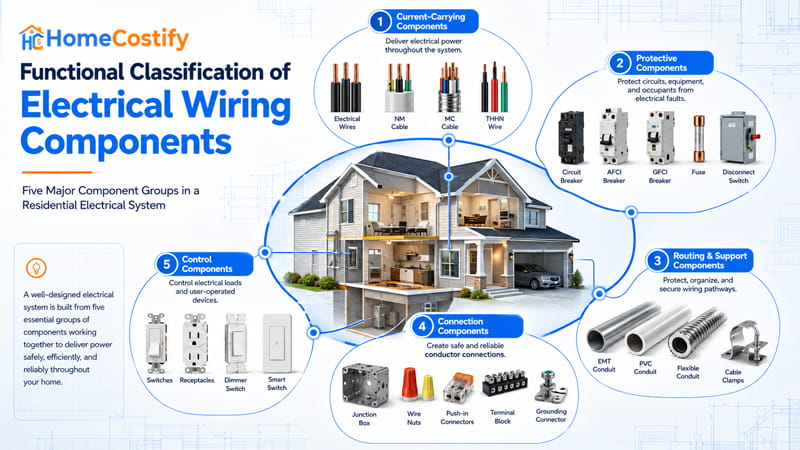
Electrical wiring components cover dozens of products with different jobs inside a residential electrical network. Grouping them by function creates a practical map before moving into individual products and technical details.
| Functional Classification of Electrical Wiring Components | Primary Function | Components Covered Later |
|---|---|---|
| Current-Carrying Electrical Wiring Components | Deliver electrical power across circuits | Electrical wires, electrical cables, hot conductors, neutral conductors, grounding conductors, service entrance conductors |
| Protective Electrical Wiring Components | Limit damage during electrical faults | Circuit breakers, fuses, AFCI, GFCI, disconnect switches, service panel components |
| Electrical Wiring Routing & Support Components | Protect and secure cable pathways | Conduits, cable clamps, cable staples, conduit fittings |
| Electrical Connection Components | Join conductors at termination and branching points | Junction boxes, wire connectors, terminal blocks, connection accessories |
| Electrical Control Components | Operate loads from user control points | Switches, receptacles, dimmers, smart switches, GFCI outlets |
Every category addresses a different stage inside an electrical system. Current-carrying products move electricity, protective devices respond to abnormal conditions, routing hardware shields conductors, connection hardware joins circuits, and control devices operate electrical loads.
Main Electrical Wiring Component Groups
Electricity reaches every circuit through component groups with different responsibilities. Current-carrying conductors move power, protective devices respond to faults, routing hardware shields conductors, connection hardware joins circuits, and control devices operate electrical loads.
Current-Carrying Electrical Wiring Components
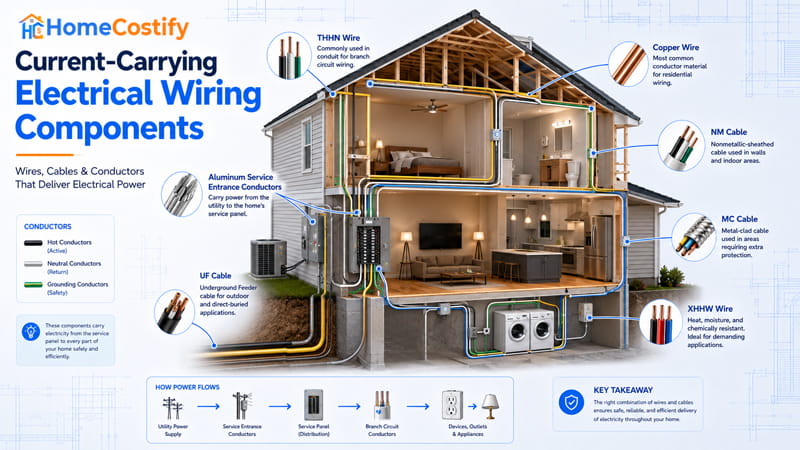
Power distribution depends on conductors with different purposes, not a single product. Wires, cables, and specialized conductors form one continuous path from utility service to branch circuits and electrical loads.
| Primary Components | Supporting Components | Related Components |
|---|---|---|
| Electrical Wires | Hot Conductors | Copper Wire |
| Electrical Cables | Neutral Conductors | Aluminum Wire |
| Grounding Conductors | Service Entrance Conductors | THHN Wire |
| XHHW Wire | ||
| NM Cable | ||
| UF Cable | ||
| MC Cable |
Electrical Wires
An electrical wire contains a single conductor surrounded by insulation. Electricity travels through conductor, and insulation separates energized metal from nearby surfaces.
Solid and stranded conductors appear across residential circuits, depending on application and cable construction. Copper remains a common copper conductor, although aluminum still appears in selected service applications.
Electrical wire specifications describe conductor material, insulation type, construction, and intended application. Those specifications identify physical characteristics without covering installation or circuit capacity.
Copper wire, aluminum wire, THHN, and XHHW represent familiar examples used across residential electrical distribution. Material, insulation, and construction vary between product families.
Electrical Cables
An electrical cable combines multiple conductors inside one cable assembly. An outer jacket surrounds internal conductors, adding another protective layer around insulated wires.
Cable construction differs from a single wire because conductors stay enclosed within one assembly. Residential branch circuit wiring commonly uses cable assemblies for lighting, receptacles, and general power distribution.
NM cable, UF cable, and MC cable represent familiar residential cable assemblies. Each product family matches different installation environments and construction requirements.
Supporting Conductors in a Residential Electrical System
Current reaches electrical loads through conductors with separate functions. Hot conductors carry energized current from a power source. Neutral conductors return current after electricity passes through a load.
Grounding conductors stay available during fault conditions, directing fault current toward grounding and protective equipment. Service entrance conductors carry incoming utility power from an electrical meter to a service panel.
One conductor cannot complete electrical distribution alone. Wiring components within this group form a continuous path from utility service to branch circuits and end-use equipment.
Wire and cable receive most attention because they stay visible during construction and remodeling. Complete electrical distribution still depends on hot, neutral, grounding, and service entrance conductors operating as one coordinated network.
Protective Electrical Wiring Components
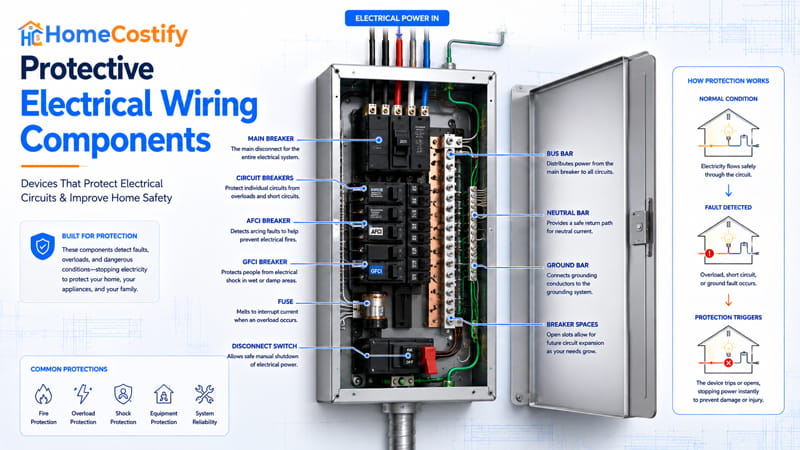
Power distribution depends on protective devices that respond when electrical conditions move outside normal operating limits. Different products address different fault types, forming layered protection across residential circuits.
| Primary Components | Supporting Components | Related Components |
|---|---|---|
| Circuit Breakers | AFCI | Service Panel |
| Fuses | GFCI | Main Breaker |
| Disconnect Switch | Bus Bar | |
| Neutral Bar | ||
| Ground Bar | ||
| Breaker Spaces |
Circuit Breakers
A circuit breaker interrupts electrical flow during overloads or short circuits. Internal switching mechanisms open a circuit once current exceeds safe operating limits.
Resetting restores operation after fault correction, eliminating replacement after every trip. That feature separates breakers from one-time protective devices.
Every breaker occupies a position inside a service panel. Main breakers control incoming supply, bus bars distribute electricity across branch circuits, and breaker spaces hold protective devices within panel assemblies. These electrical wiring parts operate as one distribution assembly.
Fuses
A fuse protects a circuit with a metal element that melts under excessive current. Electrical flow stops once that element opens.
Fuse protection works only once. Restoring power requires replacing a blown fuse with another matching unit.
Older residential panels frequently used fuses before circuit breakers became common. Current applications still appear in selected equipment, control circuits, and specialty electrical systems.
Modern Fault Protection Devices
AFCI devices detect electrical arcing that standard overload protection cannot identify. GFCI devices interrupt power after detecting current leaking from an intended path, reducing exposure during ground faults.
Disconnect switches isolate electrical supply whenever complete circuit separation becomes necessary. Service work, maintenance, and emergency shutdowns commonly require this function.
No protective device responds to every electrical fault. Electrical components within this group target overloads, short circuits, arc faults, ground faults, and complete power isolation through different operating principles.
Circuit breakers, fuses, AFCI devices, GFCI devices, disconnect switches, and panel hardware create multiple protective layers across residential electrical distribution. Different fault conditions trigger different protective responses, matching device operation with fault type.
Electrical Wiring Routing & Support Components
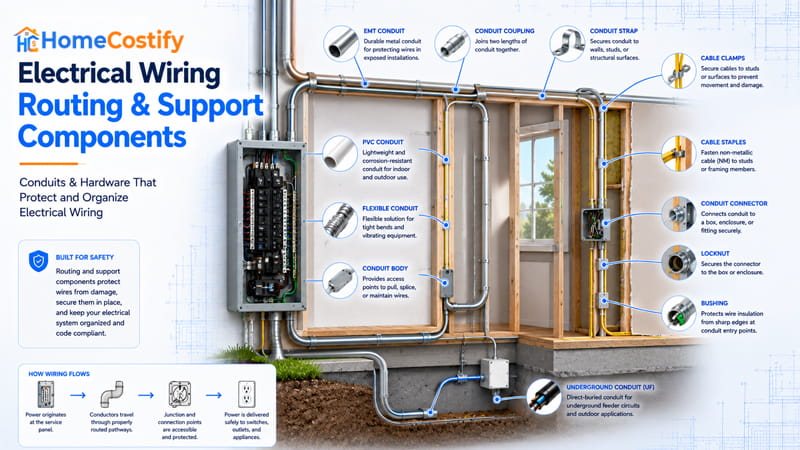
Conductors need physical protection beyond insulation alone. Routing and support hardware shields cable paths, limits movement, and guards exposed sections from accidental damage.
| Primary Components | Supporting Components | Related Components |
|---|---|---|
| Conduits | Cable Clamps | EMT Conduit |
| Cable Staples | PVC Conduit | |
| Flexible Conduit | ||
| Conduit Body | ||
| Conduit Coupling | ||
| Conduit Connector | ||
| Locknut | ||
| Bushing | ||
| Conduit Strap |
Conduits
A conduit surrounds conductors with a protective raceway. Physical impacts, moisture, sunlight, and harsh environments create fewer risks when conductors stay inside suitable conduit systems.
Conduit differs from cable construction. Cable carries its own outer jacket, whereas conduit forms a separate enclosure surrounding conductors after installation.
Residential projects use EMT conduit, PVC conduit, and flexible conduit in different environments. Conduit bodies, couplings, connectors, locknuts, bushings, and straps complete conduit assemblies. These wiring components support one continuous raceway from one section to another.
Cable Support Components
Cable clamps secure conductors at boxes, cabinets, and entry points. Cable staples fasten cable runs against framing members, limiting unnecessary movement.
Stable cable routing lowers strain at connection points and limits movement caused by vibration or accidental contact. Support hardware contributes to mechanical protection without becoming part of current-carrying conductors.
Electrical wiring parts within this group include conduit systems, clamps, staples, and supporting fittings. Each product contributes to cable routing, physical stability, and long-term protection across residential electrical distribution.
Electrical Connection Components
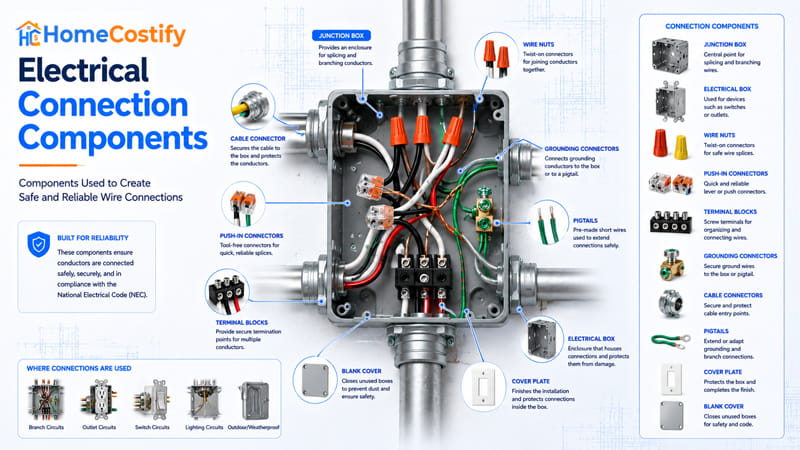
Electricity passes through connection points long before reaching switches, receptacles, or equipment. Secure connections maintain circuit continuity and protect conductors at every splice and termination.
| Primary Components | Supporting Components | Related Components |
|---|---|---|
| Junction Boxes | Wire Nuts | Electrical Box |
| Wire Connectors | Push-in Connectors | Device Box |
| Terminal Blocks | Grounding Connectors | Cover Plate |
| Cable Connector | Blank Cover | |
| Pigtail |
Junction Boxes
A junction box encloses every electrical splice inside a protective enclosure. Cable openings support proper cable entry, shielding splices from accidental contact and physical damage.
Electrical boxes and device boxes house branching points, switches, receptacles, or other circuit terminations. Cover plates and blank covers close unused openings and shield interior connections from dust and accidental contact.
Electrical wiring components within this enclosure system keep splices accessible for inspection without leaving energized connections exposed.
Wire Connectors
A wire connector joins two or more conductors at a shared connection point. Stable electrical connection depends on secure conductor contact across every splice or termination.
Wire nuts, push-in connectors, terminal blocks, grounding connectors, cable connectors, and pigtails serve different connection methods. Product selection depends on conductor arrangement and connection purpose.
Loose or damaged connections interrupt circuit continuity even when conductors remain intact. Conductor splice quality directly affects current flow across every joined conductor.
Enclosures, connectors, covers, and supporting accessories form one connection system. Electrical components within this group protect splices, secure terminations, and keep connection points accessible throughout residential electrical distribution.
Electrical Control Components
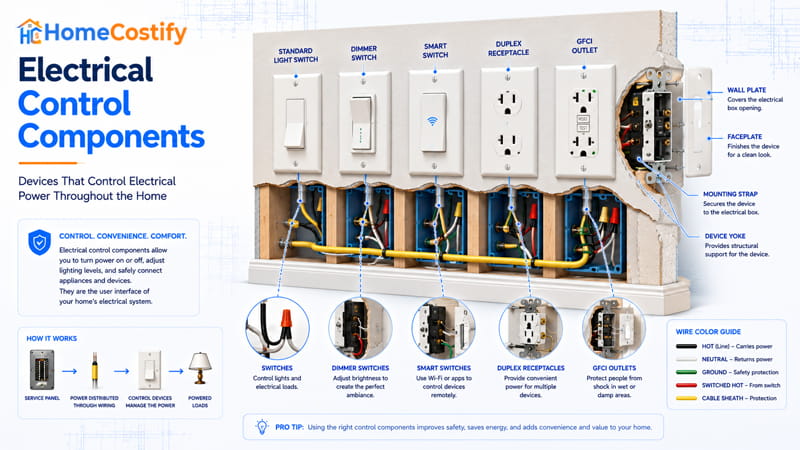
Control devices determine when electricity reaches a connected load. Daily operation depends on switching, power access, and user interaction at each branch circuit endpoint.
| Primary Components | Supporting Components | Related Components |
|---|---|---|
| Switches | Dimmer Switches | Wall Plate |
| Receptacles | Smart Switches | Faceplate |
| GFCI Outlets | Mounting Strap | |
| Duplex Receptacles | Device Yoke |
Switches
A switch opens or closes a circuit through simple switching action. Lights, exhaust fans, and similar loads respond after contact changes between open and closed positions.
Standard wall switches perform basic on-and-off control. Dimmer switches adjust light output, and smart switches add programmable control through compatible control systems.
Mounting straps, device yokes, wall plates, and faceplates complete finished installations around these electrical wiring parts.
Receptacles and Outlets
A receptacle accepts a plug and transfers electricity into connected equipment. An outlet identifies any point where electricity becomes available, including receptacles and hardwired connections.
Duplex receptacles place two plug connections within one device, supporting common household use. GFCI outlets add ground-fault protection in locations exposed to moisture or water.
Electrical wiring components within this group create accessible power points across living spaces, kitchens, garages, bathrooms, and outdoor areas.
Matching Control Devices to Electrical Loads
Control devices must match electrical load characteristics, circuit capacity, and operating location. Lighting circuits, kitchen appliances, bathroom receptacles, and outdoor equipment place different demands on control hardware.
Compatibility affects long-term operation as much as physical installation. Electrical components selected for each circuit should match load type, intended operating environment, and device function.
How Electrical Wiring Components Work Together
Residential electrical distribution depends on multiple component groups working in sequence. Each group performs a different function within one distribution path.
From Electrical Panel to End Device
Power enters a service panel before moving into branch circuits. Conductors carry electricity, protective devices monitor abnormal conditions, routing hardware shields cable paths, connection hardware joins conductors, and control devices deliver electricity where people use it.
Every group occupies a different position within electrical distribution. Removing any stage interrupts normal operation across a branch circuit. Wiring components function as one distribution chain from utility service to electrical loads.
| System Stage | Primary Component Group | Main Function |
|---|---|---|
| Power Distribution | Conductors | Carry electricity |
| Circuit Protection | Breakers & Fuses | Protect circuits |
| Wire Routing | Conduits & Supports | Protect and secure conductor pathways |
| Electrical Connection | Boxes & Connectors | Maintain secure conductor connections |
| User Control | Switches & Receptacles | Operate electrical loads |
Every group depends on another. Missing protection, damaged routing hardware, failed connections, or defective control devices interrupt normal circuit operation even when conductors remain intact.
Why Every Component Depends on Another
Power distribution depends on conductors, protection, routing, connections, and control devices functioning within one electrical network. Electrical wiring components perform different tasks, yet every circuit passes across these groups before reaching electrical equipment.
According to the U.S. Department of Energy, residential power distribution follows one continuous path from utility service to a distribution panel, then through conductors and protective devices before reaching points of use.
That framework places every component group within one electrical system instead of treating products as separate pieces.
Choosing the Right Electrical Wiring Components
Selecting wiring hardware starts with matching products to circuit requirements and installation conditions. Material, ratings, compatibility, and service life carry equal weight during evaluation.
Match Components to Their Intended Use
Indoor products differ from versions intended for outdoor exposure. Moisture, sunlight, temperature, and physical contact influence suitable electrical components for each location.
Dry rooms, damp spaces, and wet areas place different demands on insulation, enclosures, and protective hardware. Residential products should match intended operating conditions from day one.
| Selection Factor | Why It Matters |
|---|---|
| Intended application | Matches product function |
| Material | Influences service life |
| Compatibility | Avoids conflicts between products |
| Electrical rating | Matches circuit requirements |
| Environmental exposure | Matches installation conditions |
| Certification | Demonstrates recognized testing standards |
Verify Ratings and Compatibility
Voltage ratings, current ratings, conductor material, and environmental classifications should match circuit requirements before selecting electrical wiring parts. Mixing incompatible materials or ratings creates unnecessary problems during normal operation.
Compatibility extends across conductors, connectors, protective devices, enclosures, and control hardware. Product specifications should align across every section of a circuit instead of matching only one device.
Think Beyond Initial Purchase Cost
Purchase price represents only one portion of electrical wiring cost. Material quality, expected service life, and compatibility affect future replacement frequency and long-term ownership expenses.
A lower product price does not automatically reduce electrical installation cost. Replacement, troubleshooting, or future upgrades can outweigh small savings from inexpensive materials.
Future repairs contribute to electrical work cost when unsuitable products require replacement before reaching normal service life. Selecting compatible materials reduces repeated labor and replacement cycles.
Professional installation estimates also reflect electrician labour rates, especially when projects involve panel upgrades, circuit expansion, or extensive rewiring. Product quality and system compatibility remain useful evaluation points regardless of project size.
Safety & Code Considerations
Safe electrical systems depend on suitable materials, compatible ratings, protective devices, and accepted safety standards. Product quality matters, yet proper application carries equal importance.
Use Components That Meet Recognized Safety Standards
Certified products pass standardized testing before entering commercial use. A certified component carries evidence of performance under defined testing conditions.
Quality manufacturing lowers variation between products and supports long-term electrical safety. Selecting tested electrical wiring parts adds another layer of compliance across residential electrical systems.
| Basic Safety Principle | Why It Matters |
|---|---|
| Use certified components | Confirms standardized testing |
| Match component ratings | Avoids circuit mismatch |
| Use protection devices | Limits electrical fault damage |
| Maintain grounding continuity | Supports shock protection |
| Follow local codes | Aligns with accepted safety practices |
Protection Devices Are Part of the System, Not Optional Accessories
Circuit breakers interrupt overloads and short circuits. AFCI devices respond to electrical arcing. GFCI devices interrupt ground faults, and grounding carries fault current through an intended path.
Electrical wiring components include protection as a core system element, not an optional addition. Fault protection and overload protection operate alongside conductors, connections, and control devices across residential circuits.
Follow Local Electrical Codes
Local electrical codes establish accepted practices for materials, product ratings, equipment placement, and electrical wiring installation. Code requirements continue evolving as new products and technologies enter residential construction.
According to the DOE Electrical Science Handbook, safe electrical systems depend on conductors, protective devices, grounding methods, and components meeting recognized safety standards. This combination reduces electrical hazards and supports dependable system operation.
Selecting compliant electrical components aligns residential projects with accepted safety practices and current technical standards.
Common Mistakes When Selecting or Using Wiring Components
Selection mistakes begin long before installation. Confusion about product function, compatibility, or ratings can affect circuit reliability and long-term operating costs.
Assuming Every Electrical Component Serves the Same Purpose
Conductors, protective devices, connectors, routing hardware, and control devices perform different jobs. Substituting one product for another simply because both carry electricity creates incorrect applications.
Wiring components belong at specific points within a circuit. Product names may appear similar, yet circuit function determines where each one belongs.
| Common Mistake | Possible Impact |
|---|---|
| Choosing incompatible components | Reduced reliability |
| Ignoring component ratings | Increased safety risk |
| Using uncertified products | Premature failure |
| Treating all components the same | Incorrect application |
| Prioritizing price over compatibility | Higher long-term ownership costs |
Mixing Incompatible Components
Material type, electrical rating, and environmental suitability should align across one circuit. Combining incompatible electrical wiring parts can create poor electrical contact, shortened service life, or unnecessary replacement.
Compatibility extends beyond conductors. Connectors, protective devices, enclosures, and control hardware should follow matching product specifications.
Focusing Only on Initial Price
Low purchase price does not guarantee lower ownership cost. Short service life, repeated replacement, and poor compatibility can increase maintenance expenses across future years.
Incorrect product selection can contribute to larger repair projects, including work approaching a cost to rewire a house when replacement extends across multiple circuits. Electrical wiring components should match circuit requirements before purchase, not after problems appear.
Conslusion
Electrical wiring components form one integrated electrical distribution system, not a collection of unrelated products. Conductors carry current, protective devices interrupt faults, routing hardware protects cable paths, connection hardware secures splices, and control devices manage electrical loads.
Residential electrical system performance depends on component compatibility, suitable electrical ratings, and proper application. A mismatch in any category can affect circuit operation across multiple components.
FAQs About Electrical Wiring Components
What are the components used in electrical wiring?
Common electrical components include wires, cables, circuit breakers, conduits, junction boxes, connectors, switches, receptacles, grounding conductors, and protective devices.
What are the standard electrical components?
Standard electrical wiring parts include conductors, insulation, cables, breakers, fuses, junction boxes, conduits, connectors, switches, receptacles, and grounding hardware used across residential circuits.
What are the four basic components of an electric circuit?
Four basic electrical wiring components in a simple circuit include a source, conductor, load, and control device that opens or closes current flow.
What is an IC and its types?
An integrated circuit (IC) is an electronic component, not a residential wiring component. Common categories include analog ICs, digital ICs, and mixed-signal ICs.
How many electrical components are there?
No fixed number exists. Component count depends on system electrical wiring type, building size, electrical design, intended application, and project requirements.