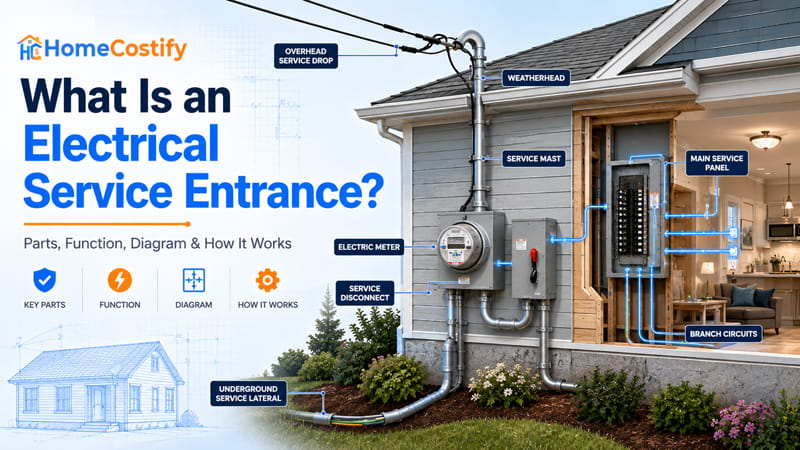
A service entry can be mistaken for a single piece of electrical hardware. The term electrical service entrance covers part of the electrical service arrangement, so a visible item does not necessarily represent the full path.
Utility power travels toward the building through a service pathway. Its physical form varies with the way electricity reaches the site, yet the basic idea stays tied to the supply reaching the building and its service-side hardware.
The utility-to-building path puts the electrical parts in relation to what comes before and after them. Electricity carried from the utility connection reaches the service equipment, where distribution begins for circuits inside the house. That boundary separates the supply side from wiring farther downstream.
What Is an Electrical Service Entrance
The phrase electrical service entrance refers to the portion of an electrical supply linking the utility connection with service-side hardware at the premises. A meter can be located within this area, but the meter itself is not the full entry. The main panel occupies a separate place within the electrical installation.
The Function of the Service Entrance
Electricity from the utility enters the premises through this service-side section. The electrical service entrance function centers on carrying that supply to the equipment where distribution begins. Power headed to receptacles, lighting, and appliances travels farther downstream through the building’s wiring.
Where the Service Entrance Is Located
Physical placement varies with the utility connection. An overhead setup brings conductors to the exterior wall through the mast and weatherhead. Below grade, a service lateral runs beneath the yard before rising at the house and joining the service-side equipment.
Service Entrance vs. the Rest of the Electrical System
The incoming side ends at the service boundary. From there, branch circuits carry electricity to loads such as lighting, receptacles, and fixed appliances. That downstream wiring belongs to the building’s distribution system, so the term does not cover every wire installed inside a house.
How an Electrical Service Entrance Works
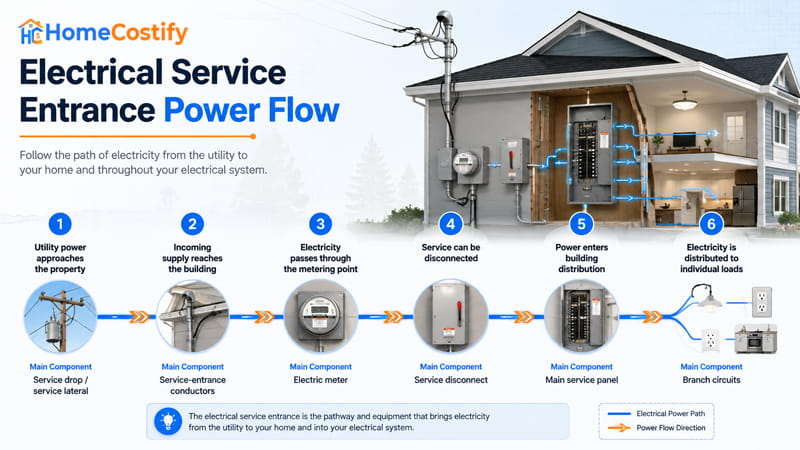
Electricity starts at the utility distribution network and moves toward the house. The route passes through several service-side points before household circuits take over.
| Stage | What Happens | Main Component |
|---|---|---|
| 1 | Utility power reaches the property | Service drop / service lateral |
| 2 | Conductors carry electricity toward service equipment | Service-entrance conductors |
| 3 | Supplied electricity is metered | Electric meter |
| 4 | Building service can be disconnected | Service disconnect |
| 5 | Distribution begins inside the house | Main service panel |
| 6 | Circuits carry power to household loads | Branch circuits |
Utility Power Reaches the Property
A distribution transformer feeds the residential connection from the utility network. From there, an overhead service drop or underground service lateral carries electricity to the premises. The physical route varies by installation, but both configurations bring the grid supply to the house.
Service-Entrance Conductors Carry the Incoming Supply
At the service point, conductors link the utility connection with the service-side hardware. OSHA defines service-entrance conductors as the portion between service equipment and the utility connection point. An overhead setup connects with the service drop; an underground setup connects with the service lateral.
Electricity Reaches the Metering Point
The electric meter records electricity delivered to the premises. Metering sits ahead of the wiring that serves receptacles, lighting, and appliances. The meter therefore belongs to the supply path, not the distribution network inside the house.
The U.S. Department of Energy describes a grid-connected house receiving electricity at the utility connection and meter before the main electrical service panel sends power into household wiring.
The Service Disconnect Controls the Incoming Service
Cutting power to the service takes place through the service disconnect. Its location varies by installation, and related hardware can form part of the service equipment. Branch-circuit breakers handle separate circuits within the house.
Power Enters the Main Service Panel
At the main service panel, electricity enters the central distribution point. Circuit wiring branches from this panel toward separate loads. Service entrance equipment belongs on the supply side of that boundary, ahead of wiring serving rooms and appliances.
Branch Circuits Deliver Power to Loads
Receptacles, switches, lights, and appliances depend on branch wiring for their electrical feed. Circuit breakers serve those branch circuits, carrying electricity from the panel toward specific loads. Service-entrance conductors belong upstream of this household wiring.
Main Electrical Service Entrance Components
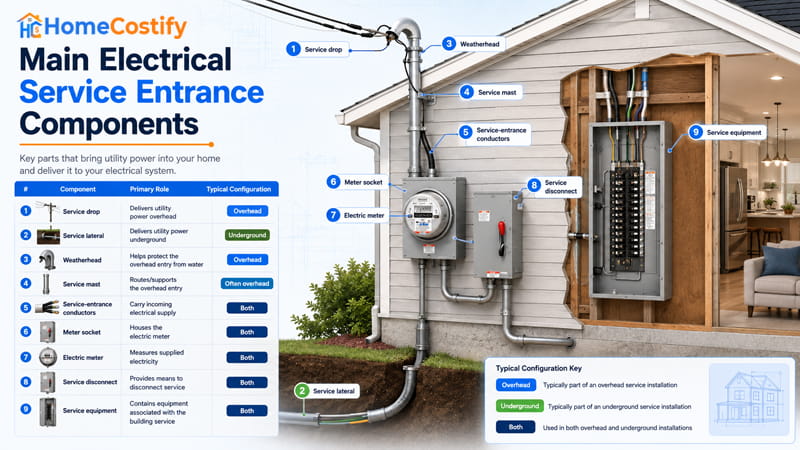
The electrical service entrance includes delivery routes, entry fittings, conductors, metering hardware, and disconnect equipment.
| Component | Primary Role | Typical Configuration |
|---|---|---|
| Service drop | Delivers utility power overhead | Overhead |
| Service lateral | Delivers utility power underground | Underground |
| Weatherhead | Protects the overhead entry from water | Overhead |
| Service mast | Routes/supports the overhead entry | Often overhead |
| Service-entrance conductors | Carry electrical supply | Both |
| Meter socket | Houses the electric meter | Both |
| Electric meter | Measures supplied electricity | Both |
| Service disconnect | Provides means to disconnect service | Both |
| Service equipment | Contains equipment associated with building service | Both |
Service Drop and Service Lateral
The route outside the building takes either an overhead or buried form. An overhead service drop runs through the air toward the premises, whereas an underground service lateral follows a below-grade route. Both terminate at the service point.
Weatherhead and Service Entrance Cap
At an overhead entry, weather exposure becomes a physical concern at the upper fitting. A weatherhead covers the top of the raceway and directs water away from the opening. A service entrance cap serves a similar protective purpose on applicable assemblies.
Service Mast and Raceway
Vertical hardware gives the overhead entry its physical route. A service mast can extend above the roofline, with the raceway carrying conductors through a protected passage. These are among the service entrance parts that also relate to how the exterior assembly attaches to the structure.
Service-Entrance Conductors
The conductor set occupies the electrical path between the service connection and service equipment. Within overhead or underground configurations, the supplied current passes through service entrance conductors. Their position separates them from downstream branch wiring serving loads inside the building.
Meter Socket and Electric Meter
The metering assembly contains two distinct pieces. A meter socket or enclosure houses the measuring device, whereas the electric meter records supplied electricity. Their shared location does not make them a single component.
Service Disconnect and Service Equipment
Control of the building supply centers on the service disconnect. Related hardware can fall within the service equipment arrangement, depending on how the installation is configured. The term does not refer to every panel found inside a house.
How the Components Form One Service Arrangement
The physical assembly spans several types of hardware. Delivery routes bring the provider’s supply toward the entry, protective fittings cover exposed points, and routing hardware guides the conductors.
Metering hardware records usage, then disconnecting equipment handles the building-side service connection. These relationships define the electrical service entrance components as parts of a single service arrangement, not interchangeable pieces.
Electrical Service Entrance Diagram: How the Components Connect
A useful diagram shows where each component belongs around the house. Overhead and underground configurations need different visual layouts, especially around the roofline, exterior wall, and finished grade.
Overhead Electrical Service Entrance Diagram

An elevated utility route frames the overhead arrangement. The electrical service entrance diagram should show the transformer, aerial service drop, attachment point, roofline, weatherhead, and mast.
Service-entrance conductors continue toward the meter and service equipment, with the main panel and branch circuits shown inside as downstream context.
Diagram: Utility transformer → aerial service drop → building attachment → weatherhead/mast → service-entrance conductors → meter → service equipment → main panel → branch circuits → loads.
Underground Electrical Service Entrance Diagram

A ground cross-section gives the underground arrangement its clearest spatial reference. The service entrance begins visually at the utility side, then follows the buried lateral and conduit beneath finished grade.
Metering hardware and service equipment sit at the building entry, with the panel and downstream circuits shown inside.
Diagram: Utility transformer → underground lateral → below-grade route/conduit → meter → service equipment → main panel → branch circuits → loads.
Service-Entrance Conductors and Cables
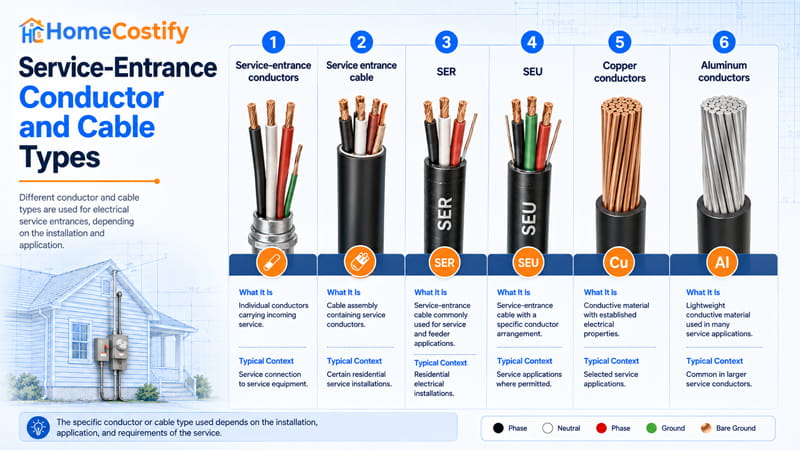
A wire can be a single conductor, while a cable groups conductors within a shared construction. That difference matters when reading service wiring terminology. Material choice and conductor sizing add another layer, since copper, aluminum, ampacity, and calculated load each relate to the electrical design
| Type | What It Is | Typical Context |
|---|---|---|
| Service-entrance conductors | Conductors carrying the electrical supply | Service connection to service equipment |
| Service entrance cable | Cable assembly containing service conductors | Certain residential installations |
| SER | Service-entrance cable designation | Residential service and feeder applications |
| SEU | Service-entrance cable with a specific conductor arrangement | Applicable service installations |
| Copper conductors | Conductive material | Selected service applications |
| Aluminum conductors | Lightweight conductive material | Common in larger service conductors |
Service-Entrance Conductors
Electrical conductors receive their service designation from their position within the installation. Between the service connection and service equipment, the incoming current travels through service entrance conductors.
Their routing varies with overhead or underground configurations, and they are separate from wiring serving branch circuits farther inside the house.
Service Entrance Cable
A cable groups multiple conductors within a single assembly. Service entrance cable describes a wiring form used for certain service installations, with its construction providing a packaged conductor assembly.
Not every conductor serving a service connection takes cable form; some installations use separate conductors within a raceway.
SER and SEU Cable
SER and SEU identify distinct service-entrance cable constructions. Their conductor arrangement and permitted applications are not interchangeable across every installation, so the designation alone does not establish suitability.
Residential work can involve either type, subject to the installation conditions and applicable electrical requirements.
Copper and Aluminum Conductors
Copper and aluminum both serve as conductor materials in residential electrical work. Copper has different physical and termination characteristics from aluminum, and those differences affect how the wiring interfaces with associated hardware.
Aluminum conductors are common in larger service applications where the selected material matches the installation requirements.
Service Entrance Materials and Wire Sizing
Wire size follows the electrical design, not the house size or service rating alone. Calculated load, conductor material, installation conditions, and conductor ampacity all enter the sizing decision.
Service entrance materials therefore need to be considered alongside the rating assigned to the service and the equipment involved. The service entrance conductors must have an ampacity suited to those conditions.
Meter, Service Disconnect, and Main Service Panel: How They Fit Together
A meter, disconnect, and panel can be found near each other, yet their jobs are different. Metering records supplied electricity. Disconnection occurs through its designated control point, whereas the panel sends power into branch circuits.
The Electric Meter Measures Supplied Electricity
Usage recorded at the meter represents electricity supplied to the premises. The meter sits within a socket or enclosure tied to the electrical service, with metering kept separate from switching and circuit distribution. In an electrical service entrance, its task concerns measurement, not control of downstream loads.
The Service Disconnect Provides a Means of Disconnection
Cutting the building supply occurs at the service disconnect. Its physical form varies with the installation, and the disconnecting means can be incorporated into service equipment. A meter records usage; it does not perform the disconnecting task.
The Main Service Panel Distributes Power
From the main service panel, electricity branches toward separate household circuits. Circuit breakers occupy the panel and feed branch circuits serving rooms, appliances, lighting, and receptacles.
Service entrance equipment belongs to the service portion, whereas panel distribution concerns circuits farther into the electrical installation.
The Bus Bar Connects the Panel’s Distribution System
Inside the panel, bus bars form conductive paths for the breakers. Their position links the panel supply with circuit protection hardware. Metering has no part in this internal distribution path.
Power Moves From the Panel Into Branch Circuits
A circuit breaker feeds a branch circuit leading to an electrical load. Receptacles and light switches mark familiar endpoints, alongside lighting and appliances. At this point, the wiring serves household loads, not the incoming service.
Grounding and Bonding at the Electrical Service Entrance
Grounding links the electrical system with earth. Bonding serves a different electrical purpose, joining conductive parts so fault current has a suitable path.
Grounding Electrode System
Earth enters the picture through grounding electrodes associated with the service grounding arrangement. A grounding electrode system links these electrodes with the electrical system. Its presence does not mean earth serves as the primary route for clearing every electrical fault.
Grounding Electrode Conductor
A grounding electrode conductor links the applicable grounding point with the electrode system. Its size and installation follow the system design and applicable requirements. This conductor has a different purpose from grounding conductors used with branch circuits.
Bonding at the Service Equipment
During a fault, conductive metal parts need a low-impedance route back toward the source. At the electrical service entrance, bonding joins qualifying metal parts electrically and supports the fault-current path needed for protective devices to operate. Bonding is not simply a connection between the electrical system and earth.
The Role of the Grounding System
Grounding and bonding serve different purposes within the grounding system. The arrangement extends beyond a ground rod and includes the relationships among electrodes, conductors, bonded metal, and service equipment. Damaged or altered service grounding requires assessment by a qualified electrician.
Electrical Service Entrance Requirements and Code Considerations

A residential service installation can fall under several layers of rules. The NEC sets a national framework, utility standards govern utility-specific conditions, and local authorities enforce adopted provisions.
NEC Article 230
Article 230 of the National Electrical Code covers service conductors, service equipment, disconnecting means, and related installation provisions. Its application follows the configuration involved and the code edition adopted for the project.
Service Clearances and Routing
Physical placement brings another set of code considerations. Overhead conductors require prescribed clearances, and raceway placement must match applicable provisions and site conditions. Exact dimensions depend on the governing code and the installation.
Service Equipment and Disconnect Requirements
Service equipment and disconnecting means have their own compliance requirements. The applicable provisions cover matters such as equipment suitability, disconnect location, and installation conditions. Exact requirements vary with the configuration being evaluated.
Utility Requirements and Local Amendments
A serving utility can impose standards beyond the adopted code. PG&E, for example, publishes separate electric and gas service requirements for new or remodeled connections. Local jurisdictions can adopt amendments alongside the NEC, so service entrance requirements need local verification.
Permits, Inspections, and the AHJ
Permits and inspections fall under the authority having jurisdiction, or AHJ. ICC defines the AHJ as the authority responsible for enforcing applicable code provisions or approving regulated installations.
For permitted work, inspection requirements follow the governing jurisdiction; utility approval can apply at the utility interface. Service entrance requirements therefore need to be checked against the adopted local rules and project conditions.
How to Inspect an Electrical Service Entrance Safely
A visual inspection starts from a safe distance. Exterior conditions can reveal damage or deterioration, but energized equipment should never be opened, touched, or tested by a homeowner.
Weatherhead, Service Mast, and Roof Entry
A bent mast, damaged weatherhead, or displaced support deserves attention. Check the roof or wall penetration for cracked sealing, staining, or signs of water intrusion. No part of the overhead conductors should be touched during this observation.
Service-Entrance Conductors, Cable, and Raceway
Damaged insulation, abrasion, unusual sagging, or exposed material warrants professional evaluation. Raceway sections and fittings should not show obvious breaks or displacement. Visible damage to the incoming cable is enough reason to stop there.
Meter Enclosure and Exterior Service Equipment
Corrosion, cracked housing, missing covers, or moisture marks around the meter enclosure deserve attention. Water entering the housing can expose internal electrical system components to moisture or contaminants. Keep the enclosure closed; internal inspection is outside a homeowner’s visual check.
Visible Warning Signs
Burn marks, melted material, severe rust, exposed conductors, and water intrusion are serious warning signs. Loose or damaged hardware adds another concern. Repeated tripping or unusual electrical behavior alongside visible damage warrants professional evaluation.
Quick Visual Check
- Damaged or exposed conductors
- Severe corrosion or rust
- Water entering an enclosure or service entry
- Bent or visibly displaced mast
- Burn marks or melted components
- Missing or damaged enclosure covers
When to Stop a Visual Inspection
Stop if further inspection requires removing a cover, opening an enclosure, touching conductors, or approaching visibly damaged energized parts. Concerns involving utility-owned facilities should go to the utility. Customer-side conditions warrant evaluation by a qualified electrician.
Common Electrical Service Entrance Problems
Physical deterioration can develop before an electrical failure becomes obvious. Moisture, environmental exposure, mechanical stress, and aging can affect different parts of the service installation.
Damaged Service-Entrance Conductors and Cables
Cracked insulation or abrasion can expose conductors to environmental stress. In some service entrance problems, excessive movement or poor support adds mechanical strain to the cable. Visible deterioration warrants professional evaluation because these conductors handle the incoming electrical supply.
Damaged Service Mast and Weatherhead
Bending or displacement can affect the physical stability of an overhead entry. Corrosion can weaken the mast, especially where exposed metal has sustained prolonged weather contact. A cracked weatherhead or damaged support can also leave the entry vulnerable to water intrusion.
Corrosion and Water Intrusion
Moisture exposure can accelerate corrosion around metal enclosures, fittings, raceways, and connections. Water entering protected areas can degrade materials and affect nearby electrical components. The severity varies with exposure, location, and the condition of the affected hardware.
Outdated Electrical Service
An older installation can face limitations when household electrical demand has increased substantially. Service capacity becomes a concern after major additions or high-load equipment enters the home. Age alone does not prove that an electrical service entrance is unsafe or requires replacement.
When a Problem Needs Professional Evaluation
Burning evidence, severe corrosion, water intrusion, unstable hardware, or damaged conductors warrant qualified evaluation. Unexplained service problems also deserve attention when their source is unclear. A professional can assess whether the condition calls for repair, component replacement, or broader service work.
When an Electrical Service Entrance Upgrade May Be Needed
Upgrade decisions begin with capacity, not simply the age of a house. An older installation can still serve its present demand, yet added loads or outdated equipment can justify an assessment.
Older Electrical Service
Age alone does not establish a need for replacement. Limited capacity or dated equipment becomes relevant when present household demand has grown, especially alongside physical deterioration or planned electrical changes. An assessment should consider the existing installation on its actual merits.
Increased Electrical Loads
New electrical demand can place greater pressure on available service capacity. For an electrical service entrance, the key question concerns the calculated load and whether the existing service rating can support present use under applicable requirements. Multiple high-demand additions can warrant further evaluation.
Remodeling and Major Electrical Changes
A major remodeling project can introduce new circuits and substantial electrical loads. Kitchen expansions, home additions, finished spaces, and large mechanical changes can alter the building’s demand profile. Service capacity deserves review when the project significantly expands electrical use.
High-Load Equipment
EV chargers, heat pumps, electric ranges, and large HVAC equipment can add substantial demand. A single appliance does not automatically require a service entrance upgrade. The calculated load, existing capacity, and proposed equipment should guide the assessment.
Conclusion
Incoming electrical service forms the boundary between utility supply and household distribution. Its physical configuration can run overhead or underground, with conductors, metering, disconnecting means, and service equipment serving separate functions. Beyond that boundary, branch circuits carry electricity to household loads.
Physical condition deserves equal attention. Corrosion, water intrusion, damaged hardware, aging equipment, or increased demand can warrant professional evaluation. Service work should follow applicable requirements and conditions set by the serving utility.
Electrical Service Entrance FAQ
What Is the Electrical Service Entrance Section?
The service entrance section carries utility supply from the connection point toward building service equipment, forming the incoming portion of a home’s electrical system.
What Is the NEC Code for Service Entrance?
NEC Article 230 covers electrical services within the National Electrical Code. Applicable rules also follow the adopted code and local jurisdiction.
What Is the Difference Between Service Entrance and Non-Service Entrance?
Service conductors and service equipment belong to the incoming supply. Downstream wiring serves branch circuits, receptacles, lighting, appliances, and other household loads.
Where Is the Service Entrance?
The physical entry occurs where utility service reaches the premises. Overhead installations use a service drop; underground configurations use a service lateral.
How Many Wires Are Used for a Service Entrance?
There is no universal wire count. The number depends on service configuration, voltage system, grounding arrangement, conductor setup, and applicable electrical requirements.