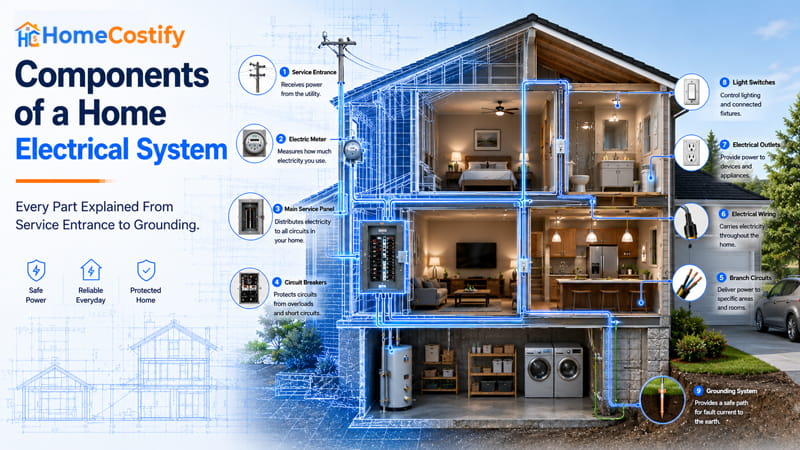
Morning usually begins long before anyone thinks about electricity. A bedside lamp turns on, the coffee maker starts brewing, the refrigerator keeps food cold, and a phone reaches a full battery before leaving for work. components of a home electrical system make those ordinary moments possible, even though most of the equipment stays hidden behind finished walls or inside metal enclosures.
Every day, the same group of electrical system components receives power from the utility company, directs electrical current toward different circuits, and delivers it to the places where electricity is needed. The process happens quietly. Most people never notice it unless something suddenly stops working.
A typical home electrical system contains far more than wires running from one room to another. Electricity follows a fixed path from the utility connection before reaching outlets, lighting fixtures, large appliances, and electronic devices across the household electrical system.
Each section handles a specific stage of that path. Current enters the residential electrical system, passes through protective equipment, travels across branch circuits, and finally reaches the equipment people use every day inside the electrical system in a house.
Main Components of a Home Electrical System, Their Functions, and Where They’re Located
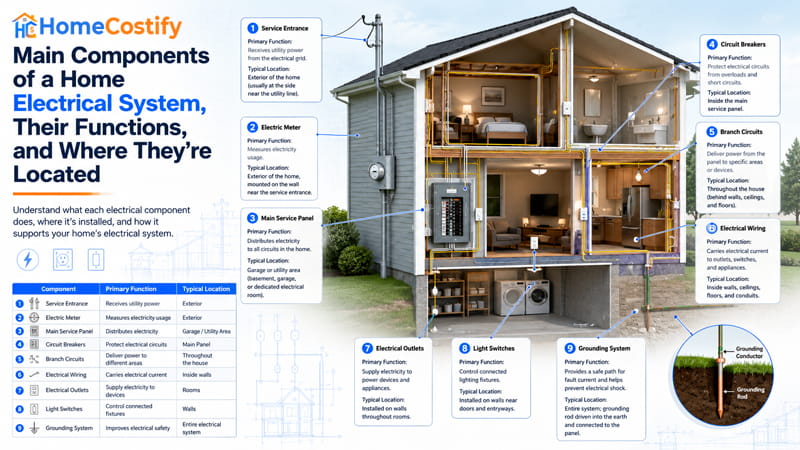
Electricity follows a fixed path after entering a house. components of a home electrical system occupy different points along that path, carrying incoming power, directing it to branch circuits, controlling electrical flow, and adding safety before electricity reaches lights and appliances. Viewed as one sequence, these electrical system components form a complete electrical system.
The sections below cover the primary electrical components, where they are commonly found, and how the major components of an electrical system fit into the main electrical system parts found in a typical residential electrical system.
| Component | Primary Function | Typical Location |
|---|---|---|
| Service Entrance | Receives utility power | Exterior |
| Electric Meter | Measures electricity usage | Exterior |
| Electrical Service Panel | Distributes electricity | Garage / Utility Area |
| Circuit Breakers | Protect electrical circuits | Main Panel |
| Branch Circuits | Deliver power to different areas | Throughout the house |
| Electrical Wiring | Carries electrical current | Inside walls |
| Electrical Outlets | Supply electricity to devices | Rooms |
| Light Switches | Control connected fixtures | Walls |
| Grounding System | Improves electrical safety | Entire electrical system |
Service Entrance
The service entrance marks the point where utility electricity first reaches a house. Every electrical path inside the home begins here before power passes through the meter and moves toward the main service panel. Utility service may arrive overhead or below ground, depending on local distribution practices and neighborhood infrastructure.
Functions of a Service Entrance
This section receives incoming utility power and carries it into the house through service conductors. It also forms the transition between the electric utility network and the private wiring serving the home.
How a Service Entrance Works
Power arrives from the utility distribution system through overhead conductors or an underground cable. Current then travels through the service entrance toward the electric meter. After energy usage is recorded, electricity continues to the main service panel, where it is divided into separate branch circuits serving different areas of the house.
Main Parts of a Service Entrance
- Service Drop – Overhead conductors extending from the utility pole to the house.
- Service Lateral – Underground utility cable supplying houses with buried electrical service.
- Weatherhead – A protective fitting mounted at the top of the service mast to keep rain from entering around incoming conductors.
- Service Conductors – Heavy-gauge conductors carrying electricity from the service connection toward the electric meter and main service panel.
Electric Meter
An electric meter records the amount of electricity entering a house from the utility company. In most U.S. homes, the meter sits on an exterior wall near the service entrance, placing it near the point where utility service reaches the house.
Every light, appliance, and receptacle draws electricity that passes through this device first. Without a meter, the utility company would have no accurate record of household energy consumption.
Functions of an Electric Meter
The meter tracks electricity usage in kilowatt-hours (kWh), the unit electric utilities use for billing. It also creates a continuous record of energy consumption over time. That information supports monthly billing, usage comparisons, and, in some service areas, daily or hourly consumption reports.
How an Electric Meter Works
Electrical current enters the meter before moving toward the main service panel. Older electromechanical models measure usage with a rotating aluminum disk driven by magnetic fields created by voltage and current. Digital meters perform the same task with electronic sensors and internal circuitry.
Smart meters build on that technology by sending usage data directly to the utility through secure communication networks, reducing the need for manual meter readings. Some utility companies also use smart meters to detect outages more quickly and support time-of-use rate programs where available.
Main Service Panel
After electricity passes through the meter, it reaches the main service panel. This enclosure forms the central distribution point inside a residential electrical system. From here, electricity moves into branch circuits serving different areas of the house.
The panel is commonly installed in a garage, basement, utility room, or another accessible location with adequate working clearance.
Functions of a Main Service Panel
The panel divides incoming electrical service into multiple circuits, each protected by its own breaker. Lighting, kitchen receptacles, HVAC equipment, laundry appliances, and other electrical loads receive power through separate circuit paths. That layout limits the effect of an overloaded or faulty circuit to a smaller portion of the house instead of interrupting electrical service everywhere.
Main Components Inside the Panel
Four parts stand out inside a typical panel.
- Main Breaker — Controls electrical service entering the panel and disconnects power from all branch circuits when switched off.
- Bus Bars — Heavy metal strips that distribute incoming electricity to the circuit breakers.
- Neutral Bus — Collects return current from branch circuits through neutral conductors.
- Ground Bus — Carries fault current toward the grounding system during electrical faults.
How a Main Service Panel Works
Incoming electricity enters the main breaker before reaching the bus bars. Circuit breakers attach to those bars and receive power for their assigned circuits. Current travels from each breaker through branch-circuit wiring, reaches outlets, lighting fixtures, or permanently installed equipment, then returns through the neutral conductors after electrical loads operate.
The National Fire Protection Association (NFPA) identifies the National Electrical Code (NEC) as the benchmark used for safe electrical design, installation, and inspection. Across the United States, state and local jurisdictions commonly adopt the NEC as the foundation for residential electrical safety requirements.
That widespread adoption creates a consistent framework for panel layout, circuit protection, conductor sizing, grounding, and other safety practices used in new construction and electrical upgrades.
Circuit Breakers
Circuit breakers sit inside the main service panel, with each breaker assigned to a specific electrical circuit. A kitchen receptacle, bedroom lighting, bathroom outlets, or an air conditioning unit may each have its own breaker, depending on the circuit layout.
Circuit breakers are one of the electrical system components that separate incoming utility power from the branch-circuit wiring serving different areas of the house.
Functions of Circuit Breakers
Every breaker monitors the amount of current flowing through its circuit. Under normal conditions, electricity passes through without interruption. A sudden overload or short circuit changes that condition.
The breaker senses the increase in current and opens the circuit before conductors reach unsafe temperatures. Power stops flowing only on the affected circuit, leaving the remaining circuits inside the house operating normally.
How Circuit Breakers Work
Each breaker contains an internal trip mechanism that reacts to abnormal current. Thermal elements respond to sustained overloads, giving circuits time to handle brief increases in demand. Magnetic elements react much faster during a short circuit, disconnecting power within a fraction of a second. After the fault has been corrected, the breaker can usually be reset by moving the handle back to the ON position.
Common Types of Circuit Breakers
- Standard Breaker — Protects against overloads and short circuits in general household circuits.
- GFCI Breaker — Monitors current leaving and returning through a circuit. A difference between those values causes the breaker to trip, reducing shock hazards in wet locations.
- AFCI Breaker — Detects electrical arcing that may occur because of damaged conductors, loose connections, or deteriorated wiring.
Branch Circuits
A branch circuit begins at a circuit breaker inside the main service panel and ends at the outlets, switches, lighting fixtures, or permanently installed equipment supplied by that circuit. Each path serves a defined portion of the house, allowing electricity to reach specific rooms or appliances without sharing one continuous line.
Branch circuits form another group of electrical system components found in every residential electrical installation.
Functions of Branch Circuits
Electricity leaves the main panel through separate circuits, carrying power to different parts of the house. Lighting, kitchen receptacles, laundry equipment, and large appliances often receive power from different circuits because each area places a different demand on the electrical system. A dedicated circuit serves equipment requiring its own electrical supply, such as an electric range or clothes dryer.
How Branch Circuits Work
Power enters a breaker first. From there, current travels through branch-circuit wiring until it reaches an outlet, light switch, lighting fixture, or another electrical device connected to that electrical circuit. After an appliance or light uses electrical energy, current returns through the neutral conductor to the panel.
Each circuit carries only the electrical load connected to it, allowing household circuits to operate independently within the same electrical system.
Electrical Wiring
Electrical wiring forms the pathway electricity follows after leaving the main service panel. Hidden inside walls, ceilings, and floors, these conductors carry electrical current toward outlets, switches, lighting fixtures, and permanently installed equipment.
Hidden conductors account for the longest path found in the electrical system components, reaching outlets, switches, lighting fixtures, and permanently installed equipment across the house
Functions of Electrical Wiring
Every conductor carries electricity from the panel to the point of use, then returns current through the neutral path after a device operates. Conductor size varies according to circuit capacity. A heavier wire gauge carries higher current than a smaller one, making proper conductor sizing part of safe residential electrical distribution.
How Electrical Wiring Works
Electricity leaves a circuit breaker and enters insulated conductors routed through framing cavities or protective raceways. Current continues toward the connected outlet, switch, or lighting fixture.
After an appliance or light operates, current returns to the panel through the neutral conductor, completing the electrical circuit. Most home electrical wiring remains hidden after construction, leaving only outlets, switches, and fixtures visible.
Common Types of Residential Wiring
- NM Cable (Romex) — The most common cable used for indoor residential branch circuits. Although Romex is a brand name, the term is widely used for nonmetallic sheathed NM cable.
- Conduit — A metal or nonmetallic raceway that encloses conductors for additional physical protection.
- Copper Wiring — The most common conductor material in modern homes because of its excellent electrical conductivity.
- Aluminum Wiring — Found mainly in houses built during the late 1960s and early 1970s. Modern installations follow different material standards and connection practices than those used during that period.
These examples form the foundation of residential wiring basics and electric wiring basics found in U.S. homes.
Electrical Outlets (Receptacles)
Electrical outlets, often called receptacles, provide the point where lamps, appliances, chargers, and other electrical devices receive power. Every outlet connects to a branch circuit through concealed wiring.
Electrical outlets are the Components of a Home Electrical System people encounter most often during everyday use, with receptacles installed throughout nearly every living space.
Functions of Electrical Outlets
Outlets transfer electricity from branch-circuit wiring to equipment plugged into the receptacle. Room placement depends on electrical layout, furniture use, and code requirements covering spacing and accessibility.
How Electrical Outlets Work
Current reaches the outlet through branch-circuit conductors. Plug blades contact the energized terminals inside the receptacle, allowing electricity to flow into the connected appliance. Once the device operates, current returns through the neutral conductor to complete the circuit.
Common Types of Electrical Outlets
- Standard outlet — Found in living rooms, bedrooms, hallways, and other general-use locations.
- GFCI outlet — Monitors current entering and leaving the receptacle. A difference between those values interrupts power within fractions of a second, making a GFCI outlet common near kitchens, bathrooms, garages, and outdoor locations.
- AFCI-protected outlet — Receives power from an AFCI breaker that detects hazardous arcing conditions.
- 240V outlet — Supplies larger appliances such as electric ranges, clothes dryers, and certain HVAC equipment.
Light Switches
A light switch opens or closes the path carrying electricity to a light fixture. Wall-mounted light switches appear in nearly every room because they provide direct control over a lighting circuit without requiring access to the electrical panel.
Of all the visible Components of a Home Electrical System, switches become part of everyday routines with little attention paid to what happens behind the wall after the toggle moves.
Functions of Light Switches
A switch controls the flow of current reaching a connected fixture. Flip the handle to one position and current reaches the light. Move it back and the electrical path opens, stopping the flow. The operation is simple, yet every switch is matched to the circuit and load it serves.
How Light Switches Work
Power enters the switch through one conductor and leaves through another after the internal contacts close. The fixture receives electricity only when those contacts complete the circuit. Open contacts interrupt current, leaving the light off even though power remains available at the panel.
Common Types of Switches
- Single-pole — Controls one light or fixture from a single location.
- Three-way — Allows the same fixture to operate from two separate locations, such as each end of a hallway or staircase.
- Dimmer — Adjusts light output by varying the amount of electrical power reaching compatible fixtures.
Grounding System
The grounding system creates a direct path for fault current to reach the earth under abnormal electrical conditions. Normal household electricity does not travel through this path during everyday operation. It remains available for faults that place metal parts or electrical equipment at an unsafe voltage.
Within the electrical system components found in a house, grounding serves as a safety measure working behind the scenes.
Functions of a Grounding System
Fault current follows the grounding path instead of remaining on exposed metal surfaces that people may touch. This path also supports the operation of overcurrent devices, allowing breakers to trip when a ground fault develops. Without an effective grounding system, dangerous voltage may remain on electrical equipment long after the original fault occurs.
How a Grounding System Works
Current normally leaves the panel through the ungrounded conductor and returns through the neutral conductor after a connected load operates. A ground fault changes that path. Electrical current flows through grounding conductors and bonded metal parts until the circuit breaker opens and removes power from the affected circuit.
Guidance from the U.S. Department of Energy describes electricity as the movement of electrical charge powering lighting, HVAC equipment, appliances, and electronics. That energy passes through multiple electrical system components and circuits before reaching equipment inside the home.
Safe distribution depends on each section of the system functioning as intended, including the grounding path available during abnormal conditions.
Main Components of a Grounding System
- Ground Rod — A metal rod driven into the soil to establish a grounding connection with the earth.
- Grounding Electrode Conductor — Connects the service equipment to the grounding electrode.
- Bonding — Joins metal piping, equipment, and other conductive parts so they remain at the same electrical potential during a fault.
How Home Electrical System Components Work Together
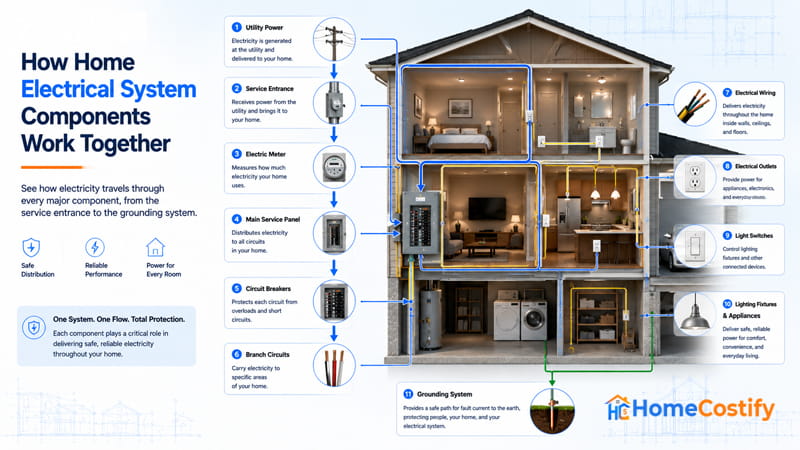
Electricity follows the same sequence every time a light turns on or an appliance starts running. Components of a Home Electrical System occupy different points along that path, passing electrical current from one section to the next until it reaches the final destination.
Remove or interrupt any point in that sequence and the flow of electricity stops long before it reaches the connected equipment.
Power Enters Through the Service Entrance
Every electrical cycle begins at the service entrance. Utility conductors bring electricity from the local distribution network to the house before current reaches the electric meter.
The meter records energy usage as electricity passes through it, creating the first step in the chain formed by the home’s Electrical System Components.
Electricity Is Distributed by the Main Service Panel
After leaving the meter, electricity enters the main service panel. From there, current reaches the bus bars before flowing into circuit breakers assigned to separate branch circuits.
Each breaker serves a specific circuit, allowing lighting, receptacles, kitchen appliances, HVAC equipment, and other electrical loads to receive power through independent paths. A problem affecting one branch circuit usually remains limited to that circuit after the breaker trips.
Electrical Wiring Delivers Power Where It’s Needed
Electricity leaves the panel through branch-circuit wiring hidden inside walls and ceilings. Conductors carry current toward outlets, light switches, lighting fixtures, and permanently installed appliances. Every branch follows the same sequence.
Breaker first, wiring second, then the connected device at the end of the circuit. That steady flow links the remaining Electrical System Components serving each room.
The Grounding System Protects the Entire Electrical System
Grounding remains available from the beginning of the electrical path to the final outlet or fixture. Under normal operating conditions, current does not travel through the grounding conductors. A fault changes that path.
Electricity moves through bonded metal parts and grounding conductors until the breaker opens, removing power from the affected circuit. Every section depends on that protective path, making grounding part of the same electrical network rather than a separate feature.
Common Problems Found in Home Electrical System Components
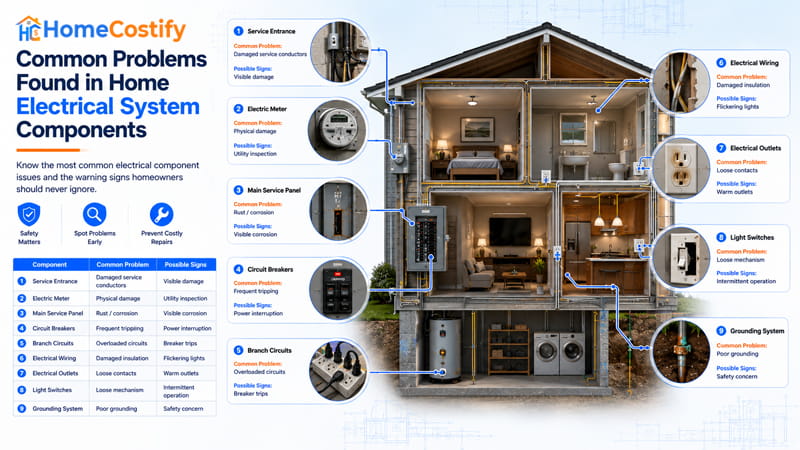
Most electrical systems operate for years without visible trouble, yet wear, moisture, loose connections, and physical damage can appear as equipment ages. Routine electrical inspection often begins with signs that are easy to notice, even without opening electrical equipment.
| Component | Common Problem | Possible Signs |
|---|---|---|
| Service Entrance | Damaged service conductors | Visible conductor damage |
| Electric Meter | Physical damage | Utility inspection required |
| Main Service Panel | Rust or corrosion | Visible rust or moisture |
| Circuit Breakers | Frequent tripping | Repeated power interruption |
| Branch Circuits | Overloaded circuits | Breaker trips under normal use |
| Wiring | Damaged insulation | Flickering lights |
| Outlets | Loose contacts | Warm outlets |
| Switches | Loose mechanism | Intermittent operation |
| Grounding System | Poor grounding | Electrical safety concern |
These conditions do not always point to the same cause, and visible symptoms can originate elsewhere in the electrical system. Frequent breaker trips may indicate an overloaded circuit, a short circuit, or another fault requiring further evaluation.
Warm outlets, flickering lights, and corrosion inside the panel also deserve attention because they may indicate deteriorating electrical connections.
Regular observation of these Electrical System Components provides an opportunity to notice changes before larger electrical issues develop. Maintaining electrical safety begins with recognizing abnormal conditions, even if the source of the problem has not yet been identified.
Overcurrent devices remain part of that protection through overload protection, limiting damage when excessive current flows.
How to Visually Inspect Home Electrical System Components Safely
A visual check can reveal warning signs without removing covers, opening the electrical panel, or touching energized equipment. The goal is simple. Notice visible changes that may indicate one of the Components of a Home Electrical System deserves closer attention from a licensed electrician.
Regular electrical inspection from a safe distance also supports better electrical safety by identifying conditions that should not be ignored. The following items are easy to recognize without dismantling any part of a residential electrical system or handling live electrical equipment.
- Burn marks around outlets, switches, or the electrical panel — Dark stains, melted plastic, or scorch marks may indicate excessive heat or electrical arcing.
- Rust or moisture near the main service panel — Corrosion and water exposure can affect metal parts and electrical connections inside the enclosure.
- Warm or discolored electrical outlets — Heat or yellowed plastic may point to loose connections or excessive current.
- Loose or damaged light switches — A switch that moves excessively or feels unstable deserves further evaluation.
- Frequently tripped circuit breaker — Repeated tripping usually signals an electrical condition requiring additional inspection.
- Flickering or dimming lights — Changes in brightness may originate from loose wiring, overloaded circuits, or another electrical issue.
- Damaged or exposed electrical wiring — Cracked insulation or visible conductors should never remain uncovered.
Visible changes do not confirm the exact cause, yet they can indicate that one or more Electrical System Components require professional attention. Regular observation of Components of a Home Electrical System supports safer operation without opening electrical equipment.
Conclusion
Every light that turns on and every appliance that starts operating follows the same electrical path. Power enters through the service entrance, passes the meter, reaches the panel, flows through branch circuits, and finally arrives at outlets, switches, or permanently installed equipment.
Each section depends on the next, forming a complete electrical network inside the house.
Learning the Components of a Home Electrical System creates a clearer picture of how electricity reaches everyday equipment and how each section contributes to safe power distribution. Familiarity with these Electrical System Components also makes unusual conditions easier to recognize during routine visual checks.
Routine observation, clean equipment, and prompt attention to visible damage all contribute to a safer home electrical system. If corrosion, damaged wiring, repeated breaker trips, or other unusual conditions appear, a licensed electrician can determine the source before the condition becomes more serious.
A well-maintained residential electrical system starts with recognizing how the Electrical System Components fit into the same electrical path, from the utility connection to the grounding system.
FAQs About Home Electrical System Components
What are the main components of a home electrical system?
The primary Components of a Home Electrical System include the service entrance, electric meter, main service panel, circuit breakers, branch circuits, electrical wiring, outlets, light switches, and the grounding system.
Which component distributes electricity throughout a house?
The main service panel receives incoming electricity from the meter and routes power into branch circuits serving different parts of the house.
What is the difference between a circuit breaker and a branch circuit?
A circuit breaker monitors and disconnects a circuit during abnormal current conditions. A branch circuit carries electricity from that breaker to outlets, switches, lighting fixtures, and connected equipment.
Why is grounding important in a residential electrical system?
Grounding provides a low-resistance path for fault current, allowing breakers to disconnect electrical power during ground faults.
Which electrical components should homeowners inspect regularly?
Visible items such as the service entrance, electrical panel, circuit breakers, wiring that can be seen, outlets, switches, and grounding connections should receive periodic visual checks for signs of damage, moisture, corrosion, or overheating.