A branch circuit links the breaker panel with the outlets, lights, and appliances used around the house. The panel can sit in a garage or utility area, yet the devices it serves can be in bedrooms, kitchens, or living spaces. Wiring carries power between these locations.
The home electric system splits incoming power among separate circuits. A living room receptacle can be served by one circuit, with a laundry appliance supplied by another. Household loads therefore can have separate routes from the panel.
Near the end of each route, wiring reaches a receptacle, light, or appliance that uses the supplied power. The arrangement ties the panel to everyday electrical use without putting every household load on a single circuit.
What Is a Branch Circuit?
The wiring serving household loads has a defined starting point and endpoint. That boundary separates the portion covered by the term branch circuit from other parts of the electrical distribution system.
Branch Circuit Definition
OSHA defines a branch circuit as conductors extending from the final overcurrent protective device to an outlet or point where current is taken for utilization equipment. At the upstream end, the final protective device marks the starting boundary. At the other end, the conductors reach an outlet or another place where current serves the connected load.
For a homeowner, this refers to wiring on the load side of the protective device. The circuit can serve a lighting fixture, an electrical outlet, or an appliance. It does not describe the electrical distribution system from the service equipment onward.
Where a Branch Circuit Begins and Ends
A wire leaving an electrical panel does not reveal its full boundary by appearance alone. Its position relative to the protective device matters. Conductors on the load side continue toward an outlet, lighting point, or utilization equipment.
A simple residential path can be pictured as:
panel → protective device → wiring → receptacle
The electrical system components form a chain in which each point has a defined place. The panel supplies the protective device, the conductors continue from its load side, and the downstream end reaches the place where electricity is used. This gives the circuit a physical boundary without treating the wire itself as the whole circuit.
How a Branch Circuit Works
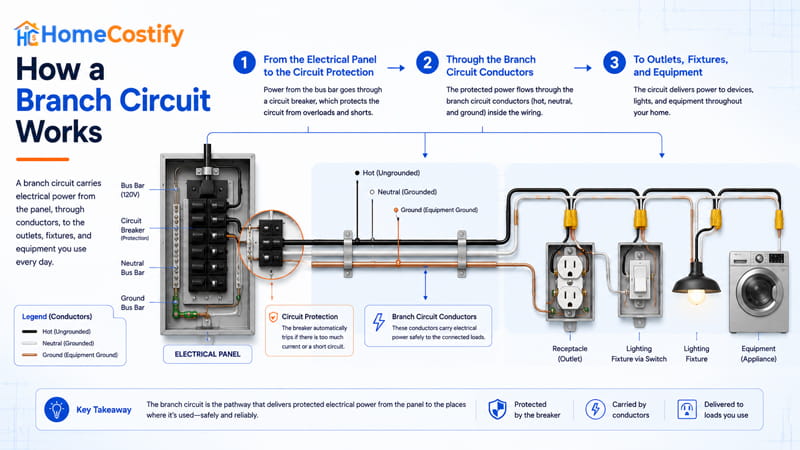
Electrical power follows a path from the service equipment to the place where electricity is used. The route includes distribution equipment, circuit protection, conductors, and the final connection.
From the Electrical Panel to the Circuit Protection
Electrical service enters the dwelling at the electrical service entrance and continues along the service path. An electric meter records the supplied energy before the supply reaches the electrical service panel. From there, power becomes available for downstream circuits serving lighting, receptacles, and appliances.
A el stands between panel distribution and the conductors serving those circuits. Its position places circuit protection ahead of the downstream wiring. The branch circuit continues on the protected side, carrying power to the fixture, outlet, or appliance being served.
Through the Branch Circuit Conductors
Past the protective device, conductors form the physical route for current. An energized or ungrounded conductor carries current from the source to the operating load.The grounded conductor serves as a current-carrying path in circuit configurations that use it. Its function differs from the equipment grounding conductor.
The equipment grounding conductor serves a safety function. It provides a path for fault current and supports protective operation during a fault. It does not carry current during normal operation. Conductors therefore have distinct functions within branch wiring.
To Outlets, Fixtures, and Equipment
At the downstream end, wiring reaches a receptacle, lighting fixture, switch, or directly wired appliance. A receptacle provides a connection for plug-in devices. A lighting fixture can use the supplied electricity directly. A light switch controls the lighting circuit but does not serve as its load.
An appliance without a plug connects directly to the circuit conductors. The final connection depends on how the appliance or other utilization equipment is supplied.
What Are the Main Types of Branch Circuits?
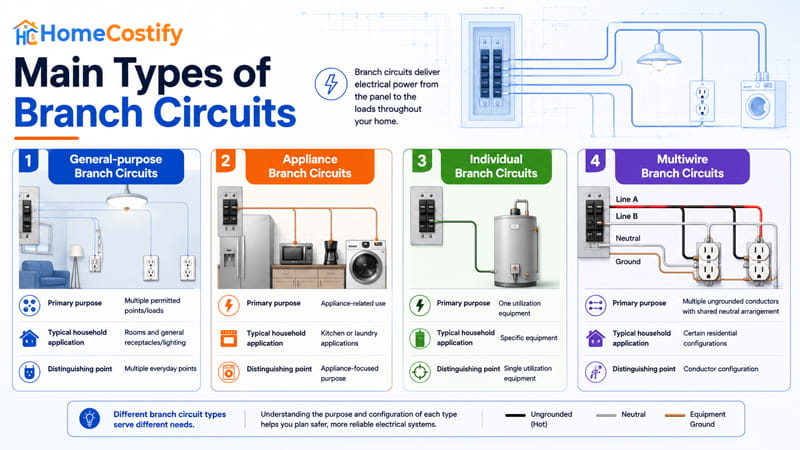
Branch circuits can differ by intended use, the number of utilization points served, or conductor configuration. Four classifications cover the main residential examples: general-purpose, appliance, individual, and multiwire.
| Type | Primary purpose | Typical household application | Distinguishing point |
|---|---|---|---|
| General-purpose | Multiple permitted points or loads | Rooms with receptacles and lighting | Multiple everyday points |
| Appliance | Appliance-related use | Kitchen or laundry | Appliance-focused purpose |
| Individual | One utilization equipment | Specific equipment | Single utilization equipment |
| Multiwire | Multiple ungrounded conductors with a shared neutral | Certain residential configurations | Conductor configuration |
Purpose separates the first three categories, whereas the multiwire type is identified by its conductor setup. A residential panel can contain circuits serving very different uses, even when their physical form looks similar.
General-Purpose Branch Circuits
Receptacles and lighting in a living area can share a circuit when the applicable requirements permit that use. A general-purpose branch circuit serves multiple everyday points within a residential area. The emphasis is on shared household use, not a fixed number of outlets or a particular room.
Appliance Branch Circuits
A dishwasher or washing machine draws power for a specific household task. An appliance branch circuit describes use centered on an appliance, such as those found in kitchen or laundry areas. That classification concerns the circuit’s purpose; it does not automatically mean the appliance requires a dedicated circuit or a particular breaker rating.
Individual Branch Circuitsmulti
A circuit can serve a specific utilization equipment without supplying ordinary receptacles or fixtures elsewhere. This arrangement directs the supply to that utilization equipment alone. The classification identifies a single-utilization relationship, without setting breaker size or declaring that every large appliance requires this type.
Multiwire Branch Circuits
Two ungrounded conductors can share a neutral in a multiwire branch circuit. The grounding conductor has a separate safety function. Line A and Line B can serve separate downstream portions under this configuration, with the shared neutral forming part of the circuit relationship. Protection requirements also vary with the configuration.
Branch Circuit Diagram
A branch circuit diagram can answer two separate questions: where the circuit lies in the electrical distribution system, and how its conductors are arranged. The two views serve different visual purposes.
Branch Circuit Wiring Diagram

A broader diagram shows service equipment and the feeder upstream of the panel. The service disconnect and bus bar identify key locations in the distribution section. Final circuit protection marks the boundary before downstream conductors form the branch-circuit portion shown in the diagram.
The visual then follows those conductors to a switch, lighting fixture, or receptacle. This branch circuit wiring diagram gives system context without treating the service equipment or feeder as part of the branch circuit.
Multiwire Branch Circuit Diagram
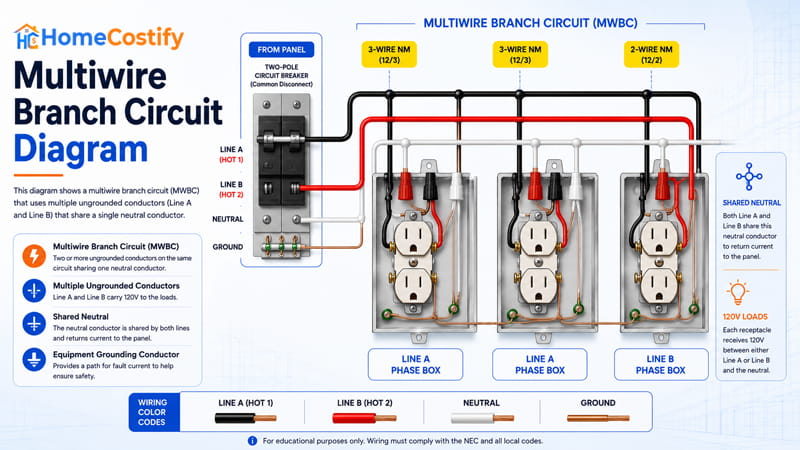
A second diagram focuses on conductor arrangement. Line A and Line B represent multiple ungrounded conductors in the configuration. A shared neutral serves both conductors, accompanied by an equipment grounding conductor.
The multiwire branch circuit shown here can continue to receptacles supplied by the conductor arrangement. Sections using 3-wire NM and 2-wire NM can be shown at the receptacle boxes, depending on the visual configuration. The multiwire branch circuit diagram therefore focuses on the relationship among Line A, Line B, neutral, and grounding conductor.
Dedicated vs. General-Purpose Branch Circuits
Household electricity can serve several everyday needs from shared supply, or serve a specific appliance on its own circuit. The practical difference comes from what the supply is intended to serve.
General-Purpose Circuits in Everyday Use
A living area can have receptacles and a light fixture supplied by the same circuit. People can plug in lamps, chargers, or small household devices at those outlets during normal use. The lighting serves the room at the same time.
A general-purpose circuit suits this pattern of shared household use. Several permitted loads draw from the circuit as occupants use the room, with the exact applications governed by applicable electrical requirements. No fixed outlet count defines the concept.
Dedicated Circuits for Specific Loads
A dishwasher, washing machine, or other appliance can have electrical requirements that call for a separate supply. Manufacturer instructions can specify circuit conditions, and applicable electrical requirements can add further provisions for the installation.
A dedicated circuit gives that appliance its own supply from the panel. Its electrical demand does not share the circuit with ordinary receptacles or room lighting. The reason for separation comes from the appliance characteristics and applicable requirements, not simply from the appliance being large.
A branch circuit serving focused equipment therefore has a different practical purpose from shared household distribution. The specific requirements for the appliance determine whether separate circuit provision is needed.
How Branch Circuit Loads and Ratings Work
A circuit rating reflects the relationship between the demand being served, overcurrent protection, and conductor capability. A breaker number or wire gauge alone does not describe the sizing decision.
What Determines the Circuit Load
An appliance can draw current intermittently, continuously, or at changing levels during operation. Its electrical demand depends on how the device operates, not simply on its presence at the end of a circuit. A motor, for example, can have operating characteristics that differ from a simple resistive device.
Continuous operation also matters. A load that runs for an extended period places a different demand on the supply than a device used briefly. For a branch circuit, the expected operating demand forms part of the information used when evaluating the circuit.
Breaker Ratings and Conductor Ampacity
The protective device limits excessive current reaching the circuit conductors. Its rating must correspond with the conductors and the demand being served.
Conductor ampacity describes how much current a conductor can carry under specified conditions. A branch circuit therefore cannot be evaluated from the breaker rating alone. Protection and ampacity have to work within the conditions governing the installation.
Why Wire Gauge Alone Does Not Determine Sizing
Wire gauge describes conductor size, but size alone does not settle conductor sizing. Ampacity can vary with installation conditions, temperature, load characteristics, and applicable requirements.
Before treating a gauge number as the answer, several factors need consideration:
- Load characteristics — the demand that the circuit must serve.
- Continuous operation — how long the demand persists under expected use.
- Conductor ampacity — current-carrying capability under specified conditions.
- Installation conditions — physical conditions that can affect ampacity.
- Applicable requirements — provisions governing the equipment and installation.
A gauge number can identify conductor size without revealing the full set of conditions used for the sizing decision.
Branch Circuit vs. Feeder
A feeder and a branch circuit occupy separate positions in the home’s power distribution. The useful boundary comes from the final overcurrent protective device, not conductor size or the amount of power carried.
| Feature | Branch Circuit | Feeder |
|---|---|---|
| Position | Downstream of final branch-circuit protection | Upstream of final branch-circuit protection |
| Primary function | Supplies utilization points | Carries supply toward downstream distribution |
| Residential use | Receptacles, lighting, appliances | Downstream panel or distribution point |
| Defining boundary | Final downstream portion serving utilization | Distribution portion ahead of final protection |
The final overcurrent protective device provides the reference for separating upstream distribution from the downstream portion. Conductor size alone does not define either category.
Where the Feeder Ends and the Branch Circuit Begins
Power moving from service equipment toward a downstream panel remains on the feeder side. The final branch-circuit overcurrent protective device marks the relevant boundary. Beyond that protective point, conductors continue to receptacles, fixtures, or utilization equipment. A branch circuit therefore occupies the downstream portion associated with electrical use. Feeder and branch-circuit conductors can carry substantial current, yet their position in the distribution system gives them separate identities.
Common Branch Circuit Applications in a Home

Household electricity reaches rooms, appliances, fixtures, and outdoor points for very different daily activities. Location and intended use shape the context around each electrical connection.
Lighting and General Receptacles
A living area needs illumination and places for portable devices to plug in. A light switch controls the fixture, whereas an electrical outlet gives occupants a connection for lamps, chargers, or small devices. A receptacle and lighting point can share a circuit when the applicable design permits such use.
Kitchen and Laundry Loads
A dishwasher or washing machine introduces a type of demand tied to a household task. Kitchen and laundry appliances can have operating characteristics that differ from portable devices used at ordinary receptacles. Circuit planning accounts for those demands and the requirements associated with the specific appliance.
Dedicated Equipment and Larger Loads
Heating and cooling systems, water heaters, electric ranges, and dryers can place substantial demands on a home’s power system. Manufacturer instructions can specify supply requirements for a particular unit. A branch circuit serving such equipment must reflect the unit’s demand and applicable requirements, with sizing handled separately.
Bathroom, Garage, and Outdoor Applications
Location changes the conditions around an electrical connection. Bathroom receptacles and lighting operate in an area where moisture is present; garages contain tools and powered devices; outdoor points face weather exposure.
- Bathroom: receptacles and lighting in an area with moisture exposure.
- Garage: receptacles used for tools or powered devices with varied operating demands.
- Outdoor: receptacles or equipment exposed to weather and environmental conditions.
Branch Circuit Wiring and Protection
A household circuit has a physical route and a safety layer. Cable, conduit, and enclosures shape the route, whereas overcurrent and ground-fault measures address abnormal conditions.
Branch Circuit Conductors and Wiring Methods
Inside walls and ceilings, insulated conductors form the path for normal current. Residential installations can place them inside cable assemblies or conduit, according to the wiring method and site conditions.
A cable assembly groups the conductors within a protective covering. Conduit encloses separate wires along a defined route. Boxes provide enclosed points for splices and terminations.
The chosen method affects how the wiring occupies wall cavities, ceiling spaces, and other permitted locations. Physical protection matters because the conductors must remain shielded from damage during normal use.
Overcurrent and Ground-Fault Protection
An excessive current condition calls for overcurrent protection. A circuit breaker can interrupt the supply when current rises beyond its intended limit. Ground faults involve another hazard, where current finds an unintended path toward ground.
GFCI protection addresses this type of fault by detecting an imbalance and interrupting power. AFCI protection serves a separate purpose related to certain arcing conditions.
The grounding system has another function. Its grounding path can carry fault current toward the source, supporting protective operation during a fault.
- Overcurrent protection: responds to excessive current through a protective device.
- Ground-fault protection: responds to certain unintended current paths involving ground.
- Grounding path: carries fault current along a safety path and is not the normal route for operating current.
Conclusion
A light can stop working even though the rest of the house still has power. The same thing can happen at a receptacle or with a particular appliance. Tracing the problem leads back to the wiring serving that point, the breaker protecting it, and the electrical load placed on the circuit. A branch circuit is part of that path, not a separate system operating on its own.
The wiring, protection, and connected load have to make sense as a set. For a homeowner, the useful questions are simple: which breaker serves the point, what is connected to that circuit, and does the wiring match the equipment and its electrical demand?
Frequently Asked Questions About Branch Circuits
What does a branch circuit mean?
A branch circuit is the portion extending from the final overcurrent protective device to an outlet or point where current serves utilization equipment.
How are branch circuits wired?
Branch circuits use conductors placed within an approved wiring method, with protective measures and connections leading to the points that use electrical power.
How many outlets are allowed on a 240V branch circuit?
A 240V rating does not set a universal outlet count. The permitted number depends on load, circuit design, equipment, and applicable requirements.
How do I install a branch circuit?
Installation requires circuit design, overcurrent protection, conductor sizing, wiring methods, and compliance with applicable NEC and local requirements. Electrical work should follow qualified professional practice.
Are multiwire branch circuits legal?
A multiwire branch circuit can be permitted when its conductor arrangement, shared neutral, protection, and installation meet applicable electrical requirements.