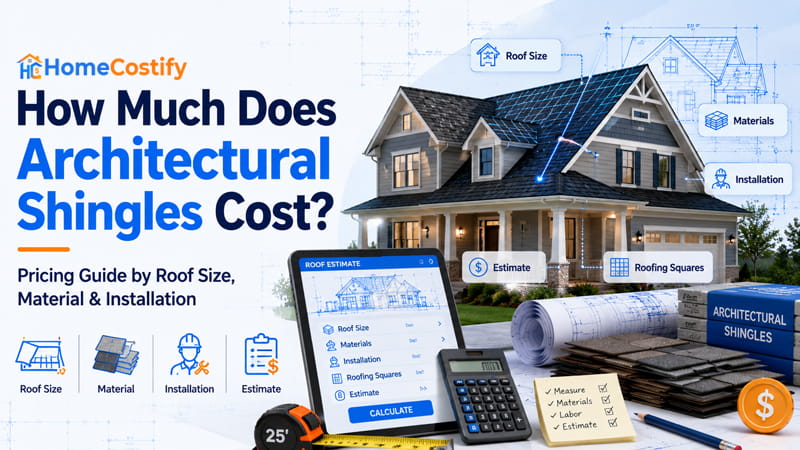
Roofing quotes often surprise people. A house with a floor plan similar to the one next door can receive a proposal that differs by thousands of dollars, making the architectural shingles cost far less predictable than the roof area alone might suggest. Square footage matters, yet it represents only one piece of a much larger calculation.
Across the United States, a complete roof replacement cost can range from moderate to premium pricing even when two homes appear nearly identical from the street.
A roofing contractor measures the roof itself, calculates material quantities, reviews the roof layout, and builds a roofing estimate around conditions that may never appear on a real estate listing. The final installed cost reflects that process, not just the home’s living area.
Regional conditions add another layer to the estimate. Labor availability, permit fees, disposal costs, and seasonal demand can all influence pricing before installation begins. Roofing proposals also vary in what they actually include.
One contractor may budget for upgraded flashing or additional ventilation, while another treats those items as optional extras. Reading beyond the final number often explains why estimates that appear similar at first produce very different totals later.
Average Architectural Shingles Cost
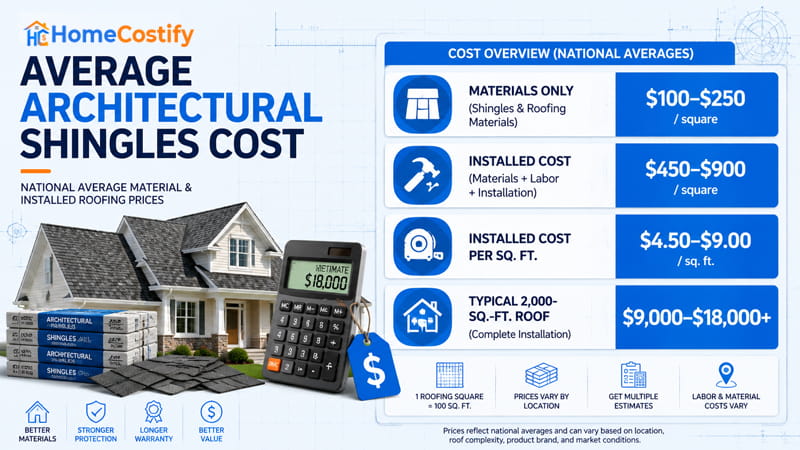
A full roof installation includes far more than shingles, so national averages offer the clearest starting point for estimating the architectural shingles cost before reviewing project-specific details.
Average Installed Cost
Across the U.S., the average architectural shingles cost falls between $450 and $900 per roofing square for a complete installation. That translates to roughly $4.50 to $9.00 per square foot, placing a typical 2,000-square-foot roof in the $9,000 to $18,000+ range.
Projects near the lower end usually involve straightforward roof layouts, standard materials, and favorable labor markets. Premium quotes commonly include upgraded shingles, additional roofing components, or larger, more intricate roof surfaces.
National averages provide a realistic reference point, although final proposals still reflect the specifications of each roofing project.
Material-only purchases require a much smaller budget. Current architectural shingles price ranges generally fall between $100 and $250 per roofing square, depending on product line, warranty level, and manufacturer. Installation expenses account for the remaining share of a completed roof replacement.
| Cost Category | Average Range |
|---|---|
| Materials Only | $100–$250 per square |
| Installed Cost | $450–$900 per square |
| Installed Cost Per Sq. Ft. | $4.50–$9.00 |
| Typical 2,000-Sq.-Ft. Roof | $9,000–$18,000+ |
The national average gives homeowners a practical benchmark before requesting local bids. For most residential projects, the architectural shingles cost lands comfortably within these ranges unless premium products or unusually complex roof layouts enter the estimate.
Material Cost vs Installation Cost
A roofing proposal combines far more than bundles of shingles. The architectural shingles cost shown on a contractor’s estimate usually reflects two broad categories: the materials delivered to the jobsite and the work required to complete the installation.
Material cost includes shingles along with the roofing products needed to finish the system. Labor cost covers the crew performing the installation from tear-off through final cleanup.
Material cost covers the shingles and the roofing products purchased for the job. Labor cost covers the crew, installation work, and cleanup after the last shingle is installed.
Accessory materials, tear-off, disposal, permit fees, and contractor overhead usually appear on the same proposal as separate line items, each adding its own amount to the final price.
Retail roofing prices often create the wrong expectation because they reflect only the products sitting on the pallet. A contractor’s quote includes everything required to finish the roof, from delivery and material handling to installation and site cleanup.
Two numbers may appear far apart even though the shingles themselves account for only part of the total bill.
| Cost Component | Typical Share |
|---|---|
| Materials | 30–40% |
| Labor | 50–60% |
| Disposal & Tear-Off | 5–10% |
| Permits & Miscellaneous | 2–5% |
For quick budgeting, most completed installations fall between $4.50 and $9.00 per square foot. Within that range, the architectural shingles cost captures both the material purchase and the work required to complete the roof from start to finish.
Architectural Shingles Cost by Roof Size
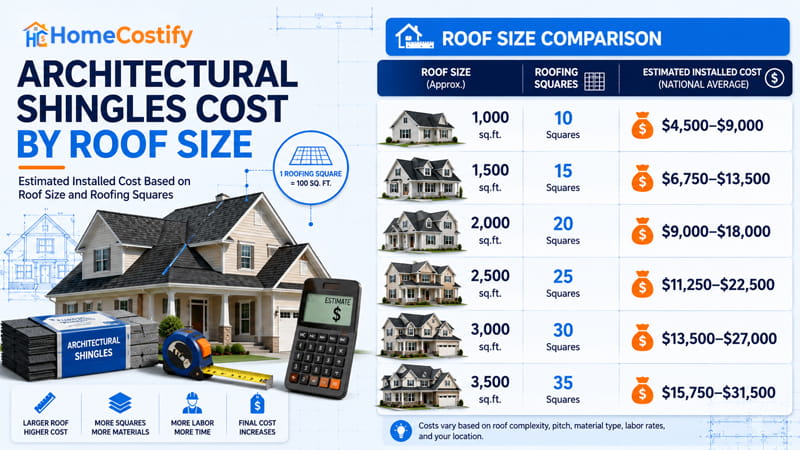
Roof size has the strongest influence on the final price because it determines how much roofing material is needed from the start. More roofing squares mean more shingles, more bundles, and a larger installation scope.
Small Homes
Smaller houses often produce the lowest roofing estimates, although the roof still needs enough material to cover waste, starter rows, ridge caps, and other standard roofing components. A 1,000-square-foot roof typically requires about 10 roofing squares, or roughly 30 bundles of architectural shingles.
Moving up to 1,200 or 1,500 square feet increases material quantities at a steady pace. The price does the same. A 1,500-square-foot roof generally requires 15 roofing squares, placing the architectural shingles cost between $6,750 and $13,500 for a complete installation based on current national averages. Using a cost per square estimate keeps the numbers consistent across different house sizes.
Medium Homes
Medium-sized homes account for a large share of residential roofing projects across the United States. Roofs measuring 1,800 to 2,500 square feet usually require 18 to 25 roofing squares, depending on the measured roof surface.
A 2,000-square-foot roof commonly needs about 20 roofing squares, equal to roughly 60 bundles of shingles. National pricing places the architectural shingles cost between $9,000 and $18,000, with an average cost per square foot of about $4.50 to $9.00 for a completed installation.
At 2,500 square feet, material quantities continue climbing in a predictable pattern. Roughly 25 roofing squares are needed, so both shingle quantities and project totals increase in nearly the same proportion.
Large Homes
Larger roofs consume material quickly. A roof measuring around 3,000 square feet usually requires 30 roofing squares, which equals about 90 bundles before any waste allowance is added.
Moving into the 3,500- to 4,000-square-foot range raises the total even further. A 3,500-square-foot roof commonly falls between $15,750 and $31,500, placing the architectural shingles cost well above the national average for smaller houses. The pattern stays remarkably consistent because roof area remains the primary driver behind material quantities.
The table below summarizes common residential roof sizes and their estimated installed price ranges.
| Roof Size | Roofing Squares | Estimated Installed Cost |
|---|---|---|
| 1,000 sq.ft. | 10 | $4,500–$9,000 |
| 1,500 sq.ft. | 15 | $6,750–$13,500 |
| 2,000 sq.ft. | 20 | $9,000–$18,000 |
| 2,500 sq.ft. | 25 | $11,250–$22,500 |
| 3,000 sq.ft. | 30 | $13,500–$27,000 |
| 3,500 sq.ft. | 35 | $15,750–$31,500 |
Why Roof Area Isn’t Always Equal to House Size
Two houses with identical living space can produce different roofing measurements. The number shown on a real estate listing reflects interior floor area, whereas a roofing estimate starts with the roof itself.
Wide eaves, attached garages, covered patios, porches, and other attached structures add roofing surface without adding much to the home’s reported square footage. From the street, the difference may appear small. A tape measure tells a different story.
Contractors calculate roofing squares from the roof’s actual footprint instead of the home’s interior dimensions. That measurement determines how much material is ordered, how bundles are counted, and where the architectural shingles cost ultimately lands.
A house listed at 2,000 square feet may require more roofing material than another house with the same living area simply because the roof covers more ground.
Architectural Shingles Material Cost by Product Type
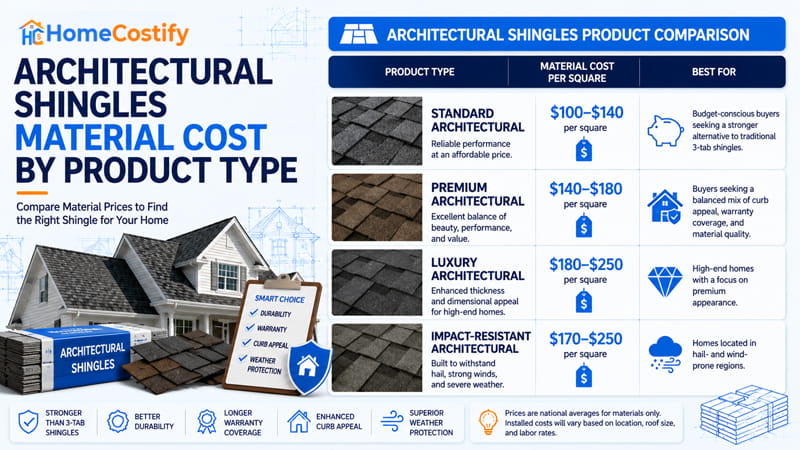
Shingle prices do not move within a single price range. Product thickness, warranty coverage, wind ratings, and impact resistance all influence architectural shingles material pricing long before a roofing crew arrives at the jobsite.
Standard Architectural Shingles
Entry-level standard architectural shingles remain the most affordable option in this category. Material prices typically range from $100 to $140 per roofing square, making them a common choice for budget-conscious roof replacements and new residential construction.
Even at the lower end of the market, these asphalt shingles offer a noticeable upgrade from traditional 3-tab products. The laminated profile creates a thicker appearance, and most manufacturers back these shingles with warranty coverage that exceeds basic roofing products. For buyers balancing price and appearance, the architectural shingles cost in this tier usually fits the widest range of budgets.
Premium Architectural Shingles
Premium product lines move into the $140 to $180 per roofing square range. The price increase often reflects thicker shingle construction, longer warranty coverage, and higher wind classifications available from major manufacturers.
These premium shingles appeal to buyers planning to stay in the same house for years or those seeking a more refined roof profile without entering the luxury category. The jump in architectural shingles cost remains moderate, making this tier one of the strongest values in today’s roofing market.
Luxury Architectural Shingles
Luxury collections sit at the top of the standard asphalt roofing market. Luxury shingles cost generally falls between $180 and $250 per roofing square, depending on the manufacturer and product series.
The visual difference becomes noticeable from the curb. Deeper shadow lines, larger laminated sections, and profiles inspired by slate or cedar create a high-end appearance that standard products cannot easily match. For upscale homes, the higher architectural shingles cost often reflects aesthetics as much as material construction.
Impact-Resistant Architectural Shingles
Impact-resistant shingles usually cost $170 to $250 per roofing square, placing them close to luxury products in material pricing. Most carry a Class 4 impact rating, making them a popular choice across regions where hailstorms occur frequently.
Insurance carriers in some areas may offer premium discounts after qualifying products are installed, although eligibility varies by insurer and location. Insurance discounts available in some states can offset part of the added material expense over time.
| Product Type | Material Cost per Square | Best For |
|---|---|---|
| Standard Architectural | $100–$140 | Budget-conscious buyers seeking a stronger alternative to traditional 3-tab shingles. |
| Premium Architectural | $140–$180 | Buyers seeking a balanced mix of curb appeal, warranty coverage, and material quality. |
| Luxury Architectural | $180–$250 | High-end homes with a focus on premium appearance. |
| Impact-Resistant Architectural | $170–$250 | Homes located in hail- and wind-prone regions. |
Why Impact Ratings Affect Price
Impact ratings reflect more than a product label printed on the packaging. Manufacturers submit asphalt shingles to standardized testing that measures wind uplift and impact resistance under controlled conditions.
Higher-rated products often use thicker laminates, reinforced construction, or modified asphalt formulations, all of which add manufacturing cost before the shingles reach a distributor.
The Asphalt Roofing Manufacturers Association (ARMA) notes that asphalt shingles are evaluated under ASTM D7158 and may receive Class D, G, or H wind classifications based on resistance to wind uplift.
Products earning higher classifications typically require more robust engineering and construction methods, which is one reason material prices climb as ratings increase.
What Affects Architectural Shingles Cost?
Two roofs with the same square footage can still receive very different proposals. Measurements may match, yet the work required to complete each roof often does not. That is where the architectural shingles cost begins to separate, long before a written roofing estimate reaches the customer.
Roof Pitch
A steeper roof pitch changes the pace of the job from the first day on site. Crews move more carefully, additional safety equipment becomes part of the setup, and carrying bundles across a steep surface takes more time than working on a low-slope roof.
Contractors account for those conditions when preparing an estimate. The roof may require the same number of shingles as a neighboring house, yet the architectural shingles cost can move upward because the installation demands more labor hours to complete safely.
Roof Complexity
Simple roof layouts keep material planning fairly predictable. Extra valleys, hips, dormers, skylights, and chimneys change that calculation almost immediately.
Every cut creates waste. Every roof intersection calls for more measuring, trimming, and waterproof detailing. Flashing requirements also increase around roof penetrations, leaving fewer full shingles and more custom cuts. As the roof layout becomes more intricate, the architectural shingles cost often climbs even if the measured roof area remains similar.
Existing Roof Removal
Older roofing materials rarely disappear without affecting the budget. A complete tear-off produces truckloads of debris that must be removed from the site and transported to an approved landfill.
Some roofs have a single layer of shingles. Others hide two or even three layers installed decades apart. Extra material adds weight, extends removal time, and increases disposal charges. Those items become part of the estimate before the first bundle of new shingles reaches the roof, pushing the architectural shingles cost beyond the price of new materials alone.
Roof Deck Repairs
The condition of the roof surface stays hidden until the old shingles come off. Rotten plywood, damaged OSB, or moisture-damaged roof decking often remains invisible during an inspection from the ground.
A contractor cannot fasten new shingles onto weak sheathing. Damaged panels must be replaced before the roofing system moves forward. The amount of repair varies from one house to another, which is why the architectural shingles cost sometimes changes after demolition reveals hidden damage beneath the old roof.
Regional Labor Costs
Roofing prices rarely move at the same pace across the country. Local labor rates, contractor availability, and seasonal demand all shape the numbers appearing on a proposal.
A city experiencing heavy storm activity may see roofing schedules fill weeks in advance. Busy seasons also place additional pressure on contractor schedules across regions where roof replacements peak during warmer months.
The same roofing specification can produce noticeably different estimates from one market to the next, even with identical material selections. Local conditions remain a major piece of the architectural shingles cost calculation.
Factors that commonly increase total project costs include:
- Steep roof slopes: Extra safety equipment, slower movement across the roof, and longer installation time increase labor requirements.
- Multiple roof features: Dormers, valleys, hips, and skylights create more cuts, more flashing work, and additional material waste.
- Hidden deck damage: Rotten sheathing often appears only after the old roofing has been removed, creating repair work that was impossible to measure earlier.
- Premium accessories: Upgraded underlayment, flashing, ridge ventilation, and related roofing components add material cost before the roof is finished.
Why Professional Installation Matters
Roofing materials are only part of the finished system. Nail placement, shingle alignment, sealing conditions, flashing details, and weather during installation all influence how the roof performs after the project is complete.
Research published by the Insurance Institute for Business & Home Safety (IBHS) notes that asphalt shingles develop long-term wind resistance through proper sealing after installation.
Roof slope, weather conditions, and workmanship all affect that process, making architectural shingles installation quality just as meaningful as the roofing products selected for the job.
For that reason, contractors evaluate the work involved as carefully as the materials themselves when preparing an estimate.
Architectural Shingles Cost by Roofing Square and Bundle
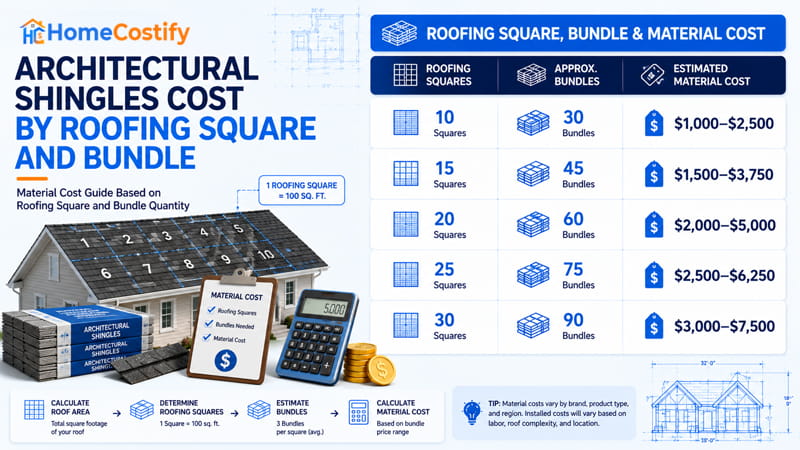
Roofing materials are purchased using two measurements that rarely appear in real estate listings: the roofing square and the bundle. Contractors build material estimates around those units, and manufacturers package shingles the same way.
Cost Per Roofing Square
A roofing square represents 100 square feet of roof surface. Material suppliers, manufacturers, and contractors all use this measurement when pricing asphalt shingles, so it serves as the standard unit across the roofing industry.
Current material pricing places the architectural shingles cost between $100 and $250 per roofing square, depending on the product line. A complete roof installation usually falls between $450 and $900 per roofing square, although the installed figure includes far more than the shingles themselves.
Estimating by the square also keeps material quantities consistent. A roof requiring 20 squares needs twice as much roofing material as a roof measuring 10 squares. That calculation remains the same no matter which manufacturer supplies the shingles.
Cost Per Bundle
Shingles arrive on pallets, but they are sold in bundles. Most laminated products require three bundles per square, making bundle counts just as useful as square counts during material planning.
The architectural shingles cost per bundle generally falls between $33 and $85, reflecting the same material range shown on a per-square basis. Entry-level products sit near the lower end of the range. Premium collections, impact-rated shingles, and luxury lines move toward the upper end.
Package size also changes from one product line to another. Heavier shingles may contain fewer pieces in each bundle even though the coverage remains close to one-third of a roofing square. Checking the manufacturer’s coverage information avoids ordering too little material.
How Many Bundles Does a Typical Roof Need?
Bundle counts increase in a simple pattern because each roofing square requires about three bundles. A roof measuring 15 squares typically uses 45 bundles. Moving to 20 squares raises that figure to roughly 60 bundles, and 25 squares brings the total close to 75 bundles.
Contractors rarely order the exact number needed to cover the roof surface. A small waste allowance is usually added for starter rows, ridge caps, valleys, and trimmed shingles. That extra material keeps the installation moving without unexpected shortages after work has already started.
Bundle totals also create a quick way to estimate the architectural shingles cost before requesting quotes. Multiply the expected number of roofing squares by three, then apply current bundle pricing. The result provides a realistic material budget long before the full estimate is prepared.
| Roofing Squares | Approx. Bundles | Estimated Material Cost |
|---|---|---|
| 10 | 30 | $1,000–$2,500 |
| 15 | 45 | $1,500–$3,750 |
| 20 | 60 | $2,000–$5,000 |
| 25 | 75 | $2,500–$6,250 |
| 30 | 90 | $3,000–$7,500 |
Moving from bundles to roofing squares also explains how contractors build material estimates. Count the roof in squares first, convert that figure into bundles, then calculate the architectural shingles cost using current material pricing.
Every proposal follows that same sequence, even though customers usually see only the finished total.
How Much Does a Bundle of Architectural Shingles Weigh?
Anyone asking how much does a bundle of architectural shingles weigh will usually find a range between 60 and 80 pounds. Premium products can weigh even more because thicker laminates and reinforced construction add extra material to every bundle.
Weight matters long before the first shingle reaches the roof. Delivery crews unload hundreds of bundles during large projects, and roofing suppliers often use boom trucks or conveyor equipment to move pallets into position.
A 20-square roof may require about 60 bundles, turning a single delivery into well over two tons of roofing material.
Bundle weight, bundle count, and roofing squares all connect to the same estimate. Once those numbers are clear, the architectural shingles cost becomes much easier to verify from supplier pricing or contractor proposals.
How Contractors Estimate Architectural Shingles Cost
A roofing proposal does not begin with a price per square foot. Contractors build the numbers piece by piece, adding measurements, material quantities, and project requirements until the full picture is complete.
Following that same sequence gives far more insight into the architectural shingles cost than reading the final total alone.
Step 1 — Measure the Roof
The first visit usually starts with roof measurements, not material catalogs. Contractors measure the roof’s actual surface, including overhangs, porches, attached garages, and every roof section visible from above. Interior living space stays out of this calculation because shingles cover the roof, not the floor below.
Each roof section is measured separately. A house that appears simple from the driveway may include small extensions or rear sections that add hundreds of square feet to the finished measurement. Every added section moves the architectural shingles cost higher because more roofing material is required.
Step 2 — Convert Measurements Into Roofing Squares
After measuring the roof, contractors convert the total area into roofing squares. One square represents 100 square feet of roof surface, creating a standard unit for ordering shingles and preparing a contractor estimate.
The calculation does not stop there. A waste factor is added to cover trimmed shingles, starter rows, ridge caps, valleys, and other sections where full shingles cannot be used. Simple roof layouts require less extra material. Roofs filled with angles and intersections consume more.
By this point, the material quantity has already been established.
Step 3 — Select the Roofing System
Shingles make up only one portion of the material order. Contractors also count underlayment, starter strips, ridge caps, flashing, drip edge, ventilation products, and other roofing accessories listed in the proposal.
Each selection changes the material total. Premium underlayment carries a different price than standard felt. Flashing replacement may cover one chimney or multiple roof penetrations.
Ridge ventilation may already exist on one roof and be added to another. Each selection increases the material total before the project starts.
Step 4 — Calculate Labor and Additional Costs
Material quantities are only half of the worksheet. The remaining columns cover the work required to complete the project from demolition through cleanup.
A labor estimate includes roof removal, debris disposal, permit fees, equipment, and installation. Ice and water shield, replacement flashing, or minor roof deck repairs may also appear if they are expected during the project.
Once every line item has been entered, the contractor combines those figures into the final proposal. The finished proposal reflects every item on the worksheet.
Example Contractor Estimate Workflow
| Step | What’s Included |
|---|---|
| Roof Measurement | Measure the roof’s actual surface area, including overhangs, attached garages, porches, and every roof section that requires shingles. |
| Roofing Squares | Convert the measured area into roofing squares and include a waste allowance based on valleys, hips, dormers, and roof layout. |
| Material Selection | List the shingles, underlayment, starter strips, ridge caps, flashing, ventilation products, and related roofing materials. |
| Labor | Prepare the labor estimate using installation time, tear-off requirements, site access, and local labor pricing. |
| Accessories | Add permits, disposal fees, drip edge, flashing replacement, ice and water shield, ventilation upgrades, and roof deck repairs if needed. |
| Final Estimate | Combine material totals, labor, accessories, and project charges into one completed roofing estimate. |
Following this sequence also explains why two proposals may differ even though both contractors recommend the same shingles. One estimate may include replacement flashing, upgraded underlayment, and additional roof repairs from the beginning.
Another may list only the base scope of work. Reading each line item reveals where the architectural shingles cost comes from instead of leaving it as a single number at the bottom of the page.
Architectural Shingles Cost by Brand
Brand names appear on almost every roofing estimate, and the price gap between them is not random. Product construction, warranty coverage, wind ratings, algae resistance, and specialty product lines all influence the architectural shingles cost before the first bundle reaches the supplier.
Budget-Friendly Brands
TAMKO Heritage and GAF architectural shingles often sit near the lower end of national material pricing. TAMKO Heritage generally ranges from $90 to $115 per roofing square, making it a familiar choice for cost-conscious roof replacements and builder-grade projects.
GAF Timberline HDZ usually falls between $95 and $120 per roofing square. The difference in price is modest, yet GAF products are available through a broad network of roofing suppliers and contractors across the country.
That wide availability makes them one of the most frequently quoted products in residential roofing. Buyers searching for a competitive architectural shingles cost often find both brands appearing on local estimates.
Mid-Range Brands
The middle tier includes Owens Corning Duration and Atlas Pinnacle Pristine. Owens Corning commonly sells for $100 to $125 per roofing square, with Atlas remaining close behind at $100 to $130.
Owens Corning stands out for its color selection and strong wind ratings across much of the product line. Atlas attracts attention for algae-resistant technology, a feature that appeals to homes located in warm, humid climates where dark roof streaks tend to appear over time.
Material prices remain close enough that regional availability often has just as much influence on the final purchase decision as the price tag itself.
Premium Roofing Brands
Higher-priced products include CertainTeed Landmark and Malarkey Vista. CertainTeed commonly ranges from $110 to $140 per roofing square, followed by Malarkey Vista at approximately $120 to $145.
The difference is visible long before warranty documents come into the conversation. CertainTeed shingles typically feature heavier laminated construction, creating a thicker roof profile once installed.
Malarkey uses SBS-modified asphalt in the Vista line, giving the shingles added flexibility and stronger impact resistance for areas that experience frequent hail or severe weather.
Buyers comparing premium products often weigh those construction differences alongside the best architectural shingles, not the price tag alone.
| Brand | Typical Material Price per Roofing Square | Warranty* | Best For |
|---|---|---|---|
| GAF (Timberline HDZ) | $95–$120 | Limited Lifetime | Dependable roofing products with broad contractor availability. |
| Owens Corning (Duration) | $100–$125 | Limited Lifetime | Strong wind ratings and a wide selection of color options. |
| CertainTeed (Landmark) | $110–$140 | Limited Lifetime | Thicker laminated shingles and premium material quality. |
| Atlas (Pinnacle Pristine) | $100–$130 | Limited Lifetime | Homes in humid regions where algae resistance is a priority. |
| Malarkey (Vista) | $120–$145 | Limited Lifetime | Areas exposed to hail and severe weather requiring SBS-modified asphalt. |
| TAMKO (Heritage) | $90–$115 | Limited Lifetime | Budget-focused roof replacements and builder-grade residential projects. |
Material pricing tells only part of the story. One brand may emphasize algae resistance, another may focus on thicker laminated construction, and another may prioritize impact resistance for storm-prone regions.
Those engineering differences separate one product line from another far more than appearance alone. Giving buyers more to compare than the dollar amount printed on the estimate.
Architectural Shingles Replacement Cost vs. Repairs Cost
A few missing shingles do not always lead to a full roof replacement. The condition of the roof, the extent of the damage, and the remaining service life usually point toward the more practical choice. Viewing the roof as a whole often prevents unnecessary spending.
When Roof Replacement Makes More Sense
Age changes the equation. A roof nearing the end of its service life may continue to develop new trouble spots even after isolated repairs are completed. Fresh shingles installed beside weathered ones can also create noticeable color differences across the roof.
Widespread granule loss, curling edges, recurring leaks, or damage spread across multiple roof sections often indicate a larger issue than a single repair can address.
In that situation, the architectural shingles replacement cost may deliver better value over the coming decades because the roof starts over with a full roofing system instead of scattered patches. Upfront spending increases, yet repeated repair bills often disappear afterward. yet repeated repair bills often disappear afterward.
When Repairs May Be Enough
Smaller problems usually call for a much smaller project. Wind may lift a few shingles, flashing around a vent pipe may loosen, or a fallen branch may damage one section without affecting the rest of the roof.
In cases like these, the architectural shingles repairs cost is often limited to replacing damaged shingles or repairing the affected flashing. Color matching is usually less noticeable on newer roofs, particularly when the same product line is still available from the manufacturer.
A localized repair can return the damaged area to good condition without replacing the full roof. Material use stays limited, the scope of work remains small, and the final project total is far lower than a complete roof replacement.
Common signs that a full replacement often delivers better long-term value include:
- Widespread shingle wear across multiple roof sections.
- Repeated leak repairs within a relatively short period.
- Rotten or damaged roof decking uncovered during inspection.
- A roof nearing the end of its expected service life.
Architectural Shingles Lifespan and Long-Term Value
Years of service often have a much greater influence on the real value of a roof, especially for owners planning to stay in the same house well into the future.
Typical Lifespan by Product Category
The architectural shingles lifespan varies across product tiers. Standard laminated shingles commonly last 20 to 30 years under normal conditions.
Premium products often remain in service for 30 to 40 years, and top-tier products installed under favorable conditions may continue performing for 50 years or longer.
| Product Category | Typical Lifespan |
|---|---|
| Standard | 20–30 Years |
| Premium | 30–40 Years |
| Ideal Conditions | Up to 50 Years |
A longer service life spreads the original architectural shingles cost across more years of use. Viewed from that perspective, a higher purchase price does not always translate into a higher annual ownership cost.
What Shortens Roof Life?
Time alone does not determine the condition of a roof. Poor attic ventilation, installation mistakes, hailstorms, strong winds, falling tree limbs, and neglected maintenance can shorten the architectural shingles life expectancy well before the manufacturer’s projected service range.
Small issues also tend to build over time. Loose flashing may admit water during heavy rain. Debris trapped in roof valleys can slow drainage. Damaged shingles left in place through multiple seasons often expose surrounding materials to additional wear.
Lifetime Value vs Initial Price
Choosing the least expensive shingles does not always produce the lowest lifetime roofing expense. A product that remains in service for decades spreads its purchase price across a much longer period than one requiring replacement much sooner.
Viewing the roof in terms of annual ownership cost often paints a clearer picture. A higher purchase price may still produce better long-term value if the roof delivers years of dependable service before another replacement becomes necessary.
Choosing Architectural Shingles Colors Without Overspending
Color influences more than curb appeal. It also affects how the roof complements the house, nearby homes, and neighborhood requirements. In most cases, color alone does not create a large jump in material pricing, although specialty finishes can change the final number.
Do Colors Affect Cost?
Most architectural shingles colors fall within the same price range. Black, gray, brown, and weathered wood blends are widely available across standard product lines, so selecting one of those shades rarely changes the material budget.
Premium color blends tell a different story. Multi-tone finishes, high-definition color patterns, and reflective “cool roof” products often belong to higher product lines, bringing a higher material price with them. The difference usually comes from the product series, not the pigment itself.
Choosing the Right Color for Your Home
Climate deserves a place on the checklist. Lighter shades may reflect more sunlight in warmer regions, whereas darker colors remain a common choice across colder climates.
Neighborhood rules deserve equal attention. Some HOA communities limit acceptable roof colors, leaving fewer choices than buyers expect. Resale value also enters the conversation.
Neutral colors tend to appeal to a broader range of buyers, especially in neighborhoods where bold roof colors are uncommon. Matching the roof to the home’s exterior finishes usually creates a cleaner appearance that ages well.
Conclusion
Roofing estimates become much easier to evaluate once the numbers are broken into smaller pieces. Roof measurements, roofing squares, material selection, brand, roof layout, and project conditions each leave a visible mark on the final proposal.
Comparing bids also becomes more meaningful after reviewing what each contractor includes. One quote may cover upgraded underlayment, replacement flashing, or roof deck repairs from the beginning, whereas another may leave those items for later. Reading beyond the total price often reveals where the difference comes from.
The lowest bid is not always the strongest value. A complete estimate, quality materials, and a clearly defined scope of work usually create a better outcome than choosing the smallest number on the page.
Using that process to evaluate the architectural shingles cost gives you a stronger foundation for selecting the right roofing contractor and avoiding costly surprises after work begins.
FAQs About Architectural Shingles Cost
Are architectural shingles worth it?
For many roofs, yes. Architectural shingles typically deliver a thicker appearance, longer service life, and stronger wind ratings than traditional 3-tab shingles, making the higher purchase price worthwhile for long-term ownership.
How much is 20 squares of architectural shingles?
Material costs for 20 roofing squares generally range from $2,000 to $5,000. A professionally installed roof of the same size commonly falls between $9,000 and $18,000, depending on the project scope.
Are architectural shingles more expensive than 3-tab shingles?
Yes. Laminated construction, heavier materials, and longer expected service life place architectural shingles above standard 3-tab products in both material price and installed architectural shingles cost.
What is the average cost for a bundle of architectural shingles?
A bundle typically costs $33 to $85, depending on the manufacturer and product line. Most roofs require approximately three bundles to cover one roofing square.
Can I install architectural shingles myself?
Experienced DIYers may handle small roofing projects, but full roof replacements demand accurate measurements, specialized tools, and careful installation. Most manufacturers also require installation that follows published specifications for warranty coverage.