How long does a metal roof last in practice? A typical installation has a service life of about 40–70 years. Construction quality and accumulated exposure can push some systems beyond this span. The figure represents an expected service period, not a fixed expiration date.
Forty years on the calendar does not automatically signal failure. Metal roof lifespan is shaped by the condition reached after years of exposure, so roofs of similar age can reach different stages of service life.
The metal panel forms the visible surface, but weather protection also involves fasteners, sealants, flashing, seams, and coatings. These components face wear at different rates.
Within a metal roofing system, failure at a vulnerable connection or detail can compromise weather-tightness before the main panel reaches its material limit.
How Long Does a Metal Roof Last?

The 40–70-year figure describes an expected service window, not a scheduled endpoint. Its practical meaning comes from the installed assembly and its accumulated exposure. Reaching the upper end of the period does not automatically signal the end of useful service.
| Age | What it generally means | What can change the outcome |
|---|---|---|
| Around 40 years | Serviceable performance can still be present, with accumulated wear warranting closer attention. | Exposure, component condition, installation quality, maintenance |
| Around 50 years | A well-cared-for system can still have useful service ahead. | Corrosion, coating condition, fasteners, weather exposure |
| Around 60 years | The roof sits near the upper portion of the commonly cited lifespan range. | Material, system design, climate, component aging |
| 70+ years | Service beyond the common range is possible under favorable conditions. | System condition, environmental severity |
Decades of exposure leave physical evidence a calendar number cannot show. Metal roofing lifespan therefore covers a broad span of real-world outcomes. Surface wear, connection condition, and weather-sealing details can progress at different rates across a finished installation.
The phrase metal roof life expectancy refers to a projected period, not a field measurement. Actual metal roof service life concerns performance under real weather exposure and the condition of the assembly. A surface can still look sound while weather protection elsewhere has weakened.
The life span of metal roof gives useful age context. Metal roof condition supplies the physical evidence needed to judge current performance. A 45-year-old roof with sound weather protection can be in better shape than a 35-year-old installation showing serious deterioration.
Metal Roof Lifespan by Material
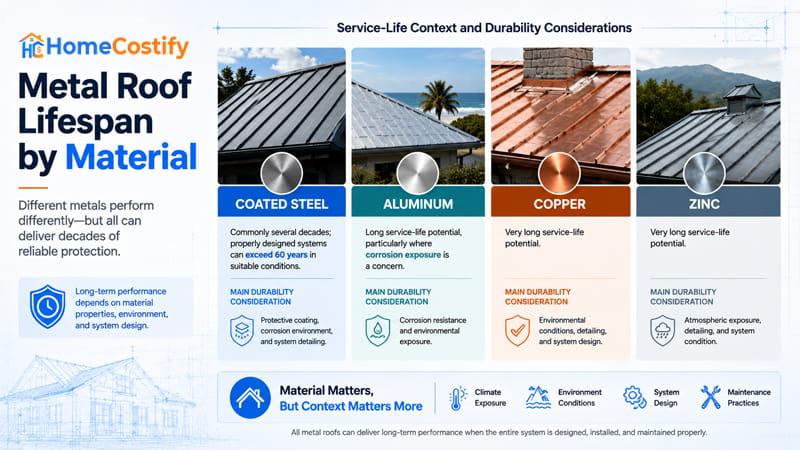
The metal chosen for a roof affects how its surface responds to moisture, corrosion, and atmospheric stress. Material selection shapes the durability profile, but it cannot set a fixed lifespan for the finished roof.
| Metal material | Typical lifespan context | Main durability consideration |
|---|---|---|
| Coated steel | Several decades; comparable systems can exceed 60 years under suitable conditions | Protective coating, corrosivity, detailing |
| Aluminum | Long-term performance, especially where corrosion is a concern | Corrosion resistance, environmental severity |
| Copper | Very long lifespan potential | Atmospheric conditions, detailing, system design |
| Zinc | Very long lifespan potential | Atmospheric conditions, detailing, system condition |
Steel Metal Roofs
Steel is a major category within metal roofing. Among common metal roofing material types, coated steel can deliver decades of use when protective measures and construction practices are appropriate. MCA research found an expected lifespan exceeding 60 years for comparable unpainted 55% Al-Zn coated steel standing-seam systems built using best practices.
Steel roofing needs effective corrosion protection across its exposed surface. A weakened protective layer leaves the substrate under greater corrosive stress. Atmospheric severity and detailing can add to metal roof corrosion. Fasteners, joints, and other vulnerable areas can deteriorate before broad sheet surfaces show substantial wear.
Aluminum Metal Roofs
Aluminum naturally resists corrosion across many roofing environments. Metal roofing lifespan for aluminum benefits from this property where moisture and salt exposure persist. An aluminum roof can perform well in coastal settings, although harsh marine conditions still require appropriate roofing material selection.
Corrosion resistance does not settle the question of aluminum roof lifespan by itself. Fasteners, seams, flashing, and finishes face their own environmental stresses. Metal roof corrosion resistance describes the primary metal’s behavior; aluminum roof life expectancy concerns the finished roof and its vulnerable details.
Copper and Zinc Roofs
Copper and zinc belong to roofing metals with extended longevity potential. Their surface behavior gives copper roofing lifespan and copper roof lifespan a profile distinct from coated steel. Metal roof life expectancy for these materials still rests on atmospheric conditions and detailing.
A long potential lifespan does not make zinc roof lifespan predictable from the metal specification alone. Zinc roofing lifespan also reflects the quality of surrounding details and component compatibility. A long lasting metal roof needs sound detailing at joints and interfaces. Metal roof longevity ultimately comes from how the chosen metal performs within its finished construction.
Material selection sets the durability potential of a roof. Components, detailing, and weather protection determine how well an installed system carries that potential. A material name alone cannot define the practical life span of a metal roof.
Metal Roof Lifespan by Roof Type

Panel configuration changes the locations of fasteners, seams, and thermal movement. Metal roofing lifespan is partly shaped by these system details. Concealed connections leave fewer attachment points directly exposed to rain.
| Roof type | Longevity context | Main consideration |
|---|---|---|
| Standing seam metal roof | About 50–70+ years; MCA cites five to ten decades | Concealed clips, thermal movement, seam detailing |
| Exposed-fastener metal roof | Decades are possible | Screws, washers, gaskets, connection exposure |
| Corrugated/ribbed panels | Decades are possible | Profile, fastening arrangement, drainage |
Standing Seam Metal Roofs
Concealed clips attach the panels at the seams, keeping fastening points out of direct weather exposure. MCA describes standing seam metal roofing with concealed clips and few fastening penetrations. Metal roofing lifespan can benefit from fewer exposed connections.
Panels expand during heating and contract during cooling. The attachment method must accommodate it; rigid restraint can stress seams or connection details. The life span of metal roof includes movement capacity within the metal roofing system.
Exposed-Fastener Metal Roofs
Screws pass through the sheet in an exposed fastener metal roof, leaving heads, washers, and gaskets at weather-facing locations. Metal roof fasteners carry a significant connection burden. MCA guidance calls for fasteners with performance equal to or exceeding the roof they serve.
Repeated movement can stress attachment points. MCA documents elongated screw holes and cracked ridge caps from exposed fastening. A screw-down metal roof warrants attention at connection areas.
Corrugated and Ribbed Metal Panels
A corrugated metal roof takes its performance from panel shape and fastening arrangement. MCA documents a 20-gauge example serving from 1938 to 2008. The case spans about 70 years, but it does not set a universal lifespan. Metal roofing dimensions describe specification variables, with drainage affecting performance.
Roof configuration changes how forces and rain reach vulnerable details. Concealed connections, exposed hardware, and ribbed profiles present distinct mechanical demands. Roof type describes a configuration, not a guaranteed lifespan.
How Climate and Weather Affect Metal Roof Lifespan
Salt, sunlight, dampness, and severe storms place distinct environmental pressures on a roof. Metal roof lifespan can face greater stress when these forces occur frequently or persist for long periods. The effect comes from the type, duration, and severity of the environmental pressure reaching the roofing surface and its vulnerable details.
Coastal and Salt-Air Environments
Salt-laden moisture reaches surfaces near the coast and can intensify corrosion pressure. Metal roof salt air introduces chloride-rich moisture to exposed areas. Coastal metal roof corrosion becomes a concern when dampness persists. Metal roof corrosion resistance can reduce this pressure, but coastal location alone does not set a fixed lifespan.
Hot and Sunny Climates
Strong sunlight brings prolonged UV radiation to the surface. Metal roof UV exposure can weather finishes after repeated solar loading. Metal roof sun exposure also drives heating and cooling. Metal roof temperature changes produce expansion and contraction, placing movement demands on seams and fasteners.
Humid and Rainy Climates
Annual rainfall totals tell little about how long a surface stays wet. Metal roofing lifespan can be affected by humidity and dew formation. Nighttime dew can extend wet periods after precipitation stops. Metal roof humidity matters alongside rainfall totals, with metal roof moisture exposure tied to wetness duration.
MCA guidance gives wetness duration significant weight when assessing service life. Its technical material cites bare G-90 steel roofs in dry, desert-like settings remaining in good condition after 50–60 years. Humid settings can produce frequent wetting near the dew point. The example applies to its stated environment, not to every G-90 roof.
Snow, Wind, Hail, and Severe Weather
Snow and ice add loading and moisture stress. High winds can act on panels, flashing, and fastening areas. Hail and debris can strike finishes or produce localized defects. Metal roof storm damage can alter practical performance. Metal roof wind damage and metal roof hail damage can affect metal roof life expectancy without signaling failure.
Environmental Conditions That Matter
- Salt-laden moisture: Raises corrosion pressure on susceptible surfaces.
- Wetness duration: Dampness can matter beyond annual rainfall totals.
- UV and thermal cycling: Sunlight and temperature changes bring finish and movement stress.
- Severe weather: Storm events can produce localized defects without ending useful performance.
Frequency, duration, and severity give a clearer climate profile than a regional label.
What Factors Determine How Long a Metal Roof Lasts?

The installed system faces the environmental pressures described earlier through its workmanship, surface protection, inspection history, and component condition. These factors shape metal roof life expectancy, especially when small weaknesses develop at exposed details.
Installation Quality
Workmanship sets the starting condition for weather-tightness. Accurate fastening, sound flashing, sealed penetrations, and properly formed seams matter when installing metal roofing. Metal roof installation quality is visible in details such as metal roof flashing and water-shedding paths.
A weak detail can form a water-entry path at a seam or penetration. Metal roof seam problems can then introduce localized deterioration, with metal roof premature failure developing before the broader surface reaches its expected service period. This affects where actual metal roof lifespan falls within its potential range.
Protective Coatings and Finish
The exposed finish takes the first impact from sunlight and weather. Metal roof coating protects the surface, and finish color can influence how metal roofing colors age visually. Chalking and fading provide clues about surface wear. The metal roof finish does not, by appearance alone, establish the panel’s remaining service period.
Visible wear does not automatically mean structural failure. Metal roof coating deterioration matters when protective performance or weather-tightness has been affected. Metal roof coating lifespan therefore cannot be judged from fading alone.
Maintenance and Inspection
An inspection can reveal debris, drainage trouble, loose fasteners, damaged flashing, seam defects, or visible corrosion. Maintenance and inspection bring these findings into view before a localized problem affects nearby components.
A practical maintenance schedule supports early detection. Prompt attention to a small defect can limit wider deterioration. Delayed action can also increase metal roofing repair cost when damage reaches nearby components. Preventive maintenance cannot stop natural aging, but it can bring trouble to light sooner.
Corrosion and Component Deterioration
Fasteners, seams, penetrations, and flashing can develop metal roof corrosion in localized areas. Localized corrosion does not automatically indicate failure across the broad surface.
Sealants and attachment hardware can reach their limiting condition ahead of the main panels. Metal roofing lifespan then becomes a question of weather-tightness at vulnerable details. Metal roof premature corrosion can restrict practical service life when deterioration spreads across multiple connection areas.
How Metal Roofs Age Over Time
A defect at a penetration or drainage detail can surface during the early service period. Material age does not explain every problem found during this phase. Fastening trouble, blocked drainage, or weak detailing can produce visible defects before substantial wear develops.
Mid-life wear tends to spread across several physical elements. Finish weathering progresses gradually, and sealants or fasteners can lose performance with continued use. The metal roofing lifespan can still include useful service during this phase, even with localized wear or corrosion. Functional weather protection does not require every component to remain in its original condition.
Recurring water intrusion matters when deterioration extends across multiple areas. Repeated leaks point to an ongoing performance problem, not merely cosmetic wear. Broad corrosion and failing components can weaken weather-tightness across the assembly. Calendar age alone cannot show how far the decline has progressed.
A Metal Construction Association assessment examined 14 low-slope, unpainted 55% Al-Zn alloy-coated steel standing-seam roofs across the United States. The roofs had up to 35 years of service, and comparable systems built using best practices were projected to exceed 60 years. Sealants and ancillary components could influence system end-of-life.
The study has a narrow scope, so its projection cannot represent every roofing application. Its value lies in showing how metal roofing service life is assessed at system level. The main panel is only part of the evidence; ancillary components can influence when reliable weather protection is lost.
Signs a Metal Roof Is Starting to Age
A visible defect does not automatically signal the end of useful service. Metal roof life expectancy is better judged through location, severity, recurrence, and any effect on weather protection.
- Localized rust or corrosion. A small discolored area can indicate material deterioration. Expansion around the affected spot deserves attention, particularly near seams, penetrations, or other vulnerable details.
- Deteriorating coating. Chalking, fading, and visible wear point to finish aging. Such changes alone do not prove that the underlying panel has failed.
- Loose or deteriorated fasteners. Screws, washers, or attachment points showing movement or wear deserve attention. A weakened connection can affect the intended weather barrier.
- Damaged flashing or seams. A compromised edge detail can form a localized path for water entry. Broad panel surfaces can still look sound when trouble is concentrated around a seam or flashing area.
- Recurring leaks. Repeated water intrusion carries greater significance than an isolated event. Recurrence can signal an unresolved condition affecting weather-tightness.
- Panel distortion or storm damage. Dents, bends, or displaced sections can alter water flow across the surface. Localized impact does not automatically indicate failure across the full assembly.
A symptom needs context before it supports a conclusion. For metal roofing life expectancy, the useful questions concern where deterioration occurs, how severe it is, whether it returns, and how broadly it extends. A metal roof inspection can separate a localized defect from wider performance concerns.
What Can Shorten or Extend a Metal Roof’s Lifespan?
Long-term durability comes from how material choice, workmanship, exposure, upkeep, and component condition interact. Metal roofing cost also enters the decision, since upfront spending carries different value when a system serves for decades.
- Poor detailing. Weak joints, penetrations, flashing, or fastening details can introduce vulnerable points. Water intrusion at those locations can push deterioration toward the shorter end of the expected service period.
- Persistent moisture. Prolonged dampness places sustained pressure on susceptible surfaces. Extended wetness can accelerate corrosion where environmental conditions are demanding.
- Neglected inspection. A small defect can spread when it goes unnoticed. Delayed attention gives deterioration time to affect nearby areas and turn a localized concern into broader performance trouble.
- Aggressive exposure. Salt-laden air, severe storms, and demanding surroundings place greater stress on exposed elements. Repeated environmental pressure can shorten practical service.
- Appropriate maintenance. Timely inspection and attention to localized defects can preserve weather protection. Metal roofing life expectancy still has natural limits, yet prompt care can reduce the consequences of manageable deterioration.
Upkeep can preserve performance, but it cannot erase limits imposed by material, exposure, and system condition. The best metal roofing choice is therefore a matter of suitability for the property’s environment and construction.
When Does a Metal Roof Need Replacement?
Calendar age gives useful reference, but it does not set a replacement date. The metal roof lifespan can span decades, with serviceability tied to physical condition at the property.
A roof near the upper range deserves evaluation. Yet younger installations can suffer premature deterioration, while older roofs can function with localized defects. The question of when to replace a metal roof starts with observed condition.
Widespread corrosion, recurring water intrusion, or deterioration across multiple components raises broader concern. Repeated defects across separate areas carry greater weight than an isolated blemish. Metal roofing life expectancy has limited meaning when weather protection is failing across the roof. Such patterns count among key metal roof replacement signs and can indicate metal roof end of life.
Cost enters the decision after the physical condition has been assessed. Metal roofing replacement cost matters when deterioration has reached a point where renewal deserves serious consideration.
Replacement should rest on current physical state, performance, and deterioration scope.
Final Takeaway
The 40–70-year figure describes an expected service period, not a scheduled removal date. Material choice and roof configuration can place a finished installation higher or lower within the broader service range.
A metal panel does not carry the full burden of weather protection. Fasteners, sealants, flashing, surface protection, and workmanship all contribute to the metal roofing system. Its practical duration follows the metal roof condition across these areas.
For homeowners, elapsed years provide context. Physical wear and actual weather protection carry greater weight when judging useful service. A roof approaching the upper end of its expected range can still function well, whereas premature defects can affect a newer installation.
Metal Roof Lifespan FAQ
How Long Does a Metal Roof Last Compared to Shingles?
Metal roofing generally serves for about 40–70 years, compared with roughly 15–30 years for asphalt shingles. Exposure, workmanship, material, and upkeep can alter those figures.
How Long Does a Metal Roof Last on a Mobile Home?
A metal roof on a mobile home can serve for several decades. Low-slope geometry, moisture management, workmanship, and ongoing care influence the practical duration.
How Long Does a Metal Roof Last on a House?
For a standard house, 40–70 years is a reasonable general expectation. Material, configuration, local exposure, workmanship, and upkeep can move the result above or below that range.
How Long Does a Metal Roof Last in California?
A metal roof in California can serve for several decades, but regional exposure matters. Coastal locations face salt-laden moisture, whereas inland areas can experience stronger heat and sunlight.
How Long Does a Metal Roof Last in Florida?
A metal roof in Florida can potentially serve within the broader 40–70-year range. Humidity, salt air, intense sunlight, and severe storms can place greater pressure on the installed covering.