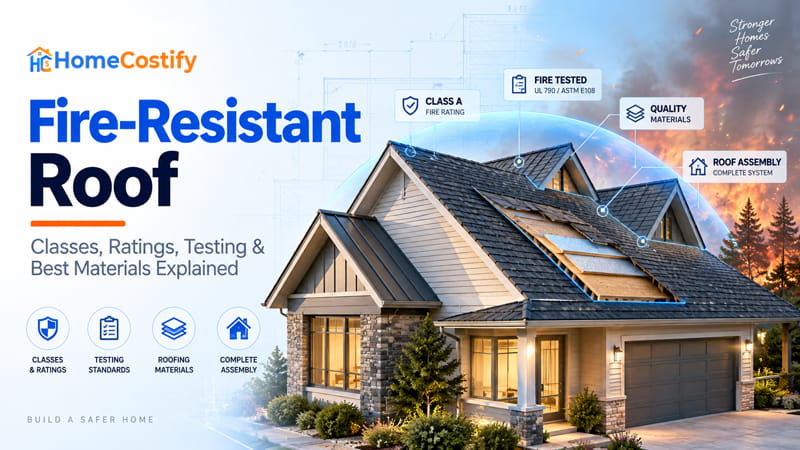
“Fire resistant” describes a level of protection, not an absolute condition. A fire-resistant roof is not guaranteed to remain unaffected by fire. Its behavior depends on the conditions used for evaluation. The phrase expresses resistance to fire, with the degree of protection depending on what the evaluation measures.
Fire resistance also cannot be judged from a label or visible surface alone. A roof should be considered as a system when its response to fire is assessed. This broader perspective helps homeowners interpret fire-related information without treating one visible characteristic as the basis for judging a roof.
What Is a Fire-Resistant Roof?
A fire-resistant roof describes roofing construction that resists specific fire effects when exposed to fire. The focus is the roof’s response, including its ability to resist damage and penetration.
A fire-resistance claim can apply to different parts of the roofing system. A roofing product may carry its own fire-related documentation, while evaluation of a complete roof assembly addresses the construction as a whole. The scope of the claim tells homeowners what the stated result actually represents.
How Fire Resistance Helps Protect a Home
Flames spreading across a roof can reach other areas as the fire progresses. Limiting flame spread slows that movement over the surface and can reduce the rate at which additional areas become exposed. The protection concerns the progression of fire on the roof.
Fire can also penetrate the exposed roofing surface and reach underlying portions of the construction. Resistance to penetration can limit that movement beneath the surface. This matters during exterior fire exposure, where the roof may face flames approaching from outside the home.
How Is a Roof Rated for Fire Resistance?
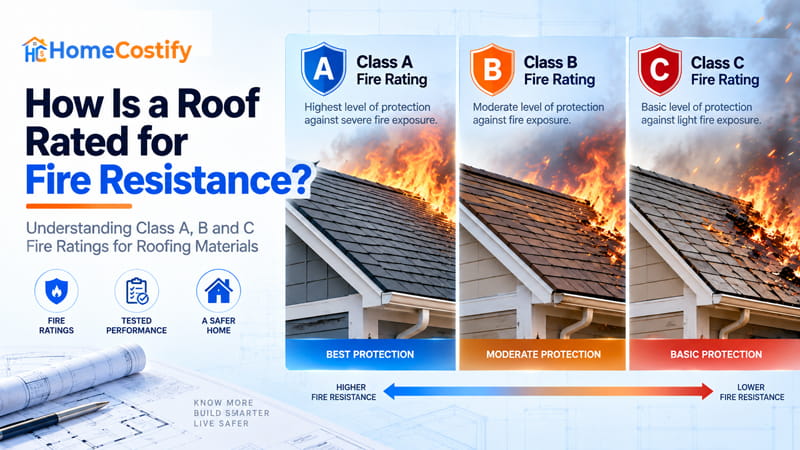
Roof fire classifications provide a standardized way to rate roof coverings against exterior fire. The system uses three categories—Class A, Class B, and Class C—ordered by the severity addressed by each category.
Class A Fire Rating
Class A is the highest category in the A/B/C system and corresponds to the most severe conditions addressed by the classification. ASTM International states that Class A testing is intended for roof coverings expected to provide a high degree of protection to the roof deck. Fire-resistant roofing with this rating has met the criteria assigned to the category under controlled testing.
The designation belongs to the tested result, not to a material name by itself. A roofing material can have different ratings depending on the product and test basis. The Class A label therefore cannot be inferred from material type alone.
Class B Fire Rating
Class B occupies the middle position in the three-class system, with criteria for conditions less severe than Class A. Fire-resistant roofs carrying this rating have satisfied the requirements associated with Class B under the applicable test.
The category is not intended as a general ranking of roofing quality. Its position tells homeowners which classification the tested result achieved, rather than whether one roofing material is inherently better than another.
Class C Fire Rating
Class C is the lowest category in the A/B/C system and covers the least severe conditions in the classification. The rating reflects the result of testing against the criteria assigned to this category.
A lower position does not mean that the roof has no tested fire resistance. Class C remains a recognized roof fire classification, with its meaning tied to the criteria used for the applicable rating.
What the Class Does Not Tell You
A roof fire classification has a defined scope. ASTM International notes that roof-covering fire-test methods evaluate roof coverings under specified test conditions, but they do not necessarily reproduce every circumstance found in an actual fire.
For a fire-resistant roof, the rating applies to the conditions used for its evaluation. Actual fires can involve different fuel sources, intensities, directions of attack, weather, debris, and other factors beyond the test conditions.
How Is Roof Fire Resistance Tested?
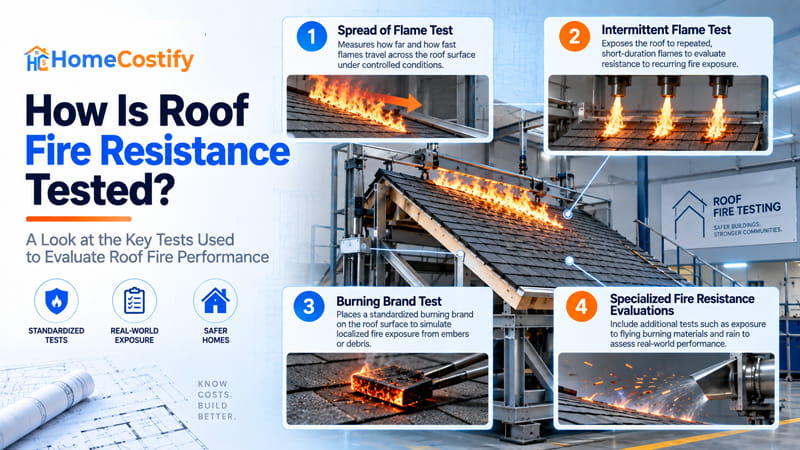
Standardized roof fire tests expose roof coverings to controlled external fire conditions. Each method isolates a particular type of fire contact for evaluation.
Spread of Flame Test
Flame is applied to the exposed roof-covering surface to observe how far it travels. A fire-resistant roof undergoes a defined exterior fire test as the procedure measures flame movement.
The observation concerns surface flame movement and its response to the applied flame. Results provide a standardized basis for comparison, not a prediction of every wildfire scenario.
Intermittent Flame Test
Intermittent flame testing introduces contact at repeated intervals instead of maintaining one continuous flame. Each interval places the roof under another period of flame contact.
This approach shows how the surface responds when flame contact stops and resumes. It forms one defined part of the broader roof-covering fire-test framework.
Burning Brand Test
A burning brand introduces a localized source of burning material onto the roof-covering surface. Fire-resistant roofing shingles can encounter this type of contact in a standardized test. The brand creates a concentrated contact point rather than flame moving primarily across the surface.
The observation shows how the exposed surface handles a concentrated burning source. It remains distinct from the many forms of ember exposure possible during wildfires.
Additional Fire Exposure Tests
ASTM E108 includes several other roof-covering fire-test methods. One method introduces a flying brand, with burning material becoming airborne as the test proceeds. This creates a different contact pattern from a brand placed directly on the covering. The standard also lists rain testing among its methods.
Fire-resistant roofing may therefore be evaluated through multiple fire-test methods, depending on the applicable requirements. The selected method determines which aspect of fire response receives attention.
What Makes a Roof Fire Resistant?
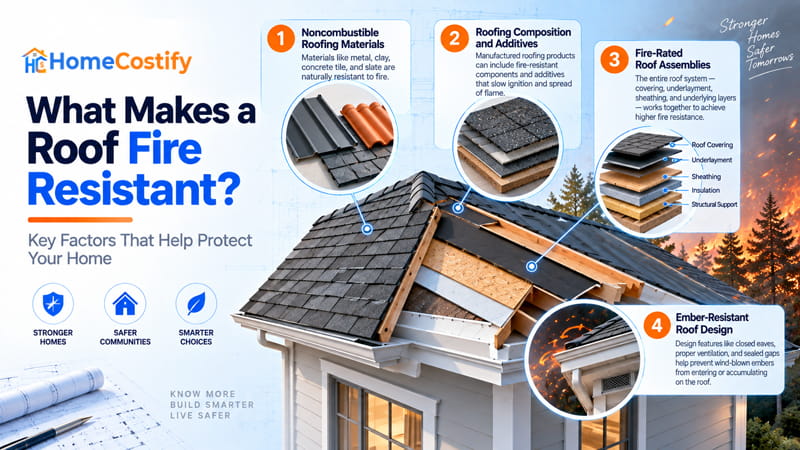
A roof’s fire response depends on features extending beyond its outermost layer. Composition, product structure, supporting layers, and physical openings each create different fire-related considerations.
Noncombustible Roofing Materials
Combustibility starts with the substance forming the exposed roof covering. Metal, clay or concrete tile, and slate have noncombustible characteristics. These fire-resistant roofing materials reduce combustible content at the exterior surface. Their properties, however, do not determine the classification of an entire roof.
| Material | Relevant Fire Characteristic | Important Qualification |
|---|---|---|
| Metal | Noncombustible roof-covering option | Complete roof construction still matters |
| Clay/concrete tile | Noncombustible covering | Installation and underlying construction still matter |
| Slate | Noncombustible covering | Final classification depends on the tested configuration |
A noncombustible covering can have favorable characteristics while other parts of the roof behave differently. Whole-roof fire behavior depends on the relationship between the covering and the rest of the assembly.
Roofing Composition and Additives
Fiberglass reinforcement forms the structural base of many asphalt shingle products. It gives the manufactured product a defined internal structure that can affect its response to heat and fire. Fire resistant shingles therefore reflect the composition of a finished product, not asphalt alone.
Granules cover much of the exterior on asphalt shingles. Beneath them, reinforcement and other layers form the rest of the shingle. These elements work together as part of the manufactured product. Fire-resistant roofing shingles cannot be attributed to any single ingredient.
Fire-Rated Roof Assemblies
The material above the deck is only one part of a roof assembly. Other layers can include underlayment, sheathing or decking, insulation, vapor retarders, and thermal barriers. Their placement and interaction can influence how heat and fire reach deeper portions. A fire-resistant roof therefore involves the arrangement of multiple components.
| Assembly Component | Why It Matters to Fire Performance |
|---|---|
| Roof covering | Forms the exposed exterior surface |
| Underlayment | Sits beneath the covering and forms part of the roof construction |
| Sheathing/decking | Provides the underlying roof surface and can be relevant to fire penetration |
| Thermal barrier/substrate | May separate or protect underlying layers within the assembly |
The 2024 International Residential Code treats a roof assembly as a combination of several elements. These include the roof deck, substrate or thermal barrier, insulation, vapor retarder, and roof covering. Required classified assemblies are tested to ASTM E108 or UL 790.
The tested configuration determines how those components are considered together. A fire-rated roof sheathing product describes one component’s characteristic, not the entire assembly’s classification. Fire-resistant roofing at the assembly level depends on the combination evaluated.
Ember-Resistant Roof Design
Wind-blown embers can reach roof areas without a sustained flame front. Valleys can trap combustible debris, while gaps may provide paths into enclosed spaces. Vents and other openings create additional locations where burning material can enter.
- Valleys: Can collect combustible debris, increasing vulnerability during ember exposure.
- Roof gaps: Small openings can create pathways toward underlying or enclosed areas.
- Vents and openings: Unprotected openings can provide potential routes for embers to enter.
- Ember entry points: Small vulnerabilities can matter even when the main covering handles defined fire exposure well.
For fire-resistant roofs, wildfire vulnerability also depends on where burning material accumulates or finds an entry path. Wind can influence ember movement around roof surfaces and openings. A wind resistant roof addresses wind movement, but it does not establish ember or fire resistance. Ember-focused detailing remains a separate wildfire consideration from formal roof fire classification.
Common Types of Fire-Resistant Roofing
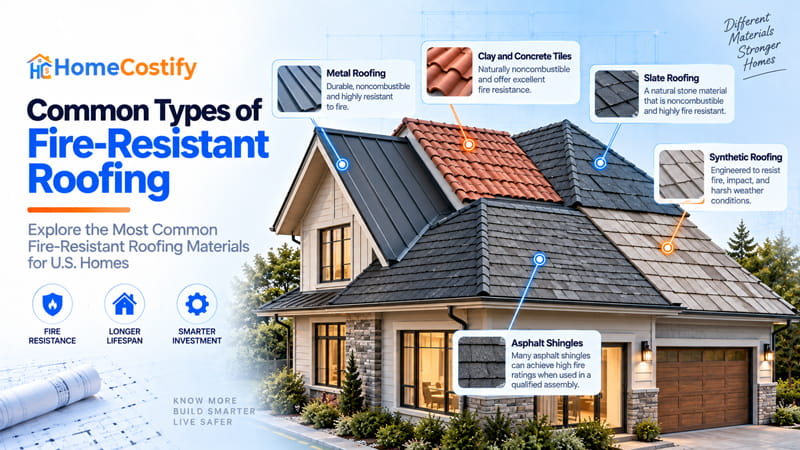
Roofing materials differ in composition, combustibility, and product design. These differences affect how each category compares when fire protection is considered.
Metal Roofing
Metal offers a noncombustible choice for the exposed roof covering. That characteristic gives it a useful place among fire-resistant roofing options. Metal itself does not supply combustible fuel to a fire at the covering.
The fire rating can vary between roofing products and configurations. A metal roof therefore needs to be considered according to the product and construction in question.
Clay and Concrete Tiles
Clay tiles and concrete tiles come from mineral-based compounds rather than organic materials. Their composition gives these products a noncombustible characteristic valued in fire-related roofing decisions.
The tiles form one part of the finished roof. Other elements can influence how the roof responds to fire.
Slate Roofing
Slate roofing is a natural stone used as a roof covering. Its noncombustible nature gives it an inherent advantage when fire resistance enters the comparison.
The stone itself does not assign a fire classification to an installation. That classification belongs to the qualifying roof configuration associated with the product.
Asphalt Shingles
Asphalt shingles occupy a different position because they are manufactured products rather than inherently noncombustible coverings.
Some products can achieve recognized fire ratings when paired with qualifying roof constructions. Fire-resistant roofing shingles therefore depend on the individual product and its stated rating.
A shingle can carry several claims at the same time. Impact-resistant roof shingles address resistance to physical impact, not fire.
The phrase fire resistant shingles refers to a separate fire-related property. An impact rating does not establish that property.
Synthetic Roofing
Synthetic roofing is a broad product category with no single formulation. Manufacturers can use different compositions, structures, and surface treatments across individual products.
That variation makes the individual product more informative than the category label. Its classification and supporting documentation provide the relevant basis for judging fire resistance.
Conclusion
Fire resistance is ultimately about tested roof results, not an absolute promise that a roof will avoid fire damage. Fire-resistant roofs use classifications to communicate how the roofing system performed under defined conditions.
Those ratings give homeowners a consistent basis for interpreting roof fire ratings and comparing documented results.
When evaluating a product or existing roof, look beyond the material name or marketing language. Check the product classification, manufacturer documentation, and whether the actual roof configuration matches the documented or tested assembly where applicable.
FAQs About Fire-Resistant Roofing
What Is the Most Fire-Resistant Roofing Material?
Noncombustible materials such as metal, clay or concrete tile, and slate are strong candidates, but tested roof assembly performance provides the more meaningful benchmark.
Are Asphalt Shingles Fire Resistant?
Some asphalt shingles can provide strong fire performance and achieve Class A classification when included in a qualifying tested assembly.
Are Roof Shingles Fire Resistant?
Some shingle products can meet recognized fire classifications, but performance depends on the specific product and qualifying roof configuration.
Is a Metal Roof Fireproof?
Metal is generally noncombustible, but calling an entire metal roof “fireproof” overstates what a material characteristic or roof classification establishes.
What Is the Best Fire Rating for a Roof?
Class A represents the highest of the standard Class A, B, and C roof fire classifications for the specified exterior fire exposure.