A roof comparison can put several performance claims beside familiar choices in material, color, and style. One product might carry the term impact-resistant roof shingles. The phrase can sound straightforward at first, yet it represents a specific piece of information about the product.
For a homeowner, the decision eventually comes down to what the stated performance actually represents. A rating attached to a roofing material needs to be understood according to the characteristic it addresses.
That raises a different issue from simply spotting a claim during product research: which part of the roof’s expected performance does the designation speak to? Without that distinction, comparing products can turn a technical label into a broader assumption about the roof.
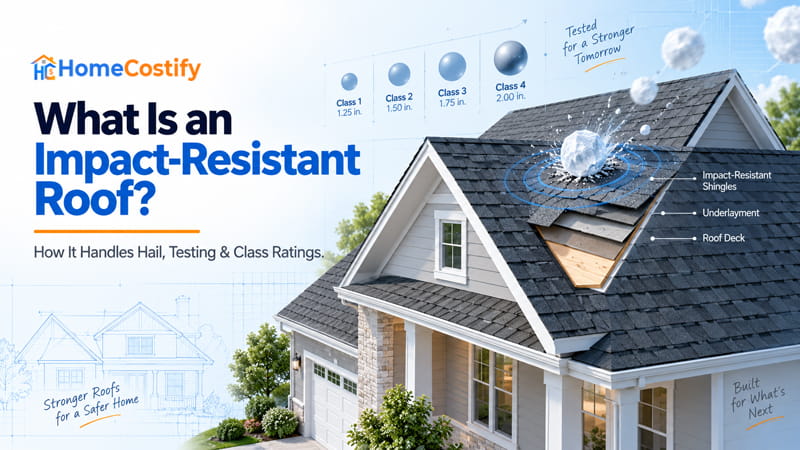
What Is an Impact-Resistant Roof?
An impact-resistant designation identifies roofing that has demonstrated resistance to specified impacts through documented criteria. Within impact resistant roofing, the term functions as a performance designation instead of a promise that the roof will remain damage-free.
It tells homeowners that a measurable characteristic has been evaluated, while leaving the extent of real-world protection to later interpretation.
What Impact Resistance Is Designed to Protect Against
Hail is one of the primary impact events considered in residential roofing because falling hailstones can strike exposed roof surfaces with substantial force.
Products described as impact-resistant roof shingles are intended to address that type of impact rather than every source of roof damage. Storms vary in hail size, velocity, hardness, and angle of impact, so identical roofs can experience very different outcomes during separate weather events.
Impact Resistance vs. Ordinary Roofing
Ordinary roofing is not automatically incapable of handling impact. The meaningful difference lies in whether a product carries documented resistance against established criteria.
Impact resistant shingles identify a product with measurable impact performance, while ordinary roofing may or may not include that documented characteristic. The comparison is therefore based on verified product performance, not on the material category alone.
Impact-Resistant Does Not Mean Impact-Proof
Even the highest-performing roof can experience damage under severe weather. Natural hailstorms introduce variables that extend beyond controlled impact scenarios, including changing hail size, direction, and storm intensity.
An impact-resistant roof is designed to improve resilience against impact, but it should never be interpreted as a guarantee that every hail event will leave the roof undamaged.
What Are Impact-Resistant Roof Shingles Made Of?
A shingle is a layered assembly, with each component serving a different physical role. The materials interact as one roof covering, so impact behavior does not originate from a single layer.
Reinforced Fiberglass Mat
The fiberglass mat forms the reinforcement backbone of the shingle sheet. It gives impact-resistant roof shingles a stable internal framework that helps the sheet retain its integrity under stress.
Embedded beneath the surface, the mat supports the surrounding asphalt and coating layers. Its reinforcing function comes from the fiberglass structure itself, separate from the work performed by the outer surface.
Polymer-Modified Asphalt
Polymer modification changes the character of the asphalt matrix used in some asphalt shingles. SBS-modified asphalt is one form that can alter flexibility and toughness in the finished material.
Flexibility affects how the matrix accommodates movement, while toughness relates to its ability to resist physical stress. Formulations differ across roofing materials, so their material behavior is not identical from one shingle to another.
Backing and Reinforcement Layers
Supporting layers contribute to the shingle’s shape, stability, and overall construction. In impact resistant shingles, these layers work alongside the primary mat and asphalt matrix, with each serving a distinct structural function.
Their placement helps the finished shingle maintain dimensional stability during normal exposure. Layer arrangement also determines how the individual components occupy the completed roof-covering structure.
Granule Coating
Mineral granules cover the shingle’s outer surface and create its characteristic texture. On impact-resistant roofs, the coating helps shield asphalt from environmental exposure and surface wear. The granules form a distinct layer above the underlying matrix, while their distribution gives the shingle its finished appearance.
Weather exposure or impact can loosen individual particles, leaving areas where the coating becomes thinner or uneven.
How Are Impact-Resistant Shingles Tested?

Laboratories use standardized impact procedures to expose roofing specimens to repeatable test scenarios. Such controls make results easier to compare, while natural hail varies in shape, properties, velocity, and impact behavior.
The UL 2218 Testing Method
UL 2218 is the Standard for Impact Resistance of Prepared Roof Covering Materials. The standard uses steel balls to generate impact energies associated with natural hail.
For impact resistant roofing, the evaluation examines how a roof covering responds to those defined impacts. UL 2218 supports four impact-resistance classifications, from Class 1 through Class 4.
The evaluation focuses on physical breach or fracture under the criteria established by the standard. A dent or area of granule loss does not automatically carry the same significance as a qualifying breach.
The UL 2218 Testing Process
The testing sequence can be understood through four stages:
- Setup — A test specimen is prepared according to the configuration specified by the standard.
- The Drop — A steel ball produces the required impact on the specimen.
- The Repeat — Further impacts follow the sequence and requirements established for the test.
- The Inspection — The specimen is examined for damage that meets the evaluation criteria.
Inspection connects the observed condition of the specimen with the criteria used for the test outcome. A visible mark does not by itself establish a qualifying result. Physical openings and other observed effects receive their significance from the evaluation framework.
Alternative Testing Methods
UL 2218 is not the only way researchers examine hail impact. Research protocols can capture additional damage modes and compare relative performance. Their purpose differs from formal certification classifications.
IBHS Testing
IBHS uses laboratory-manufactured hailstones designed around measured characteristics of natural hail. The protocol considers impact energy, hailstone properties, and impact mechanics during laboratory testing.
For impact-resistant roofs, the protocol records dents, tears, and granule loss as separate damage modes. Impact resistant shingles can receive differentiated assessments based on those observations.
The research focuses on relative performance across specimens, rather than assigning the same certification classification used by UL 2218. Results from either protocol represent the conditions and measurements used by that specific approach.
3D Scanners
Three-dimensional scanning can capture surface deformation with greater quantitative detail than visual inspection alone. IBHS has used image-processing tools and three-dimensional models to quantify dent-related damage during hail research.
The resulting measurements provide another way to document surface changes without creating a separate roofing classification.
Impact Resistance Roof Classes
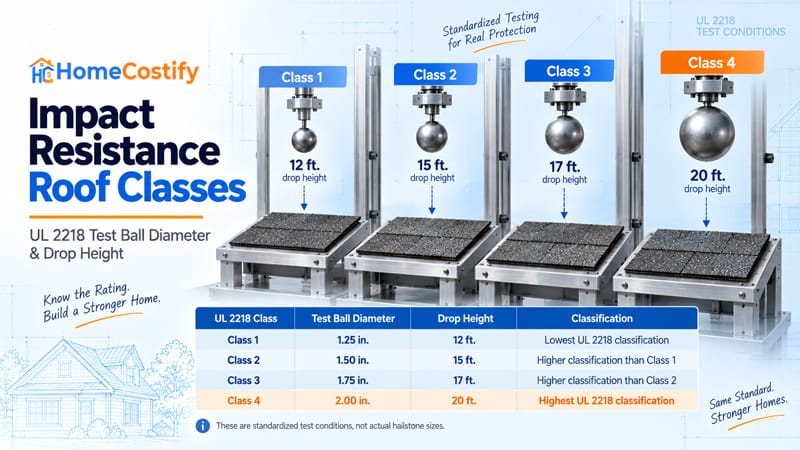
UL 2218 places impact performance into four classes, from Class 1 through Class 4. Each level marks a position on the classification scale, while storm damage varies with hail and other conditions.
| UL 2218 Class | Test Ball Diameter | Drop Height | Classification |
|---|---|---|---|
| Class 1 | 1.25 in. | 12 ft. | Lowest UL 2218 classification |
| Class 2 | 1.50 in. | 15 ft. | Higher classification than Class 1 |
| Class 3 | 1.75 in. | 17 ft. | Higher classification than Class 2 |
| Class 4 | 2.00 in. | 20 ft. | Highest UL 2218 classification |
The four levels form a hierarchy for comparing classified roof coverings. Test-ball diameter belongs to the standardized rating framework, not to a promised natural hail size.
Class 1
At the bottom of the four-level UL 2218 scale, Class 1 marks the lowest classification. The designation still places the roof covering within the standard’s impact-resistance scale. Its position indicates a lower tier of rated impact resistance, not an absence of impact capability.
Class 2
Class 2 follows Class 1 as the next level in the UL 2218 hierarchy. With impact resistant shingles, this classification provides another point for comparing rated products. The class number offers no percentage estimate for protection during an actual hailstorm.
Class 3
Near the upper end of the four-level scale, Class 3 provides a higher classification for comparison. A roof classified under impact resistant roofing standards still faces damage patterns that vary with natural hail. The class number captures a defined aspect of impact performance, not every possible storm effect.
Class 4
The highest position belongs to Class 4 in the UL 2218 classification system. Impact-resistant roofs with this classification occupy the top tier of the scale. Severe hail can still damage a roof at the highest classification. A list of class 4 impact-resistant shingles identifies products with this rating, while certification details remain specific to each product.
Common Types of Impact-Resistant Roofing
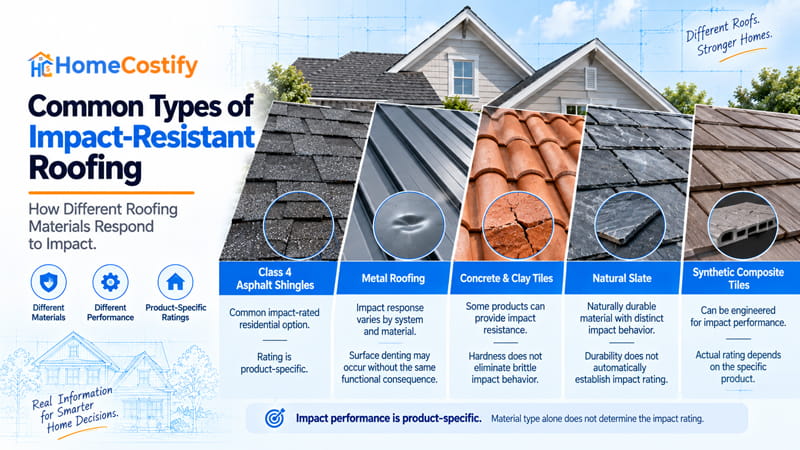
Several roofing materials offer impact-resistant options, but their physical responses vary by construction. Fire-resistant roofing addresses a separate property from resistance to physical impact.
| Roofing Type | Impact-Resistance Context | Material-Specific Consideration |
|---|---|---|
| Class 4 Asphalt Shingles | Common impact-rated residential option | Rating is product-specific |
| Metal Roofing | Impact response varies by system and material | Surface denting may occur without the same functional consequence |
| Concrete & Clay Tiles | Some products can provide impact resistance | Hardness does not eliminate brittle impact behavior |
| Natural Slate | Naturally durable material with distinct impact behavior | Durability does not automatically establish impact rating |
| Synthetic Composite Tiles | Can be engineered for impact performance | Actual rating depends on the specific product |
Class 4 Asphalt Shingles
Asphalt shingles are common on residential roofs, with impact-rated options available across specific product lines. Impact-resistant roof shingles vary in their documented classifications and supporting certifications.
Metal Roofing
Metal roofing often shows deformation as a visible response to hail strikes. Dent depth and appearance vary with metal type, thickness, profile, and system design. Surface deformation alone provides limited information about the roof’s functional condition.
Concrete and Clay Tiles
Concrete tiles and clay tiles have rigid structures that differ sharply from flexible shingle materials. Their hardness contributes to surface durability, while brittle behavior remains a consideration under sudden force. With impact resistant roofing, the tile’s composition and design influence its response.
Natural Slate
Natural slate roof is valued for durability, yet its rigid structure creates a different response to sudden force. Long-term durability and impact classification describe separate material properties. Product-specific documentation matters if impact resistance forms part of the buying decision.
Synthetic Composite Tiles
Synthetic composite tiles can incorporate engineered characteristics aimed at impact performance. Their response depends on the material formulation, tile design, and construction of the individual product. Impact-resistant roofs using composite tiles therefore vary across manufacturers and product lines.
Pros and Cons of Impact-Resistant Roofs
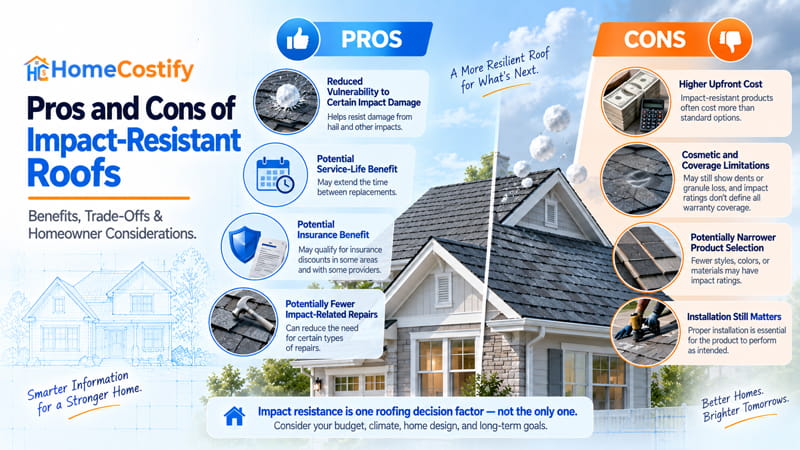
Impact resistance adds a specific consideration to the choice of a roofing system. Its value depends on how that characteristic fits the home’s needs and priorities.
Pros of Impact-Resistant Roofs
- Reduced Vulnerability to Hail Strikes: Specified impact resistance can reduce vulnerability when hail strikes exposed roof surfaces.
- Potential Service-Life Benefit: Limiting premature surface damage can help preserve the roof’s condition.
- Potential Insurance Benefit: Qualifying products may satisfy requirements set by certain insurers or policies.
- Potentially Fewer Repairs: A lower incidence of storm-related damage could reduce associated repair needs.
Durability extends beyond resistance to physical strikes. Impact-resistant roof shingles help protect the covering during severe weather, while roof longevity also reflects exposure, maintenance, ventilation, installation, and material quality.
Repair frequency matters more when a property experiences repeated hailstorms. For homeowners asking are impact resistant shingles worth it, the answer depends on local exposure, product choice, and project circumstances. Fewer repair events could offset part of the added investment across the roof’s service life.
Insurance incentives vary by insurer, location, policy terms, and product qualification requirements. An impact resistant shingles insurance discount depends on eligibility and supporting documentation. The applicable policy determines whether a qualifying roof receives a premium reduction.
Cons of Impact-Resistant Roofs
- Higher Upfront Cost: Some impact-resistant options require a higher initial investment than conventional alternatives.
- Cosmetic and Coverage Limitations: A performance rating does not define every warranty or insurance coverage condition.
- Potentially Narrower Product Selection: Available products, colors, profiles, and appearances vary by manufacturer and market.
- Installation Still Matters: Product performance remains connected to application quality and the surrounding roofing system.
The cost of impact resistant shingles represents more than the initial material premium. Comparing that expense with impact resistant shingles requires attention to storm exposure, expected maintenance, and the project’s broader lifecycle.
Coverage presents a separate consideration when visible damage occurs. Dents, granule loss, repairs, and replacement can fall under different warranty or insurance provisions. An impact designation alone provides no complete answer about financial coverage.
Installation quality remains part of the finished roofing system. With impact resistant roofing, application errors or poor workmanship can affect the result achieved on the completed roof.
Roof performance covers several distinct risks. A wind resistant roof addresses wind exposure, while water resistance, fire resistance roof, weathering, and impact resistance address other concerns. Impact-resistant roofs therefore represent one performance dimension within a broader roofing decision.
How to Tell if Shingles Are Impact Resistant
Documented evidence provides the strongest basis for verifying an impact-resistance claim. Product identity matters because specifications and certifications apply to specific roofing products, not appearance alone.
Check Product Labels and Packaging
Product documentation can appear in several places, including manufacturer specifications, product literature, bundle wrappers, and packaging labels. Impact-resistant roof shingles may have rating information printed on the bundle wrapper or product label.
Match the stated designation with the product name, model, or other identifying information shown elsewhere. A marketing phrase without a corresponding product reference provides limited evidence of a formal rating.
Look for UL 2218 or FM 4473 Ratings
Certification references provide a more specific trail when researching impact resistant shingles. Look for references to UL 2218 or FM 4473 in manufacturer documentation and product literature. The reference should correspond to the actual product designation being purchased.
A manufacturer may offer several variations within one product family, so the family name alone cannot establish the same rating for every version. Product documentation should connect the rating to the specific shingle designation.
Inspect the Shingle Underside
Physical identification offers another way to match the shingles in hand with their documentation. Some shingles have markings on the underside that identify the product or manufacturing information.
For impact resistant roofing, such markings can help confirm which product is being handled before comparing it with packaging or manufacturer specifications. The marking itself serves as an identification check; certification evidence comes from the supporting documentation.
Conclusion
Impact resistance is a documented characteristic of a roof covering’s response to specified impacts, particularly hail-related impacts. The designation describes a defined capability, while hail events vary in size, force, and resulting damage.
A product rating adds another layer of context through its classification and supporting evidence. For impact resistant roofing, Class 1 through Class 4 belong to the UL 2218 framework and reflect defined testing conditions. The actual rating still requires verification through product documentation, and the classification offers no guarantee against hail damage.
FAQs About Impact-Resistant Roof Shingles
Should I Get Impact-Resistant Shingles?
Suitability depends on the home’s hail exposure, durability goals, insurance considerations, and available budget. Impact-resistant roof shingles may fit a project when the added product value aligns with those circumstances and the homeowner’s priorities.
Are Architectural Shingles Impact-Resistant?
l describe a shingle type and design, not a specific impact rating. The actual product specifications determine whether an impact rating applies.
Are Impact-Resistant Shingles the Same as Hail-Resistant Shingles?
The terms overlap in consumer use because both relate to protection from hail damage. “Hail-resistant shingles” commonly describes products marketed for hail exposure. Product documentation remains the stronger reference for evaluating documented impact resistance.
Are Class 4 Shingles Impervious to Hail?
Class 4 is the highest classification in the UL 2218 framework, but the designation does not provide immunity from hail. Severe storms can still produce hail damage across different parts of a roof.
Are 30-Year Architectural Shingles Impact Resistant?
A 30-year designation describes a stated warranty or lifespan-related term. It does not establish an impact classification. Any impact rating appears separately in the product’s supporting specifications.