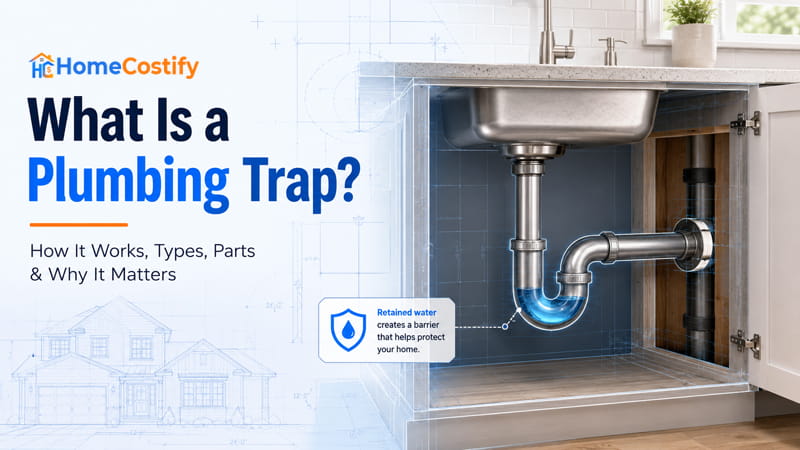
A home’s drainage system moves wastewater away from the fixtures used throughout the house. Sinks, showers, tubs, and other fixtures connect to piping carrying discharged water into the broader residential waste network. A plumbing trap is one of the fittings found along these fixture drainage routes.
From a homeowner’s perspective, the arrangement beneath a fixture may look like a simple continuation of the drain. In reality, the drainage connection includes a dedicated fitting occupying a specific place in the route. Its presence becomes especially relevant when tracing where wastewater travels after leaving a fixture.
What Is a Plumbing Trap?
At a fixture’s waste connection, A plumbing trap forms part of the home plumbing system at a fixture’s waste connection.. Its configuration creates a low section where water stays after normal discharge. The passage does not empty completely between drainage cycles.
The water held there gives the fitting a specific role within the fixture’s drainage connection. The fitting itself is the component; the water retained inside it is a separate element.
Where It Sits in a Home Drainage System
Wastewater leaving a sink or another fixture enters the drain connection, then moves into downstream piping. From the fixture outlet, the drainage route continues toward the larger DWV system.
The waste-disposal network carries used water away from the home, while the supply network delivers fresh water to fixtures. Placement varies with the fixture and the surrounding piping arrangement.
What “Trap” Means in This Context
In residential plumbing, “trap” refers to a drainage fitting or configuration capable of retaining water after discharge. The word describes a functional arrangement, not simply the curved appearance commonly associated with these fittings.
For anyone asking what is a trap in plumbing, the term identifies a particular drainage configuration at a fixture. Its meaning comes from how the fitting serves the connection, rather than from appearance alone.
What Does a Plumbing Trap Do?
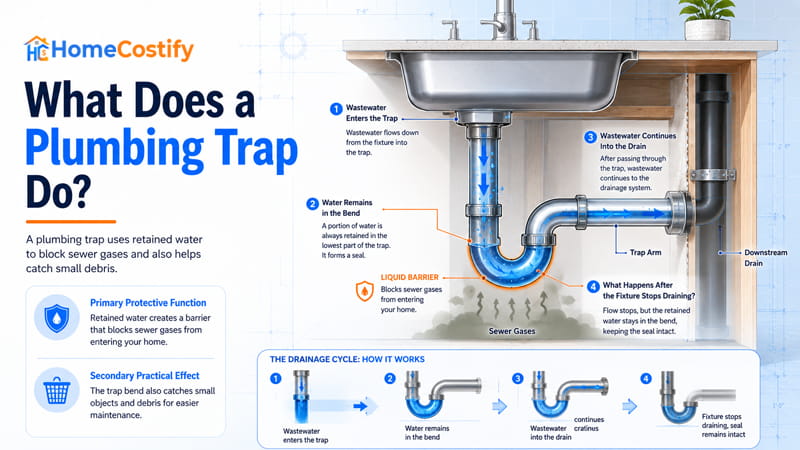
A fixture drain carries wastewater toward downstream piping during normal discharge. The plumbing trap serves a separate purpose at the fixture connection, maintaining a condition that limits direct exposure to the drainage environment.
Primary Protective Function
The liquid held in the fitting provides the separation needed at the fixture opening. Normal discharge can continue into the drainage line without leaving a direct opening to the drainage environment.
Gases associated with wastewater encounter the liquid before reaching occupied space through the drain opening. That protective condition depends on the liquid present at the connection.
Secondary Practical Effect
Small objects or debris entering a fixture drain may settle near the configuration’s low point. Hair, grease, or a dropped item can collect there instead of traveling farther along the waste line.
Under a sink, the fitting’s accessible location places collected material within reach during routine maintenance. Retrieval from that point may be simpler when material has accumulated near the fixture. Debris retention remains an incidental consequence, not the primary engineering purpose.
How Does a Plumbing Trap Work?
During normal use, wastewater leaves a sink, shower, or tub through the fixture drain. The discharge enters the trap before continuing into the home’s downstream drainage route. Inside the fitting, the passage changes direction around the bend instead of following a straight path.
Understanding how a trap works also helps explain how plumbing works in a house, from fixture drains to downstream piping. The same drainage network connects with different types of plumbing pipes and their uses, depending on the function of each section.
Wastewater Enters the Trap
Opening a fixture sends a fresh discharge into its drain connection. The incoming stream reaches the inlet and moves into the curved passage. Liquid already present at the bottom stays in place as new wastewater enters. The incoming stream moves around it and continues through the fitting.
Water Remains in the Bend
The bend directs the moving stream around its lowest point. After the active discharge has passed, part of the liquid stays inside the fitting. The retained amount depends on the configuration and conditions of use.
Discharge volume also affects how the contents move during a drainage cycle. The geometry determines how much residual liquid the fitting can hold between periods of use.
Wastewater Continues Into the Drain
Beyond the bend, the discharge rises toward the outlet and enters the trap arm. From there, the fixture’s wastewater proceeds into the downstream drainage piping. The retained portion does not obstruct the route used by normal discharge.
The two conditions coexist within the fitting: moving wastewater follows the outlet path, while residual liquid stays in the lower area.
What Happens After the Fixture Stops Draining?
When the fixture stops discharging, movement through the passage comes to an end. No additional wastewater enters until another use cycle begins. The fitting settles into its post-discharge state.
A later sink, shower, or tub discharge starts the process again at the inlet. The sequence then repeats as the fixture sends another volume through the drainage route.
Plumbing Trap Parts and Anatomy
The trap is one of the parts of a plumbing system, divided into several sections from the inlet on the fixture side to the outlet leading downstream. These plumbing trap parts appear in a fixed spatial order. The diagram shows where each part sits within the drainage path, not how wastewater moves through it.
Anatomy diagram: Fixture drain → trap inlet → trap bend → retained-water area → trap weir/outlet → trap arm → downstream drainage
| Part | Where It Sits | What It Represents |
|---|---|---|
| Trap inlet | Fixture side | Entry point from the fixture drain |
| Trap bend | Lower portion | Curved section where water can remain |
| Trap weir | Downstream side of the bend | Boundary of the retained-water area |
| Trap outlet | Exit from the trap | Transition toward the trap arm |
| Trap arm | Beyond the outlet | Connection toward downstream drainage |
Trap Inlet
The inlet marks where the fixture-side drain connection reaches the fitting. Discharge from the fixture drain enters at this opening, forming the entry point of the trap. Its location identifies the beginning of the fitting without describing the movement that follows.
Trap Bend
The bend forms the lower curved portion and establishes the fitting’s low point. Its shape provides the area where water can remain between uses. On an anatomy diagram, the curved section provides the clearest reference for locating the bottom of the fitting.
Trap Weir and Outlet
At the far side, the weir and outlet mark the transition from the lower portion into the continuing drainage route. The weir forms part of this boundary, while the outlet provides the opening toward the trap arm.
Trap Arm
Beyond the outlet, the trap arm carries the connection toward downstream drainage. It links the trap with the remaining plumbing network beyond the fitting. Its position extends the drainage layout from the outlet into the larger system.
What Are the Main Types of Plumbing Traps?

Trap configurations vary in shape, outlet arrangement, and intended setting. Plumbing traps in residential work may reflect modern fixture layouts, older installations, or specialized spatial requirements. The most relevant forms include P-traps, S-traps, drum traps, and several specialty configurations.
| Trap Type | Physical Configuration | Typical Context |
|---|---|---|
| P-trap | Curved section with horizontal outlet | Modern residential fixtures |
| S-trap | Extended bend with downward outlet | Older installations |
| Drum trap | Larger chamber-like body | Older or specialized applications |
| Bottle trap | Compact chamber-like form | Certain fixture and space constraints |
| Specialty traps | Configuration varies by application | Specific drainage requirements |
P-Trap
The familiar curved profile identifies a P-trap, while its outlet extends horizontally toward the drainage connection. In p-trap plumbing, the bend retains water as part of its normal design. This configuration commonly appears beneath sinks and other modern fixtures, with the waste outlet connecting to piping near the wall.
A sink cabinet often leaves the trap visible beneath the basin. The fixture outlet feeds into the curved section, while the opposite side continues toward the wall-side drainage route. This placement makes P-traps a familiar feature in contemporary residential plumbing.
S-Trap
A downward-turning outlet gives the S-trap its distinctive extended shape. Plumbing s-trap configurations can appear in older installations where the waste route drops toward piping below the fixture. Their layout differs from configurations using a horizontal wall-side connection.
The concern surrounding older S-traps relates to siphonage under certain drainage conditions. Their geometry can make the retained water more vulnerable to being drawn from the fitting. For this reason, S-traps are not generally accepted as a standard configuration under modern plumbing requirements. Existing installations still require jurisdiction-specific evaluation rather than an automatic illegal designation.
Drum Trap
A larger chamber distinguishes a drum trap from the compact forms commonly associated with fixture drainage. Plumbing drum trap configurations use a chamber-like body instead of a simple curved passage. Older plumbing systems may contain them, along with certain specialized applications.
The larger body provides access for maintenance. Material collected inside the chamber can be reached through its opening. That characteristic helps explain its presence in older systems without making it a standard choice for contemporary residential work.
Bottle Traps and Other Specialty Configurations
Limited space or unusual fixture design can call for a different configuration. Bottle traps use a compact, chamber-like form suited to certain fixture layouts. Other specialty trap configurations address particular spatial constraints or drainage applications.
Their presence does not mean every form has equal relevance in a standard U.S. home. Application, fixture design, and available space influence where these less familiar arrangements appear. Floor-drain and other specialty settings can also require forms suited to their specific installation context.
How Does the Trap Seal Relate to the Trap?
The fitting and the liquid inside it represent two distinct aspects of the same protective arrangement. A plumbing trap seal refers to the retained liquid, not the component that holds it. The distinction matters when examining what remains inside the curved section after normal drainage.
Water Retained Inside the Trap
The trap seal forms from water left in a designated portion after wastewater passes through. Geometry creates a low section where liquid can stay between drainage cycles. No separate insert, coating, or component creates the seal; the retained water itself provides the seal.
Changes in water level affect the seal without changing the trap itself. The fitting remains present even when its liquid content becomes insufficient. This difference provides the basis for understanding later changes in seal effectiveness.
The Seal as a Barrier Against Sewer Gas
The retained liquid spans the passage from the fixture opening to the waste side. It prevents that route from remaining continuously open to the occupied area around the fixture. In plumbing traps, an intact liquid seal limits movement of gases associated with the drainage system into the room.
Continuous liquid presence maintains the barrier across the relevant passage. The seal can change even while the surrounding trap remains intact.
Why Can a Trap Seal Be Lost?
A trap seal can disappear, shift, or become inadequate through several different mechanisms. A plumbing trap may lose water by evaporation, siphonage, back pressure, or leakage. These causes differ in how water leaves the fitting.
Evaporation
An infrequently used fixture receives little fresh water through its drainage connection. Over an extended period, exposed liquid gradually evaporates from the water held in the trap. Continued water loss can reduce the level until the barrier no longer provides the intended separation.
Siphonage
Active drainage can create a pressure difference capable of pulling water from the fitting. A plumbing trap may therefore lose liquid during or around a drainage event without showing an external leak. Siphonage describes this pull on the water, distinguishing it from leakage through a damaged component.
Back Pressure
The pressure direction changes with back pressure. Positive pressure originating in downstream drainage piping can push water toward the fixture side. Movement in that direction can lower the amount remaining in the fitting. Unlike siphonage, the defining action here is a push rather than a pull.
Leakage
Physical damage creates another route for water to escape. A cracked body, deteriorated joint, or faulty connection can release liquid from the damaged area. The loss comes from compromised component integrity rather than pressure-driven movement.
Why Does a Plumbing Trap Need Venting?
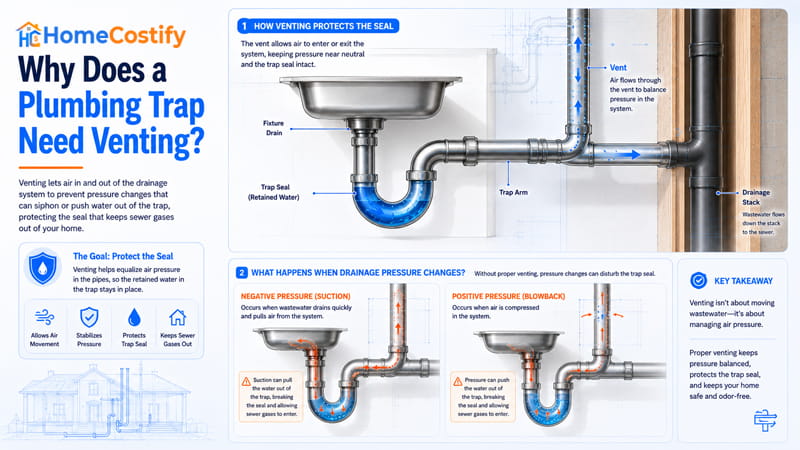
Wastewater moving through drainage piping can alter the air pressure around connected fixtures. A plumbing trap depends on controlled pressure conditions within the broader drainage network. Plumbing venting provides an air path, helping moderate pressure changes before they significantly disturb the water in the trap.
How Venting Protects the Seal
Airflow gives changing pressure somewhere to move as discharge travels through the drainage network. A plumbing trap vent helps reduce the pressure differential acting across the fixture connection. Within the broader DWV system, this air movement helps keep pressure conditions more stable around the trapped section.
Under the IPC framework, venting is intended to limit pressure differences acting on a fixture trap seal to no more than 1 inch of water column (249 Pa). Local adoption and amendments can establish different requirements.
What Happens When Drainage Pressure Changes?
Negative pressure can develop around moving discharge and create a pull on water in the trap. The liquid may shift away from its normal position when the pressure difference becomes significant. The concern here involves pressure acting across the trapped connection, not a separate physical defect.
Positive pressure produces the opposite directional force within the drainage network. A plumbing trap can experience water pushed toward the fixture side when downstream pressure rises. Such movement may disturb the water level even though the fitting itself remains intact.
Where Are Plumbing Traps Used?
A homeowner encounters traps at several drainage points connected to common plumbing fixtures throughout a residential plumbing system. Their appearance depends on the fixture, surrounding layout, and whether the trap remains visible after construction.
Common locations include:
- Kitchen sinks — typically have a plumbing trap directly associated with the sink drain.
- Bathroom sinks — use a fixture drain connection that includes a trap.
- Showers and bathtubs — trapping is incorporated into the fixture’s drainage layout.
- Floor drains — can have a trap below or as part of the drain assembly.
- Laundry fixtures — use trapping as part of their drainage connection.
Under a sink, the trap is often visible inside the cabinet. A plumbing trap for shower applications can instead remain below the finished surface. Bathtubs can place the drainage layout beneath the tub enclosure, making the same relationship less apparent.
Toilets provide a different example because the trapway forms part of the fixture itself. In many plumbing traps, the trapping arrangement appears as a separate component, but toilet drainage integrates it into the fixture body. This distinction explains why homeowners do not see the same visible setup at every drain.
Common Plumbing Trap Problems
A homeowner can first notice an unusual odor, slow drainage, moisture, or sound near a fixture. A plumbing trap problem can produce several noticeable symptoms. Yet the same symptom can have more than one possible cause.
Dry Trap
An unused fixture can develop a noticeably dry condition if little water remains inside its trap. Sewer odor can become noticeable near the drain opening once the liquid barrier is no longer present. The smell can alert occupants to a changed drainage condition without identifying its exact source.
Clogged Trap
Accumulated hair, sludge, grease, or small objects can narrow the passage through a plumbing trap. Restricted flow can cause a slow drain or leave standing water around the fixture. The severity depends on how much material occupies the drainage path and how freely wastewater can pass.
Leaking Trap
Moisture around the fitting or its connections can point toward a physical leak. A plumbing trap with a damaged body, joint, or connection can release water into the surrounding cabinet or floor area. Continued exposure can affect cabinetry, walls, or flooring even if the leak appears minor.
Sewer Odors
A sewer odor near a fixture can indicate that the liquid barrier has become compromised. The odor source can also lie elsewhere in the drainage system, so the smell alone cannot establish a damaged trap. Nearby connections, drains, or other system conditions can produce similar observations.
Gurgling or Unusual Drainage Sounds
Unusual sounds can occur as wastewater and air move irregularly through connected piping. Plumbing traps can be near the affected fixture, but the underlying condition can exist elsewhere in the system. Gurgling therefore signals an abnormal drainage condition rather than proving that the trap itself has failed.
How to Protect a Trap Seal
Normal fixture use replenishes water naturally as discharge passes through the drain. Infrequently used fixtures can need additional attention if water loss becomes a recurring concern. The appropriate protection depends on why the water level is difficult to maintain.
Trap Primers
A dedicated plumbing trap primer can supply water automatically as needed. The added water helps maintain the liquid level in drains that receive little regular discharge. Floor drains and similar locations can benefit from this approach if evaporation creates a maintenance concern.
Trap Seal Protection Devices
Some protective devices address water loss without functioning as a trap primer. A plumbing trap seal protection device can help maintain the barrier under specific conditions. Suitability depends on the fixture, drainage configuration, device design, and applicable requirements. Different products or mechanisms are therefore not automatically interchangeable.
Plumbing Trap Requirements Under U.S. Plumbing Codes
A homeowner checking plumbing work can encounter different requirements in different parts of the country. A plumbing code provides a technical framework, but local adoption determines which provisions apply. Jurisdictions can modify model-code provisions through amendments or adopt another code.
Trap Seal and Fixture Requirements
The IPC establishes a measurable boundary for fixture trap seals. Under this framework, a fixture trap generally requires a liquid seal at least 2 inches (51 mm) deep. The maximum depth is 4 inches (102 mm), with specific provisions for certain special accessible fixtures. This range serves as a technical code requirement within the IPC framework, rather than a universal rule for every U.S. property.
Prohibited Trap Configurations
Code provisions also address configurations that are unsuitable for ordinary fixture applications. Under the IPC, plumbing trap types can be subject to restrictions based on their configuration and intended use.
Certain forms are not permitted for standard applications, while specific exceptions or conditions can apply to particular circumstances. The relevant provision determines whether a configuration meets the adopted requirements.
Local Code and AHJ Considerations
A model code does not automatically establish identical rules for every home. A locally adopted plumbing code can include amendments, use a different model, or reflect jurisdiction-specific provisions.
The authority having jurisdiction, or AHJ, is the appropriate reference for requirements affecting a specific property. Permit and inspection expectations likewise depend on the locally adopted framework.
Final Takeaway
A plumbing trap is the assembly within a fixture’s drainage connection. Its shape provides the space where liquid can remain between discharge cycles. The trap seal is different: it describes the liquid held inside the trap. No separate component creates the seal.
For a homeowner, the distinction becomes useful when looking beneath a sink or considering another fixture drain. A fitting can remain intact while its protective liquid barrier becomes inadequate.
Conversely, water inside the fitting does not prove that every surrounding drainage condition is functioning correctly. The useful mental model is simple: the trap holds water, and that water forms the protective liquid barrier.
FAQs About Plumbing Trap
Does every drain need a trap?
Not every drain has the same arrangement, but fixture drains generally require a trap or integral trapping arrangement under applicable plumbing-code provisions.
Does a bathroom sink have to have a trap?
Yes. A typical bathroom sink uses a separate trap between the fixture drain and downstream drainage piping, maintaining a liquid seal.
What is the best trap for a bathroom sink?
A properly installed P-trap is the standard configuration for most bathroom sinks, connecting the fixture drain to downstream piping.
Does a toilet drain need a trap?
A toilet normally does not need a separate downstream trap because its drainage design incorporates an integral trapway within the fixture.
Why are S traps no longer used in plumbing?
S-traps can be vulnerable to siphonage that reduces their water seal, so modern plumbing codes generally restrict or prohibit the configuration.