Roof replacement budgets rarely stay within a narrow price range. A typical composite roof cost can vary by thousands of dollars even when two homes appear similar from the street.
Measurements, product selection, and installation conditions all contribute to the final proposal. Early planning starts with realistic numbers instead of rough guesses.
Across the United States, the average composite roofing cost usually falls within a national pricing range, although local estimates may land above or below that midpoint. Material choices account for part of the difference, yet they are only one piece of the project.
Roof geometry, installation difficulty, and labor pricing shape the final amount as well. Small project details can change the total more than expected.
Budget planning becomes far less stressful when national averages are used as a starting point instead of a final expectation. A written proposal reflects measurements taken at the house, making every quote slightly different even inside the same city.
That is why published pricing should be treated as a benchmark for estimating a realistic roof cost. It creates a practical foundation before requesting bids.
A complete budget includes more than the roofing products delivered to the job site. Removal of the existing roof, installation work, accessories, and project requirements all contribute to the final roof replacement cost.
Viewing every expense as part of one project produces a clearer estimate long before construction begins. Financial decisions become much easier when the full budget is considered from the beginning.
How Much Does a Composite Roof Cost?

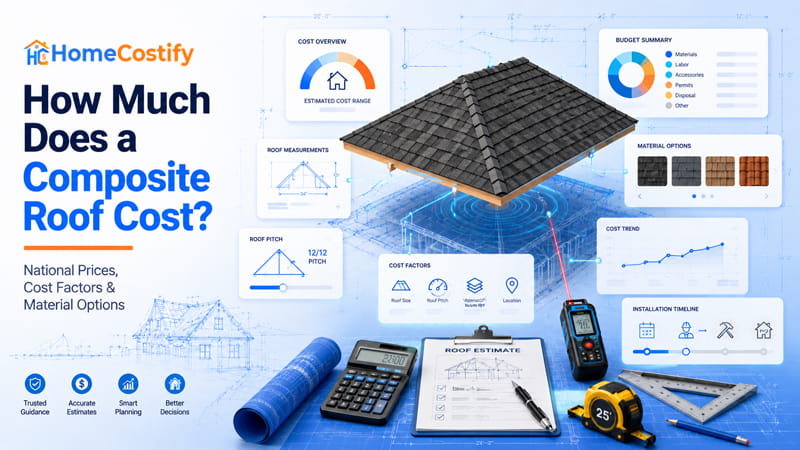
A typical composite roof cost in the United States ranges from $15,000 to $26,500 for a professionally installed roof.
National installed pricing generally falls between $7 and $$14 per square foot, giving buyers a realistic starting point before requesting contractor estimates.
Average Composite Roof Cost in the U.S.
Most projects that fall within the national average involve detached single-family houses with straightforward roof layouts.
Homes with multiple roof sections, steep slopes, or custom architectural details often receive higher estimates even before optional upgrades enter the proposal.
Material pricing usually ranges from $4–$10 per square foot, and installation commonly adds $3–$5 per square foot.
| National Composite Roof Cost Snapshot | National Average |
|---|---|
| Installed Cost | $15,000–$26,500 |
| Installed Cost per Sq. Ft. | $7–$14 |
| Material Cost | $4–$10 |
| Labor Cost | $3–$5 |
| Roofing Square | $700–$1,400 |
National averages establish a budgeting baseline, not a guaranteed contract price. One contractor may include tear-off, flashing replacement, disposal, and permit fees from the beginning, whereas another lists those items as separate line items.
Composite Roof Cost Per Square Foot
Square-foot pricing is commonly used during early budgeting because it scales quickly across roofs of different sizes.
Contractors frequently convert that figure into a Roofing Square, with one square representing 100 square feet, when calculating material quantities and preparing detailed estimates.
Terms such as composite roof per square foot and composite roof price per sf often appear in preliminary quotes for the same reason.
Typical Composite Roof Replacement Cost
A typical composite roof replacement cost usually covers removal of the existing roof, installation of new roofing materials, job-site cleanup, and debris disposal.
Quotes that appear unusually low sometimes exclude part of that work, making direct price comparisons difficult without reviewing the scope of work.
Reviewing every item included in a proposal gives a more realistic picture of the expected roof replacement cost.
A proposal with a lower total is not always the lower-cost project. Missing line items such as tear-off, disposal, or flashing replacement can change the final roof replacement cost by thousands of dollars after the estimate is fully itemized.
Composite Roof Cost by Material Type

Material choice has a larger effect on pricing than most people expect. A difference of only a few dollars per square foot can add thousands to the final composite roofing cost on an average-sized roof.
Manufacturing methods, product profiles, and finish quality all influence pricing long before installation begins. The result is a wide price range across premium composite products.
Composite Shingles Cost
For buyers moving beyond standard asphalt, composite shingles cost usually represents the lowest entry into the premium composite category. Installed pricing generally ranges from $7 to $10 per square foot.
Clean roof lines suit everything from ranch homes to newer suburban construction. Product families from CertainTeed and GAF are common choices for projects that balance appearance with budget, keeping composite roof cost below the higher-end synthetic options.
Synthetic Slate Roof Cost
Premium curb appeal comes with a higher price tag. The average synthetic slate roofing cost typically falls between $9 and $14 per square foot installed, reflecting the deeper molds and detailed textures required during manufacturing.
Roofs from DaVinci Roofscapes and EcoStar can closely resemble natural slate from ground level. That visual detail is a major reason this category sits above composite shingles in the composite roofing cost range.
Synthetic Cedar Shake Roof Cost
Rustic homes, lake houses, and Craftsman designs often pair well with Synthetic Shake roofing. Installed pricing generally falls between $9 and $15 per square foot. Wide exposures, pronounced grain textures, and thicker butt ends create stronger shadow lines across the roof.
Keeping every course aligned takes more precision than flatter roofing profiles, adding to the finished project price.
Composite Tile Roof Cost
Composite Tile products usually range from $10 to $14 per square foot installed, placing them at the upper end of the market. Curved profiles create a roofline that stands out from a distance.
Manufacturers such as Brava Roof Tile produce a wide selection of composite roof colors, making this category a frequent choice for Mediterranean and Spanish-inspired homes.
The profile itself requires more intricate manufacturing than flatter products, contributing to a higher composite roof cost.
Which Material Offers the Best Value?
Lower pricing does not automatically translate into the strongest value over the life of a roof. Spending more at the beginning can make sense when the product stays in service much longer before replacement becomes necessary.
Purchase price deserves attention. Expected service life deserves equal attention.
| Material | Installed Cost / Sq. Ft. | Typical Lifespan |
|---|---|---|
| Composite Shingles | $7–$10 | 30–40 years |
| Synthetic Slate | $9–$14 | 40–50+ years |
| Synthetic Cedar Shake | $9–$15 | 40–50 years |
| Composite Tile | $10–$14 | 40–50 years |
The gap between these products comes from manufacturing complexity as much as raw materials. Deeper profiles require larger molds, textured finishes demand extra production steps, and premium product lines undergo more detailed finishing before shipment.
Installation becomes more demanding as profiles grow thicker or more intricate, adding another layer to the final composite roofing cost.
Composite Roof Cost per Square, Square Foot & Bundle
Roofing estimates are not always presented in the same format. One proposal may use square feet, another may rely on roofing squares, and product catalogs sometimes list material pricing by bundle.
Recognizing the difference between these units makes contractor quotes much easier to interpret.
Composite Roof Cost per Roofing Square
A Roofing Square equals 100 square feet of roof area and remains the measurement contractors use most often when preparing estimates. Material orders, waste calculations, and bid sheets are commonly built around this unit because it matches the way roofing products are purchased and installed.
A proposal showing $700–$1,400 per square refers to the same measurement commonly searched as composite roof per square.
Composite Roof Cost per Square Foot
Square-foot pricing is familiar to most homeowners because it connects directly to roof area. Estimating composite roof cost with a per-square-foot figure makes preliminary budgeting quicker before detailed measurements are completed.
Terms such as composite roof per square foot and composite roof price per sf often appear during the early quoting process, then convert into roofing squares once the contractor prepares a complete estimate.
Composite Roof Cost per Bundle
A Bundle is common with asphalt and composition shingles, but premium composite roofing products are packaged differently.
Synthetic slate, synthetic shake, and composite tile products are frequently sold by piece, carton, or pallet instead of by bundle. A published composite roof per bundle price may represent only one product line, making direct comparisons unreliable across different manufacturers.
| Composite Roof Pricing Units | National Average |
|---|---|
| Per Square Foot | $7–$14 |
| Per Roofing Square | $700–$1,400 |
| Material per Bundle* | $45–$90 (selected products) |
Bundle pricing should be treated carefully when comparing premium roofing products. Coverage per package varies from one manufacturer to another, and some product lines are never sold by bundle at all.
Matching prices without checking coverage can produce misleading budget estimates for the same composite roofing cost.
Composite Roof Cost by Roof Size

Roof area forms the starting point for estimating project costs. More square footage requires more roofing material, longer installation time, and greater disposal capacity.
National pricing becomes far more useful once it is matched with the size of the roof being replaced.
Small Roofs (1,000–1,500 sq. ft.)
Roofs in this range are common on smaller ranch homes, cottages, and compact single-story houses. Estimated pricing runs from $7,000–$14,000 for 1,000 square feet and $10,500–$21,000 for 1,500 square feet. Smaller projects usually finish faster.
Material quantities remain manageable, making this range a common starting point when estimating composite roof cost.
Medium Roofs (1,600–2,500 sq. ft.)
This size covers a large share of detached homes across the United States. A 2,000-square-foot roof generally falls between $14,000 and $28,000, with 2,500 square feet reaching roughly $17,500–$35,000.
Garages, covered patios, and intersecting roof sections often add usable roof area beyond the home’s interior floor space. That extra surface can influence the final roof cost even when the living area appears similar.
Large Roofs (2,600–4,000 sq. ft.)
Large houses require substantially more roofing material, producing higher overall project totals. Estimated pricing ranges from $21,000–$42,000 for 3,000 square feet and $28,000–$56,000 for 4,000 square feet.
Roofs of this size frequently include multiple wings, attached garages, or extended outdoor living spaces. Each section contributes additional roofing area that must be measured and covered.
Why Larger Roofs Don’t Always Cost More Per Square Foot
Large projects sometimes produce a lower cost per square foot because fixed setup expenses are spread across a wider roof area. Equipment delivery, dumpsters, and site preparation remain relatively similar whether the crew replaces a medium roof or a much larger one.
Longer uninterrupted roof sections can keep crews working more efficiently, reducing downtime between work areas.
| Roof Size | Estimated Installed Cost |
|---|---|
| 1,000 sq. ft. | $7,000–$14,000 |
| 1,500 sq. ft. | $10,500–$21,000 |
| 2,000 sq. ft. | $14,000–$28,000 |
| 2,500 sq. ft. | $17,500–$35,000 |
| 3,000 sq. ft. | $21,000–$42,000 |
| 4,000 sq. ft. | $28,000–$56,000 |
Roof size establishes the starting estimate, not the final contract value. Two homes measuring 2,000 square feet can still produce different composite roofing cost figures because roof layout, intersecting sections, and installation complexity determine how much work is required after measurements are complete.
Composite Roof Installation Cost Breakdown
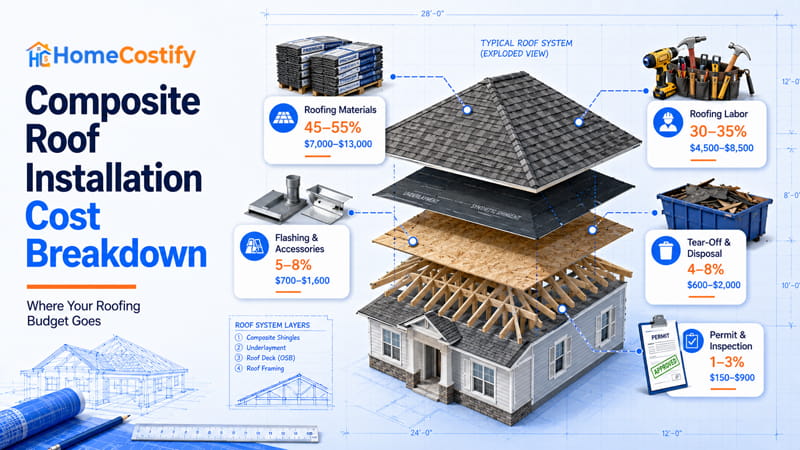
Material prices receive most of the attention, yet they represent only part of the project budget. Installation crews, roof accessories, tear-off work, permits, and cleanup all contribute to the final composite roof cost.
Breaking a proposal into individual cost categories makes it much easier to judge whether one quotation is reasonably priced or simply structured differently.
Roofing Materials
Roofing materials usually account for the largest share of a replacement project, often representing 45% to 55% of the total budget. That portion covers the primary roofing product along with underlayment, starter courses, ridge components, and other required materials supplied with the system.
Premium product selections naturally increase this portion of the estimate. Lower-priced materials leave a larger share of the budget available for other project expenses.
Roofing Labor Cost
Installation commonly represents 30% to 35% of the total project value, making roofing labor cost the second-largest expense after materials. Crew size, installation time, safety requirements, and local wage levels all contribute to this portion of the quotation.
Labor charges remain visible even when two projects use identical roofing products. Faster installation does not always translate into a lower bill if additional craftsmanship is required across the roof.
Accessories & Flashing
Accessories account for a much smaller percentage of the budget, yet they remain essential to the finished roof system.
Flashing, ridge ventilation components, drip edge, pipe boots, and fastening hardware typically represent 5% to 8% of total project costs. Individual parts may appear inexpensive on their own. Combined across an entire roof, they become a meaningful part of the overall composite roofing cost.
Tear-Off, Disposal & Permits
Removing the existing roof creates another category that deserves attention before comparing estimates. Old shingles, underlayment, nails, and other debris must be removed, transported, and disposed of according to local requirements.
Permit fees and inspections vary by jurisdiction, adding another small percentage to the final project budget. A quotation that includes these items from the beginning often appears higher than one that lists them separately.
| Composite Roof Installation Cost Breakdown | Typical Share | Average Cost |
|---|---|---|
| Roofing Materials | 45–55% | $7,000–$13,000 |
| Roofing Labor | 30–35% | $4,500–$8,500 |
| Flashing & Accessories | 5–8% | $700–$1,600 |
| Tear-Off & Disposal | 4–8% | $600–$2,000 |
| Permit & Inspection | 1–3% | $150–$900 |
Comparing quotations by percentage often reveals differences that a single total price cannot. One contractor may allocate a larger share to materials, another may budget more for labor, and a third may include accessories or permits that appear as optional charges elsewhere.
Reading each category side by side provides a stronger basis for evaluating total composite roof cost and composite roofing cost.
What Affects Composite Roof Cost?
Two houses with similar dimensions can receive noticeably different estimates. Roof design, job-site conditions, regional pricing, and product availability all influence the amount of work required before the first shingle is installed.
Small changes in project conditions can produce meaningful differences in the final proposal.
Roof Pitch
Steeper roofs require slower movement, additional safety equipment, and extra staging. Crews spend more time securing materials and repositioning themselves across the roof surface.
Even a modest increase in roof pitch can add measurable labor hours to the project.
Roof Complexity
Simple roof layouts move quickly from one section to the next. Dormers, intersecting ridges, valleys, skylights, and multiple roof planes introduce extra cutting, fitting, and flashing work.
Every transition demands additional attention before installation continues.
Accessibility
Job-site access affects productivity from the first delivery until the final cleanup. Long carrying distances, limited driveway access, landscaping obstacles, or restricted staging areas slow material movement across the property.
Disposal work follows the same path, extending project time.
Local Labor Rates
Regional labor markets vary across the United States. Metropolitan areas often carry higher installation costs than smaller communities, even when identical roofing products are used.
Local demand for experienced roofing crews can widen that difference during peak construction seasons.
Material Availability
Some premium composite products are stocked locally, whereas others must be shipped from regional warehouses or directly from the manufacturer.
Longer delivery distances, special-order colors, or limited inventory can affect scheduling as well as total composite roofing cost.
- Steeper roofs — Require additional safety precautions and longer installation time.
- Multiple valleys — Increase cutting, fitting, and flashing work.
- Limited access — Slows material delivery and debris removal.
| Cost Impact by Project Complexity | Typical Cost Impact |
|---|---|
| Steep Roof Pitch | +10–20% |
| Two-Story Home | +5–10% |
| Multiple Valleys | +8–15% |
| Difficult Access | +5–10% |
The Insurance Institute for Business & Home Safety notes that long-term roof durability depends on the complete roofing system, including fastening methods and installation quality, not only the roofing product itself.
Two proposals using the same material can legitimately produce different prices when installation methods, fastening patterns, or system specifications are not identical. That difference often has a direct effect on both composite roof cost and long-term roof performance.
Additional Composite Roof Costs to Budget For

Some expenses only appear after the old roofing material has been removed. Hidden damage, required upgrades, and local permitting requirements can increase the final project total even when the original estimate appears complete.
Leaving room in the budget for these possibilities reduces the chance of unexpected surprises.
Roof Inspection
A professional roof inspection may be recommended before replacement begins or after hidden conditions are uncovered during tear-off.
Inspection fees commonly range from $150 to $400. Early findings often clarify whether additional repairs are required before new roofing materials are installed.
Roof Deck Repairs
Removing old shingles occasionally exposes damaged roof sheathing that was impossible to evaluate from the surface.
Soft decking, moisture damage, or deteriorated panels typically require replacement before installation continues. Repair costs commonly range from $2 to $5 per square foot.
Flashing & Ventilation Upgrades
Older flashing components do not always meet current installation standards or match new roofing products. Replacing flashing, improving attic ventilation, or updating edge details can add $300 to $1,500 to the project.
These upgrades are frequently completed during replacement because the roof structure is already exposed.
Permit & Disposal Fees
Permit requirements vary by city and county, and disposal charges depend on the amount of material removed from the roof. Permit fees generally range from $150 to $500, with tear-off and disposal adding $1 to $5 per square foot. Large roofs naturally generate more debris than compact projects.
| Additional Cost | Typical Cost |
|---|---|
| Roof Inspection | $150–$400 |
| Roof Deck Repair | $2–$5/sq. ft. |
| Flashing Replacement | $300–$1,500 |
| Permit | $150–$500 |
| Tear-Off & Disposal | $1–$5/sq. ft. |
The Insurance Institute for Business & Home Safety FORTIFIED Home program includes upgrades such as sealed roof decks, reinforced roof edges, and enhanced fastening methods for stronger wind resistance.
Projects incorporating these improvements usually carry higher upfront costs, although they strengthen the roof system against severe weather.
Including room for these items during budgeting produces a more realistic composite roof cost estimate and a more complete picture of total composite roofing cost.
Is a Composite Roof Worth the Cost?
A roof is one of the few home improvements where the lowest purchase price does not always produce the lowest lifetime expense.
Looking beyond the initial installation makes it easier to judge whether the composite roof cost delivers lasting value through durability, lower maintenance, and fewer replacement projects over the decades.
Composite Roof Lifespan
One of the biggest reasons homeowners choose composite roofing is its impressive service life. While premium asphalt shingles often last around 20 to 30 years under normal conditions, many composite roofing products are designed to perform for 40 to 50 years, with some premium systems lasting even longer when properly maintained.
A longer composite roof lifespan means the installation cost is spread over many more years. Instead of budgeting for another complete roof replacement after two or three decades, many homeowners may never need to replace the roof again while they own the property.
Climate, installation quality, attic ventilation, and routine maintenance all influence actual composite roof life expectancy. Even so, composite roofing consistently ranks among the longest-lasting alternatives to traditional asphalt shingles.
Annual Ownership Cost
The sticker price tells only part of the story. Dividing the installation cost by the expected lifespan often provides a clearer picture of long-term value.
For example, a homeowner spending about $22,000 on a composite roof with a 50-year lifespan is effectively paying around $440 per year before maintenance costs. By comparison, a $13,000 asphalt roof lasting 25 years works out to roughly $520 annually.
Although the upfront composite roof cost is higher, the yearly ownership expense can actually be lower because the roof remains in service much longer. This is especially important for homeowners planning to stay in the same house for many years.
Maintenance & Repair Expectations
Composite roofing requires relatively little routine maintenance compared with many traditional roofing materials. Regular inspections, clearing leaves from valleys, and keeping gutters clean are usually enough to prevent most problems.
Because composite shingles resist moisture, cracking, insect damage, and UV exposure better than many conventional products, repair needs are often less frequent.
When damage does occur from severe storms or falling branches, composite roof repairs cost depends on the affected area, roof accessibility, and whether matching replacement shingles remain available.
Keeping up with minor repairs early is generally far less expensive than allowing moisture intrusion to spread into the roof deck or attic.
Insurance & Long-Term Value
Some insurers view high-quality composite roofing as a durable roofing option because many products offer excellent resistance to wind, hail, and fire.
Depending on the product rating, local insurance market, and carrier guidelines, homeowners may qualify for lower premiums, although discounts are never guaranteed.
Composite roofs can also improve resale appeal. Buyers often appreciate knowing that a recently installed roof may not require replacement for decades, reducing one of the largest future maintenance concerns.
Long-Term Cost Comparison
| Roofing Material | Installed Cost | Lifespan | Estimated Annual Cost |
|---|---|---|---|
| Asphalt Shingles | $13,000 | 25 years | ≈ $520/year |
| Composite Roofing | $22,000 | 50 years | ≈ $440/year |
Overall, composite roofing can provide strong long-term value because it offers:
- Lower replacement frequency.
- Reduced long-term maintenance.
- Better value for long-term homeowners.
Composite Roof Cost vs. Other Roofing Materials
Comparing roofing materials side by side helps put the composite roofing cost into perspective.
While composite roofing sits in the middle of the price range, it often delivers a balance of durability, appearance, and lifetime value that many homeowners find attractive.
Asphalt Shingles
Asphalt remains the most affordable roofing option, with an average asphalt shingles cost of roughly $4 to $8 per square foot installed.
The lower upfront investment appeals to budget-conscious homeowners, but asphalt typically has a shorter lifespan and may require replacement decades earlier than composite roofing.
Metal Roofing
The average metal roofing cost ranges from approximately $8 to $18 per square foot installed, depending on the metal type and profile.
Metal roofs are known for exceptional longevity and energy efficiency, although installation is usually more specialized and often costs more than many composite systems.
Natural Slate Roofing
Natural slate represents the premium end of residential roofing. Typical slate roofing cost ranges from $15 to $30 or more per square foot installed.
Slate offers unmatched longevity and timeless appearance, but its heavy weight may require structural reinforcement, adding to the overall project budget.
| Roofing Material | Installed Cost per Sq. Ft. |
|---|---|
| Asphalt Shingles | $4–$8 |
| Composite Roofing | $7–$14 |
| Metal Roofing | $8–$18 |
| Natural Slate roofing | $15–$30+ |
The right choice depends on your priorities. While the composite roofing cost exceeds asphalt, it generally remains more affordable than premium slate and can compete well with many metal roofing systems.
For homeowners seeking durability without paying luxury roofing prices, the composite roof cost often represents a practical middle ground.
How to Estimate Your Composite Roof Budget
Planning ahead makes it easier to understand the likely composite roof cost before requesting contractor estimates. A few basic calculations can produce a realistic starting budget.
Measure Your Roof
Start by estimating your roof’s total square footage. Remember that roof area is usually larger than your home’s floor area because of roof pitch, overhangs, dormers, and other architectural features.
Choose a Material
Composite roofing products vary in price depending on their profile, manufacturer, warranty, and performance ratings. Selecting the material early helps narrow your expected composite roofing cost.
Add Labor & Hidden Costs
Material pricing is only one part of the project. Labor, tear-off and disposal, underlayment, flashing replacement, ventilation upgrades, permits, and unexpected deck repairs can all increase the final composite roof cost.
A simple budgeting checklist includes:
- Estimate roof size.
- Select the material.
- Add installation and additional costs.
- Compare multiple contractor quotes.
Obtaining at least three detailed estimates allows you to compare pricing, warranty coverage, and the scope of work before making a final decision.
Final Thoughts
A composite roof costs more than traditional asphalt shingles, but the higher investment often comes with a longer lifespan, lower maintenance needs, and fewer replacement cycles. When evaluated over several decades, the annual ownership cost can compare favorably with less expensive roofing materials.
The best value depends on your budget, how long you plan to stay in the home, your local climate, and the quality of installation. Looking beyond the initial price and considering lifetime ownership costs provides a more complete picture of whether composite roofing is the right investment for your property.
FAQs About Composite Roof Cost
What is the average cost of a composite roof?
Most homeowners spend between $7 and $14 per square foot installed, or roughly $14,000 to $28,000 for a typical residential project, depending on roof size, material quality, and labor rates.
Is a metal roof more expensive than composite?
In many cases, yes. Metal roofing generally costs between $8 and $18 per square foot installed, although some basic metal panels may be priced similarly to premium composite roofing.
What is the lifespan of a composite roof?
Most composite roofs last 40 to 50 years, while premium products may exceed that with proper installation and regular maintenance.
How do you maintain a composite roof?
Routine maintenance includes cleaning gutters, removing debris, inspecting flashing, checking for storm damage, and replacing damaged shingles promptly to prevent water intrusion.
Can you pressure wash a composite roof?
Pressure washing is generally not recommended because high-pressure water can damage shingles or remove protective finishes. Manufacturers typically recommend low-pressure cleaning methods and roof-safe cleaning solutions instead.