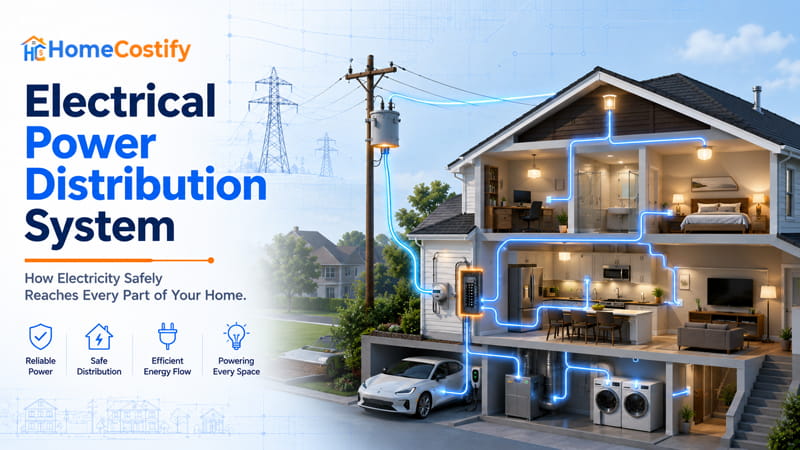
A light switch, a kitchen outlet, and an air conditioner all respond within seconds after someone presses a button or flips a switch. Behind that routine sits an electrical power distribution system that moves electricity from the utility grid to every part of a house without drawing much attention during a normal day.
Most families only notice the network after a power outage, a tripped breaker, or lights that suddenly begin flickering. Ordinary routines quickly change once electricity stops arriving where it should.
Power begins its journey far from the neighborhood where it will eventually be used. A utility company delivers electricity across a vast distribution network, linking generating facilities with homes through equipment built for residential electricity rather than transmission-level power.
Every stop along the way prepares electricity for the next stage before it reaches outlets, lighting, and permanently installed appliances. The process stays hidden behind walls, utility poles, and underground cables, making it easy to overlook.
An electrical power distribution system exists to move electricity safely from large-scale electrical infrastructure into spaces where people cook, work, relax, and charge everyday devices. Voltage arriving from the utility grid cannot enter a house in its original form because household wiring and electrical equipment are built for a much lower service level.
Controlled delivery keeps electricity suitable for daily use across the entire home. Even small interruptions can quickly disrupt routines that normally feel effortless.
Growing electrical demand has changed what families expect from residential electricity. Heat pumps, induction cooktops, battery storage, home offices, and electric vehicle chargers place far greater demands on electrical power distribution than a typical house required years ago.
Expansion continues as new technologies become part of everyday living. A clear picture of the distribution network makes future electrical decisions far easier to evaluate before new loads are added.
What Is an Electrical Power Distribution System?
Electricity reaches far more than a single room or appliance once it enters a house. An electrical power distribution system is the network that carries electrical power from the utility supply to locations where people use it every day, creating a safe connection between the transmission grid and residential electrical service without exposing household wiring to transmission voltage.
Definition and Primary Purpose
Power stations may generate enormous amounts of electricity, yet wall outlets never receive energy directly from the transmission system. An electrical power distribution system begins where large-scale transmission gives way to local delivery, using a distribution substation, a distribution network, and carefully managed voltage reduction before electricity reaches end users.
Each stage prepares electricity for a lower operating voltage suitable for homes. Without that transition, energy carried across the utility grid would remain far beyond the limits of residential electrical equipment.
Large transmission corridors stretch across states because moving electricity over long distances works best at high voltage. Local neighborhoods operate under very different electrical conditions.
Electrical power distribution bridges those two environments, converting bulk electricity into a supply that matches everyday household demand without changing where the energy originally came from.
Every light fixture, receptacle, and permanently wired appliance depends on electricity that has already passed through that distribution chain.
Why Electrical Power Distribution Is Important
High-voltage electricity traveling across regional power lines carries far more energy than household wiring can safely receive. A distribution transformer lowers the voltage before electricity reaches the service entrance, and the electrical meter records consumption before power continues into the home electrical system.
Household appliances are built around standardized residential service rather than transmission voltage. Stable electrical conditions protect motors, electronic controls, and other equipment from unnecessary stress during normal operation.
Voltage that remains within its intended operating range keeps electrical equipment working as expected throughout daily use. Large swings can shorten the service life of sensitive electronics, interrupt appliance operation, or trigger nuisance breaker trips.
Safe residential electricity depends on controlled delivery long before power reaches a wall outlet. Electrical safety begins across the utility network instead of inside the breaker panel alone.
How Modern Distribution Systems Are Changing
Neighborhood electrical demand looks very different from what utilities managed a few decades ago. Rooftop solar, battery storage, home electrification, and EV charger installations introduce new patterns of electricity moving across the local network, including bidirectional power flow created by distributed generation.
Power no longer travels in only one direction from the grid to every house. Grid planning now accounts for electricity moving back toward utility equipment under certain operating conditions.
According to the U.S. Department of Energy, the electrical power distribution system continues to evolve as utilities expand the use of smart grid technologies and integrate growing levels of distributed energy resources across local networks.
Utility planners now prepare for neighborhoods where electricity may be produced as well as consumed. Growing electrification continues to reshape long-term distribution planning.
- Integrates distributed energy resources (DER) into local distribution networks.
- Accommodates growing numbers of rooftop solar installations.
- Expands grid flexibility for battery storage systems.
- Supports rising residential EV charging demand.
How Electrical Power Distribution Works

Electricity begins another stage of its journey after leaving the high-voltage transmission network. Local electrical power distribution gradually lowers voltage through dedicated utility equipment before residential service reaches a house.
Every stage prepares electricity for the next destination. The sequence keeps power suitable for everyday use.
| Step | Where Electricity Goes | Main Purpose |
|---|---|---|
| 1 | Transmission Network → Distribution Substation | Begin local electricity distribution |
| 2 | Distribution Substation → Feeders | Deliver electricity to neighborhoods |
| 3 | Feeders → Distribution Transformer | Prepare electricity for residential use |
| 4 | Transformer → Service Entrance | Supply electricity to individual properties |
| 5 | Main Service Panel → Branch Circuits | Distribute electricity throughout the home |
Electricity Leaves the Transmission Network
Steel towers carrying high-voltage electricity often stretch across open land long before power reaches a neighborhood. The electrical power distribution system begins after electricity leaves the transmission system and enters a distribution substation, where voltage reduction prepares energy for shorter travel distances.
Transmission lines move electricity across regions. Local distribution focuses on supplying nearby homes and businesses connected to the utility grid.
Moving electricity across hundreds of miles demands much higher voltage than household wiring could ever tolerate. Lower voltage becomes practical once electricity reaches local service areas.
Each reduction balances efficient delivery with equipment built for residential use. Electrical power distribution begins only after bulk transmission has completed its part of the journey.
Distribution Feeders Deliver Electricity Locally
Neighborhood streets usually reveal the next stage through wires running along utility poles or cables hidden beneath sidewalks. A distribution feeder carries electricity away from the substation and spreads it across residential and commercial areas without stopping at every building along the route.
Some communities rely on overhead distribution. Others use underground distribution with buried underground cables instead of exposed feeder lines.
Population density, weather conditions, local regulations, and construction costs often influence how utilities build neighborhood distribution routes.
Older communities frequently retain utility poles installed decades ago. New developments may place electrical lines below ground for appearance or storm protection. Both layouts deliver electricity toward the same destination.
Distribution Transformers Reduce Voltage for Safe Use
Gray transformers mounted on poles or green cabinets placed near sidewalks often blend into the surrounding landscape. Every distribution transformer performs another stage of voltage regulation, lowering electricity to the 120/240-volt service used by most U.S. homes before power continues toward nearby buildings.
A pole-mounted transformer serves overhead systems. A pad-mounted transformer commonly appears where underground utilities are installed.
An electrical power distribution system would never deliver transmission voltage directly into household wiring. Residential equipment operates within carefully established service limits.
Electrical panels, lighting, appliances, and electronic devices all depend on electricity prepared long before reaching the front of a house. Safe residential service begins at the transformer instead of the breaker panel.
Electricity Enters and Moves Through Your Home
Power reaches private property through a service drop suspended from overhead lines or a buried service lateral connected below ground. Electricity first passes through the electrical meter, giving the utility a way to record energy consumption before entering the main service panel.
Every house follows the same general path. Small differences usually depend on local utility construction standards.
Inside the electrical panel, circuit breaker positions separate incoming electricity into multiple branch circuits serving different parts of the house. Kitchen receptacles, bathroom outlets, bedroom lighting, laundry equipment, and large appliances rarely share a single circuit because electrical demand varies across each area.
Organized circuit layouts simplify future maintenance. Overloaded wiring becomes far less likely when electrical loads remain properly distributed.
Light switches, receptacles, ceiling fixtures, HVAC equipment, and permanently installed appliances receive electricity only after branch circuits complete the final stage of distribution. Daily routines rarely reveal how much planning sits behind every energized outlet.
Coffee makers, refrigerators, televisions, and charging stations all draw power from circuits assigned inside the panel. Anyone curious about electrical system works quickly discovers that utility distribution and in-home distribution form one continuous path rather than two separate systems.
Key Stages of Residential Power Distribution
Every stage changes either the location of electricity or the voltage carried along the line before power reaches household wiring.
Bulk transmission covers long distances, neighborhood distribution narrows the delivery area, and the transformer prepares electricity for residential service before the electrical panel divides power into branch circuits.
The electrical meter records usage along the way. Each stage depends on the one before it.
- High-voltage electricity leaves the transmission grid.
- Distribution substations lower voltage for local delivery.
- Feeders transport electricity through neighborhoods.
- Distribution transformers prepare usable residential voltage.
- The main service panel divides electricity into branch circuits.
Main Components of an Electrical Power Distribution System

Electricity passes through a chain of equipment before reaching the first energized outlet inside a house. Every electrical power distribution system combines utility-owned equipment with residential service equipment, and each component handles a different part of the journey from the utility grid to the final branch circuit.
| Component | Primary Function | Typical Location |
|---|---|---|
| Distribution Substation | Reduces transmission voltage | Utility network |
| Distribution Feeder | Delivers electricity locally | Neighborhood distribution lines |
| Distribution Transformer | Supplies usable residential voltage | Pole or pad mounted |
| Service Entrance | Connects utility service to property | Exterior of the home |
| Electrical Meter | Measures electricity consumption | Meter base |
| Main Service Panel | Distributes electricity to branch circuits | Inside the home |
Distribution Substations
Large electrical yards filled with steel structures usually mark the point where regional transmission gives way to neighborhood service. A distribution substation receives electricity from the transmission network, performs controlled voltage reduction, and prepares power for local distribution across nearby communities.
Utility equipment inside the yard operates under carefully coordinated conditions. Local distribution begins once electricity leaves the substation.
Distribution Feeders
Power lines stretching along streets or disappearing beneath new subdivisions form the next link in the distribution chain. A distribution feeder carries electricity away from the substation and routes it through neighborhoods using feeder lines, overhead distribution, or buried underground cables, depending on local construction practices.
One feeder may supply hundreds of nearby houses. Utilities often build multiple feeder routes across larger service areas.
Distribution Transformers
Green metal cabinets beside sidewalks and cylindrical cans mounted high on utility poles perform the same basic task despite their different appearance. A distribution transformer converts incoming electricity into residential service voltage before power enters nearby houses.
A pole-mounted transformer usually serves overhead utility lines. A pad-mounted transformer commonly appears in neighborhoods with underground electrical service.
Service Entrance and Electrical Meter
Electrical service reaches private property through overhead conductors or underground cables before crossing into the house.
The service entrance marks the connection between utility equipment and the home’s electrical system, while the service drop or underground service lateral delivers incoming electricity to the electrical meter for consumption tracking.
Meter readings determine monthly electric bills. A secure meter socket keeps the connection stable under normal operating conditions.
Main Service Panel and Branch Circuits
Opening the panel door reveals rows of breakers instead of a single switch controlling every room. The electrical power distribution system reaches its final distribution point inside the electrical panel, where each circuit breaker directs electricity into dedicated branch circuits serving lighting, receptacles, kitchen equipment, HVAC units, and other household loads.
Electricians often refer to the panel as a load center, distribution panel, power distribution board, or breaker panel, depending on the installation and regional terminology. Anyone exploring the components of a home electrical system will find the main panel at the center of nearly every electrical upgrade, inspection, or future circuit addition.
Distribution Voltage Levels Explained
Electricity does not keep the same voltage from the power plant to a kitchen outlet. Voltage changes in carefully controlled stages so electricity can travel long distances with lower energy losses before reaching homes and businesses at a level suited for everyday use.
| Distribution Stage | Typical U.S. Voltage | Primary Purpose |
|---|---|---|
| Transmission | 115–765 kV | Long-distance transmission |
| Primary Distribution | 4–35 kV | Local electricity distribution |
| Secondary Distribution | 120/240 V | Residential electricity supply |
Transmission Voltage
Tall steel towers carrying power across highways and open countryside operate at extremely high transmission voltage. High-voltage electricity moves through transmission lines as part of the bulk power system, allowing utilities to deliver power over long distances with far lower energy losses than lower-voltage networks.
Long-distance delivery comes first. Electrical power distribution begins only after electricity reaches the local network.
Primary Distribution Voltage
Electrical equipment inside neighborhood substations lowers voltage before electricity continues toward nearby streets. Primary distribution commonly operates between 4 kV and 35 kV in the United States, giving each distribution feeder enough capacity to supply homes, schools, and commercial buildings across a local distribution area.
Voltage remains too high for residential wiring. Another reduction still lies ahead.
Secondary Distribution Voltage
Green transformer cabinets and pole-mounted transformers mark the final voltage change before electricity reaches a house. A distribution transformer converts incoming electricity into 120/240-volt service voltage, creating the secondary distribution level used for residential service across most U.S. neighborhoods.
Household wiring is built around that standard. Everyday electrical equipment depends on the same service level.
Why Homes Use 120/240 Volts
Kitchen appliances, lighting, televisions, computers, and HVAC equipment all share one expectation before receiving power.
Residential wiring follows standardized residential voltage established through long-standing electrical code requirements, giving manufacturers a consistent electrical supply for household appliances sold across the country.
Lower-voltage circuits handle lighting and receptacles. Larger appliances draw 240-volt power where additional electrical capacity is required without changing the residential service standard.
Types of Electrical Power Distribution Systems
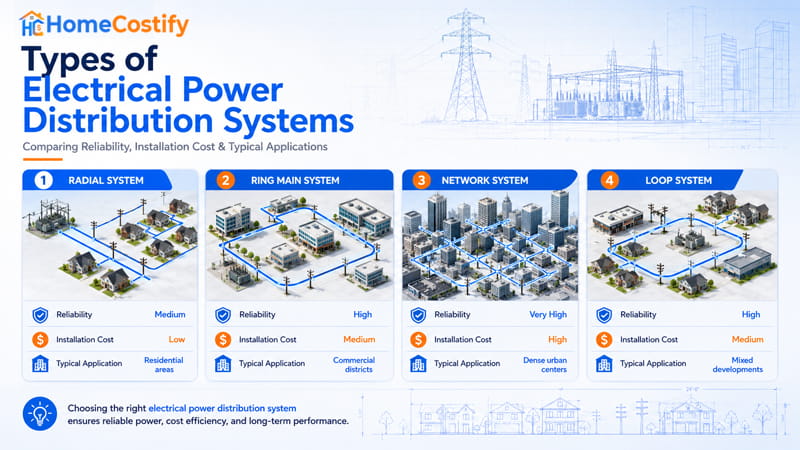
Neighborhood streets do not all receive electricity through the same layout. Utilities choose a distribution configuration based on service reliability, construction cost, local demand, and future expansion plans.
Four designs appear most often across utility networks. Each one fits a different operating environment.
| System Type | Reliability | Installation Cost | Typical Application |
|---|---|---|---|
| Radial | Medium | Low | Residential areas |
| Ring Main | High | Medium | Commercial districts |
| Network | Very High | High | Dense urban centers |
| Loop | High | Medium | Mixed developments |
Radial Distribution System
A single feeder leaving a substation often supplies an entire neighborhood without another incoming supply path. A radial distribution system follows that layout, sending electricity through one primary route before branching into local distribution lines connected to homes and nearby buildings.
Utilities favor the radial system because construction costs remain relatively low. Repairs or maintenance can interrupt service beyond the affected section until power returns.
Residential neighborhoods across the United States commonly use radial layouts because suburban development usually spreads outward from local substations. Long feeder routes remain practical across lower-density communities.
Fewer switching devices simplify day-to-day operation. An electrical power distribution system built around radial feeders remains the standard choice for most suburban developments.
Ring Main Distribution System
Busy commercial streets rarely tolerate long service interruptions during normal business hours. A ring main system connects distribution equipment in a closed loop, allowing electricity to reach part of the network from another direction after switching operations isolate a damaged section.
Alternate supply paths create additional operating flexibility. Local outages often remain confined to a much smaller area.
Stores, office buildings, and mixed commercial districts frequently benefit from this arrangement because uninterrupted electrical service carries greater operational value. More equipment increases construction complexity.
Utilities balance additional cost against higher service continuity. Dense business areas often justify the added infrastructure.
Network Distribution System
Downtown skylines place extraordinary demands on the local electrical network every hour of the day. A network distribution system links multiple power sources through an interconnected grid, creating overlapping supply paths across an urban electrical network serving high-rise buildings, transit systems, hospitals, and major business districts.
Power can continue flowing from another source if one section experiences a fault. Large cities depend on that redundancy every day.
Extensive underground construction usually accompanies network systems in heavily developed urban centers. Utility planning becomes more complex as additional equipment enters the network.
Maintenance requires careful coordination across multiple supply points. High reliability remains the primary reason utilities invest in this configuration.
Loop Distribution System
Roads winding through planned communities often create practical opportunities for a loop distribution layout.
A distribution loop connects feeder sections into a continuous path while still operating differently from a fully interconnected network, giving utilities more routing flexibility than a basic radial arrangement.
One section can be isolated during maintenance. Electricity may continue reaching unaffected areas through another side of the loop.
Which Distribution System Is Most Common?
Driving through suburban neighborhoods usually reveals the answer without anyone noticing the electrical layout overhead.
Electrical power distribution for most U.S. residential distribution networks relies on radial feeders because construction remains economical, expansion is straightforward, and routine maintenance fits well within typical utility distribution practices.
Larger cities often combine multiple distribution designs across different service areas. Local demand usually determines which configuration utilities build first.
How Modern Homes Influence Power Distribution
A typical house now draws far more electricity than it did twenty years ago. Larger electrical loads, renewable energy systems, and new technologies continue changing how utilities plan neighborhood distribution.
Local networks must accommodate far more than lighting and basic appliances. Future expansion is now part of long-term planning.
Growing Residential Electrical Demand
Walk through a newly built house and the electrical demand becomes easy to spot. High-capacity HVAC equipment, induction ranges, larger kitchen appliances, entertainment systems, and a dedicated home office all increase the total electrical load carried by the house throughout the day.
Daily electricity use rarely follows a steady pattern. Morning routines, afternoon cooling, and evening activities create different peaks across the same electrical system.
Utilities account for changing residential demand long before new neighborhoods receive electrical service. Circuit capacity inside a house matters just as much as capacity outside the property line.
Electrical power distribution continues adapting as residential electrical loads grow from one generation of homes to the next. Demand no longer centers on lighting alone.
Rooftop Solar and Battery Storage
Solar panels have become a familiar sight across neighborhoods in many parts of the United States. Electricity produced by rooftop solar can move back toward the utility network through bidirectional power flow, creating a form of distributed generation that differs from traditional one-way electricity delivery.
Local circuits now carry electricity in more than one direction. Distribution planning has expanded alongside that change.
Research from the National Renewable Energy Laboratory (NREL) describes every local distribution system as having a hosting capacity for distributed energy resources. Utilities evaluate how much battery storage and rooftop solar a neighborhood can accommodate before equipment upgrades or operational adjustments become necessary.
Capacity limits vary from one service area to another. Population density, existing equipment, and local demand all shape the final result.
Electric Vehicle Charging and Distribution Capacity
A Level 2 charger draws considerably more electricity than most household devices operating at the same time. One EV charger may add a substantial electrical load, especially during evening hours when air conditioning, cooking equipment, and laundry appliances are already running.
Charging patterns often overlap with existing demand peaks. Local distribution equipment must accommodate both.
Service upgrades have become more common as electric vehicles enter more garages across the country. Existing service capacity may already be close to its practical limit in older houses.
Extra electrical demand sometimes requires panel modifications before charging equipment can be installed. Capacity planning starts long before the charger is mounted on the wall.
Planning Future Electrical Upgrades
A finished basement, workshop, or new addition often brings more circuits than the original electrical design anticipated. Checking load calculation results before adding a subpanel or replacing the main panel creates a clearer picture of available service capacity and future expansion options.
Good planning often prevents expensive surprises later. Electrical upgrades work best when capacity is evaluated before construction begins.
Project budgets extend beyond equipment prices alone. Articles covering electrical installation cost, electrical work cost, and typical electrician labour rates offer useful background while comparing upgrade options or preparing for larger electrical projects.
Labor, permitting, and panel capacity frequently influence the final estimate. Careful planning usually produces a smoother installation process.
Common Electrical Power Distribution Problems
Electricity usually reaches every room without attracting much attention. Small faults can develop gradually inside a distribution system, and early warning signs often appear long before a complete outage occurs.
Routine use places continuous stress on electrical equipment. Recognizing common symptoms early often prevents larger repair work later.
Overloaded Circuits
Busy evenings often place the highest demand on household wiring. Air conditioning, cooking equipment, portable heaters, and multiple household appliances operating together can increase the electrical load on the same branch circuits until a circuit breaker trips.
Repeated overload conditions place extra strain on the electrical panel. Frequent breaker trips usually point to a circuit carrying more electricity than it was intended to handle.
Voltage Fluctuations
Lights that dim for a moment or brighten unexpectedly usually indicate changing voltage somewhere along the supply path.
Poor voltage regulation, loose utility connections, aging equipment, or problems involving a distribution transformer can create unstable service voltage reaching the house. Sensitive electronics often react first. Larger voltage swings may interrupt normal appliance operation or shorten equipment life.
Aging Distribution Equipment
Outdoor electrical equipment faces years of changing weather, temperature swings, and continuous electrical demand. Components with a long service life, including the electrical meter, service entrance, and utility transformer, gradually wear as insulation, connections, and protective parts age over time.
Regular inspections become more valuable as equipment grows older. Worn distribution equipment rarely fails without earlier warning signs.
Warning Signs Homeowners Shouldn’t Ignore
A buzzing panel, warm breaker, or faint burning odor deserves attention even if the lights remain on. Repeated breaker trips, flickering lights, unusual heat around the breaker panel, or irregular behavior across multiple branch circuits often signal developing electrical safety concerns that should not be ignored.
Small symptoms can point to larger electrical issues. Prompt inspection usually limits further damage.
- Frequently tripping breakers
- Flickering or dimming lights
- Burning smells near the electrical panel
- Warm or buzzing electrical equipment
Why Understanding Electrical Power Distribution Matters
Every electrical upgrade depends on more than adding another breaker or installing new wiring. A clear picture of how electricity reaches each circuit creates a stronger foundation for safer planning, realistic capacity decisions, and long-term reliability across the entire house.
Better Safety Decisions
A tripped breaker tells part of the story, but the cause often begins much earlier in the electrical path. Familiarity with electrical power distribution, the service entrance, the breaker panel, and each circuit breaker makes unusual electrical behavior easier to recognize before minor issues develop into larger hazards. Small warning signs deserve attention.
Electrical problems rarely disappear on their own.
Smarter Planning for Future Electrical Needs
A garage conversion or kitchen renovation can change electrical demand far beyond the original design.
New EV charger installations, rooftop solar, battery storage, growing electrical load, and limited panel capacity all deserve consideration before expanding a system or comparing different types of home electrical systems.
Future projects often build on earlier electrical work. Capacity planning keeps expansion options open.
A Stronger Foundation for Home Electrical Knowledge
Every section of a house depends on electricity following the same path from the utility grid to the final circuit.
An electrical power distribution system connects every stage of electrical distribution, creating a continuous path that delivers residential electricity through interconnected equipment instead of isolated components.
Seeing the full picture changes how electrical upgrades are evaluated. Better decisions usually begin with a clearer view of the entire system.
Conclusion
Electricity follows a carefully planned route long before it reaches a light switch or wall outlet. Every electrical power distribution system depends on coordinated utility equipment, controlled voltage changes, and properly sized residential circuits to deliver dependable residential electricity from the utility grid into everyday living spaces.
Small changes in electrical demand can place new pressure on the same network. Future upgrades deserve the same level of planning.
A clearer picture of electrical power distribution makes electrical decisions more practical, whether the project involves adding circuits, installing new equipment, or preparing for larger electrical loads.
Familiarity with the distribution network, the electrical panel, and the work performed by each distribution transformer creates a stronger foundation before any upgrade begins.
Electrical systems continue changing as household demand grows. An electrical power distribution system built around sound planning remains ready for both current needs and future expansion, while dependable electrical power distribution continues supporting everyday life behind the walls.
FAQs About Electrical Power Distribution System
What is the basic electrical power distribution system?
A basic electrical power distribution system carries electricity from the transmission network through substations, feeders, transformers, and service equipment before distributing power to branch circuits inside a house.
What are the types of electrical power distribution system?
The four common configurations are radial, ring main, network, and loop distribution systems. Utilities choose each layout according to reliability requirements, service area, and construction cost.
What is the 3 formula of electricity?
The three basic electrical formulas are Power (P = V × I), Voltage (V = I × R), and Current (I = V ÷ R), all derived from Ohm’s Law and the power equation.
Does the grid use AC or DC?
Public power grids use alternating current (AC) for transmission and distribution. Direct current (DC) is mainly used inside batteries, solar equipment, and certain electronic devices.
How is electric power distributed?
Electricity travels from transmission lines to distribution substations, moves through local feeders, passes a distribution transformer, enters the service connection, and finally reaches branch circuits inside the house.