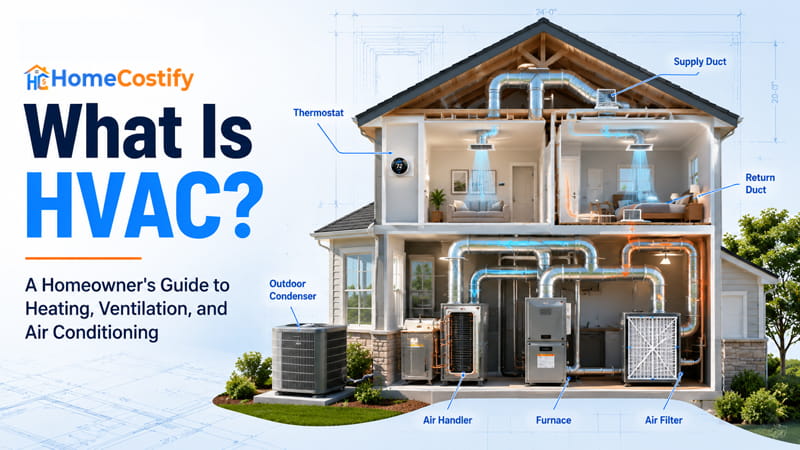
Few household systems attract attention only when something goes wrong. A room suddenly feels warmer than the rest of the house, indoor air starts feeling stale, or utility bills rise without any obvious explanation. In many cases, the issue traces back to the HVAC equipment responsible for heating, cooling, and airflow throughout the building.
The term appears frequently in contractor estimates, maintenance records, and real estate listings. People shopping for a new furnace may encounter it. The same thing happens during an air conditioner replacement or when comparing heat pump options. Despite how often the acronym appears, many people are unfamiliar with what the system actually does beyond producing warm or cool air.
Temperature is only part of the story. Air circulation, humidity levels, filtration, and energy consumption all connect to the same network of equipment. A house that feels comfortable in spring may reveal airflow problems during a summer heat wave or a prolonged cold spell. Those seasonal shifts often expose weaknesses that go unnoticed during mild weather.
What Is HVAC?
The HVAC meaning comes from three functions found in many residential and commercial buildings: heating, ventilation, and air conditioning. Rather than operating as separate systems, these functions are usually connected through equipment designed to manage indoor conditions throughout the year.
What Does HVAC Stand For?
HVAC stands for Heating, Ventilation, and Air Conditioning.
Heating equipment generates warmth during colder months. Ventilation deals with air movement, bringing fresh air into the building while removing stale indoor air. Air conditioning removes heat and excess moisture during warmer periods. Each function serves a different purpose, yet all three influence the way a house feels on a daily basis.
What Is an HVAC System?
An HVAC system refers to the collection of equipment that controls temperature, airflow, humidity, and indoor air quality. Depending on the layout of the house, that setup may include a furnace, heat pump, central air conditioner, air handler, ductwork, vents, filters, and a thermostat.
Some homes rely on a traditional split system with indoor and outdoor equipment connected by ductwork. Others use ductless mini-splits that condition individual rooms. The equipment may differ, but the objective remains the same: maintaining stable indoor conditions throughout the year.
Quick Answer: HVAC stands for Heating, Ventilation, and Air Conditioning. An HVAC system is responsible for maintaining indoor comfort by controlling temperature, airflow, humidity, and air quality throughout a home or building.
Why HVAC Systems Matter in Modern Homes
Daily life places constant demands on heating and cooling equipment. Cooking adds heat to indoor spaces. Showers release moisture into the air. Outdoor temperatures fluctuate throughout the day. The system responds to all of those changes while keeping conditions within a relatively narrow range.
According to data from the U.S. Energy Information Administration (EIA), heating and air conditioning account for more than half of annual household energy use in the United States. That figure places HVAC among the largest ongoing expenses tied to operating a house. Small differences in equipment condition, airflow restrictions, or system sizing can have a noticeable effect on monthly utility costs.
Many residential HVAC systems operate for thousands of hours each year. Houses in Phoenix face different demands than houses in Minneapolis, even when the square footage is similar. Climate, building design, insulation levels, and occupancy patterns all influence how heating and cooling equipment performs over time.
How HVAC Affects Home Performance
| HVAC Function | Impact on the Home |
|---|---|
| Heating | Keeps indoor spaces comfortable during cold weather |
| Cooling | Removes heat and excess humidity |
| Ventilation | Brings in fresh air and removes stale air |
| Filtration | Captures airborne particles that circulate indoors |
| Humidity Control | Limits excess moisture that can affect indoor conditions |
The Three Core Functions of an HVAC System
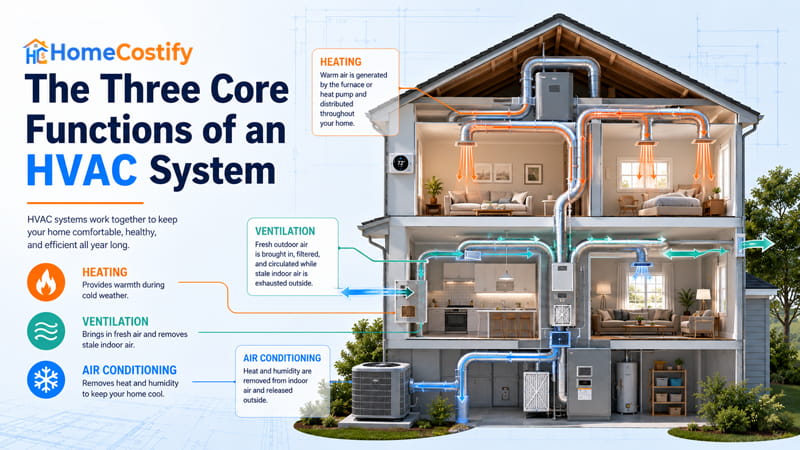
A house can feel too cold, too humid, stuffy, or uncomfortably warm even when the equipment appears to be running normally. Temperature is only one piece of the puzzle. Air movement, moisture levels, and the condition of the indoor air all influence how a space feels throughout the year.
That is why residential climate-control systems are built around three core functions rather than a single task.
Heating
Cold weather places unique demands on a house. Windows lose heat, exterior walls become colder, and indoor temperatures begin to drop as outdoor conditions change. The heating side of an HVAC system offsets that heat loss by generating warmth and distributing it throughout the building.
Furnaces remain the most common types of heating systems source in many parts of the United States. Natural gas models dominate in colder regions, although electric furnaces are also used in some areas. Boilers take a different approach. Instead of moving warm air through ducts, they circulate heated water through pipes connected to radiators or other distribution systems.
Heat pumps have become increasingly common because they can operate in both summer and winter. During colder months, the equipment extracts heat from outdoor air and transfers it indoors. That process may sound surprising at first, but modern units can continue operating even when temperatures fall well below freezing.
The goal remains the same regardless of equipment type. Indoor temperatures stay within a comfortable range even when conditions outside are far less predictable.
Ventilation
Fresh air rarely enters a house evenly on its own. Doors stay closed, windows remain shut during extreme weather, and modern construction techniques create tighter building envelopes than older homes typically had. Air exchange still needs to occur.
This is where home ventilation becomes part of the equation. Air moves through the house, stale air leaves, and fresh outdoor air enters through designated pathways or mechanical equipment. The process also influences moisture levels, odors, and airborne particles that accumulate over time.
Based on guidance from the U.S. Environmental Protection Agency (EPA), proper ventilation and air filtration play a critical role in reducing indoor pollutants and improving indoor air quality. Because Americans spend most of their time indoors, ventilation is just as important as heating and cooling when evaluating the performance of an HVAC system.
The effects often become noticeable during everyday activities. Cooking releases moisture and odors. Showers add water vapor to the air. Dust, pet dander, and other particles continue circulating unless filtration and airflow work together to remove them.
Air Conditioning
Summer heat affects more than temperature. Humidity often rises alongside outdoor temperatures, creating rooms that feel warmer than the thermostat setting might suggest.
The cooling side of HVAC air conditioning system addresses both issues at the same time. Heat is removed from indoor air and transferred outdoors through a refrigeration cycle. Moisture is also extracted during that process, which is why water commonly drains from air conditioning equipment during hot weather.
Many people associate air conditioning strictly with cooler temperatures. Humidity management is equally important. A room maintained at 75°F can feel very different depending on how much moisture remains in the air.
Heating, ventilation, and cooling each perform separate tasks. Together they form the foundation of heating and air conditioning systems used in homes across the country.
How HVAC Systems Work
A thermostat adjustment often appears simple from the outside. Behind the scenes, multiple components respond in sequence before conditioned air reaches individual rooms.
Understanding how HVAC systems work becomes easier when the process is broken into a few basic steps.
Step 1 – The Thermostat Detects Temperature
The cycle begins with the thermostat. It constantly compares indoor temperatures against the selected setting. Once a difference is detected, a signal is sent to the appropriate equipment.
Step 2 – Heating or Cooling Equipment Activates
The next step depends on the season and thermostat settings. A furnace, boiler, heat pump, or air conditioner starts operating to change the temperature of the air moving through the system.
People often search for explanations of how home heating work processes operate during winter. The principle is straightforward. Heat is generated or transferred, then prepared for distribution throughout the house.
Step 3 – Conditioned Air Moves Through the Home
After the air reaches the desired temperature, an air handler or blower pushes it through ductwork and supply vents. Rooms farther from the equipment receive the same airflow pathway as rooms located nearby.
Questions about home air conditioner work cycles usually focus on cooling. The airflow process itself remains similar regardless of season.
Step 4 – Air Returns to the System
The journey does not end once conditioned air enters a room. Return vents pull air back toward the equipment, where filtration and temperature adjustments occur again. Continuous circulation is what keeps indoor conditions relatively stable.
The same principle applies to many forms of home ventilation work, where airflow follows a repeating cycle rather than a one-way path.
Simplified HVAC Process
| Step | What Happens |
|---|---|
| Thermostat | Detects indoor temperature |
| Heating/Cooling Equipment | Produces warm or cool air |
| Air Handler | Moves conditioned air |
| Ductwork | Distributes air throughout the home |
| Return Vents | Pull air back into the system |
Main Components of an HVAC System
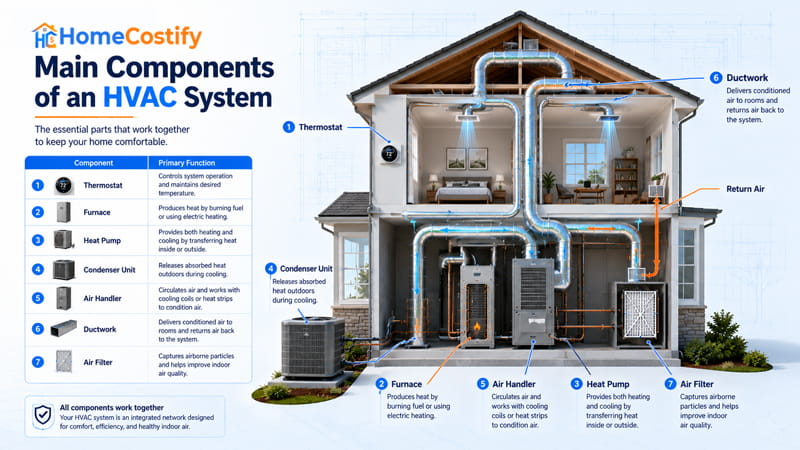
A complete heating and cooling setup relies on several pieces of equipment working together. Some houses contain every component listed below, while others use alternative configurations.
The exact layout varies, but these are among the most common HVAC system components found in residential applications.
Thermostat
The thermostat serves as the control center. Temperature settings entered by occupants determine when heating or cooling cycles begin and end.
Furnace or Heat Pump
These units act as the primary heating source in many homes. Furnaces generate heat directly, while heat pumps transfer heat from one location to another depending on seasonal conditions.
Air Conditioner or Condenser Unit
The outdoor condenser is responsible for releasing collected heat outside the building. During summer, this equipment plays a central role in the cooling process.
Air Handler
Air does not move through a house on its own. The air handler contains components responsible for circulating conditioned air throughout the distribution system.
Ductwork and Vents
Ductwork forms the pathway connecting equipment to individual rooms. Supply vents deliver conditioned air, while return vents bring air back for another cycle.
Air Filters
Filtration captures dust, pollen, pet dander, and other airborne particles before they continue circulating through the house.
HVAC Component Overview
| Component | Primary Function |
|---|---|
| Thermostat | Controls system operation |
| Furnace | Produces heat |
| Heat Pump | Provides heating and cooling |
| Condenser Unit | Releases heat outdoors |
| Air Handler | Circulates air |
| Ductwork | Delivers conditioned air |
| Air Filter | Captures airborne particles |
Common Types of HVAC Systems for Homes
No single heating and cooling setup works best for every house. Climate, building layout, existing ductwork, energy prices, and available installation space can all influence the final choice. A system that performs well in a mild coastal region may not be the strongest fit for a house exposed to long winters and subfreezing temperatures.
That is why several HVAC system types are commonly used across the United States. Each configuration approaches heating, cooling, and air distribution in a slightly different way. Some rely on ductwork running through walls and ceilings. Others deliver conditioned air directly into individual rooms.
Split Systems
Among all types of HVAC systems, the split system remains the most common in American homes. The name comes from the fact that the equipment is divided between indoor and outdoor components.
A furnace or air handler is typically located inside the house. The condenser unit sits outdoors. Refrigerant lines connect the two pieces of equipment, allowing heat to move between them during cooling cycles.
Many builders favor this configuration because ductwork can distribute conditioned air throughout multiple rooms from a central location. Houses constructed during the last several decades often use some variation of this arrangement.
Heat Pump Systems
Heat pumps have gained attention in recent years, particularly in regions with moderate winters. Instead of generating heat through combustion, the equipment transfers heat from one location to another.
During summer, the process resembles a conventional air conditioner. Heat is collected from indoor spaces and released outdoors. During winter, the cycle reverses. Heat from outdoor air is transferred inside the house.
A single system handles both heating and cooling duties. That characteristic makes heat pumps attractive in areas where winter temperatures remain relatively manageable for most of the year.
Ductless Mini-Split Systems
Not every house contains ductwork. Older homes, additions, converted garages, and certain renovation projects often create situations where installing ducts would be expensive or impractical.
Mini-split systems approach the challenge differently. Indoor air handlers are mounted directly within individual rooms or zones. Refrigerant lines connect those units to outdoor equipment.
This arrangement allows separate areas of the house to operate independently. A home office can remain cooler while a guest room receives less conditioning. Zoning flexibility is one reason these systems continue to grow in popularity.
Packaged HVAC Systems
Some properties have limited indoor space available for mechanical equipment. A packaged configuration places major heating and cooling components inside a single cabinet rather than splitting them between indoor and outdoor locations.
The unit is commonly installed outside the house or on a rooftop in certain applications. Conditioned air then travels through ductwork connected to the structure.
The overall footprint inside the building remains smaller. That feature can be useful in houses where utility room space is limited.
Hybrid HVAC Systems
Hybrid configurations combine more than one heating approach. A common setup pairs a heat pump with a gas furnace.
Mild weather often favors the heat pump because it can operate with lower energy consumption under suitable conditions. As outdoor temperatures drop further, the furnace takes over.
The transition occurs automatically based on system settings and outdoor temperatures. This flexibility gives occupants multiple ways to manage seasonal heating demands.
Common Residential HVAC Types
| System Type | Best For |
|---|---|
| Split System | Traditional homes with ductwork |
| Heat Pump | Moderate climates |
| Mini-Split | Homes without ducts |
| Packaged Unit | Limited indoor space |
| Hybrid System | Energy-conscious households |
Many HVAC systems for home applications fall into one of these categories. The right choice depends less on marketing claims and more on how the house is built, where it is located, and what equipment already exists on-site.
HVAC vs. AC: What’s the Difference?
The two terms are often used interchangeably, especially during conversations about cooling equipment. They do not mean the same thing.
An air conditioner is only one part of a larger climate-control setup. Cooling equipment removes heat from indoor spaces and transfers that heat outdoors. That process addresses summer temperatures, but it does not cover every function associated with year-round indoor climate management.
The comparison between HVAC vs AC becomes clearer when heating and ventilation enter the discussion. A complete system may include a furnace, heat pump, filtration equipment, ductwork, and airflow management components in addition to cooling equipment.
Another way to look at HVAC AC terminology is through scope. One term describes the entire category. The other refers to a specific cooling component within that category.
| HVAC | AC |
|---|---|
| Heating + Ventilation + Cooling | Cooling only |
| Whole-system term | One component of HVAC |
| Year-round indoor climate control | Warm-weather cooling |
Many discussions about HVAC air conditioning focus exclusively on summer comfort, but the broader category covers much more than cooling equipment alone.
HVAC vs. Heat Pump
Confusion also occurs when comparing complete climate-control systems with heat pumps. The two terms describe different things.
The phrase HVAC vs heat pump compares a broad category against a specific piece of equipment. One includes multiple technologies. The other represents a single heating and cooling approach.
A heat pump can be part of an HVAC setup. It can also serve as the primary source of heating and cooling in many houses. Furnaces, boilers, air conditioners, ductwork, thermostats, and filtration equipment may still exist alongside it.
The easiest way to think about heat pump HVAC terminology is to view the heat pump as one possible component within a larger system.
| HVAC | Heat Pump |
|---|---|
| Complete climate-control system | Specific heating and cooling technology |
| May include several equipment types | One equipment option |
| Broad category | Individual component or system |
A comparison between the two is similar to comparing a vehicle with an engine. One describes the larger system. The other refers to a particular technology operating within it.
HVAC Efficiency Ratings Explained
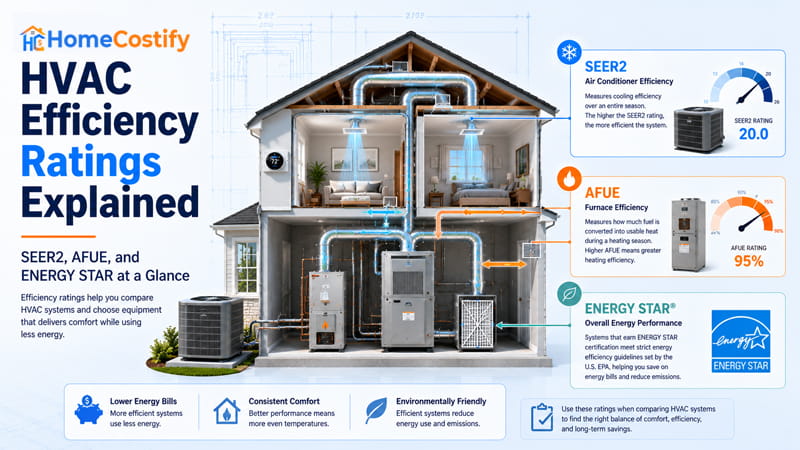
Two houses can contain equipment of similar size and still produce very different utility bills. The difference often comes down to how effectively the equipment converts energy into heating or cooling. Manufacturers use several rating systems to measure that difference, giving buyers a way to compare products before installation.
SEER2
SEER2 stands for Seasonal Energy Efficiency Ratio 2. The rating applies to cooling equipment and measures how much cooling output is produced relative to energy consumption under updated testing conditions.
Higher numbers generally indicate stronger HVAC efficiency during cooling operation. The rating does not guarantee identical results in every house, however. Ductwork condition, insulation levels, climate, and installation quality all influence real-world energy use.
AFUE
AFUE, or Annual Fuel Utilization Efficiency, is commonly used for furnaces. The rating measures how much fuel is converted into usable heat over a heating season.
A furnace with a higher AFUE rating directs more of its fuel toward heating the house rather than losing energy through exhaust gases. This metric becomes particularly relevant in regions where furnaces operate for long periods during winter.
ENERGY STAR
ENERGY STAR is a certification program backed by the U.S. Environmental Protection Agency and the Department of Energy. Products carrying the label must meet specific energy-performance criteria established for their category.
For buyers comparing equipment options, an ENERGY STAR HVAC designation can serve as an additional reference point alongside manufacturer specifications and efficiency ratings.
Greater HVAC energy efficiency often translates into lower operating costs over the life of the equipment. Installation quality still matters. Even high-rated systems can struggle when airflow, duct design, or equipment sizing is not matched to the house.
HVAC Efficiency Rating Overview
| Rating | Measures |
|---|---|
| SEER2 | Air conditioner efficiency |
| AFUE | Furnace efficiency |
| ENERGY STAR | Overall energy performance |
How Much Does an HVAC System Cost?
Equipment prices vary widely across the United States. A small single-story house typically requires a different setup than a larger two-story property, and that difference can influence both equipment selection and labor requirements.
The HVAC system cost associated with a project is usually shaped by four major factors: equipment type, home size, installation complexity, and local labor rates. Existing ductwork can also influence the final proposal. Some projects involve little more than equipment replacement, while others require electrical upgrades, duct modifications, or additional structural work.
The cost of HVAC system installation generally falls within a broad range because houses rarely present identical conditions. A heat pump installation may differ significantly from a packaged unit replacement, even when both projects serve similar square footage.
The figures below reflect typical installed ranges reported for residential projects in the United States and should be viewed as budgeting estimates rather than contractor quotes.
| HVAC System | Typical Cost Range |
|---|---|
| Split System | $8,000–$15,000 |
| Heat Pump | $6,000–$25,000 |
| Mini-Split | $2,000–$10,500 |
| Packaged Unit | $8,000–$16,000 |
Anyone researching HVAC installation cost, replacement expenses, or the broader HVAC system price landscape should compare multiple estimates before making a decision.
HVAC Maintenance Basics
Heating and cooling equipment spends much of the year cycling on and off in response to changing indoor and outdoor conditions. Wear accumulates gradually. Small issues often develop long before a breakdown occurs.
Change Air Filters Regularly
Air filters collect dust, pet dander, pollen, and other airborne particles moving through the system. As debris accumulates, airflow can become more restricted.
A heavily loaded filter places additional strain on moving components. Airflow often drops before occupants notice any obvious change in temperature.
Schedule Annual Maintenance
Routine HVAC maintenance gives technicians an opportunity to identify developing issues before they become expensive repairs. Electrical connections, refrigerant levels, safety controls, and moving parts can all be inspected during a scheduled visit.
Many service calls originate from conditions that developed gradually over months rather than days.
Keep Outdoor Units Clear
Leaves, grass clippings, and windblown debris frequently collect around outdoor equipment. Air circulation becomes more difficult when the surrounding area becomes congested.
The equipment should have adequate clearance around all sides. Vegetation growth can become a problem surprisingly quickly during the growing season.
Watch for Warning Signs
A system rarely fails without giving clues. Strange noises, weak airflow, inconsistent temperatures, and rising utility bills often appear before a major breakdown.
An annual HVAC inspection can identify some of these issues early. Scheduled HVAC service visits also provide an opportunity to evaluate equipment condition before extreme weather places additional demands on the system.
Conclusion
The HVAC meaning extends far beyond heating or cooling alone. Modern systems combine three core functions—heating, ventilation, and air conditioning—to manage temperature, airflow, humidity, and indoor air quality throughout the year.
Different houses require different approaches. Split systems remain common, heat pumps continue gaining popularity, and ductless equipment offers alternatives where traditional ductwork is impractical. Regardless of the configuration, routine maintenance and periodic inspections play a major role in long-term operation.
Equipment ratings such as SEER2, AFUE, and ENERGY STAR provide useful benchmarks when comparing products. Installation quality, climate conditions, and house design still influence day-to-day results.
Repair decisions, maintenance planning, and replacement projects become easier when the system is no longer a mystery. Before approving major work or investing in new equipment, take time to understand how the heating, cooling, and ventilation systems inside the house actually operate.
FAQs About HVAC
What does HVAC stand for?
HVAC stands for Heating, Ventilation, and Air Conditioning. The term describes the equipment used to manage indoor temperature, airflow, humidity, and air quality within a home or building.
How is HVAC different from AC?
HVAC refers to the entire heating, ventilation, and cooling system. An air conditioner is only one component within that larger category and focuses on cooling and moisture removal.
What are the main components of an HVAC system?
Common components include a thermostat, furnace or heat pump, air conditioner, air handler, ductwork, vents, and air filters. Not every house contains the same configuration.
How long do HVAC systems last?
Many systems operate for 15 to 25 years, although lifespan varies by equipment type, maintenance history, climate conditions, and installation quality.
What is the $5000 rule for HVAC?
The $5000 rule multiplies the repair cost by the equipment age. A high result often suggests replacement may be worth evaluating instead of another major repair.