Electricity powers nearly every activity inside a house. Different types of home electrical systems are built for different electrical demands, energy sources, and levels of automation, so one setup rarely fits every situation.
A suburban house with standard utility service usually has different electrical needs than a mountain cabin, a home equipped with rooftop solar, or a newly built house designed for future EV charging. Selecting the right system begins long before equipment is purchased.
Daily power consumption, future expansion, and available utility connections all influence the direction of that decision.
Six systems dominate today’s residential market:
- Single-Phase
- Three-Phase
- Grid-Tied
- Off-Grid
- Hybrid
- Smart Home
Each system fits a different set of priorities. Utility availability, renewable energy plans, backup expectations, and long-term electrical demand can all outweigh raw power capacity during the selection process.
Houses built today often continue evolving for decades. Planning for future additions, solar expansion, battery storage, or connected technologies usually starts with choosing the home electrical system types that leave room for those changes instead of creating limitations later.
How Home Electrical Systems Are Classified
A residential electrical system can also be classified by electricity supply, energy source, and the way power is monitored after entering a house.
Viewing systems from these angles makes electrical system types much easier to compare before evaluating individual options.
Utility Supply
Utility supply describes how electricity reaches a house before flowing to individual circuits. Across most types of home electrical systems, electricity travels from a Utility Transformer through a Utility Service, enters at the Service Entrance, and becomes part of the home’s residential electrical service. Available capacity starts with that connection.
Different supply configurations create distinct categories long before circuit layout or equipment selection becomes a consideration.
Power Source
Power can originate from more than one location. Utility power still serves as the main electricity source for most homes, while Solar PV, Battery Storage, and standby generators have expanded residential energy options in recent years.
Some houses rely on a single source. Others combine multiple sources within one design, making types of electrical systems and residential electrical system types easier to distinguish by energy origin instead of grid connection alone.
Automation Level
Automation introduces another way to separate residential electrical systems. Conventional installations distribute electricity with little interaction after commissioning, while newer designs incorporate HEMS, smart electrical panel technology, and smart breaker controls that track electrical activity throughout the day.
Circuit-level monitoring, automated scheduling, and real-time consumption data have become part of everyday operation in some houses. A home energy management system creates another category within home electrical system types without changing the incoming electricity supply itself.
The 6 Main Types of Home Electrical Systems

Electricity usage varies widely from one house to another. Home electrical system types exist to match those changing demands, giving each home a power setup that fits its energy source, electrical load, and long-term plans. Choosing among them involves more than capacity alone.
Daily living habits, future upgrades, and available utility service all shape which system fits a particular home best.
| Home Electrical System | Primary Purpose | Typical Residential Application |
|---|---|---|
| Single-Phase | Standard household electricity | Most U.S. homes |
| Three-Phase | Higher continuous electrical demand | Large homes & workshops |
| Grid-Tied | Utility-connected power | Homes with rooftop solar |
| Off-Grid | Independent electricity supply | Remote properties |
| Hybrid | Grid + battery storage | Backup power & energy flexibility |
| Smart Home | Intelligent energy management | Connected modern homes |
1. Single-Phase Electrical System
Single-phase service powers most houses across the United States because household electrical demand rarely requires anything more complex. Familiar appliances, lighting, heating, cooling, and everyday electronics all operate comfortably within a system that has remained the residential standard for decades.
How It Works
Electricity begins its journey at a neighborhood utility transformer before entering a house through the local utility connection. From there, power reaches the electrical service panel, where incoming electricity is divided into multiple branch circuits serving different rooms and appliances.
Most American houses use split-phase electrical service, delivering 120 volts for everyday outlets and lighting while supplying 240 volts for larger equipment such as electric ranges or central air conditioners.
That distribution pattern illustrates how an electrical system works in everyday life and why types of home electrical systems often start with single-phase service as the baseline for residential power.
Pros
Single-phase remains one of the most common residential electrical system types for good reason.
- Widely available across U.S. neighborhoods.
- Familiar to electrical contractors and utility companies.
- Matches everyday household appliances without unnecessary complexity.
- Fits most detached houses, townhomes, and similar residential construction.
Cons
Continuous electrical demand has practical limits within a single-phase system. Large collections of high-powered equipment operating at the same time may place greater demand on available capacity than a typical household ever experiences.
Future expansion deserves attention as well. Houses expected to add substantial electrical loads over time may require long-term planning before major projects move forward.
Best Uses
Single-phase remains a practical choice for suburban neighborhoods, townhouses, smaller detached houses, and family homes with ordinary daily electrical needs.
New construction frequently begins with this configuration because it aligns with utility availability across much of the country, and system selection may influence overall electrical installation cost during project planning even before fixtures or appliances are installed.
Everyday household activities rarely place sustained pressure on electrical capacity in a typical house. Lighting, kitchen appliances, HVAC equipment, and everyday electronics all operate comfortably within the range that single-phase service was built to supply, making it the standard across most types of electrical systems found in American homes.
2. Three-Phase Electrical System
Three-phase service appears in houses that place far greater demands on electrical capacity than a typical residence. Large HVAC equipment, commercial-grade machinery, oversized workshops, or extensive electrical installations often require a steadier flow of power across the day.
Capacity is only part of the picture. Stable power delivery is usually the reason this service is selected for specific residential applications.
How It Works
Three-phase electricity delivers power through three alternating AC waveforms that operate in sequence instead of reaching their peak at the same moment. Energy continues moving with fewer fluctuations because another phase is always supplying power as one cycle begins to decline.
That continuous flow creates smoother electrical power distribution, particularly during sustained operation of larger electrical equipment.
Factories are not the only places that benefit from steady power delivery. Large homes with extensive HVAC systems, workshops filled with heavy machinery, or agricultural buildings often place long-running electrical loads on the system, making Load Balancing and Three-Phase Service practical choices within certain types of home electrical systems.
Pros
Large electrical loads place very different demands on a power system than ordinary household appliances. Three-phase service supplies greater capacity for continuous operation, creating steady power delivery during long periods of use.
Heavy-duty equipment, extensive workshops, and larger mechanical systems can operate without placing the same strain on available electrical capacity.
For that reason, three-phase remains one of the residential electrical system types selected for properties with unusually demanding electrical requirements.
Cons
Residential availability remains limited across much of the United States. Utility infrastructure varies from one service area to another, so access often depends on local distribution networks instead of homeowner preference alone.
Utility companies do not offer three-phase service in every neighborhood. Availability depends on local distribution infrastructure, so confirming service options is often one of the first steps before selecting home electrical system types for a new project or major expansion.
Best Uses
Luxury homes with extensive electrical equipment, large estates, dedicated home workshops, and agricultural properties are common examples where three-phase service fits naturally. Daily operation in these settings often includes equipment that draws substantial power for extended periods instead of short household cycles.
Installation or service upgrades normally require licensed electrical professionals, making electrician labour rates one factor that may influence overall project planning without determining whether this configuration is appropriate.
Across available electrical system types, three-phase earns its place through electrical demand, not because it represents a universally superior option.
3. Grid-Tied Electrical System
Rooftop solar has become a familiar sight in neighborhoods across the United States. A grid-tied system lets a house generate part of its own electricity without giving up access to utility service. Solar production changes throughout the day. Grid electricity fills the gap whenever sunlight alone cannot meet household demand.
How It Works
Electricity produced by Solar PV panels first passes through a solar inverter, where direct current is converted into usable alternating current for household equipment. Power flows to the home’s electrical panel before reaching lighting, appliances, and other circuits.
Electricity flows in both directions during normal daily operation. Solar panels power household circuits first, and excess production can move back to the utility network through Net Metering, which has made grid-connected solar one of the most common types of electrical systems for residential use.
Pros
Grid-tied service fits households that want to produce part of their own electricity without changing everyday routines.
- Lower monthly electricity bills when solar production offsets utility usage.
- High energy utilization because solar electricity is consumed as it is generated.
- Minimal routine maintenance after installation.
- Straightforward integration with rooftop solar systems.
Cons
Electricity still depends on utility availability whenever solar production falls below household demand. A neighborhood outage can interrupt power even if rooftop panels continue receiving sunlight, depending on local system requirements.
Utility policies and interconnection rules vary by service area. Differences like these shape how electrical system types operate from one location to another.
Best Uses
Grid-tied service fits urban neighborhoods, suburban developments, and houses with reliable utility access where rooftop solar is part of long-term energy planning.
Daily electricity demand remains closely linked with utility service, yet solar generation offsets part of that consumption whenever conditions are favorable.
Adding solar equipment and utility interconnection may influence overall electrical work cost during project planning without changing the purpose of the system itself.
Grid-tied service fits houses where lowering daytime utility consumption is a higher priority than complete electrical independence. That balance explains why it remains a common choice among residential electrical system types in cities and suburban neighborhoods with dependable utility service.
4. Off-Grid Electrical System
Distance from utility lines changes the way electricity reaches a house. Off-grid systems produce, store, and distribute power without relying on a permanent utility connection. Cabins deep in the mountains, remote ranches, and isolated vacation homes are common examples where this arrangement becomes a practical choice.
How It Works
Solar panels generate electricity during daylight hours before sending power to a charge controller, which regulates charging for the battery bank.
Stored electricity supplies household circuits after sunset or during cloudy weather, and a generator can provide additional backup power when renewable production drops for extended periods. Every part of the system works within the property because no utility connection supplies electricity from outside.
Every watt used inside an off-grid house comes from equipment installed on the property. Solar generation, battery storage, and internal power distribution operate as one complete electrical supply, placing this option in a distinct group within today’s types of home electrical systems and types of electrical systems.
Pros
Remote locations often leave few practical alternatives to independent electricity generation. Off-grid service gives occupants full control over energy production without depending on utility infrastructure reaching the property.
Rural houses, seasonal cabins, and isolated retreats can continue operating regardless of nearby utility expansion plans. Within current home electrical system types, few options offer the same level of energy independence.
Cons
Equipment requirements are greater because electricity must be generated and stored on site throughout the year. Battery maintenance, seasonal weather changes, and careful energy planning all become part of normal ownership.
Daily electricity use usually requires closer attention than houses supplied by utility service. Those practical considerations separate this option from other residential electrical system types built around existing electrical networks.
Best Uses
Off-grid service fits cabins, rural homes, remote properties, and vacation houses located far from existing utility infrastructure.
Converting an older building to independent electricity may require updates to existing distribution equipment, making the cost to rewire a house one planning consideration before work begins.
Location often drives this decision more than electricity consumption alone. Across available electrical system types, off-grid service is intended for energy independence, not automatic savings.
5. Hybrid Electrical System
Power demands rarely stay the same year after year. A hybrid system combines utility electricity, renewable generation, and stored energy so a house can draw power from more than one source as conditions change.
Seasonal weather, household demand, and solar production all influence where electricity comes from at any given moment.
How It Works
Electricity can arrive from utility service or rooftop solar, depending on which source is producing energy at that moment. A hybrid inverter manages power flow between solar equipment, battery storage, household circuits, and the utility connection without requiring manual switching.
Stored electricity may supply household demand during selected periods, then utility power takes over whenever additional capacity is needed.
Electricity can move between solar panels, utility service, and stored energy as household demand changes during the day. That flexibility places hybrid systems in a unique position within home electrical system types, especially for houses planning gradual energy expansion over many years.
Pros
Changing energy conditions create fewer interruptions because electricity is available from more than one source. Solar production can cover part of the daily demand, stored energy remains available during selected periods, and utility service continues supplying electricity whenever additional power is required.
That flexibility suits households planning gradual energy upgrades instead of relying on one electrical source alone. For long-term energy planning, hybrid remains one of the most adaptable residential electrical system types currently available.
Cons
Multiple energy sources introduce additional equipment and more complex operating logic. Installation planning requires careful coordination because solar generation, utility service, battery storage, and control equipment must operate as one system.
Maintenance may involve more components than a conventional residential installation. Across available types of electrical systems, hybrid systems generally require greater planning before installation begins.
Best Uses
Hybrid systems fit houses preparing for higher electrical demand, expanding solar capacity, or seeking greater flexibility in day-to-day energy use. Larger family homes, custom builds, and properties with changing electricity consumption often gain the greatest value from this arrangement.
Long-term renovation plans often change household electrical demand. Extra solar capacity, larger HVAC equipment, or future EV charging can be added over time without replacing the original system, making hybrid one of the more adaptable electrical system types for growing households.
6. Smart Home Electrical System
Electricity consumption no longer has to remain invisible until the monthly utility bill arrives. Smart home electrical systems focus on monitoring, automation, and energy management, giving occupants far greater visibility into daily electrical usage without changing the incoming power source.
Information becomes available in real time. Decisions about electricity use no longer depend on estimates alone.
How It Works
Sensors, connected breakers, and intelligent control equipment continuously monitor electrical activity across household circuits. Usage data appears through a central management platform, allowing occupants to track consumption, schedule selected loads, and receive alerts whenever unusual electrical patterns appear.
Incoming utility service remains unchanged because monitoring occurs after electricity reaches the house. Within types of home electrical systems, this technology expands home electrical system types by adding intelligent control instead of replacing the existing electrical supply.
Pros
Real-time information reveals where electricity is being used throughout the day. Individual circuits can be monitored without waiting for monthly utility statements, making unusual consumption patterns much easier to identify.
Electrical activity no longer has to remain hidden until a monthly utility statement arrives. Circuit-level monitoring, scheduled operation, and real-time notifications have made smart energy management increasingly common across newer residential electrical system types, particularly in newly built houses and major renovations.
Cons
Additional equipment increases system complexity compared with conventional electrical installations. Connected devices depend on software, network communication, and compatible hardware working together throughout normal operation.
Some advanced monitoring features may require equipment that is unavailable on older electrical systems. Those practical limitations distinguish smart systems from other types of electrical systems currently used in residential construction.
Best Uses
Smart electrical systems fit newly built homes, large renovations, connected households, and properties planning long-term energy upgrades. Electric vehicle charging, rooftop solar, high-efficiency HVAC equipment, and growing electrical demand all benefit from closer monitoring as household energy use changes over time.
Daily operating data gives occupants far more visibility than conventional electrical systems can provide. Across today’s types of home electrical systems, smart energy management is best suited to houses where ongoing visibility and automated control carry as much value as electricity itself.
Comparing the Main Types of Home Electrical Systems

Selecting from the available types of home electrical systems usually comes down to daily electrical demand, utility availability, future energy plans, and the level of control expected over household electricity.
Capacity matters, but it is only one part of the decision. A quick side-by-side comparison often reveals which option fits a house more naturally. Small differences today can shape expansion opportunities years later.
| System | Utility Grid | Battery Required | Typical Home | Main Advantage | Main Limitation |
|---|---|---|---|---|---|
| Single-Phase | ✔ | No | Standard homes | Simple and widely available | Lower electrical capacity |
| Three-Phase | ✔ | No | Large homes | Higher power capacity | Limited residential availability |
| Grid-Tied | ✔ | No | Solar homes | Lower electricity bills | Depends on utility grid |
| Off-Grid | ✖ | Yes | Remote homes | Complete energy independence | Higher equipment requirements |
| Hybrid | ✔ | Optional | Modern homes | Flexible energy sources | More complex system design |
| Smart Home | Depends | Optional | Connected homes | Intelligent energy management | Additional equipment required |
Single-phase remains the common choice for everyday residential use, whereas three-phase fits houses with unusually high and sustained electrical demand. Grid-tied systems pair naturally with rooftop solar in neighborhoods served by dependable utilities.
Off-grid installations answer a very different need, supplying electricity in places where utility service is unavailable or impractical. Hybrid and smart systems place greater emphasis on future flexibility, energy management, or both, depending on household priorities.
No single option ranks first in every situation. Houses with ordinary electrical needs often gain little from moving toward a more complex design, yet larger properties or long-term energy projects may justify additional capability from the beginning.
Reviewing electrical system types alongside future renovation plans usually produces a clearer decision than comparing electrical capacity by itself. That perspective keeps home electrical system types aligned with how a house is expected to grow instead of limiting the decision to current electricity use.
How to Choose the Right Home Electrical System
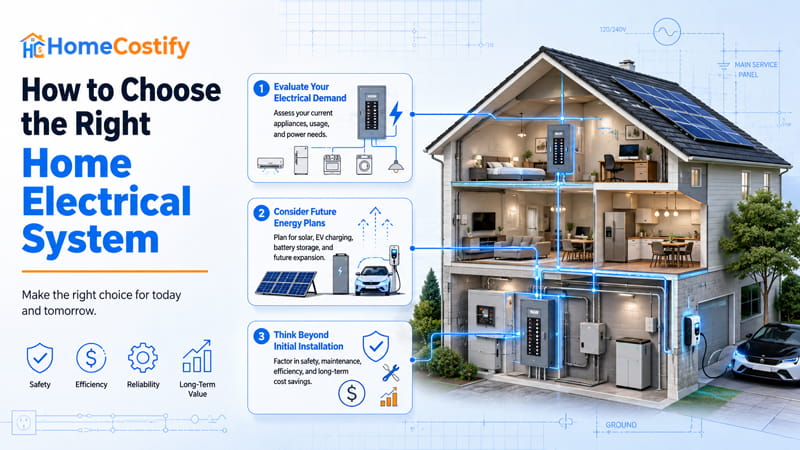
Electrical needs rarely stay frozen for the life of a house. Family size changes, new appliances arrive, and future projects can reshape electricity demand long after construction is finished.
Picking a system only for today’s conditions may leave little room for later expansion. A practical decision starts with the way the house is expected to function over the next decade.
Evaluate Your Electrical Demand
Daily routines reveal far more than a simple list of appliances. A small household with gas heating places very different demands on electrical power distribution than a large family running central air conditioning, multiple refrigerators, workshop equipment, and overnight EV charging.
Square footage tells only part of the story. Reviewing household habits, seasonal electricity use, and future equipment creates a stronger foundation for comparing available home electrical system types.
Consider Future Energy Plans
Plans that seem years away often arrive sooner than expected. Rooftop Solar PV, additional Battery Storage, a home addition, or expanded smart home technology may place new demands on an electrical system long after the original installation.
Leaving room for future changes usually avoids difficult compromises later. Long-range planning often has a greater impact on selecting residential electrical system types than current electricity use alone.
Think Beyond Initial Installation
Electrical systems remain in service for many years, so flexibility deserves as much attention as present-day capacity. Future compatibility, routine maintenance, and long-term reliability often influence ownership long after construction crews leave the site.
A house that adds solar panels, an EV charger, or extra living space years later may require additional electrical work, making electrical wiring cost part of the overall planning process. Current needs are only part of the picture.
Can You Upgrade Your Existing Home Electrical System?
Expanding a home’s electrical capability is often possible, but available options depend on existing equipment and utility capacity. Some houses need only minor upgrades before new technology can be added.
Others require additional preparation first. Existing infrastructure usually determines how far an upgrade can go.
Before selecting from available types of home electrical systems, evaluate these areas:
- Service Panel — Extra electrical demand often starts here. An undersized panel may limit future expansion even if the rest of the electrical system remains in good condition.
- Utility Service — Available utility capacity varies by neighborhood. Local service limits may determine whether higher-capacity electrical equipment can be supported.
- Solar Integration — Rooftop solar can frequently be added without replacing every electrical component already installed. Compatibility between existing equipment and new solar hardware matters more than system age.
- Energy Storage — Battery systems can expand energy flexibility for houses preparing for higher electricity consumption or future renewable energy additions.
- Smart Panel Upgrades — A Smart Panel introduces circuit monitoring and energy management without requiring an entirely new electrical system.
- Infrastructure Compatibility — Existing residential electrical service remains the starting point for every upgrade decision. Comparing current equipment with available electrical system types produces a far more practical plan than assuming every option will fit every house.
Future Trends in Residential Electrical System Types
Residential electrical planning continues to change as household electricity demand grows. Larger HVAC systems, electric vehicles, onsite solar generation, and rising energy consumption are influencing decisions made during new construction and major renovations.
Planning for future expansion now begins much earlier than it did a decade ago. That direction is reshaping home electrical system types across the residential market.
Current trends already influencing types of home electrical systems include:
- Battery Storage Adoption — Battery Storage is appearing in more residential projects as households look for greater flexibility in managing electricity produced during the day.
- Growing EV Demand — More homes are allocating electrical capacity for an EV Charger, increasing demand for electrical systems that can accommodate higher future loads.
- Smart Electrical Panels — A smart electrical panel paired with HEMS gives occupants detailed circuit monitoring and automated control through a home energy management system.
- Renewable Energy Integration — Solar installations are fitting into residential electrical systems with fewer compatibility challenges than in previous years.
- Flexible Electrical Infrastructure — New electrical designs increasingly leave room for future additions, making later upgrades far less disruptive as household electrical needs continue to evolve.
Conclusion
No electrical system fits every house. Electrical demand, location, available energy sources, future expansion plans, and preferred automation all influence which option makes sense over the long term.
A downtown townhouse, a rural cabin, and a house with rooftop solar rarely face the same electrical conditions. Spending time comparing types of home electrical systems before construction or a major upgrade can prevent costly limitations later.
FAQs About Types of Home Electrical Systems
Which type of home electrical system is most common in the United States?
Single-phase service remains the most common residential electrical system because it meets the everyday power requirements of most American homes.
Can a home be upgraded from single-phase to three-phase power?
Yes, although availability depends on local utility infrastructure, existing electrical service, and whether three-phase service is offered in the area.
Is a hybrid electrical system better than a grid-tied system?
Neither option is universally better. The right choice depends on household energy goals, electricity usage, and long-term expansion plans.
Do smart home electrical systems reduce electricity bills?
Not automatically. Better monitoring and automation can reduce unnecessary electricity use, but savings still depend on household habits and equipment.
Which electrical system works best with solar panels?
Grid-tied systems remain the most common choice for residential solar installations, while hybrid systems suit houses planning additional energy flexibility. Both are established types of electrical systems for solar applications.