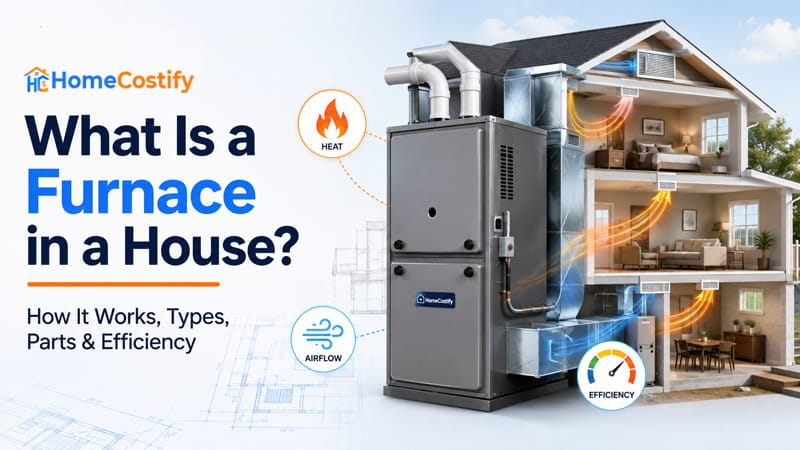
Most homes need heating during cold weather. A furnace supplies that heat and forms part of the home’s heating system. It serves the rooms where people live and spend time, helping keep the house at a suitable temperature.
The name refers to the heating equipment itself. A home can contain several types of equipment, and they do not all serve the heating function. Cooling and ventilation have separate jobs, so the term does not describe the entire HVAC arrangement.
One unit may serve several rooms, depending on the home’s layout and heating system. Its scope remains specific to the part of the setup responsible for supplying warmth.
What Is a Furnace in a House?
U.S. federal rules give residential heating equipment a more specific classification. The key question is whether the equipment serves as the principal heating source for a dwelling. That boundary distinguishes the residential category from broader everyday use of the word.
The U.S. Department of Energy defines a residential furnace as equipment designed to serve as the principal heating source for residential space heating. The listed categories include forced-air central furnace, electric central furnace, and gravity central furnace. For forced-air central furnaces, the federal definition uses a heat-input limit below 225,000 Btu per hour.
The formal boundary has a narrower purpose than a homeowner’s general description. The principal-source requirement determines the equipment’s place in the classification.
The heat-input limit is part of that regulatory framework, not a recommendation for choosing capacity in a particular home. The same scope keeps the discussion tied to residential applications rather than industrial processing.
What Does a Furnace Do in a House?
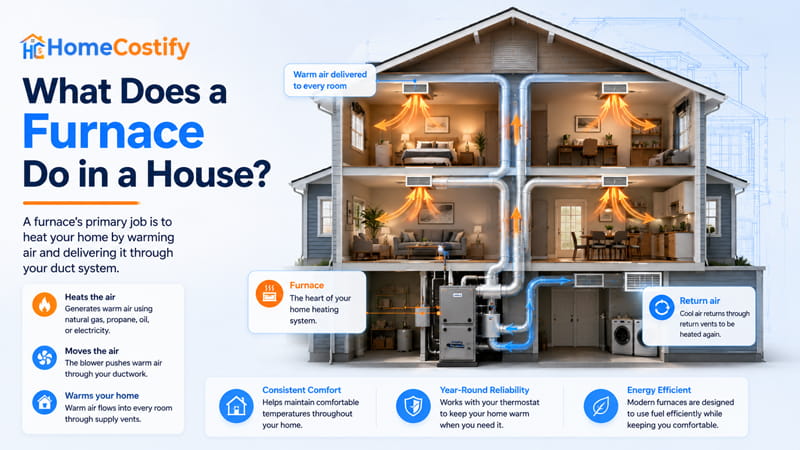
Cold weather changes what a house needs from its heating system. A drop in indoor temperature can prompt the furnace to supply the heat needed to bring those rooms back toward the selected temperature. That is its central job: space heating.
The equipment does not handle every aspect of indoor comfort. Cooling is a separate function, and ventilation has its own role. A house may use all three as part of one HVAC arrangement, with heating responsible for warmth.
For the homeowner, that distinction matters because the furnace is one piece of the larger setup, not the name for the entire system.
How Does a Furnace Work?
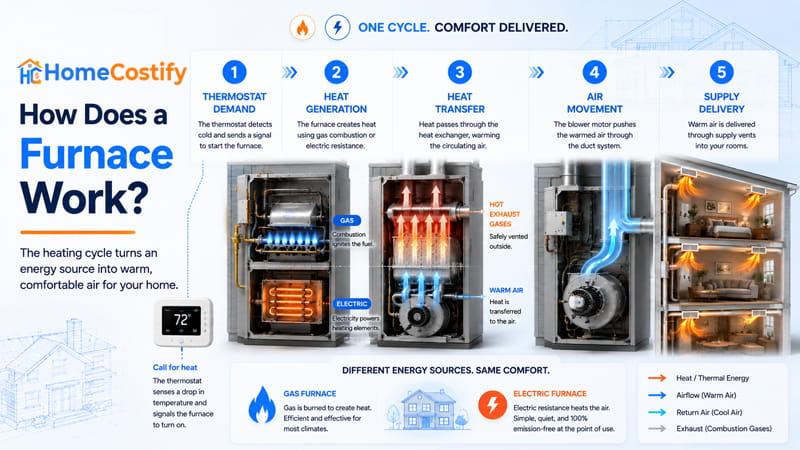
The exact process depends on the type of heating equipment, but the basic principle is the same. A call for heat begins a controlled sequence in which the heat source activates and converts its input into usable heat for the home.
The Basic Heating Cycle
The thermostat provides the starting signal for the heating cycle. That request reaches the controls, which determine whether operation can begin. Required operating and safety conditions are checked as part of that sequence.
Once heat generation begins, the blower circulates air across the heated section of the equipment. The air picks up available heat before continuing into the distribution side of the system. When the thermostat is satisfied, its call for heat ends, and the controls bring the cycle to a stop.
How a Gas Furnace Generates Heat
Gas furnaces get their heat from burning fuel. Natural gas or propane is admitted by the gas valve, which regulates the supply. An ignition source starts the burner, where the fuel undergoes controlled combustion.
Combustion takes place on one side of the heat exchanger. The other side carries the air used for space heating, so the two streams remain separated while heat transfers between them. The resulting combustion gases are routed into the exhaust path and discharged outside the house.
How an Electric Furnace Generates Heat
An electric furnace has no combustion stage because its heat source is electrical resistance. Current reaches the resistance elements, where electrical input is converted into heat. Multiple heating stages provide different levels of electrical heat, allowing output to increase as needed.
The heated elements raise the temperature of the air moving over their surfaces. That air leaves the heating section warmer and continues toward the spaces served by the equipment. No fuel is burned during the process, so the heating operation produces no combustion gases requiring outdoor exhaust.
How Does Air Move Through a Furnace?
Indoor air follows a circulation loop in a forced-air arrangement. Room air returns to the equipment while the supply side carries conditioned air back into occupied spaces. Together, the two pathways keep air circulating through the house.
The Return-Air Path
Air leaves occupied rooms through return registers or other return openings. The openings collect air from the spaces served by the heating system. Return ducts carry it toward the intake side, where it joins the circulating stream.
Return-opening placement can affect how well areas contribute to the return flow. The return side therefore gathers air from occupied areas before reaching the intake.
The Supply-Air Path
Conditioned air enters the supply plenum after leaving the equipment’s heating section. The plenum distributes the stream into branch ductwork serving rooms or zones. Each branch leads to a register, which releases the supply air into its space.
The arrangement of branches and registers determines the distribution pattern across the house. Placement matters because rooms do not all receive air from one branch.
What Are the Main Parts of a Furnace?

Several hardware groups work together within the assembly, with each serving a different operating role. Their arrangement follows the way the furnace handles its various functions.
| Component group | Examples | Main role |
|---|---|---|
| Controls | Control board, thermostat interface | Coordinates when and how operation occurs |
| Air handling | Blower motor, filter | Moves and conditions circulating air |
| Heat generation | Burner, igniter, gas valve, heating elements | Creates the thermal energy used for heating |
| Heat transfer | Heat exchanger | Transfers heat while separating combustion products from circulating air |
| Safety and exhaust | Flame sensor, pressure switch, inducer, venting | Monitors operation and manages combustion/exhaust safety |
Controls and Airflow Components
Control hardware establishes what the system should do, while air-handling hardware carries out the physical movement involved. Signals reach the control board before the blower motor performs its assigned task.
The filter sits within the circulating path ahead of downstream hardware. Their positions connect decision-making with air movement without making either group responsible for the other’s role.
Heat-Generating Components
The heat-source hardware depends on the configuration being used. Gas furnaces include a burner, ignition hardware, and fuel-control components.
Electric arrangements use resistance heating elements in place of those combustion-side parts. The gas valve has a narrower role: it regulates fuel delivery to the burner.
Heat Transfer and Safety Components
The heat exchanger separates combustion gases from the air used for heating while allowing heat to cross between them. A flame sensor verifies flame presence in combustion equipment.
Pressure-related controls watch conditions associated with combustion and exhaust operation. The inducer helps move combustion gases toward the venting system.
What Are the Main Types of Furnaces?
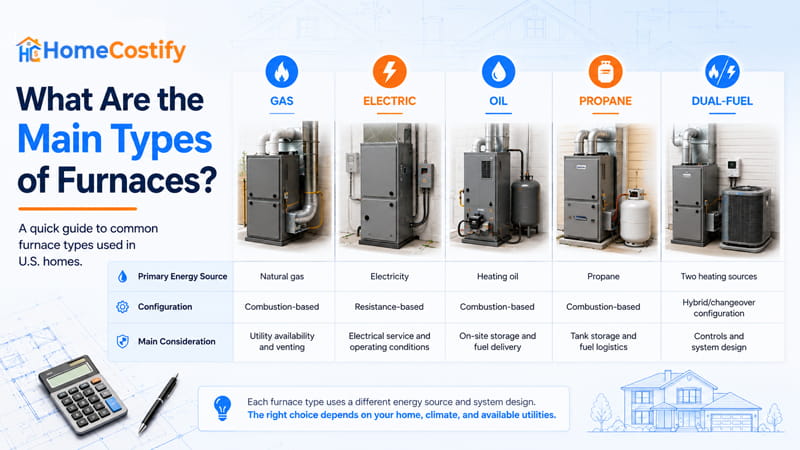
Residential heating units are commonly classified by their energy source. Combustion and electrical resistance form the two broad heating pathways. System configuration provides another classification layer for arrangements that do not rely on a single heating technology.
| Category | Primary energy source | Configuration | Main consideration |
|---|---|---|---|
| Gas | Natural gas | Combustion-based | Utility availability and venting |
| Electric | Electricity | Resistance-based | Electrical service and operating conditions |
| Oil | Heating oil | Combustion-based | On-site storage and fuel delivery |
| Propane | Propane | Combustion-based | Tank storage and fuel logistics |
| Dual-fuel | Two heating sources | Hybrid/changeover configuration | Controls and system design |
Gas Furnaces
Natural gas service connects the home to an external fuel supply. That connection affects where gas furnaces are practical within residential properties. Combustion-related venting also becomes part of the required infrastructure around the installation.
Electric Furnaces
Electricity supplies the energy for resistance heating without combustion fuel. No combustion exhaust pathway is needed for the heating process. The available electrical service therefore becomes an important infrastructure consideration for electric furnaces.
Oil Heating Systems
Heating oil is stored on the property rather than supplied continuously through a utility connection. Fuel delivery replenishes the storage supply as needed. Available storage capacity consequently becomes part of household planning.
Propane Heating Systems
Propane commonly reaches the home through a storage tank rather than utility gas service. Tank capacity and delivery schedules influence ongoing fuel access. The underlying heat-generation pathway remains combustion-based.
Dual-Fuel Heating Systems
A dual-fuel system combines two distinct heating sources within one arrangement. A common pairing uses a heat pump with combustion-based heating. Changeover controls select between those sources as operating conditions change. This configuration differs from systems built around a single heating source.
Furnace Efficiency: What AFUE Actually Tells You
AFUE provides an annualized measure of heating efficiency based on fuel use. The rating follows a defined methodology and covers the equipment’s rated fuel-use performance. Its scope matters when interpreting what the percentage says about actual heating performance.
What AFUE Measures
An AFUE percentage represents the share of fuel energy counted as space heat over an annualized rating period. A 90% rating means 90% of the fuel input is counted as useful heat under the rating methodology.
According to the U.S. Department of Energy, AFUE measures how much of a furnace’s fuel becomes usable space heat. The rating excludes electricity used by the blower and controls, along with heat losses from the home’s duct system.
Why AFUE Isn’t the Whole-System Efficiency
The rating stops at the equipment boundary, while delivered heat must still reach rooms through the home’s distribution system. Duct leakage can reduce the amount arriving at occupied spaces, while inadequate duct insulation can add distribution losses. Blower electricity also falls outside the fuel-conversion percentage.
Installation quality can further affect how well the distribution network performs. The homeowner ultimately experiences the heat delivered to conditioned spaces, not the rating alone.
AFUE describes rated fuel-use performance; whole-system performance also depends on distribution and installation conditions.
How Is a Furnace Sized for a House?
Heating capacity should follow the home’s heat-loss requirement rather than floor area alone. Several characteristics of the building determine that requirement.
| Sizing factor | Why it matters |
|---|---|
| Climate and outdoor design conditions | Establishes the temperature difference the home must overcome |
| Insulation | Changes the rate of heat moving through the envelope |
| Windows and doors | Influence conductive and solar-related heat behavior |
| Air leakage | Adds uncontrolled heat loss |
| Home size and layout | Affects the total area and distribution of heating demand |
Heating load describes the heat a home must replace to maintain the desired indoor temperature. The building envelope influences how quickly that heat escapes. Outdoor conditions determine the temperature difference the heating capacity must overcome.
As a result, homes with similar floor areas can have different heating requirements. A load calculation translates those requirements into the output capacity needed from the equipment.
Capacity also needs to match the load closely enough for appropriate operation. Oversizing can produce frequent cycling, with short cycles affecting comfort and operating behavior.
Undersizing creates the opposite problem during colder weather, when available output may fall short of actual demand. Proper equipment sizing is consequently a load-matching problem rather than a square-footage shortcut.
How Does a Furnace Fit Into an HVAC System?
An HVAC system is the broader climate-control framework serving a home. Heating forms one part of that framework alongside cooling, ventilation, and air handling. The heating function can involve dedicated hardware that supplies warmth within the home.
Furnace vs. HVAC System
HVAC refers to the broader arrangement responsible for managing indoor climate conditions. A heating unit serves the heating function within that larger arrangement. Cooling, ventilation, and controls can involve separate equipment or coordinated functions.
How Does an Air Handler Differ From Heating Equipment?
An air handler is centered on handling and circulating conditioned air through the distribution network. Heating equipment is identified by its role in providing heat to occupied spaces. Some configurations coordinate these roles within the same broader setup.
How Does Forced-Air Heating Differ From Other Central Heating?
Forced-air heating uses air as the medium carrying heat toward conditioned spaces. Hydronic heating distributes heat through water or steam instead. A heat pump follows another thermal pathway while still serving a central heating function.
What Are Common Furnace Problems?
Symptoms provide starting points for investigation rather than proof of a specific failure. One symptom can have several possible causes, while persistence, recurrence, severity, and operating context can change its significance.
| Symptom | Possible area to investigate | Appropriate next step |
|---|---|---|
| Weak airflow | Filter, blower, or duct restriction | Check basic airflow conditions |
| Uneven heating | Distribution or duct balance | Review room-level airflow conditions |
| Frequent cycling | Sizing, airflow, or controls | Arrange professional diagnosis if persistent |
| No heat | Controls, ignition, fuel, or electrical supply | Limit checks to safe homeowner-level observations |
| Unusual noise | Blower or mechanical hardware | Stop and seek service if severe, unfamiliar, or worsening |
A recurring symptom can reveal a pattern worth investigating. Timing and operating conditions may help narrow the area involved without identifying the underlying fault.
Persistent no-heat conditions, suspected combustion issues, electrical faults, or unfamiliar mechanical behavior warrant qualified service. Recurring failures also justify professional evaluation when basic observations do not resolve the concern. The appropriate boundary is escalation, not homeowner repair.
How Do You Maintain a Furnace?
Routine care focuses on observations and simple tasks that homeowners can handle safely. Assessment and work on internal components belong to qualified professionals.
Homeowner-Level Upkeep
The filter needs regular attention because restricted airflow can affect normal operation. Return and supply registers should remain unobstructed, and the area around the unit should stay reasonably clear.
Visible dust, debris, or unusual changes may signal a condition worth checking. Replace the filter according to its requirements and the equipment manufacturer’s guidance rather than following one universal interval.
Professional Maintenance
A technician can evaluate areas that require specialized knowledge or testing. This includes combustion operation, venting, electrical connections, safety controls, and overall performance.
The inspection helps verify operating conditions and identify issues that may require corrective work.
What Furnace Safety Issues Should Homeowners Know?
Some abnormal conditions exceed routine troubleshooting and require a different response. Combustion and electrical hazards can make trial-and-error investigation unsafe.
Combustion and Exhaust Safety
Combustion produces exhaust gases that require controlled removal from occupied spaces. Venting directs those products outside the building rather than allowing accumulation indoors. Carbon monoxide is a serious hazard when combustion is incomplete or exhaust is not properly contained. A CO detector provides an independent warning layer if this hazard develops.
Homeowner Stop Points
Suspected CO, damaged or disconnected venting, or an unusual combustion odor should end normal troubleshooting. Repeated safety shutdowns and significant electrical concerns also warrant stopping further checks. When safe operation cannot be established through basic observation, qualified service becomes appropriate.
How Long Does a Furnace Last?
Service life is a range shaped by more than equipment age. Current condition and operating history provide context for judging how much useful life may remain.
What Shapes Service Life?
Installation quality, operating conditions, cycling frequency, and maintenance history all influence accumulated wear. The surrounding environment can also affect how a unit ages. Two units with the same age may therefore have very different remaining service lives.
When Does Age Matter?
Age becomes more meaningful when reliability begins to decline or repairs become more frequent. Parts availability can also affect whether continued service remains practical.
Current condition offers stronger evidence than age alone. Replacement becomes an ownership decision rather than an automatic response to age.
Conclusion
Residential heating equipment provides the heat a home needs, but it is only part of the setup. The house still needs that heat to reach the rooms where people live. Sizing, installation, and the connection to the rest of the system affect the result.
A homeowner does not need to judge performance from the furnace alone. Airflow, upkeep, installation, capacity, and safe operation all matter when the system is running in the actual house. Good heating is not just about producing heat. The equipment also has to work properly within the house it serves.
FAQs About Furnaces
Can a Furnace Also Cool a House?
Central air can use the same ductwork and air-distribution infrastructure used for heating. Cooling remains a separate function from heat generation.
Can You Add Central Air to a House With Existing Heating Equipment?
Existing ductwork may support central cooling, but compatibility depends on blower capacity and system configuration. The cooling equipment also requires proper matching and installation.
Can a Furnace Improve Indoor Air Quality?
Air filters can capture particles from circulating air, depending on filter and system configuration. Heating equipment itself should not automatically be treated as an air purifier.
Can a Furnace Run Without a Thermostat?
A thermostat normally communicates the desired indoor temperature as a control signal. That heating demand initiates the system’s operating response, although control architecture varies.
Why Does a Furnace Make the Air Feel Dry?
Warming air changes its relative humidity, which can make indoor air feel drier. Perceived dryness does not necessarily mean the equipment is mechanically removing moisture.