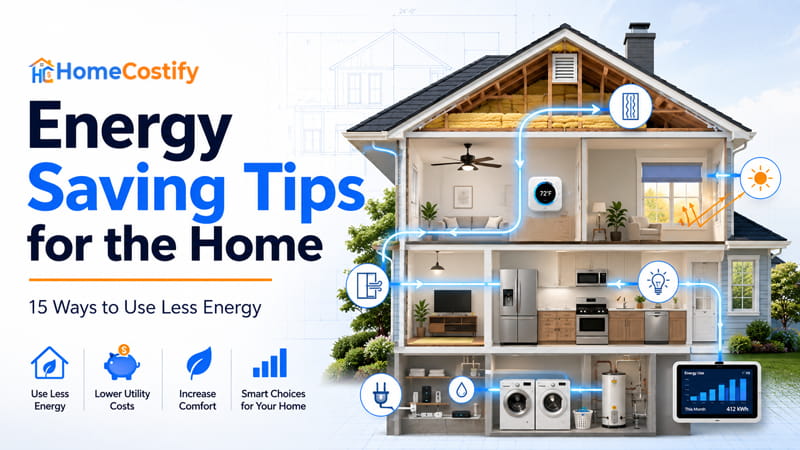
A long list of advice can leave a homeowner unsure which change deserves attention. Energy saving tips for the home cover actions with unequal potential, effort, and relevance. A light that runs briefly presents a smaller concern than equipment operating for hours each day.
Household routines alter that picture further. Ease of execution does not show how much energy a task actually involves. Changes tied to the property’s consumption pattern provide a stronger basis for deciding where to begin.
Climate helps shape the pattern of seasonal loads. Cooling often dominates during warm conditions, while colder periods place greater pressure on heating. Building design also influences heat transfer and unwanted air movement.
Equipment type and household occupancy add further variation to daily consumption. The same advice therefore deserves closer scrutiny in its actual setting before a homeowner acts on it.
What Does It Mean to Save Energy at Home?
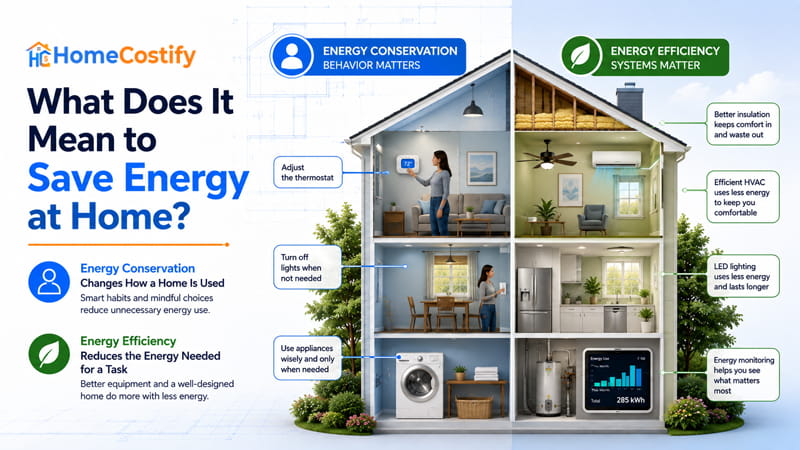
Saving energy does not always require giving up a household service. Sometimes the service is simply not needed at a particular time. In other cases, the same result requires fewer resources to deliver.
- Energy conservation: Changes occur in operation, timing, or frequency. Avoiding unnecessary use keeps a system off during periods without a needed output.
- Energy efficiency: The intended result remains available, but the equipment or system requires a smaller energy input to provide it. Controls, equipment, and physical improvements can contribute to that reduction.
Home energy efficiency extends beyond a single type of household decision. Changes in daily use and improvements to the way a system performs address consumption from separate angles. Both can contribute to the same goal without requiring the household to rely entirely on behavior or equipment.
Where to Look First for Energy Savings at Home

Repeated short periods of use can accumulate over the course of a day, even when each individual cycle remains brief.
| Home energy area | What to investigate | Typical signal |
|---|---|---|
| Heating and cooling | Runtime, controls, airflow, envelope | Frequent operation or uneven comfort |
| Water heating | Usage patterns, system condition | Heavy or frequent hot-water demand |
| Appliances | Usage frequency, age, operating settings | Heavily used or inefficient equipment |
| Lighting | Bulb type, operating hours | Frequently used inefficient fixtures |
| Plug loads | Always-connected electronics | Multiple devices remain powered |
Start With the Energy Your Home Uses Most
According to the U.S. Energy Information Administration, space heating and air conditioning accounted for 52% of U.S. household energy consumption in 2020. Water heating, lighting, and refrigeration represented another 25%.
Appliances, laundry, cooking, and consumer electronics made up the remaining 23%. These larger categories provide a useful reference for evaluating where to save energy at home. EIA notes variation by geographic location, home size and structure, equipment, and fuels.
Start With an Energy Assessment When the Problem Is Unclear
A normal walkthrough does not always reveal the source of high energy use. The U.S. Department of Energy recommends a home energy assessment to examine energy use and identify suitable efficiency measures.
Assessment methods may include walkthroughs, inspections, infrared imaging, or blower-door testing. A home energy audit can reveal conditions missed during a normal visual check and inform relevant home energy improvements.
Read the Symptom Before Choosing the Fix
Drafts near doors or windows are a clue to uncontrolled air movement. To reduce energy use at home, long HVAC runtime has several possible causes. Uneven room comfort can point toward distribution or envelope conditions. Heavy hot-water demand often reflects intensive use.
15 Energy Saving Tips for the Home
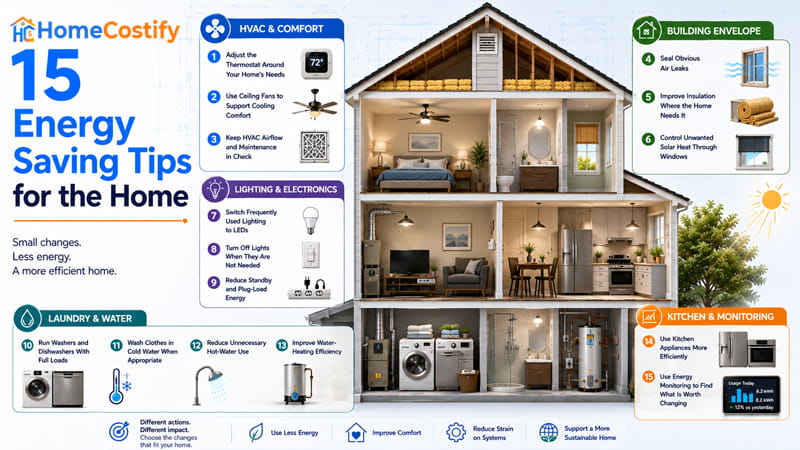
An existing system can be operated differently. Equipment condition can require attention, while other measures affect the house itself. The intervention depends on the pattern of use and the part of the house involved.
1. Adjust the Thermostat Around Your Home’s Needs
Vacant periods require less heating or cooling than occupied hours. Outdoor temperature and seasonal weather influence the appropriate setting. Humidity and personal comfort also enter that decision.
No single temperature suits every household. Thermostat adjustments are most relevant during periods without occupants, helping avoid conditioning that serves no purpose.
2. Use Ceiling Fans to Support Cooling Comfort
Moving air across exposed skin creates a cooling sensation for people in the room. Fan operation does not lower the room’s actual temperature. Once occupants leave, the comfort benefit ends with them.
During occupied periods, a ceiling fan can supplement mechanical cooling and help save energy at home without replacing air conditioning.
3. Keep HVAC Airflow and Maintenance in Check
Filter condition affects HVAC airflow. Replacement timing belongs to the manufacturer’s guidance. Supply and return vents require clear openings, so furniture, curtains, or stored items should not block them.
Clear vents and appropriate filter maintenance preserve normal airflow. Routine maintenance does not correct an inherently inefficient unit.
4. Seal Obvious Air Leaks
Gaps around doors, windows, penetrations, and transitions allow outside air to enter and conditioned air to escape. Weatherstripping fits movable joints. Caulking suits fixed gaps.
Air sealing at the building envelope limits leakage around gaps and penetrations. Home energy efficiency includes control of unwanted air movement. Insulation addresses conductive heat transfer through solid building materials.
5. Improve Insulation Where the Home Needs It
Insulation slows heat transfer in walls, ceilings, and building assemblies. An attic or boundary area with incomplete coverage has less thermal resistance. Assembly design determines where additional insulation fits.
Existing coverage and condition need review before additional material goes into the assembly. Higher thermal resistance can reduce home energy use where insufficient insulation contributes to heat transfer.
6. Control Unwanted Solar Heat Through Windows
Sun exposure at a window changes with its orientation, season, and time of day. Shades or blinds can limit solar heat entering a room during periods of strong exposure.
The approach manages heat entering through the glass without changing the window’s thermal performance.
7. Switch Frequently Used Lighting to LEDs
An incandescent bulb uses more energy per operating hour than an LED bulb. The difference becomes relevant at fixtures that run for long periods. Energy efficient home tips should account for both bulb technology and fixture use.
Rarely used lights offer a smaller reason for conversion. Efficient existing lighting does not require replacement simply because LED options exist.
8. Turn Off Lights When They Are Not Needed
An unoccupied room rarely needs its lights left on. Turning off unnecessary lighting cuts the time a fixture draws electricity. Repeated use throughout the day can add up, even with an efficient bulb. The potential effect varies with bulb efficiency and normal operating hours.
9. Reduce Standby and Plug-Load Energy
Some electronics draw electricity with their main function inactive. Several devices serving the same activity can form a practical cluster for grouped control. A smart power strip simplifies control across equipment sharing one area. Save energy at home by limiting unnecessary idle use without disconnecting equipment that needs continuous power.
- Standby power: electricity drawn by equipment kept ready for use.
- Phantom load: electricity drawn by certain connected devices despite limited active use.
- Entertainment center: TV, streaming box, game console, audio equipment, and related peripherals.
- Computer workstation: Desktop, monitor, speakers, printer, and connected accessories.
- Convenience equipment: Devices kept powered mainly for immediate availability.
10. Run Washers and Dishwashers With Full Loads
Partial loads can increase the number of cycles needed for routine laundry or dishwashing. Combining compatible items reduces repeated operation, provided the load stays within the appliance’s capacity.
Household routines determine whether waiting for a fuller load fits practical use. A full load means using available capacity without overloading the machine.
11. Wash Clothes in Cold Water When Appropriate
Heating wash water requires additional energy. A cold wash cycle avoids much of that heating during laundering.
Fabric type, soil level, stains, detergent, and sanitation needs still influence the suitable temperature. Reduce energy use at home by choosing a cold cycle for loads that suit lower temperatures.
12. Reduce Unnecessary Hot-Water Use
Long showers increase the volume of heated water used during daily routines. Repeated hot-water activities add further volume for the water heater to raise in temperature.
Shorter showers and fewer unnecessary uses reduce the amount requiring heating. The focus here is heated water, rather than overall water consumption.
13. Improve Water-Heating Efficiency
The existing water heater’s age and condition provide useful context for its performance. Distribution losses can also occur between the heater and points of use, depending on the configuration.
Pipe insulation may help limit those losses in suitable installations. Home energy improvements can extend to system-level changes, including a heat pump water heater where the home’s configuration supports one.
14. Use Kitchen Appliances More Efficiently
Kitchen operation includes several small decisions that influence appliance workload. Food storage and cooking practices can shorten unnecessary operation during ordinary use. Save energy at home by keeping appliance operation appropriate to the task being performed.
- Check refrigerator seals: Poor seals can make the refrigerator work harder to maintain internal conditions.
- Plan before opening the refrigerator: Taking several items at once reduces repeated door opening.
- Match cookware to the cooking task: Suitable size and type direct heat toward the intended cooking task.
- Use residual heat where appropriate: Some cooking processes do not require active operation until the final moment.
15. Use Energy Monitoring to Find What Is Worth Changing
Utility usage history can expose recurring patterns that are difficult to notice during ordinary routines. A smart meter may offer additional detail where the service supports it. Persistent or unusual consumption can justify closer examination.
Reduce home energy use by using consumption data to decide which area deserves further investigation. Measurement becomes useful through the decision it informs, rather than through data collection alone.
When an Energy-Saving Tip Is Not Worth Doing
An efficient measure can still have little practical value for a particular property. Existing conditions and usage shape the opportunity available from a change. Priority follows the scale and persistence of the issue, not the technical appeal of the measure.
Rarely used equipment has limited operating exposure. Already-efficient equipment may leave little room for incremental improvement. Home energy efficiency deserves a closer look where usage creates a meaningful opportunity, rather than treating every possible improvement alike.
A reasonable efficiency measure can miss the actual problem. A control change cannot correct a physical building-envelope issue. Replacing equipment may leave distribution or air-leakage problems untouched.
Energy saving tips for the home need a connection to the condition being addressed. That connection becomes important if the aim is to lower your electric bill.
- The load is already very small.
- The equipment is rarely used.
- The proposed intervention does not address the observed problem.
- A larger persistent issue remains untreated.
How to Choose the Right Energy-Saving Change for Your Home
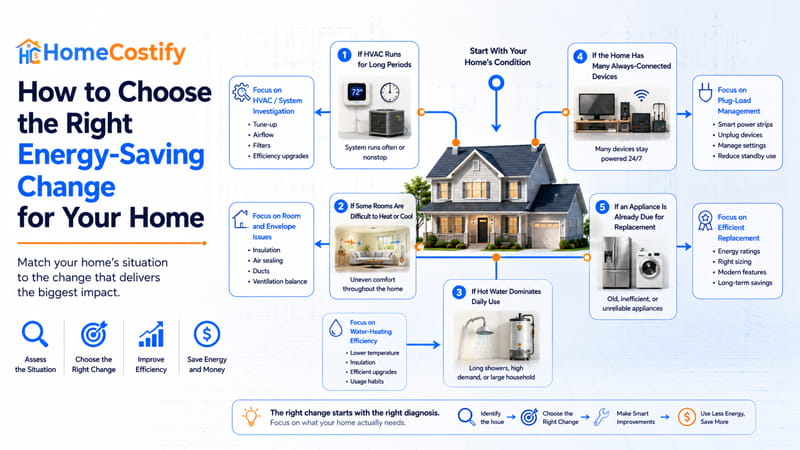
A visible condition does not point to one response in every house. The surrounding circumstances determine which intervention category fits the situation. An observed symptom provides a starting point for that decision.
If HVAC Runs for Long Periods
Extended HVAC runtime can justify looking beyond the control setting itself. Controls, airflow, distribution, the building envelope, and equipment condition each offer a different line of inquiry. Save energy at home by matching the response to the source of the extended operation. Runtime alone does not establish a case for replacement.
If Some Rooms Are Difficult to Heat or Cool
Uneven temperatures can appear for several reasons. Room location and orientation can shape the pattern, along with conditions affecting the space itself.
Comparing the affected room with other parts of the house can narrow the relevant intervention category. One uncomfortable room does not automatically point to one specific improvement.
If Hot Water Dominates Daily Use
Frequent hot-water use can make water heating a larger part of daily consumption. Household size also changes the amount of hot water typically required.
Existing system condition becomes relevant before considering a larger change. Reduce energy use at home by considering replacement timing alongside the observed usage pattern.
If the Home Has Many Always-Connected Devices
Several connected devices can create a meaningful idle load as a group. Home offices, entertainment setups, and networking equipment may contain several units serving the same activity.
Device count and usage frequency help indicate whether the cluster merits investigation. An always-connected device does not automatically warrant disconnection.
If an Appliance Is Already Due for Replacement
A functioning appliance does not need replacement solely because a newer model uses less energy. Once replacement is already necessary, efficiency becomes a useful selection criterion.
Energy efficient home tips can include checking standardized information such as ENERGY STAR certification. Expected usage should also influence the model chosen.
How to Tell Whether You Are Actually Using Less Energy
A lower utility reading after an improvement does not, by itself, establish a result. The period before the change provides the comparison point. Weather, occupancy, and normal use can shift readings independently.
Establish a Baseline Before Making a Change
Bills or utility records from before the work provide a useful starting point. Several months can show the usual pattern better than a single reading. Note major changes in occupancy or seasonal use alongside those records. The aim is a workable reference for later comparison.
Compare Similar Conditions
A mild month can produce a lower bill even without an efficiency improvement. Changes in weather, occupancy, or daily routines can alter the figures.
Compare periods with broadly similar circumstances before crediting a particular measure. This makes home energy improvements easier to assess without treating every change in consumption as proof.
Use Home Energy Data to Judge the Result
The post-change record shows what happened after the intervention. Compare it with the earlier pattern, then account for major differences in weather or use. A sustained shift carries greater weight than an isolated reading.
Home Energy Score provides a separate type of information through a 1–10 rating based on assessed characteristics. It can identify potential improvement areas, but it does not verify savings from one specific action. Save energy at home by using consumption records to judge results rather than assuming success.
Energy-Saving Tips for Different Home Situations
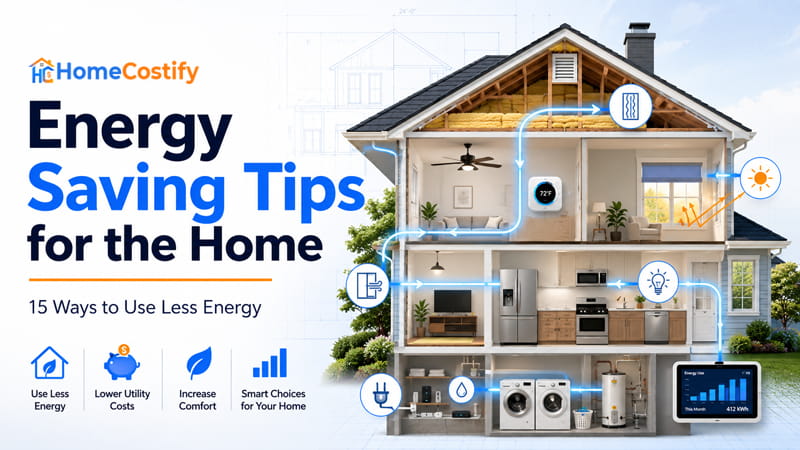
A house built decades ago may present different efficiency challenges from a newer property. Local weather creates another layer of variation. Renters also face different limits from owners because control over permanent changes is not the same.
Older or Drafty Homes
Drafts, uneven comfort, and past alterations can reveal differences within an older structure. Previous work may have improved one area while leaving another largely unchanged.
Construction details matter because assemblies and materials vary between properties. Home energy efficiency therefore needs to account for existing conditions rather than treating age as a diagnosis.
Hot, Cold, and Mixed Climates
Air conditioning often carries the larger seasonal workload in hot regions. Heating takes a larger role during colder periods. Mixed climates can shift that balance as the seasons change.
Sun exposure and the ability of the structure to retain heat add local variation. Save energy at home requires attention to the climate pattern affecting the property.
Renters and Homeowners
Renters generally control daily habits, lighting, appliance use, and thermostat settings. Permanent alterations usually require permission from the property owner. Homeowners have greater latitude over equipment and building changes.
The available choices therefore depend partly on who controls the property and what modifications are permitted.
Final Takeaway
Time, money, and effort are limited on a home project. Not every possible measure warrants the same amount of attention. Some Energy saving tips for the home require substantial work for a modest practical effect. Others address a clear source of unnecessary use with far less intervention. The goal is not to complete the longest list.
A property’s needs can shift as years pass. Occupants change, equipment ages, and alterations affect how the building performs. Seasonal weather brings another source of variation. Energy saving tips for the home should remain responsive to those shifts rather than staying tied to an earlier set of priorities.
What happens after an intervention provides a useful basis for the next choice. A measurable improvement supports keeping that approach in place. Little visible change raises a different question about what else may be involved. Over time, those observations turn individual decisions into a continuing process of adjustment.
FAQs About Energy Saving Tips for the Home
What is the best way to save energy at home?
There is no universal best action. The strongest opportunity depends on where the property actually uses energy and which conditions create unnecessary consumption.
What are the simplest energy saving tips?
Simple options include switching off unused lights, adjusting settings during unoccupied periods, and choosing cold laundry cycles where appropriate.
Does turning off lights really save electricity?
Yes. An unneeded light consumes no electricity once switched off. The effect depends on bulb efficiency, operating duration, and how often it would otherwise remain lit.
Is it bad to turn lights on and off repeatedly?
The effect varies by lamp technology. Different bulb types have different switching characteristics, so repeated switching is not equally significant across every lighting system.
Why is it a good idea to turn off lights when you leave a room?
An unoccupied room often needs no active lighting. Switching off the fixture stops its electricity use during that period, separate from the efficiency of the bulb itself.