
Saving money on home heating starts with a simple financial outcome: spending less to keep the house suitably warm. To save on your heating bill, the household should see a genuine reduction in what it pays for heating during the season.
The point is not to pursue the lowest possible number at any cost. Any reduction still needs to fit normal household needs and everyday living.
The bill provides the clearest measure of whether a change produced a financial benefit. Using less heating is not enough if the amount paid stays essentially unchanged.
Actual spending gives the homeowner a firmer basis for judging the result. The comparison should focus on money spent, rather than treating reduced use itself as proof of successful saving.
Comfort establishes the other side of that equation. A lower payment has limited practical value if ordinary living becomes uncomfortable. People still need adequate warmth for sleeping, working, relaxing, and carrying out daily activities.
The purpose of saving is therefore straightforward: keep heating expenses manageable while preserving a livable environment. Lower spending has little value if the home becomes uncomfortable for normal living.
What Makes a Home’s Heating Bill Higher?

Heating expenditure is the money spent to keep a home warm during the heating season. Actual spending shows what a household pays to maintain suitable indoor conditions and gives homeowners a baseline for efforts to save on heating bills.
According to the U.S. Energy Information Administration, fuel prices are only one part of heating costs. Weather, insulation, air tightness, indoor temperature, and equipment efficiency also influence energy use for home heating.
Heating Demand Is Not the Same as Equipment Performance
Heating demand is the quantity of heat a home needs. Equipment performance is a separate question: whether the heating system delivers that quantity effectively. To save money on heating, homeowners need to separate the amount of heat required from the condition of the equipment.
Similar furnaces do not give two houses the same heating requirement. One house may need more heat throughout the season because its heating load is greater. The equipment does not determine the full amount of heat the house needs.
A Home’s Thermal Performance Changes Its Heating Requirement
Thermal performance concerns how well a home holds its indoor conditions. Stronger thermal performance reduces the amount of replacement heat needed to keep those conditions stable. A lower requirement can help lower heating costs without changing the equipment itself.
Heat retention shapes the workload across the heating season. Greater retention leaves less heat to replace. Poorer retention creates a larger replacement requirement and, consequently, greater energy use.
The Heating Bill Is a Combined Cost Outcome
A heating bill brings several cost influences together. Weather may change the seasonal workload, while fuel prices alter the expense of supplying that workload. Equipment performance adds another variable. No single line on the bill separates these effects.
The total does not reveal which factor contributes most to the final charge. A high bill records the amount paid, but not the reason behind it. The final figure alone cannot tell a homeowner where the added cost originated.
Practical Ways to Lower Heating Costs at Home
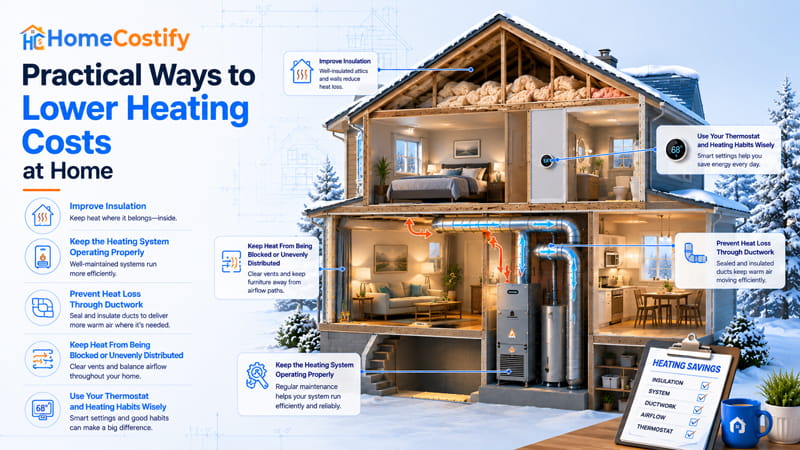
Practical savings begin with changes tied to an actual condition in the house. The goal for homeowners who want to save on heating bills is to address a real need rather than follow generic advice.
| What you notice | Area worth checking | Why it may matter |
|---|---|---|
| Drafty rooms | Building-envelope leakage paths | Uncontrolled air movement can increase the amount of heat the home needs |
| Cold upper rooms | Attic boundary | Weak thermal performance in upper areas can increase heat transfer |
| Rooms heat unevenly | Airflow and heat distribution | The system does not always deliver heat evenly where it is needed. |
| Heating system runs unusually often | Equipment performance and controls | Excessive runtime can increase heating energy use |
| One room stays colder | Room-level heat loss or distribution | A local problem can persist even when the heating system is operating |
| Persistent high bills with no obvious cause | Overall home performance | More than one condition can contribute to heating demand. |
Reduce Heat Loss Through Air Leaks
Air leakage occurs when conditioned air escapes through unintended openings in the building envelope. Replacement air then enters from other paths, adding to the home’s heating workload. Sealing relevant leakage paths makes sense once uncontrolled airflow is established as part of the problem.
Some leakage paths are easy to overlook because the opening itself is hidden from view. Attic hatches, wiring holes, plumbing penetrations, open soffits, and recessed lights can connect conditioned areas with unconditioned spaces.
Furnace flues and duct chaseways also deserve caution because openings around them may affect airflow. Basement rim joists represent another possible pathway. These locations give homeowners a starting point for checking leakage without assuming every visible gap explains the bill.
Accessible gaps sometimes allow straightforward sealing work. Weatherstripping suits certain movable joints, while caulk can address appropriate stationary gaps. The construction around the gap still matters before either approach is used.
Openings associated with combustion equipment, flues, or unusual construction require greater care. A homeowner should not treat every opening as an ordinary sealing project.
A draft felt beside a window or wall does not prove that the opening itself causes the leakage. Pressure differences can pull air through a path that begins somewhere else.
Sealing the most noticeable draft may lower heating bills in some cases, but other leakage pathways can remain untouched. The location where air is felt is not always the location where it enters or escapes.
Improve Attic Insulation and Other Weak Spots
Insulation slows heat transfer through the building envelope. Its role differs from air sealing, which limits unwanted air movement. Addressing inadequate thermal resistance can help a homeowner save on heating bills where the insulation is a weak point in the envelope.
The two measures target different physical processes, even though both can affect overall heating performance.
The attic often forms a major part of the home’s upper thermal boundary. Uneven or inadequate insulation reduces the resistance of that boundary, allowing more heat to escape during cold weather.
The heating system then has more work to compensate for the resulting loss. Addressing weak attic insulation can reduce heating bills if the attic accounts for a meaningful share of heat loss.
ENERGY STAR estimates that air sealing and added insulation in areas such as attics, floors above crawlspaces or basements, and basement walls can reduce heating and cooling costs by an average of 15% in typical U.S. homes. Actual results vary with climate and the characteristics of the home.
The presence of insulation alone does not establish that the attic is adequately insulated. Coverage, compression, gaps, and depth offer better clues during a visual inspection. Uneven coverage can leave portions of the boundary less protected than surrounding areas.
Keep Your Heating System Working Efficiently
Equipment performance affects how long a heating system must run to meet the same heating requirement. A decline in performance can extend the runtime needed to deliver the required output.
To save on your heating bill, unusual changes in heating runtime deserve attention. Longer operation does not automatically mean the equipment is inefficient, but a persistent change warrants closer inspection.
On forced-air systems, a dirty furnace filter can restrict airflow through the heating equipment. Reduced airflow can interfere with normal system operation and place additional strain on the system.
A filter check provides a simple maintenance point for homeowners seeking to lower heating bills. The appropriate inspection and replacement frequency depends on the system and the filter manufacturer’s guidance.
Routine maintenance should match the type of heating equipment in the home. Furnace maintenance and boiler maintenance involve different components and service needs. A suitable tune-up or service visit can uncover maintenance needs before they develop into larger mechanical problems.
Maintenance helps keep system operation within its intended range without promising a specific reduction in heating costs.
Maintenance has a defined boundary. It addresses equipment-side problems that affect operation or reliability. It does not correct heat loss caused by weaknesses in the building envelope.
Prevent Heat Loss Through Ductwork
Ductwork carries conditioned air from the heating equipment to the areas served by the system. Its integrity affects whether that air remains within the distribution path during delivery. A sound duct system also helps preserve the thermal condition of the air as it travels.
Check for Leaking or Disconnected Ducts
Loose connections, holes, damaged sections, and disconnected ducts can release conditioned air before it reaches the intended rooms. Finding losses within the duct system gives homeowners a clearer basis for deciding whether corrective work could save on heating bills.
Weak airflow at a register or a room-specific heating problem can provide a reason to inspect the ductwork. A high heating bill alone does not establish that duct leakage is responsible.
Pay Attention to Ducts in Unheated Spaces
Duct location matters for supply or return ducts that pass through unheated spaces. Attics, crawlspaces, and garages expose duct surfaces to temperatures outside the conditioned area.
Temperature differences between the duct and its environment can increase heat transfer before air reaches the rooms. Reducing significant duct losses can lower your heating bill by limiting that unwanted transfer.
Duct insulation limits this thermal transfer, while duct sealing keeps air from escaping the system. The two measures protect different aspects of duct-system integrity.
Keep Heat From Being Blocked or Unevenly Distributed
Furniture, curtains, or other objects can restrict airflow at supply registers, return vents, or radiators. Even a small obstruction can interfere with heat reaching part of the room.
Adequate clearance keeps airflow paths available for normal room delivery. The check requires no system modification. For homeowners, that makes it a practical way to save money on heating.
One room may remain cold while the heating system continues operating. Changing the thermostat does not necessarily address that situation.
Limited airflow is one possibility, while conditions within the room provide another. Uneven temperatures can therefore reveal a local distribution issue without establishing its exact cause.
The simplest check is visual. Make sure furnishings leave adequate clearance for air to move freely through the room. Moving an object away from a restricted opening requires little work and no system modification.
If the pathway is already clear, persistent discomfort points beyond a basic obstruction. That distinction can help determine whether further action could save on heating costs.
Use Your Thermostat and Heating Habits Wisely
The thermostat establishes the indoor condition used as the operating target. A change to that target or its schedule changes the periods during which heating is requested. For someone seeking to save on your heating bill, runtime becomes the practical link between thermostat control and household operation.
Occupancy provides a basis for scheduling. Programmable and smart thermostats can reduce heating operation during periods that do not require the same indoor target.
A question such as “best temperature to det thermostat in winter” points to the choice of an indoor target rather than a fixed rule for every home. Matching the schedule to household use can lower heating costs without turning temperature selection into the focus.
A vacant home does not require the same operating pattern as an occupied one. Aligning heating periods with actual use can save heating bill spending otherwise tied to unnecessary runtime. That differs from asking for “the cheapest way to heat a house,” which concerns system or fuel selection.
Operating habits still need to suit the heating equipment and conditions of the home. Blanket shutdowns can create problems rather than provide a universal saving strategy.
Know When a Larger Heating Problem Is Driving the Cost
A bill that suddenly rises above the home’s usual range is a warning, not a diagnosis. Changes in cycling or persistent room-temperature problems add other clues.
A homeowner seeking to reduce heating bills can compare those changes with the home’s previous normal operation. The comparison helps establish whether something has actually changed.
Repair frequency or declining equipment performance may point toward an equipment-side concern. Persistent drafts or problems confined to particular rooms suggest a different line of inquiry.
Neither pattern rules out another contributing condition. Home performance and equipment condition can overlap, leaving more than one factor behind the same cost pattern.
Some problems remain unresolved after basic checks simply because their source is difficult to isolate. Repeated symptoms can have competing explanations, especially when several conditions appear at once.
Continuing to make isolated adjustments does not necessarily reveal which factor matters most. Once the cause cannot be localized with reasonable confidence, homeowner-level checking has reached its practical limit.
When You May Need a Professional Heating Assessment

Simple checks lose value once too much uncertainty remains about the home’s condition. An assessment can provide stronger diagnostic confidence before spending money to save on your heating bill.
Several plausible causes can remain after basic checking. In that situation, deciding which condition deserves corrective action becomes difficult. A home energy assessment can narrow that uncertainty and help lower heating bills through a better-informed decision.
A clear link between the condition and the proposed action gives homeowners a sounder basis to save on heating costs without assuming one solution fits every home.
Better evidence can increase confidence about the condition and the appropriate next step. It does not establish a fixed amount of savings from future changes. Actual results depend on the home’s characteristics and how the household uses it. An assessment can support decisions to reduce heating bills, but it is not the corrective work itself.
Bottom Line
A home’s heating cost reflects the heat that must be replaced to maintain suitable indoor conditions. Reducing that replacement need reduces the heating work required. To save money on heating, look beyond how the system operates and consider why the home requires that much heat.
It is how much heating work the home requires in the first place, how effectively that work reaches the living space, and how consistently the intended indoor condition is maintained.
The clearest decision rule is simple: investigate before intervening. When the cause is reasonably clear, a targeted response gives you a stronger basis to lower your heating bill. Uncertainty changes that calculation.
Several plausible causes can make random adjustments difficult to evaluate. A better decision comes from establishing enough evidence to connect the condition with the appropriate corrective action. The objective is not to change as many things as possible, but to make a change you can reasonably connect to the problem.
FAQs About Saving on Your Heating Bill
Which heaters use the least amount of electricity?
Electricity consumption depends on heater type, rated output, runtime, and efficiency. There is no single lowest-use option without considering the equipment and operating conditions.
Should you leave heating on overnight?
Not necessarily. Overnight operation depends on the heating system, outdoor conditions, occupancy, and household needs. Adjusting the operating schedule can save on heating costs when continuous heating is not needed, but the appropriate approach depends on the home and equipment.
What will happen if I keep my heater on continuously for 8 hours?
Eight hours of operation can use more energy than shorter runtime, but actual consumption depends on heating demand, cycling, system type, and operating conditions. Comparing runtime with the resulting energy use can show whether the change could save heating bill spending.
How low should I set my heat at night?
There is no single nighttime thermostat setting for every home. System type, outdoor conditions, household needs, and safety considerations all affect the appropriate target.
Is it safe to sleep with the heater on?
Safety depends on heater type, installation, ventilation, clearance, and manufacturer instructions. Portable heaters require different safety considerations from central heating systems.