Few household upgrades have a bigger impact on daily living than reliable air conditioning. During a long stretch of summer heat, indoor temperatures can climb quickly, especially in houses that receive direct afternoon sun. Home air conditioning systems are designed to remove heat from indoor spaces and keep temperatures within a more comfortable range throughout the day.
A home air conditioning system is a mechanical cooling setup that transfers heat from inside a house to the outdoors while also managing indoor moisture levels. Most systems use components such as a thermostat, compressor, evaporator coil, and condenser coil to complete a continuous cooling cycle.
The result is lower indoor temperatures, better humidity control, and more stable indoor comfort during warm weather.
Across the United States, cooling has become a standard part of everyday life rather than an occasional luxury. Houses in Florida face different weather conditions than houses in Colorado, yet both may depend on cooling equipment for part of the year.
The equipment itself varies as well. Central systems remain common, although ductless units, heat pumps, and other home cooling systems have gained attention as housing styles and energy preferences continue to evolve.
The house itself also affects equipment selection. Square footage matters, but it is only part of the picture. Ceiling height, insulation levels, window placement, local weather patterns, and existing ductwork can all influence how well a system matches a particular home.
What Is a Home Air Conditioning System?
The term covers far more than a single outdoor unit sitting beside a house. Home air conditioning systems include a collection of mechanical components that work as a connected network. Each component performs a specific task while heat moves from one location to another through a controlled process.
An air conditioner system operates by capturing heat inside the house and releasing that heat outdoors. During hot weather, indoor air passes across an evaporator coil that contains refrigerant. Heat transfers into the refrigerant, and cooler air returns to the living space. The process repeats throughout the day as temperature conditions change.
Most air conditioning systems also influence moisture levels inside the house. Summer air often contains a large amount of water vapor, particularly in coastal and southern regions. As warm air moves across cold evaporator coils, moisture condenses and drains away. Indoor air feels drier afterward, which can make a room feel cooler even when the thermostat setting remains unchanged.
The equipment used for this process varies from house to house. Central units, ductless systems, packaged units, and heat pumps all perform the same basic task of moving heat. Their installation methods and air distribution methods differ, yet the underlying cooling cycle remains similar.
People frequently associate cooling with lower temperatures alone. Temperature is only one part of the experience. Air movement, moisture levels, and temperature consistency throughout the house all influence indoor comfort. For that reason, home AC systems are often evaluated as part of a larger HVAC system rather than as isolated pieces of equipment.
A large house in Arizona and a smaller house in Georgia may require completely different cooling strategies despite sharing similar summer temperatures. Local weather, building design, and occupancy patterns can influence equipment selection just as much as square footage.
That relationship between the building and the equipment sits at the center of how home air conditioning systems are selected and used.
Why Air Conditioning Is Common in U.S. Homes
Cooling demand has expanded steadily across the country over the past few decades. Population growth in warmer regions, larger living spaces, and higher expectations for indoor temperature control have all influenced residential cooling trends.
According to data from the U.S. Energy Information Administration, air conditioning has become a standard feature in American housing rather than a luxury. Nearly nine out of ten U.S. households use some form of cooling equipment, and central air systems remain the dominant choice in many regions of the country.
Climate patterns, home design, and rising summer temperatures have all contributed to the widespread adoption of whole-house cooling systems.
A few factors continue to drive demand for home air conditioning systems across the United States:
- Long periods of hot weather in southern states increase cooling needs during spring and summer.
- Population growth in Sun Belt regions has expanded the market for residential cooling systems.
- New construction frequently includes central air as a standard feature.
- Larger homes often require whole-house cooling rather than room-by-room solutions.
- Humidity levels in parts of the Southeast create demand for both temperature reduction and moisture removal.
Regional differences remain noticeable. A house in Phoenix faces different climate conditions than a house in Seattle. Even so, central air remains one of the most common forms of cooling equipment used in modern U.S. housing.
Demand for whole-house cooling continues to shape purchasing decisions, replacement projects, and new construction across a wide range of climates.
The Main Components of a Home Air Conditioning System
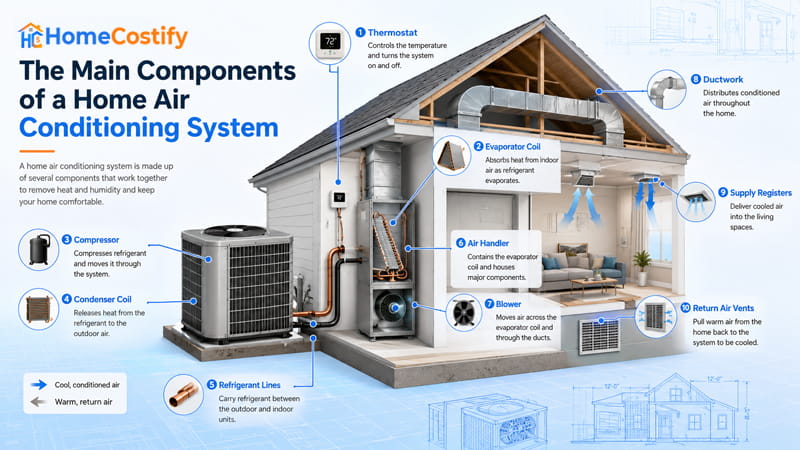
Cold air coming from a vent can make the entire process seem simple. Behind that airflow sits a network of mechanical parts that move heat from one place to another. A failure in a single component may affect the entire system, even if every other part remains in good condition.
Most home air conditioning systems use the same core hardware regardless of brand. A unit installed in Texas may look different from one installed in New York, yet both depend on a thermostat, evaporator coil, compressor, condenser coil, refrigerant, and air distribution equipment. These air conditioner components form the foundation of nearly all residential cooling equipment found across the United States.
An air conditioning system diagram usually shows these parts connected in a continuous loop. Heat enters the system indoors, travels through refrigerant pathways, and leaves the house through outdoor equipment. Air then circulates back into living spaces at a lower temperature. The process repeats throughout the day whenever cooling demand exists.
Thermostat
The thermostat acts as the command center for the system. Room temperature readings are compared against selected temperature settings, and the equipment responds whenever indoor conditions move beyond the desired range.
Older thermostats operate with simple temperature controls. Newer models often include scheduling functions, occupancy sensing, remote access, and energy tracking features. A smart thermostat may adjust cooling schedules automatically based on household routines rather than running at the same settings around the clock.
Small temperature changes can affect operating patterns throughout the day. A difference of only a few degrees may alter cycle length, runtime, and electricity consumption during periods of heavy summer heat.
Evaporator Coil
The evaporator coil sits inside the house, usually near the air handler or furnace. This component serves as the primary indoor heat collection point within the cooling cycle.
Warm indoor air passes across the coil surface while refrigerant moves through tubing inside the coil. Heat transfers from the air into the refrigerant. Moisture in the air also condenses on the cold coil surface and drains away through a condensate line.
That moisture removal process becomes especially noticeable in humid regions. Temperatures may remain similar from one day to the next, yet lower indoor humidity often changes how a room feels.
Compressor
The compressor functions as the driving force behind refrigerant circulation. Without it, refrigerant would remain stationary and heat movement would stop.
Located in the outdoor unit, the compressor increases refrigerant pressure before sending it toward the condenser coil. Pressure changes are a central part of refrigeration technology. Refrigerant enters the compressor at one condition and leaves at another, carrying heat collected indoors.
Single-stage compressors remain common in residential equipment. Variable-speed designs have become more common in newer installations because they can operate across a wider range of cooling demands instead of running at only one output level.
Condenser Coil
The condenser coil sits inside the outdoor unit and handles heat rejection. Heat collected indoors eventually arrives at this location through refrigerant circulation.
Outdoor air passes across the condenser coil while a fan pulls air through the cabinet. Heat leaves the refrigerant and moves into the outdoor environment. During hot weather, warm air discharged from the top of an outdoor unit often provides a noticeable reminder that heat is actively leaving the house.
Dirt accumulation can interfere with heat release. Leaves, grass clippings, and airborne debris may restrict airflow around the outdoor cabinet over time.
Refrigerant Lines
Copper tubing connects indoor and outdoor equipment. These refrigerant lines create the pathway that allows heat to move between major system components.
One line typically carries refrigerant toward the indoor coil, while another carries refrigerant back toward the outdoor equipment. Insulation commonly covers the larger line because temperature differences between refrigerant and outdoor air can create condensation.
Although these lines receive less attention than outdoor units or thermostats, the entire cooling process depends on uninterrupted refrigerant circulation between indoor and outdoor sections.
Air Handler and Blower
The air handler houses the blower assembly responsible for moving conditioned air throughout the house. After air passes across the evaporator coil, the blower pushes that air into the duct system.
Air movement affects temperature consistency from room to room. Weak airflow may create hot spots, uneven temperatures, and longer operating cycles. Strong airflow generally distributes conditioned air more evenly across living areas.
Different blower designs produce different airflow patterns. Variable-speed equipment can adjust airflow output gradually rather than operating at a single fixed speed.
Ductwork, Supply Registers, and Return Air Vents
Ductwork acts as the delivery network for conditioned air. Supply registers send cooled air into occupied rooms, while return air vents pull indoor air back toward the equipment for another cooling cycle.
Air distribution affects daily living more than most people realize. Two houses may use identical equipment yet feel very different because of duct layout, airflow balance, or vent placement. Long duct runs, disconnected sections, and air leakage can all influence temperature consistency.
Air movement through ducts is only one part of indoor airflow. Overall conditions can also be influenced by home ventilation, especially in tightly sealed houses where fresh-air exchange becomes more noticeable.
Main Air Conditioning Components at a Glance
| Component | Primary Function |
|---|---|
| Thermostat | Controls system operation |
| Evaporator Coil | Absorbs indoor heat |
| Compressor | Moves refrigerant |
| Condenser Coil | Releases heat outdoors |
| Air Handler | Circulates air |
| Ductwork | Distributes conditioned air |
How Home Air Conditioning Systems Work
Air conditioners do not create cold air in the same way a furnace creates heat. The process revolves around moving heat from one location to another. Heat leaves indoor spaces and is released outdoors through a continuous refrigeration process.
Home air conditioning systems use refrigerant, pressure changes, airflow, and mechanical equipment to complete that process. Most residential cooling systems follow the same sequence even when equipment designs differ.
How does a home air conditioning system work? A home air conditioning system removes heat from indoor air and transfers that heat outdoors through refrigerant circulation. Heat enters the evaporator coil, travels through the compressor and condenser coil, and leaves the house outside. Conditioned air then returns through the duct system while the cooling cycle continues.
How the Thermostat Starts the Cooling Cycle
The process begins with the thermostat. Indoor temperatures are monitored continuously, and the system receives a signal when temperatures rise above the selected setting.
That signal activates major equipment components and begins a new cooling cycle. Runtime depends on indoor conditions, outdoor temperatures, and cooling demand within the house.
How the Evaporator Coil Absorbs Heat
Indoor air passes across the evaporator coil after entering the equipment through return pathways. Refrigerant inside the coil absorbs heat from that air.
Air leaving the coil contains less heat than it did moments earlier. The blower then sends that conditioned air back through the duct system and into occupied rooms.
How Refrigerant Transfers Heat
Refrigerant serves as the transport medium within the system. Heat collected indoors does not remain inside the refrigerant permanently. It simply travels through the system until it reaches the outdoor section.
Pressure changes allow refrigerant to move through different operating conditions during the cooling cycle. That process forms the foundation of modern air conditioning technology.
How the Condenser Releases Heat Outdoors
Heat eventually arrives at the outdoor unit. The condenser coil releases that heat into outdoor air while a fan moves air through the cabinet.
Warm discharge air leaving the outdoor unit represents heat that previously existed inside the house. Indoor spaces become cooler as that transfer continues.
How Conditioned Air Circulates Through the Home
Air circulation continues long after heat leaves the refrigerant. Conditioned air must reach bedrooms, living areas, hallways, and other occupied spaces through ductwork and supply registers.
This process is often used when air conditioning explained content introduces HVAC fundamentals. The basic sequence remains straightforward: heat enters the system indoors, travels through refrigerant pathways, exits outdoors, and conditioned air returns to living spaces through controlled airflow.
Common Types of Home Air Conditioning Systems

Cooling equipment comes in different configurations, and each design fits a particular set of housing conditions. A large suburban house with existing ducts usually has different requirements than a historic home, a room addition, or a compact urban property. Installation methods, air distribution, available space, and climate patterns often influence the type of equipment selected.
Most home air conditioning systems fall into a handful of major categories. Each types of home air conditioning systems moves heat out of the house, yet the equipment arrangement varies considerably. Ducts may carry conditioned air throughout the structure, or individual indoor units may handle cooling room by room. Those differences shape installation requirements and daily operation.
Central Air Conditioning Systems
Among all air conditioning types, central systems remain one of the most recognizable options in residential construction. A typical setup includes an outdoor condensing unit connected to indoor equipment through refrigerant lines and ductwork.
Air travels through supply ducts before entering living spaces through vents placed throughout the house. Return pathways carry indoor air back toward the equipment, creating a continuous circulation pattern. This arrangement allows a single system to serve multiple rooms at the same time.
New construction frequently includes central air conditioning systems because duct networks can be installed during the building phase. Existing houses that already contain ducts from a furnace installation may also accommodate central cooling equipment with fewer modifications.
Large floor plans often benefit from this arrangement because conditioned air can reach bedrooms, hallways, kitchens, living rooms, and other occupied areas through the same distribution network. For that reason, central air conditioning systems continue to dominate a large portion of the residential cooling market.
Ductless Mini-Split Systems
Ductless systems have become increasingly common across different regions of the country. Instead of distributing air through ducts, a mini split uses one or more indoor units connected to an outdoor unit through refrigerant lines and electrical wiring.
The absence of ductwork opens opportunities in houses where installing ducts would be difficult or expensive. Older structures, finished attics, detached offices, converted garages, and room additions often fall into that category.
Zone-based temperature management is another reason these systems attract attention. Individual indoor units can operate independently, allowing different areas of the house to maintain different temperature settings.
Among the most recognizable air conditioner types, mini-splits occupy a space between whole-house cooling and single-room cooling. They can serve one room, a small collection of rooms, or larger portions of a house depending on system design and indoor unit placement.
Heat Pump Systems
A heat pump performs cooling and heating functions through the same basic equipment platform. During warm weather, the cooling process resembles that of a traditional air conditioner. During colder periods, the system reverses operation and moves heat in the opposite direction.
This dual-purpose capability has increased interest in heat pumps across various parts of the United States. Regions with moderate winter temperatures frequently see strong adoption because one piece of equipment can address cooling and heating needs throughout much of the year.
Many heat pumps provide both cooling and heating. In regions with moderate winters, they often operate alongside or instead of traditional home heating systems.
The category continues to evolve as equipment manufacturers introduce new cold-weather technologies. Although heat pumps belong to the broader family of types of AC units, their year-round functionality often places them in conversations that extend beyond cooling alone.
Packaged Air Conditioning Systems
A packaged unit combines major system components within a single cabinet. Instead of separating indoor and outdoor equipment, the system places those components in one location.
Packaged equipment frequently appears in houses where indoor mechanical space is limited. Rooftop installations and ground-mounted cabinets are both common depending on building design and regional construction practices.
From a homeowner perspective, the equipment may appear simpler because fewer major components are visible indoors. The cooling process remains similar to other forms of air conditioning, though the equipment layout differs.
Packaged systems represent a smaller share of the residential market than central systems or mini-splits, yet they remain part of the broader group of types of air conditioners used throughout the country.
Window and Portable Air Conditioners
Room-based cooling equipment occupies a different category than whole-house systems. A window AC typically serves one room or a limited portion of the house, making it a common option for apartments, bedrooms, offices, and temporary cooling needs.
A portable AC performs a similar function while offering greater mobility. These units usually vent warm air outdoors through a hose connected to a nearby window.
Neither option attempts to cool an entire house through a centralized distribution network. Their strength lies in localized temperature control where permanent installations may not be practical.
Although these products are smaller than other home air conditioning systems, they remain part of the broader landscape of residential cooling equipment across the United States.
Factors That Influence the Right Air Conditioning System

Equipment selection begins with the house itself. Two houses located on the same street can produce very different cooling demands despite sharing similar outdoor temperatures. Square footage matters, but it rarely tells the entire story.
The strongest long-term results usually come from matching the equipment to the building rather than starting with a product category. For that reason, home air conditioning systems are often evaluated through the lens of house design, cooling demand, and local climate conditions before equipment specifications enter the conversation.
Home Size and Cooling Demand
Cooling demand rises as the amount of conditioned space increases. Larger houses generally require greater cooling capacity, although floor area alone does not determine final requirements.
Window area, ceiling height, insulation levels, occupancy patterns, and sun exposure all influence the total cooling load. A smaller house with extensive west-facing glass may experience heavier cooling demand than a larger house with substantial shading.
The phrase best air conditioning system for homes rarely points to a single answer because cooling requirements vary from one structure to another.
Existing Ductwork
Existing ducts can influence equipment selection before installation planning even begins. Houses that already contain usable ductwork often present different opportunities than houses without any air distribution network.
Duct condition matters as well. Air leakage, poor routing, and aging materials can affect airflow throughout the house. Those conditions may influence decisions involving future home cooling systems and replacement projects.
Home Layout
Open floor plans create different cooling patterns than houses with extensive room separation. Large connected spaces allow conditioned air to move more freely, while enclosed rooms may experience different temperature behavior throughout the day.
Air movement patterns can vary substantially depending on wall placement, ceiling configuration, and vent locations. Floor plans influence airflow pathways long before equipment enters the picture.
Two-Story Homes
Temperature differences between floors are common in taller houses. Upper levels often receive additional solar heat through the roof, while lower levels may remain cooler for longer periods.
Airflow distribution becomes a major factor in these situations. Supply and return placement, duct design, and overall air circulation patterns can affect temperature balance between floors.
Home Additions and Converted Spaces
Garage conversions, finished basements, enclosed patios, and room additions frequently create cooling challenges. These spaces may differ from the original structure in insulation levels, window area, and construction methods.
A house that once operated comfortably with existing equipment may face new cooling demands after additional square footage enters the equation.
Local Climate Conditions
Weather remains one of the strongest influences on equipment selection. Humid coastal environments create different demands than dry desert regions. Moisture levels, seasonal temperature patterns, and annual cooling hours all affect how home air conditioning systems operate over time.
Climate also influences long-term expectations for home cooling systems. A house located in Arizona encounters different cooling conditions than a house located in Maine, even when both contain similar equipment. That reality reinforces a simple principle: house conditions come first, equipment comes second.
Air Conditioning System Efficiency, Sizing, and Performance Factors
Utility costs, temperature consistency, indoor moisture levels, and runtime patterns may vary even when the equipment model appears similar on paper. The equipment itself matters, yet installation quality, operating conditions, and house design influence the final outcome just as much.
This becomes especially noticeable with residential cooling systems installed in different climates. A system operating in a dry western climate faces different demands than equipment running through a long humid summer along the Gulf Coast. The cooling load, airflow conditions, and moisture levels inside the house all affect daily operation.
Even among newer central air conditioning systems, variations in sizing and installation can produce noticeable differences. Equipment that matches the building tends to operate more consistently than equipment selected solely by square footage or brand preference.
Why Proper Sizing Matters
Equipment size affects more than cooling capacity. Systems that are too small may run for long periods during extreme heat, while oversized equipment can create a different set of issues.
Based on guidance from the U.S. Department of Energy, bigger is not always better when selecting an air conditioning system. Oversized equipment can lower indoor temperatures quickly but often shuts off before removing enough moisture from the air. A properly sized system typically runs longer cycles, which improves humidity control and creates a more consistent indoor environment during hot weather.
Contractors frequently use a Manual J load calculation to estimate cooling demand. The process evaluates factors such as floor area, insulation levels, window placement, occupancy patterns, and local weather conditions. The final calculation produces a more detailed picture than square footage alone.
The phrase system sizing refers to matching cooling capacity to actual building conditions rather than selecting the largest available unit.
Understanding SEER2 Ratings
What Is SEER2?
SEER2 stands for Seasonal Energy Efficiency Ratio 2, a rating used to measure cooling efficiency under updated testing standards. Higher SEER2 values indicate lower home electricity consumption for the same amount of cooling output.
Consumers shopping for new equipment often encounter the SEER rating before reviewing any other specification. The number provides a way to compare cooling efficiency across different models.
A unit with a higher SEER2 value generally uses less electricity across an entire cooling season. Purchase price, operating costs, climate conditions, and expected usage patterns all influence the overall value of moving to a higher-rated system.
ENERGY STAR Certification
The ENERGY STAR label identifies products that meet specific energy-use requirements established through federal guidelines.
Equipment carrying this certification has passed efficiency thresholds that exceed minimum standards. The label appears on a wide range of products, including air conditioners, heat pumps, appliances, and building materials.
People researching energy efficient air conditioning frequently encounter ENERGY STAR recommendations because certification provides a recognizable benchmark during product evaluation.
Humidity Control and Comfort
Temperature alone rarely tells the full story. Indoor moisture levels can influence how a room feels even when the thermostat displays the same reading.
A house at 75°F with elevated humidity often feels warmer than a house at the same temperature with lower moisture levels. That difference becomes especially noticeable during summer weather in coastal and southeastern regions.
Proper humidity control depends on equipment sizing, runtime length, airflow conditions, and overall building design. Short cooling cycles frequently remove less moisture than longer operating cycles.
Airflow and Duct Performance
Conditioned air must travel through the building before occupants experience the benefits of cooling. Restrictions inside ducts, disconnected sections, closed vents, and poor return-air design can all affect circulation.
The term airflow balance refers to how evenly conditioned air moves throughout different areas of the house. Uneven airflow can contribute to hot rooms, cold rooms, and inconsistent temperatures between floors.
For that reason, evaluating duct performance often becomes part of larger assessments involving residential cooling systems, particularly when comfort complaints persist despite functioning equipment.
Home Air Conditioning System Maintenance, Lifespan, and Replacement Signs
Equipment ownership continues long after installation day. Seasonal operation, weather exposure, maintenance habits, and operating hours all influence how long cooling equipment remains in service.
A system that receives regular attention often experiences fewer unexpected interruptions than equipment that goes years without inspection. Age also becomes a factor. Mechanical parts wear over time, and replacement decisions eventually become part of long-term ownership.
Routine Maintenance Tasks
Routine maintenance does not require advanced technical knowledge in every situation. A few recurring tasks can reduce dirt accumulation and keep airflow moving through the system.
Air filters deserve attention throughout the cooling season. A clogged air filter restricts airflow and places additional strain on moving components.
Outdoor units also benefit from periodic cleaning. Grass clippings, leaves, and dirt can accumulate around condenser equipment during spring and summer. Basic condenser maintenance focuses on maintaining clear airflow around the outdoor cabinet.
Indoor equipment requires attention as well. Dust accumulation on evaporator surfaces may interfere with heat transfer. Professional evaporator cleaning is commonly performed during scheduled service visits when buildup becomes excessive.
Typical Lifespan by System Type
Cooling equipment does not age at the same rate across every category. Climate, runtime hours, maintenance history, and installation quality all influence service life.
How Long Does a Home Air Conditioning System Last?
Most cooling systems remain in service for roughly 15 to 20 years when installation quality and maintenance conditions remain favorable. Heat pumps often operate within a shorter range because they perform both heating and cooling duties throughout the year.
| System Type | Typical Lifespan |
|---|---|
| Central Air | 15–20 Years |
| Mini Split | 15–20 Years |
| Heat Pump | 10–15 Years |
| Window Unit | 8–12 Years |
The phrase air conditioner lifespan always comes with some uncertainty because operating conditions vary significantly from one location to another. Equipment running year-round in a hot climate accumulates wear differently than equipment operating for only part of the year.
Signs a System May Need Replacement
Repair and replacement decisions often develop gradually rather than through a single equipment failure. Patterns usually emerge over time.
Rising utility bills can indicate declining efficiency, particularly when weather conditions remain relatively stable from year to year.
Frequent repair visits may also point toward aging equipment. Replacing the same components repeatedly can become difficult to justify once repair costs begin to accumulate.
Uneven cooling deserves attention as well. Temperature differences between rooms may indicate airflow issues, aging equipment, or capacity limitations.
Excess indoor moisture can signal another concern. Elevated humidity levels sometimes appear when cooling equipment struggles to complete longer operating cycles.
Common warning signs include:
- Rising energy bills despite similar usage habits
- Repeated service calls for mechanical repairs
- Uneven temperatures between rooms
- Persistent humidity concerns
- Equipment age approaching the upper end of expected service life
At a certain point, HVAC replacement enters the conversation as equipment nears the end of its practical service life.
Conclusion
Cooling equipment appears in a wide range of configurations, yet the fundamentals remain consistent. Heat moves from indoor spaces to the outdoors through a coordinated process involving refrigerant, airflow, and mechanical components.
The article covered the major categories of home air conditioning systems, including central units, mini-splits, heat pumps, packaged equipment, and room-based cooling products. Each category serves a different set of building conditions, installation requirements, and operating goals.
Equipment selection begins with the house rather than the product brochure. Floor area, layout, ductwork, climate conditions, and cooling demand all influence which option fits best. That principle applies to both large central air conditioning systems and smaller alternatives.
Sizing deserves careful attention as well. Oversized equipment may create moisture-related issues, while undersized equipment can struggle during periods of extreme heat. Installation quality remains just as influential as equipment selection.
Routine maintenance affects long-term reliability. Air filters, condenser cleaning, airflow conditions, and periodic inspections contribute to longer service life across a wide range of air conditioning systems.
Taken as a whole, home air conditioning systems function as part of a larger HVAC system designed to manage temperature and indoor air conditions. Houses differ, climates differ, and cooling demands differ. Matching the equipment to those realities often produces better results than focusing on equipment specifications alone.
For that reason, evaluating house conditions remains one of the most practical starting points when comparing home cooling systems and broader residential cooling systems.
FAQs About Home Air Conditioning Systems
What is the most efficient AC system for a house?
Variable-speed central air conditioners and modern heat pumps rank among the most efficient options available today. Higher SEER2 ratings generally correspond with lower electricity consumption during the cooling season.
What is the best type of AC system for a home?
The answer depends on house size, climate, ductwork, and cooling requirements. Central systems remain common for whole-house cooling, while mini-splits suit houses without ducts.
Which type of air conditioner is best for a home?
For broad residential use, central air remains the most widely installed option. Houses with additions, converted spaces, or limited duct access may favor mini-split equipment.
What is the 20 rule for air conditioning?
The 20-degree rule suggests that residential air conditioners are generally designed to maintain indoor temperatures roughly 15 to 20 degrees lower than outdoor conditions.
How many hours should AC be on at night?
There is no universal number. Runtime depends on outdoor temperatures, insulation levels, thermostat settings, and the cooling demands of the building.