How does ventilation work in a house? The answer centers on air exchange. Fresh outdoor air enters the building while older indoor air leaves through a combination of natural airflow and mechanical equipment. Without that movement, moisture, heat, odors, and airborne contaminants gradually accumulate indoors.
Ventilation work is not limited to a single fan or vent opening. Air moves through a network of pathways that may include windows, intake vents, exhaust fans, ductwork, and dedicated mechanical equipment. The exact process depends on the type of system installed.
A well-designed home ventilation setup keeps air moving rather than trapping it indoors. Fresh air circulation replaces air that has already absorbed heat, moisture, and pollutants. A ventilation system creates that exchange continuously or at scheduled intervals, depending on the design of the house.
The Short Answer: How Does Ventilation Work in a House?
Fresh outdoor air enters the building while stale indoor air leaves through openings, fans, ducts, or dedicated mechanical equipment. That exchange keeps air from remaining trapped inside for long periods. Airflow may occur naturally through wind and temperature differences or through equipment that actively moves air.
At its simplest level, ventilation work follows a cycle. Outdoor air enters the house. That air travels through occupied spaces and mixes with indoor air. Along the way it absorbs moisture, odors, heat, and airborne particles produced by daily activities. The used air then exits through exhaust points, making room for a new supply of outdoor air.
When people ask how does ventilation work in a house, they are usually asking how fresh air gets in and where older indoor air goes. The answer depends on the type of airflow system installed, but the basic exchange process remains the same.
What Ventilation Actually Does Inside a House
Indoor air changes throughout the day. A pot of boiling water releases moisture into the kitchen. A shower fills a bathroom with warm water vapor. Laundry equipment, cleaning products, candles, pets, and ordinary occupancy all add particles, gases, heat, or humidity to the air.
Fresh air circulation continuously dilutes those indoor contaminants. Without regular air exchange, moisture and pollutants remain indoors for longer periods. Concentrations gradually increase as new contaminants enter the air faster than old ones leave.
According to guidance published by the U.S. Environmental Protection Agency, outdoor air introduced into a building lowers the concentration of pollutants that accumulate indoors from everyday activities.
Sources include cooking, cleaning products, combustion appliances, building materials, and normal occupancy. Air exchange replaces a portion of indoor air with outdoor air, reducing the buildup of contaminants over time.
Indoor air quality depends heavily on that ongoing replacement process. Stale indoor air contains a higher concentration of moisture, odors, and airborne pollutants than newly introduced outdoor air. A ventilation system creates a pathway for those contaminants to leave the building while fresh replacement air enters from outside.
How Ventilation Work Through a House

Air inside a house never remains completely still. Every day, outdoor air enters the structure while indoor air finds a way back outside. That exchange occurs continuously in houses with good airflow, even when occupants rarely think about it.
The process behind ventilation work follows a predictable cycle. Fresh air enters the building, travels through occupied spaces, absorbs moisture, heat, odors, and airborne particles, then exits through designated pathways. Weather conditions, building design, and mechanical equipment influence the route, but the basic sequence remains the same. Breaking the cycle into individual stages makes it easier to see how air moves from one side of a house to the other.
Step 1: Fresh Air Enters the House
Every ventilation work cycle begins with incoming outdoor air. Without a source of replacement air, stale indoor air has nowhere to go. The building must first receive fresh air before any meaningful air exchange can occur.
Older houses often receive outdoor air through small gaps around windows, doors, and wall assemblies. A house built fifty years ago may contain enough leakage points to create a steady stream of outdoor air without dedicated intake equipment. Drafts are common. Air movement is often noticeable near windows during windy weather.
New construction behaves differently. Tighter building envelopes limit uncontrolled airflow, which means outdoor air enters through more deliberate pathways. Air intake locations are planned rather than accidental.
Common fresh-air entry points include:
- Open windows
- Wall vents
- Soffit vents
- Outdoor air intake vents
- Mechanical fresh-air systems
Placement matters. An intake located near a clean outdoor air source typically produces better results than one positioned near driveways, exhaust outlets, or other pollutant sources. The effectiveness of ventilation work also depends on how easily incoming air can move beyond the entry point. Air that enters a house but remains trapped in one area contributes very little to whole-house air exchange.
Fresh outdoor air serves as the starting point. Everything that happens later depends on that first step.
Step 2: Air Moves Through Living Spaces
After entering the building, air begins traveling through occupied areas. This stage determines how widely fresh air reaches different parts of the house.
A large open-concept living area often creates fewer obstacles than a floor plan divided into multiple smaller rooms. Air can move more freely across connected spaces. The route becomes longer and more complicated when walls, hallways, and closed doors interrupt circulation.
Effective ventilation work depends on movement rather than simple entry. Fresh air arriving through a window does little for a distant bedroom if the airflow path never reaches that space. Distribution matters.
A variety of building features influence circulation:
- Open floor plans
- Hallways and room placement
- Interior doors
- Furniture layout
- Ceiling height
- Stairways between floors
Small changes can alter airflow patterns. A closed bedroom door may reduce air movement throughout the room for hours. Large furniture positioned near vents can interrupt circulation. Multi-story houses often experience natural movement between floors as air follows pressure differences throughout the structure.
Picture air entering a living room window during mild weather. The airflow may continue through a hallway, move toward a staircase, and eventually reach upper-floor rooms before finding an exit pathway elsewhere in the building. That journey forms a major part of ventilation work and determines how effectively fresh air reaches occupied areas.
Continuous movement keeps the process active. Stagnant air does not.
Step 3: Air Collects Heat, Moisture, and Pollutants
As air travels through a house, it picks up far more than temperature alone. Everyday activities constantly introduce moisture, particles, and gases into the indoor environment.
A hot shower can release a substantial amount of water vapor within minutes. Cooking may produce smoke, grease particles, and odors that spread beyond the kitchen. Laundry rooms generate additional humidity. Even normal occupancy contributes carbon dioxide and airborne particles throughout the day.
Common indoor contaminant sources include:
- Shower and bath moisture
- Cooking smoke and grease particles
- Laundry humidity
- Cleaning products
- Household VOCs
- Pet dander
- Human occupancy and carbon dioxide
This stage explains the necessity of ventilation work even in houses that appear clean and well maintained. Indoor air changes continuously. Fresh air entering during the morning rarely remains fresh by evening after hours of cooking, bathing, cleaning, and occupancy.
Moisture deserves particular attention. Water vapor can remain suspended in indoor air long after the original source disappears. Bathrooms, kitchens, and laundry areas often generate enough humidity to affect nearby rooms. Over time, excess moisture may accumulate on windows, wall surfaces, and cooler building components.
Air exchange interrupts that buildup. Fresh replacement air dilutes contaminants while older indoor air moves closer to its exit point.
Step 4: Stale Air Leaves the House
The final stage of ventilation work occurs when indoor air exits the structure. By this point, the air has collected moisture, odors, particles, and excess heat generated throughout the day.
An exit pathway completes the cycle. Fresh air cannot continue entering indefinitely unless existing indoor air leaves at roughly the same time.
Common exhaust pathways include:
- Bathroom exhaust fans
- Kitchen range hoods
- Roof vents
- Exhaust ducts
- Whole-house ventilation equipment
A bathroom fan may remove humid air shortly after a shower. A range hood can capture cooking odors before they spread through nearby rooms. Whole-house systems create more consistent air exchange by removing stale indoor air on a scheduled or continuous basis.
The relationship between intake and exhaust remains important. Air entering through one side of the building often depends on an exit point somewhere else. Remove the exhaust pathway and airflow slows dramatically. Remove the intake source and replacement air becomes limited.
Ventilation work reaches completion when indoor air leaves the building and creates room for another cycle of fresh outdoor air. The sequence then repeats throughout the day.
What Drives Air Movement During Ventilation Work?
Airflow requires force. Air does not travel through a building without pressure differences pushing or pulling it from one location to another.
Wind pressure creates one of the most familiar examples. As wind strikes an exterior wall, pressure increases on that side of the structure. Lower pressure develops elsewhere around the building. Air naturally moves between those areas. A breezy afternoon can produce noticeable airflow through open windows even without mechanical equipment.
Temperature differences create another source of movement. Warm air tends to rise toward higher portions of the building while cooler air remains lower. During certain weather conditions, that vertical movement creates airflow between lower and upper openings. Taller structures often experience a stronger effect because greater height creates a larger pressure difference.
Mechanical equipment introduces a more predictable source of airflow. Exhaust fans, supply fans, and whole-house ventilation systems generate pressure differences regardless of outdoor conditions. Air movement continues during calm weather when natural forces may be weaker.
The primary drivers behind residential airflow include:
- Wind pressure
- Temperature differences
- Pressure imbalances
- Mechanical airflow assistance
Every ventilation work process depends on one simple principle: air moves from one area to another because pressure conditions encourage movement. Natural forces may create that pressure. Mechanical equipment may create it instead. Either way, airflow remains the foundation of successful air exchange throughout a house.
Where Ventilation Fits Within an HVAC System
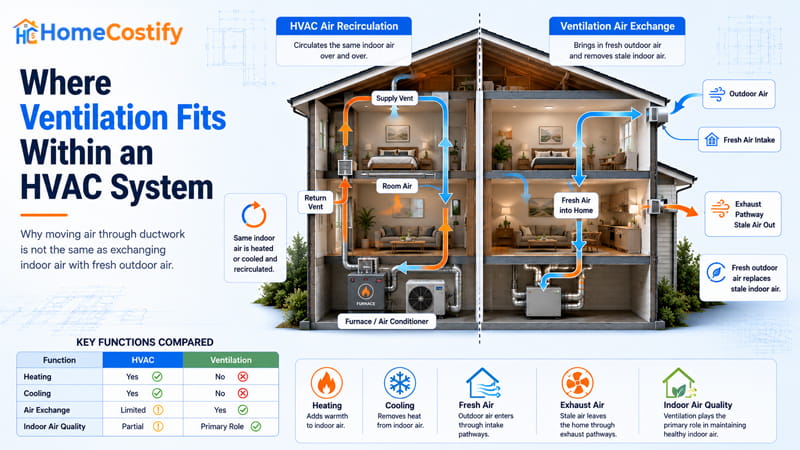
The letters HVAC stand for heating, ventilation, and air conditioning. Even though ventilation appears in the name, the entire HVAC system and the ventilation portion do not perform the same job. Heating equipment adds warmth. Cooling equipment removes heat from indoor spaces. Ventilation focuses on air exchange.
Confusion often starts when conditioned air begins moving through ductwork. Air coming from a furnace or air conditioner travels through supply vents and enters occupied rooms. That movement creates circulation, but circulation alone is not the same thing as fresh-air exchange.
A forced-air furnace may move the same indoor air through the duct system repeatedly. An air conditioner may cool that same air during summer. Fresh outdoor air never enters the building unless a dedicated ventilation pathway exists.
Return air vents perform another function. Air from living spaces travels back through the duct system and returns to the equipment for heating or cooling. The process repeats continuously while the system operates.
A dedicated HVAC ventilation system introduces outdoor air into the airflow cycle rather than recirculating indoor air exclusively. Fresh air enters through designated intake points and stale air leaves through exhaust pathways. That distinction becomes more noticeable in tightly sealed houses where natural airflow remains limited.
The relationship between home heating, cooling, and air exchange becomes easier to see when each function is separated.
| Function | HVAC | Ventilation |
|---|---|---|
| Heating | Yes | No |
| Cooling | Yes | No |
| Air Exchange | Limited | Yes |
| Indoor Air Quality | Partial | Primary Role |
Topics such as HVAC fundamentals, how heating systems move warm air, and how air conditioners circulate cooled air fit naturally within the broader heating and cooling category. Ventilation focuses on a different objective. Air enters from outside, moves through the house, and exits after carrying moisture, heat, odors, and airborne contaminants.
Common Signs of Poor Ventilation

Airflow problems often reveal themselves gradually. Small clues appear first. More visible symptoms may develop later if air exchange remains limited.
Condensation on glass surfaces is one of the earliest warning signs. Water droplets forming on windows during colder weather usually indicate excess moisture inside the house.
Common indicators include:
- Condensation on windows: Moisture collects on glass because indoor humidity levels exceed what the air can comfortably hold.
- Mold growth: Dark spots frequently appear around bathrooms, window frames, closets, or other areas where moisture lingers.
- Musty odors: Air that remains trapped indoors for extended periods often develops a damp smell.
- Stuffy rooms: Air may feel heavy, stagnant, or uncomfortable even when temperature settings remain unchanged.
- Lingering humidity — Bathrooms, laundry rooms, and kitchens remain damp long after moisture-producing activities end.
Humidity control becomes more difficult when airflow remains restricted. Mold prevention also becomes harder because moisture stays indoors longer. Stale indoor air accumulates contaminants, odors, and excess humidity that would normally leave through a functioning ventilation pathway.
Conclusion
Ventilation work centers on one basic process: air exchange. Outdoor air enters the house, moves through occupied spaces, absorbs heat, moisture, odors, and airborne contaminants, then leaves the building through exhaust pathways.
Natural ventilation uses wind pressure and temperature differences to create airflow. Mechanical ventilation uses fans and controlled air movement. Whole-house ventilation systems manage that process across the entire building and often incorporate heat or moisture recovery technology.
The question of how does ventilation work in a house becomes easier to answer once airflow is viewed as a continuous cycle rather than a single piece of equipment. Air enters. Air moves. Air exits.
The most suitable ventilation method depends on house design, climate conditions, building tightness, and indoor air quality requirements. A system that matches those conditions will create more consistent air exchange throughout the year.
FAQs About How Does Ventilation Work in a House
How Long Should You Ventilate Your House?
Daily air exchange is generally recommended. Timing varies based on occupancy, climate, humidity levels, and the type of ventilation equipment installed.
What Are the 4 Stages of Ventilation?
The process includes intake, air movement, contaminant collection, and exhaust. Air enters, travels through the house, absorbs pollutants, and leaves.
Is Ventilation the Same as AC?
No. Air conditioning cools and recirculates indoor air. Ventilation replaces indoor air with fresh outdoor air.
How to Tell if a House Has Poor Ventilation?
Window condensation, persistent humidity, musty odors, mold growth, and stuffy rooms often indicate airflow problems.
Does Ventilation Help With Mold?
Yes. Consistent air exchange removes moisture from indoor spaces, reducing conditions that allow mold colonies to develop