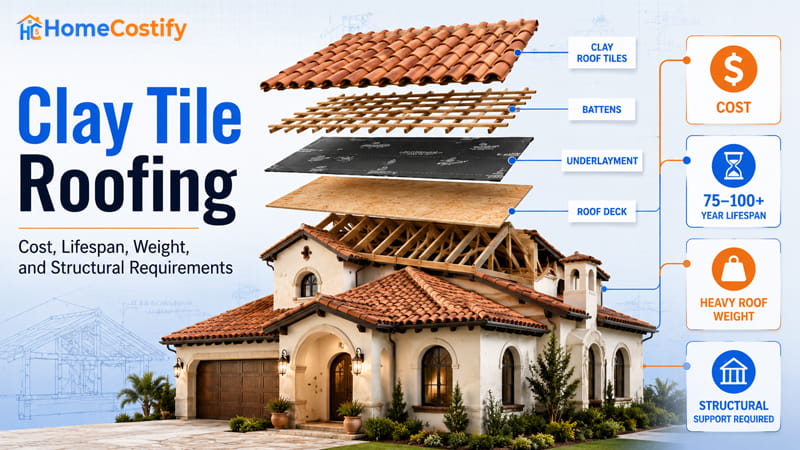
Clay roofs have remained part of American residential architecture for generations. Drive through older neighborhoods in Southern California, Arizona, or parts of Florida and they are difficult to miss. Clay tile roofing is still used on newly built homes, but many existing roofs have already been in service for decades. Some have outlasted multiple owners.
The material is often associated with Spanish and Mediterranean architecture. That connection is easy to see, yet appearance is only one piece of the equation. Roof weight, installation costs, structural requirements, and expected service life all influence whether a house is a good candidate for tile.
A roof covered with clay operates on a different timeline than many other roofing materials. Asphalt shingles are frequently replaced within a few decades. Clay products can remain on the same structure much longer. In some cases, repairs focus on the underlayment beneath the tiles rather than the tiles themselves.
Cost is another reason the material attracts attention. Installation expenses generally exceed those of asphalt roofing, and not every roof structure is designed to carry the additional load.
What Is Clay Tile Roofing?
Clay tile roofing uses tiles manufactured from natural clay that has been molded and fired in a kiln. The finished product is a hard ceramic material designed for long-term exposure to sun, rain, wind, and changing temperatures.
The history of clay roofs stretches back centuries. Long before asphalt shingles became common, fired clay was already being used on homes, churches, and public buildings throughout Europe and the Mediterranean region.
That influence eventually reached the United States, where tile roofs became closely associated with Spanish Colonial, Mission Revival, and Southwestern architecture.
A typical clay tile roof is made up of individual tiles installed in overlapping rows. Some profiles feature rounded curves. Others are flat or interlocking. The finished appearance can vary significantly depending on the tile style selected.
The manufacturing process also differs from many roofing materials sold today. Clay begins as natural earth. After shaping and firing, the material becomes dense and rigid. That process gives clay roof tiles characteristics that differ from asphalt products, composite materials, and metal roofing systems.
The term clay roofing can refer to several tile profiles, but all share the same basic foundation: fired clay designed to function as the outer covering of a residential roof.
Key Components of Clay Tile Roofing
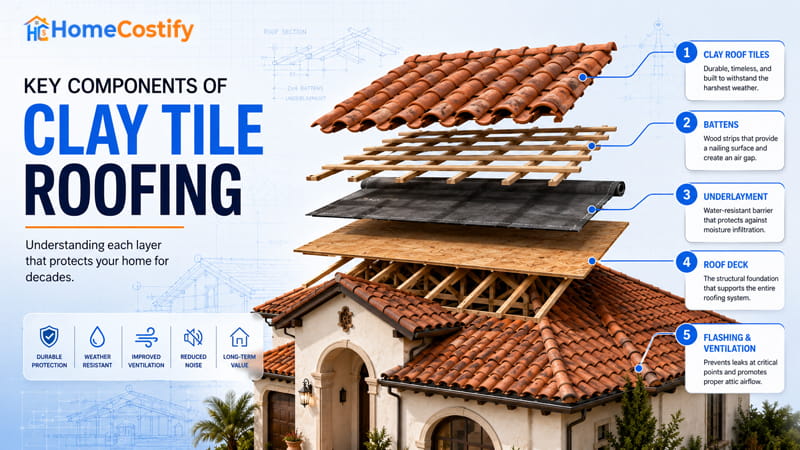
The tiles visible from the street represent only part of the assembly. Several layers sit beneath them, and each has a specific purpose within a complete clay tile roof system.
The following components form the foundation of that structure.
Roof Deck
The roof deck creates the base of the entire assembly. Every roofing component installed above it depends on this surface for support. Modern homes commonly use plywood or oriented strand board, while older houses may contain wood planking.
Underlayment
A layer of underlayment sits between the deck and the tiles. Rainwater is expected to remain on the exterior surface of the roof, but weather does not always cooperate. Wind-driven rain can occasionally move beyond the tile layer. The underlayment stands between that moisture and the roof deck below.
Battens
Many tile installations use battens positioned above the underlayment. These strips create attachment points for the tiles and establish consistent spacing across the roof surface. Tile dimensions determine the layout.
Clay Roof Tiles
The tiles form the outer shell of the roofing assembly. Their shape directs water downward across the roof while creating the appearance associated with traditional tile-covered homes.
Flashing and Ventilation
Flashing is installed around roof penetrations, valleys, and intersections where leaks are most likely to develop. Roof Ventilation components create airflow pathways beneath the roof covering. Together, these elements complete the overall clay tile roof structure.
How Clay Tile Roofing Protects a Home
A tile roof relies on multiple layers rather than a single barrier. The visible tiles, the underlayment beneath them, and the surrounding roof components all contribute to the way the system handles weather exposure.
Several processes occur simultaneously once rain, heat, or wind reach the roof surface.
Water-Shedding Design
Rainwater does not stop on the tile surface for long. The shape of each tile encourages water to move downhill toward the roof edge. Overlapping rows create a pathway that guides water away from exposed areas.
The tile layer is not completely waterproof. Small gaps exist between individual pieces, which is why the roof depends on more than one line of defense.
Secondary Moisture Protection
Water that moves beneath the tiles encounters the underlayment below. This layer becomes particularly relevant during severe storms, heavy wind, or weather conditions that force moisture into places it would not normally reach.
Ventilation and Heat Management
Sunlight can raise roof surface temperatures considerably during summer months. Airflow beneath the tile layer creates a buffer zone between the roofing material and the structure below.
Warm air naturally rises and exits through designated ventilation pathways while cooler outside air enters lower portions of the roof assembly.
Protection Against Wind and Fire
Tile roofs protection are common in regions exposed to intense sun, coastal weather, and seasonal wind events. Proper installation methods secure the tiles to the roof structure while flashing reinforces vulnerable transitions and penetrations.
Fired clay does not burn, which is one reason tile systems frequently receive high fire-resistance ratings.
Types of Clay Roof Tiles
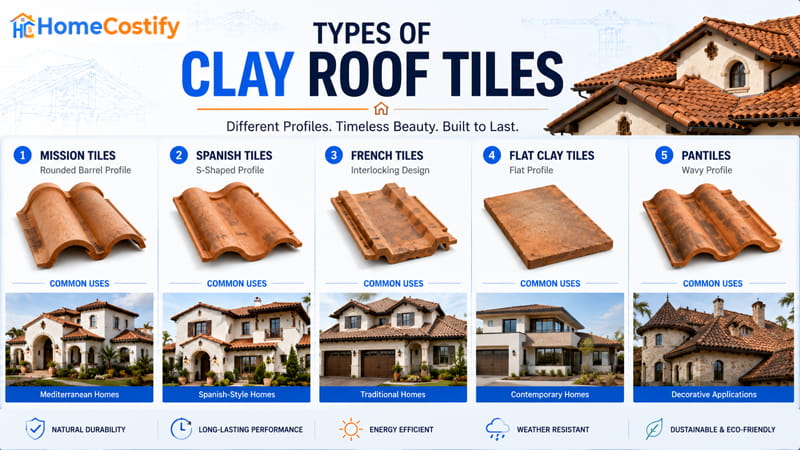
Across the United States, several tile styles dominate residential construction, particularly in regions where Spanish, Mediterranean, and Southwestern architecture remain popular.
Some profiles have been used for centuries with only minor changes. Others were developed to create tighter interlocking systems or to suit newer architectural trends.
The following styles account for most residential clay tile installations in the U.S. market.
Mission (Barrel) Tiles
Among all mission tiles, the classic barrel profile is often the easiest to recognize. Each tile forms a curved channel that creates a repeating wave pattern across the roof surface. Traditional installations use separate cap and pan pieces, producing the layered appearance commonly associated with historic Spanish architecture.
Many older California missions used this profile, which explains the name that remains attached to the style today. The shape creates strong shadow lines across the roof, especially during the morning and late afternoon hours.
Spanish Tiles
At first glance, spanish tiles may appear similar to mission products. The difference becomes more obvious when viewed from above. Rather than using separate pieces, a Spanish tile combines the pan and cap shape into a single S-shaped profile.
That design reduces the number of individual components required during installation. It also creates a distinctive rhythm across the roof surface. Houses inspired by Spanish Colonial and Mediterranean architecture frequently use this profile because the curves complement stucco walls, arches, and decorative exterior details.
French (Interlocking) Tiles
French tiles follow a different design philosophy. Instead of large curves and deep channels, these tiles feature molded ribs and interlocking edges that fit together across the roof.
The profile developed in Europe before becoming established in North America. Its cleaner lines work well on both traditional and contemporary houses. Water follows defined drainage paths created by the interlocking design, giving the roof a more structured appearance than barrel-style profiles.
Flat Clay Tiles
Not every clay roof relies on curves. Flat clay tiles create a much cleaner and more restrained appearance. Their straight lines make them a popular choice for contemporary architecture, urban infill projects, and houses influenced by European design.
From a distance, some installations resemble slate roofing. Others create a smooth geometric pattern that contrasts sharply with the texture of barrel or S-shaped tiles.
Pantiles
Pantiles feature a repeating wavy profile that falls somewhere between flat products and traditional barrel designs. They have been used throughout parts of Europe for centuries and occasionally appear on specialty residential projects in the United States.
The shape creates movement across the roof without producing the dramatic curves associated with mission-style installations.
| Clay Tile Type | Appearance | Common Uses |
|---|---|---|
| Mission Tiles | Rounded barrel profile | Mediterranean homes |
| Spanish Tiles | S-shaped profile | Spanish-style homes |
| French Tiles | Interlocking design | Modern and traditional homes |
| Flat Clay Tiles | Flat profile | Contemporary homes |
| Pantiles | Wavy profile | Decorative applications |
Clay Roof Tile Sizes, Weight, and Structural Requirements
Tile style influences more than appearance. Dimensions and weight affect material quantities, installation methods, roof framing requirements, and transportation costs.
A roof covered with clay places far more load on a structure than asphalt shingles, which is why weight becomes a major consideration long before installation begins.
Several measurements are worth examining before selecting a tile profile.
Typical Clay Roof Tile Sizes
Tile dimensions vary by manufacturer, profile, and region. Even within the same category, slight differences are common. The figures below represent typical ranges found in the U.S. market.
| Tile Type | Typical Size |
|---|---|
| Spanish Tile | 20″ × 8.5″ |
| Mission Tile | 19″ × 8″ |
| Flat Clay Tile | 10–15″ × 6–9″ |
Spanish and barrel profiles generally occupy more surface area than flat products. That difference affects the number of tiles required to cover a roofing square. Larger dimensions do not automatically mean fewer materials, since overlap requirements vary between profiles.
How Much Does a Clay Tile Roof Weigh?
Weight separates clay roofing from many competing materials. A bundle of asphalt shingles can be carried by one person. Clay products operate in an entirely different category.
The exact clay tile roof weight depends on tile profile, thickness, manufacturer, and installation method. Even so, most systems fall within a fairly predictable range.
| Metric | Typical Weight |
|---|---|
| Per Tile | 5–7 lbs |
| Per Roofing Square | 850–1,100 lbs |
Those numbers add up quickly. A large residential roof may support several tons of roofing material once installation is complete. The load remains there year after year.
Do Homes Need Structural Reinforcement?
According to the Pacific Northwest National Laboratory (PNNL), clay roof tiles can weigh roughly three times more than asphalt shingles. While the added weight may require structural evaluation, the material’s thermal mass can help moderate indoor temperatures in hot climates while providing excellent resistance to rot and insect damage.
The condition of the existing framing becomes especially important during reroofing projects. Older homes may contain undersized rafters, aging structural members, or modifications made over several decades. A contractor or structural engineer can determine whether structural reinforcement is necessary before installation begins.
The condition of the clay tile roof framing determines whether structural upgrades are necessary. Some homes already have adequate support. Others require reinforcement before the new roof can be installed.
The final decision depends on the age of the house, local building requirements, roof span, and the selected tile profile. Every clay tile roof structure carries its own set of conditions.
Clay Tile Roof Lifespan
Many roofing materials are judged by how they perform over the next twenty or thirty years. Clay operates on a different timeline. A roof installed today may remain in place long after major remodeling projects, HVAC replacements, and exterior renovations have come and gone.
Questions about how long do clay roof tiles last appear frequently because lifespan is one of the material’s strongest selling points.
Based on guidance from the U.S. National Park Service, clay tile roofing has one of the longest service lives among traditional roofing materials, with a typical life expectancy of around 100 years.
That figure does not mean every roof reaches the century mark. Climate, installation quality, maintenance history, storm exposure, and roof design all influence the final outcome. A roof subjected to repeated severe weather faces different conditions than one located in a dry region with limited storm activity.
Another detail often surprises first-time buyers. Tiles and underlayment do not age at the same pace. In many cases, the tiles remain serviceable while the underlayment beneath them eventually requires replacement.
| Roofing Material | Average Lifespan |
|---|---|
| Asphalt Shingles | 15–30 years |
| Metal Roofing | 40–70 years |
| Concrete Tile Roofing | 40–75 years |
| Clay Tile Roofing | 75–100+ years |
| Slate Roofing | 100–150+ years |
The long clay tile roof lifespan is one reason older tile-covered homes continue to attract attention across parts of California, Texas, Arizona, and Florida.
Clay roof longevity is not determined by the tiles alone. Underlayment, flashing, fasteners, and other roofing components age at a different pace, which is why many tile roofs undergo underlayment replacement long before the tiles themselves reach the end of their service life.
Clay Tile Roofing Cost
Price is often the point where admiration meets reality. A tile roof may remain in service for decades, but getting it installed is rarely inexpensive. Material costs sit well above asphalt shingles, and labor requirements tend to be more demanding because each tile must be positioned and secured correctly.
The average clay tile roofing cost in the United States generally falls between $11 and $22 per square foot installed, although premium profiles and complex roof designs can push costs beyond that range.
The final number depends on much more than material selection. Roof shape, access, local labor markets, and structural requirements all influence what a contractor ultimately charges.
The estimates below reflect common price ranges for complete installation projects.
| Roof Size | Estimated Installed Cost |
|---|---|
| 1,500 sq ft | $16,500–$33,000 |
| 2,000 sq ft | $22,000–$44,000 |
| 2,500 sq ft | $27,500–$55,000 |
A larger roof naturally requires more materials, but labor often accounts for a substantial portion of the budget. A simple roofline with few penetrations typically moves faster than one filled with dormers, valleys, skylights, and intersecting roof planes.
Cost by Tile Type
Not every tile profile falls into the same price category. Some require additional labor during installation. Others use more material or involve specialized manufacturing processes.
| Tile Type | Installed Cost |
|---|---|
| Interlocking Tiles | $11–$18/sq ft |
| French Tiles | $12–$20/sq ft |
| Mission Tiles | $15–$22/sq ft |
| Spanish Tiles | $15–$25/sq ft |
Mission and Spanish profiles often occupy the upper end of the range because of their shape and installation requirements. Flat and interlocking products generally remain more economical, although regional pricing can shift those numbers considerably.
Factors That Affect Cost
Several project-specific details influence the final clay tile roof cost:
- Roof size – Larger roofs require more tiles, underlayment, and labor hours.
- Roof complexity – Valleys, hips, dormers, and penetrations increase installation time.
- Labor rates – Local labor markets vary significantly across the country.
- Structural reinforcement – Some homes require framing upgrades before installation begins.
- Tile profile – Certain styles require more labor and material than others.
Clay roof tiles price represents only part of the total project budget. Roof complexity, labor costs, access conditions, and structural upgrades can add thousands of dollars to the final installation cost even when the same tile profile is used.
Clay Tile Roof Colors and Design Options
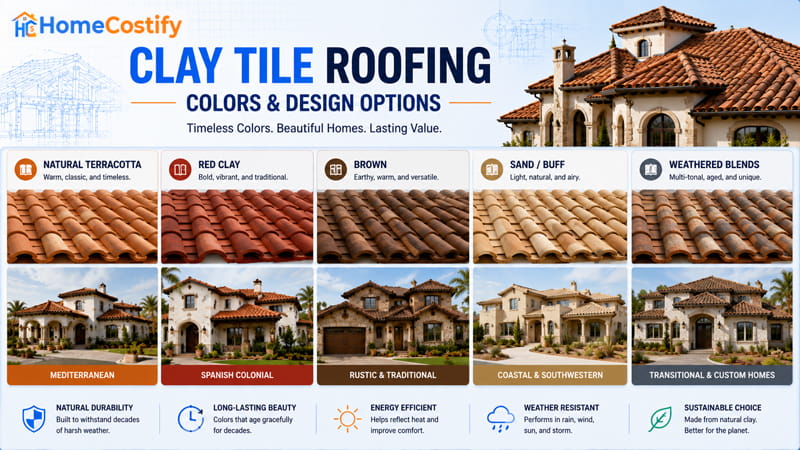
Color often draws attention before anyone notices tile shape or roof details. A roof finished with clay creates a very different impression than asphalt shingles or metal panels, particularly on Mediterranean, Spanish, and Southwestern homes.
Natural terracotta remains the color most people associate with clay roofing. Warm orange-red tones have been used for centuries and still appear on countless homes across the United States.
Other options have become increasingly common over the past two decades:
- Natural Terracotta: Traditional orange-red appearance found on many Spanish and Mediterranean homes.
- Red Clay: A deeper and richer red tone that creates stronger contrast.
- Brown: Often selected for earth-tone exterior palettes and rustic architectural styles.
- Sand or Buff: Lighter shades that pair well with stucco and coastal designs.
- Weathered Blends: Multiple tones mixed together to create an aged appearance from day one.
Color selection usually works best when viewed alongside other exterior materials. Roof tiles that look attractive in a showroom can appear very different once paired with brick, stone, stucco, or painted siding.
| Color Option | Common Architectural Styles |
|---|---|
| Natural Terracotta | Mediterranean, Spanish Colonial |
| Red Clay | Spanish Revival, Mission Style |
| Brown | Rustic, Traditional |
| Sand / Buff | Coastal, Southwestern |
| Weathered Blends | Transitional, Custom Homes |
Today’s market offers a wider range of clay roof tile colors than ever before. Traditional terracotta roof tiles remain the most recognizable option, though weathered blends and earth-tone finishes continue to gain popularity in many parts of the country.
Advantages of Clay Tile Roofing
A roof installed today may still be sitting on the same house decades from now. That reality shapes much of the appeal behind clay tile roofing. While cost and weight often receive the most attention during planning, long-term ownership tells a different story.
Replacement cycles tend to be much longer, and the material has a track record that stretches well beyond a single generation in many parts of the country.
Several characteristics continue to separate tile roofs from many competing materials:
- Exceptional lifespan
- Fire resistance
- Weather resistance
- Energy efficiency
- Strong curb appeal
- Sustainability
Some advantages become obvious immediately. Others reveal themselves after years of exposure to sun, rain, wind, and seasonal weather changes. A house in Arizona faces different conditions than one along the Gulf Coast, yet clay products have remained common in both environments for decades.
Durability and Weather Resistance
A roof in coastal Florida encounters salt air, heavy rain, and hurricane-season winds. A roof in Arizona spends much of the year under intense sunlight and high temperatures. Clay products appear in both places for a reason.
According to the Tile Roofing Industry Alliance (TRI), clay tile roofing ranks among the longest-lasting residential roof coverings in use today. TRI reports that clay roof tiles absorb less than 1% moisture on average. That low absorption rate limits the conditions that often contribute to rot, mold development, insect activity, and freeze-thaw damage.
The same source reports wind resistance ratings of up to 150 mph for certain tile roofing assemblies, along with Class A fire ratings when installed as approved systems.
The appearance of a tile roof changes very little over time. Clay roof durability becomes more apparent after years of exposure to heavy rain, strong winds, salt air, and prolonged sunlight, conditions that gradually wear down many other roofing materials.
Fire behavior also differs from many roofing materials. Fired clay does not ignite when exposed to flames. In wildfire-prone regions of the western United States, that characteristic receives serious attention during material selection.
Clay roof fire resistance receives significant attention in regions where wildfire exposure is a concern. Fired clay will not ignite when exposed to sparks or embers, a characteristic that separates it from combustible roofing materials.
The material itself is noncombustible, which places it in a different category than wood-based roof coverings. Strong storm performance contributes to interest in clay roof wind resistance, particularly in hurricane-prone coastal markets.
Temperature management is another reason tile roofs remain popular in hot climates. Air space beneath the tiles, combined with the mass of the material itself, influences heat movement through the roof assembly.
States such as Arizona, Nevada, and parts of Southern California experience long periods of intense summer heat. Much of the interest in clay roof energy efficiency comes from these regions, where roof temperatures can remain elevated for months and homeowners pay close attention to heat gain through the building envelope.
Disadvantages of Clay Tile Roofing
Every roofing material comes with tradeoffs. The same characteristics that make clay attractive in some situations can create challenges in others. A tile roof that works perfectly on one house may not be the right fit for another.
Several concerns appear repeatedly during project planning:
- Higher upfront cost
- Heavy weight
- Brittle under foot traffic
- Installation complexity
- Repair challenges
Price is usually the first hurdle. Material costs are higher than asphalt shingles, and installation often requires specialized labor. The final project budget can rise further when structural upgrades become necessary.
Weight creates another consideration. Thousands of pounds may be added to the roof structure after installation. Houses originally designed for lightweight roofing materials sometimes require evaluation before a tile system can be installed.
Walking on a tile roof requires caution. Individual pieces can crack under concentrated pressure, particularly when weight is applied in the wrong location. Damage may not always be visible from ground level.
Installation also demands greater precision than many common roofing systems. Tile layout, fastening methods, flashing details, and roof geometry all influence the finished result. Repair work can become more involved as well. Matching older tiles is not always straightforward, especially when the original profile has been discontinued.
Best Climates for Clay Tile Roofing in the USA
Climate influences roofing decisions more than many people realize. Materials that perform exceptionally well in one region may face very different challenges somewhere else.
Clay products have established a strong presence across several parts of the United States, particularly where heat, sun exposure, and coastal conditions play a major role.
The material’s history in these regions is not accidental.
Hot and Sunny Regions
Arizona, Nevada, and Southern California contain some of the most recognizable tile-roofed neighborhoods in the country. Intense sunlight, long summers, and dry conditions have contributed to the popularity of clay tile roofing throughout these areas.
Coastal Areas
Florida and the Gulf Coast present a different set of conditions. Salt air, heavy rain, humidity, and seasonal storms place continuous stress on roofing materials.
Interest in clay tile roofing in Florida remains strong because tile systems have a long history along coastal regions. Wind ratings, moisture resistance, and fire ratings often become central topics during material selection.
Cold Climate Considerations
Clay products are not limited to warm-weather regions, but freeze-thaw cycles deserve attention. Water that enters a tile and freezes can expand as temperatures drop. Repeated cycles increase the risk of cracking.
Modern manufacturing has improved clay roof weather resistance, though climate suitability should still be evaluated alongside local weather patterns and product specifications.
Clay Tile Roof Maintenance and Replacement
A roof built from clay does not require constant attention, but periodic inspections remain worthwhile. Small issues tend to be easier and less expensive to address before they spread into larger repairs.
Several areas deserve regular attention.
Routine Maintenance
Basic clay tile roof maintenance usually involves visual inspections, gutter cleaning, debris removal, and checking for damaged tiles. Tree branches rubbing against the roof can gradually wear surfaces over time, particularly during storms and windy weather.
Common Causes of Damage
Broken tiles are among the most common issues encountered during inspections. Foot traffic is often responsible. Walking directly on unsupported portions of a tile can create cracks that are not always visible from the ground.
Underlayment failure is another concern. While the tiles above may remain intact, aging underlayment can eventually reach the end of its service life. Flashing deterioration around chimneys, skylights, and roof penetrations can also create water-entry points.
When Replacement Is Necessary
A complete clay tile roof replacement is not always required when problems appear. In many cases, individual tiles can be replaced while the rest of the roof remains untouched.
The decision usually depends on the condition of the tiles, underlayment, flashing, and supporting roof structure. A localized issue may call for targeted clay tile roof repair, while widespread deterioration often points toward more extensive work. The tiles themselves frequently outlast many of the components installed beneath them.
Roofing Options for Different Needs
A roof that performs well in one region may not be the best choice somewhere else. Comparing alternatives provides useful context when evaluating clay tile roofing against other common residential roofing systems.
- Asphalt Shingles: The most widely used residential roofing material in the United States. Lower upfront costs make asphalt attractive for many reroofing projects.
- Architectural Shingles: A thicker version of standard asphalt shingles with improved dimensional appearance and longer service life.
- Luxury Shingles: Designed to mimic slate, wood shake, or tile roofing while remaining lighter than many premium materials.
- Metal Roofing: Common on both residential and agricultural buildings. Metal panels and standing seam systems are known for their long service life.
- Concrete Tile Roofing: Similar in appearance to clay tile roofing, though usually manufactured from cement, sand, and water.
- Slate Roofing: Natural stone roofing capable of lasting for generations. Weight and installation costs are often substantial.
- Synthetic Slate Roofing: Manufactured products designed to resemble natural slate while reducing structural demands.
- Wood Shingles: A traditional roofing material with a uniform appearance and natural wood texture.
- Wood Shakes: Thicker than wood shingles and known for their rugged, irregular appearance.
- Composite Roofing: Manufactured from blended materials designed to imitate higher-end roofing products.
- Solar Shingles: Roofing products that generate electricity while functioning as part of the roof covering.
Conclusion
Few residential roofing materials operate on the same timeline as clay tile roofing. Initial costs are higher than many alternatives, and structural considerations often become part of the planning process before installation begins. Those realities cannot be ignored.
The material also brings characteristics that are difficult to match. A properly installed roof can remain on a house for generations.
A tile roof makes a strong visual impression from the street, but appearance rarely becomes the deciding factor after decades of ownership. Clay tile roofing is often evaluated through a much longer lens that includes service life, weather exposure, maintenance history, and the condition of the supporting roof structure.
Weight remains an important factor. Some homes can accommodate tile without modification, while others require evaluation of the supporting structure before installation moves forward. That step becomes especially important during reroofing projects where a lightweight material is being replaced with clay.
For houses capable of supporting the load, clay tile roofing occupies a unique place within the residential roofing market. Few materials combine the same visual character, expected service life, and historical track record across such a wide range of climates and architectural styles.
FAQs About Clay Tile Roofing
Are clay roof tiles more expensive?
Yes. Material and installation costs generally exceed those associated with asphalt shingles and many other residential roofing materials.
How expensive is a clay tile roof?
The average clay tile roofing cost typically ranges from $11 to $22 per square foot installed, though premium profiles and complex roof designs can increase that figure.
How many years do clay tile roofs last?
The typical clay tile roof lifespan falls between 75 and 100 years. Some roofs remain in service even longer when installation quality, maintenance, and climate conditions are favorable.
How to maintain a clay tile roof?
Regular inspections, debris removal, gutter cleaning, and replacement of damaged tiles are common parts of routine roof care.
Do clay tile roofs need to be replaced?
Not always. In many cases, individual tiles remain serviceable long after underlayment or flashing components require attention.