Kitchen faucets, showerheads, washing machines, and outdoor hose bibs all draw water from the same incoming supply. A water treatment system addresses water quality once water crosses the service line into a house, responding to conditions found inside the distribution network instead of the public utility.
Chlorine odor can linger in a glass of drinking water. Hard water leaves mineral deposits around faucets and shower doors. Fine sediment sometimes settles inside a kettle or toilet tank after weeks of normal use.
A residential water treatment system functions as one subsystem within the home’s water infrastructure. Attention centers on overall architecture, common technologies, major component groups, and household applications viewed as parts of a complete working arrangement.
Municipal operations, installation practices, repair work, maintenance tasks, and product selection belong to separate subjects.
What Are Water Treatment Systems?
Mineral residue, chlorine residual, dissolved solids, and suspended particles do not affect every household in identical ways. The term water treatment system identifies equipment intended to reduce selected impurities before drinking, cooking, cleaning, or bathing, adding another layer between the incoming supply and everyday use.
| Water Treatment System | Primary Purpose |
|---|---|
| Improve water quality | Reduce unwanted contaminants before household use |
| Protect household water | Address home-specific water concerns |
| Support everyday activities | Improve water used for drinking, cooking, cleaning, and bathing |
Definition of a Water Treatment System
Industry references use water treatment system for equipment that targets specific impurities found in residential supplies.
Iron staining, mineral scale, chlorine residual, suspended sediment, and sulfur odors represent different categories of water concerns found in residential supplies. Selection always begins with the condition requiring attention, not with a product name.
The Primary Purpose of Water Treatment Systems
Coffee, tea, ice, cooked meals, laundry, and bathing all place their own demands on tap water. Residential water treatment systems respond to mineral buildup, chlorine, sediment, or other impurities that interfere with those activities.
Taste, odor, clarity, and hardness point to separate water conditions, so the treatment objective begins with the issue found at a specific property.
Why Water Quality Matters in Residential Plumbing
Scale inside a water heater increases cleaning work. Cloudy ice changes the appearance of cold drinks. White residue leaves visible marks on glassware, faucets, and shower doors. A home water treatment system addresses the source behind those observations.
Visible symptoms point toward the underlying water issue, making diagnosis the starting point for any treatment decision.
Where Does a Water Treatment System Fit in a Home Plumbing System?
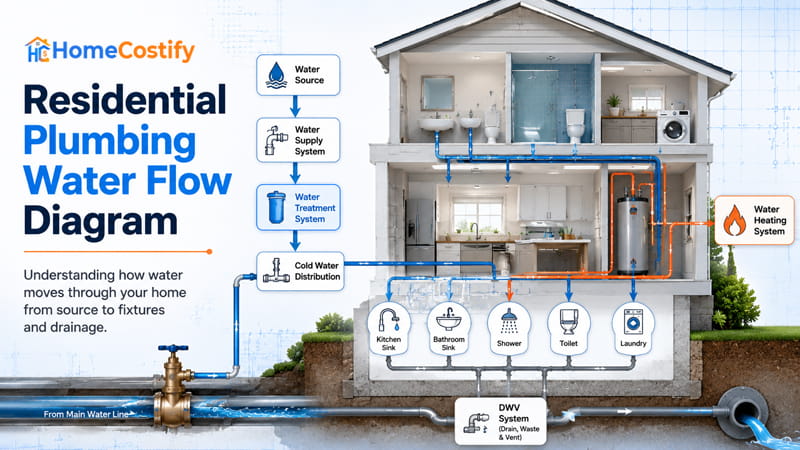
A single potable water path links the major subsystems inside a house. The water supply system passes through a water treatment system for home before reaching cold-water distribution across the plumbing network.
Water Source
      │
      ▼
Water Supply System
      │
      ▼
Water Treatment System
      │
      ▼
Cold Water Distribution
      │
 ┌────┴────┐
 ▼         ▼
Fixtures   Water Heating System
 │          │
 └────┬─────┘
      ▼
 DWV System
Water Flow Through a Residential Plumbing System
Entry begins at the service connection supplying potable water to the property. The water supply system carries potable water to the residential water treatment system, positioned upstream of the cold-water distribution network.
Branch lines then carry conditioned water toward plumbing fixtures, appliance connections, and the water heating system through separate supply lines.
Relationship with Household Plumbing
Cold-water branches deliver treated water to sinks, showers, toilets, appliances, and outdoor hose connections. A dedicated hot-water branch leaves the water heating system and supplies fixtures requiring heated water.
Wastewater follows a completely different route once household use ends, entering the DWV system for drainage, waste removal, and plumbing venting.
Why Homes Need Water Treatment Systems
Municipal supplies and private wells follow different sources, treatment practices, and underground conditions long before reaching a house. Mineral content, chlorine residual, dissolved solids, and natural groundwater characteristics can vary from one neighborhood to another.
Aging distribution pipes add another variable. Home water treatment systems respond to those property-specific differences before drinking, cooking, bathing, or cleaning become part of the daily routine.
Common Household Water Quality Problems
Common signs a home may benefit from additional water treatment include:
- Noticeable chlorine taste or odor in tap water.
- White mineral deposits on faucets or showerheads.
- Cloudy water caused by suspended sediment.
- Orange or brown staining from iron-rich water.
- Scale buildup on appliances and plumbing fixtures.
White mineral deposits rarely attract attention at first. A few weeks later, faucet bases, shower doors, and kettle interiors begin showing a chalky film that takes extra effort to remove. Freshly poured drinking water can carry a noticeable chlorine smell, especially in cold beverages.
Heavy rainfall sometimes leaves fine sediment suspended in tap water for a short period. Rust-colored marks around sinks or toilet bowls frequently trace back to elevated iron levels instead of surface dirt.
How Water Treatment Improves Household Water Quality
Fresh beverages, clearer ice cubes, and cleaner glassware reflect changes noticed during everyday use. Scale accumulates less frequently inside kettles, dishwashers, and water heaters. Bathroom fixtures require less scrubbing when mineral deposits decline.
A water treatment system targets the source behind those visible signs, allowing routine activities to continue with fewer unwanted effects. A residential water treatment system matches treatment objectives to the water profile found at a particular address instead of assuming every supply presents the same characteristics.
Residential vs. Municipal Water Treatment
Public utilities prepare drinking water for community-wide distribution under regulatory standards. Service lines deliver treated water from the utility network to individual homes. Water treatment systems for home serve the next level, responding to local preferences and property-specific water characteristics after delivery.
| Municipal Water Treatment | Residential Water Treatment |
|---|---|
| Treats public drinking water | Treats water entering a single home |
| Protects community water quality | Improves household water quality |
| Uses large-scale treatment facilities | Uses compact residential equipment |
| Focuses on regulatory compliance | Focuses on household-specific concerns |
Municipal Water Treatment Process
Large treatment facilities prepare public drinking water serving thousands of customers within a municipal utility network.
Common practice follows seven recognized methods: coagulation and flocculation, sedimentation, filtration, disinfection, sludge treatment, fluoridation where practiced, and pH correction. Utility responsibility ends at the property line. A water treatment system begins serving private needs from that point forward.
How Residential Water Treatment Differs
Public utilities focus on drinking water that satisfies health regulations for the communities they serve. Personal preference introduces another consideration.
Taste, mineral content, fixture appearance, appliance care, and daily use all influence why additional treatment is sometimes selected.
According to the U.S. Environmental Protection Agency (EPA), home drinking water filtration should match the specific water concern identified in the home. The agency also recommends selecting products certified to reduce the contaminants listed on the product certification.
Selection begins with the water issue itself, not with a product category. A household water treatment system complements municipal treatment by focusing on priorities that extend beyond community-wide treatment objectives.
How Does a Water Treatment System Work?
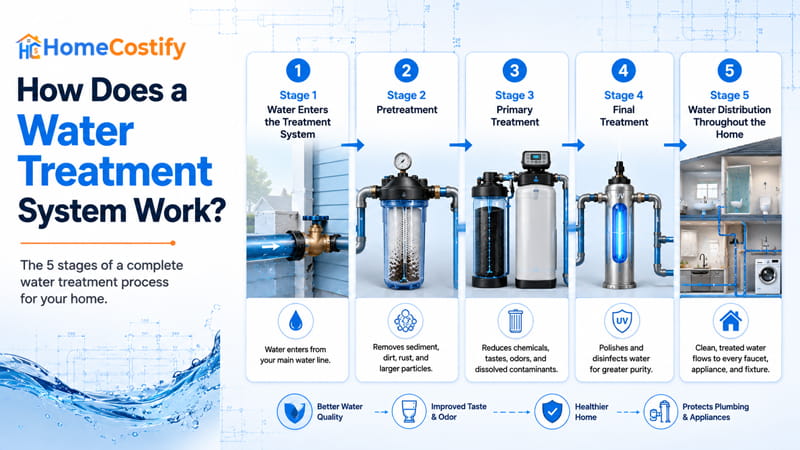
Residential treatment follows a step-by-step workflow instead of relying on a single purification method. A water treatment system moves water through multiple treatment stages, with every stage focusing on a specific objective before indoor distribution begins. The complete workflow prepares water for everyday use through a structured treatment path.
Water Source
      │
      ▼
Main Water Line
      │
      ▼
Pretreatment
      │
      ▼
Primary Treatment
      │
      ▼
Optional Treatment
      │
      ▼
Household Distribution
      │
      ▼
Indoor Fixtures
Stage 1: Water Enters the Treatment System
The main service line carries water from a municipal source or private well into the house. The home water treatment system receives that incoming flow near the point where utility piping or well piping enters the building.
From there, water moves toward the first treatment stage instead of traveling directly to indoor fixtures.
Stage 2: Pretreatment
Larger particles reach the first treatment stage ahead of finer contaminants. Sand, silt, rust particles, and similar debris are commonly separated at this point to reduce unnecessary loading on later treatment stages.
Early removal limits particle buildup inside downstream treatment media and creates a cleaner starting point for the rest of the treatment workflow. Multiple water treatment systems follow this general arrangement, although the exact configuration varies according to the incoming water profile.
Stage 3: Primary Treatment
Target contaminants enter the primary treatment stage after larger particles have already been separated. A residential water treatment system matches treatment methods with the contaminant group identified through water testing instead of applying a single process to every situation.
Dissolved minerals, organic compounds, metals, microorganisms, and other substances respond to different treatment technologies, making multiple treatment paths common within the overall workflow.
According to the Centers for Disease Control and Prevention (CDC), different home water treatment systems are intended to reduce different contaminants. The agency recommends selecting a treatment system according to the contaminants identified through water testing instead of assuming a single technology fits every situation.
Stage 4: Final Treatment
Additional polishing forms the last treatment step in configurations requiring extra refinement. Residual taste, remaining odor, or fine particles can receive another level of treatmentbefore entering the indoor distribution network.
Disinfection may take place at this point when the selected treatment process includes that function.
Stage 5: Water Distribution Throughout the Home
Completion of the treatment workflow sends finished water into the indoor distribution network. A water treatment systems for home installation supplies sinks, showers, appliances, and other fixtures through normal branch piping.
Finished water reaches sinks, showers, appliances, and other fixtures for drinking, cooking, cleaning, bathing, and routine household use.
Types of Water Treatment Systems
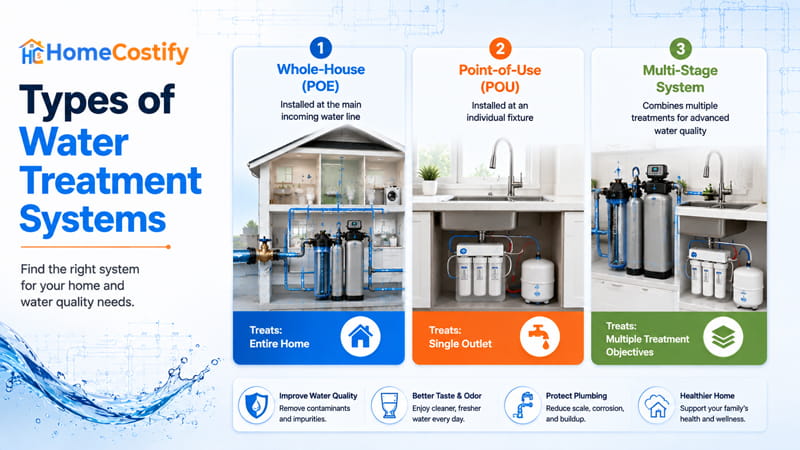
Installation scope forms the basis for classifying residential water treatment systems. Coverage area, outlet selection, and household demand separate one configuration from another long before treatment technologies enter the picture.
| System Type | Installation Location | Treats |
|---|---|---|
| Whole-House (POE) | Main incoming water line | Entire home |
| Point-of-Use (POU) | Individual fixture | Single outlet |
| Multi-Stage System | Depends on configuration | Multiple treatment objectives |
Whole-House (Point-of-Entry) Systems
Placement at the main incoming line places treatment ahead of every indoor outlet. A water treatment system for home using this configuration supplies kitchens, bathrooms, laundry areas, water heaters, refrigerators, and outdoor hose connections from a single installation point. Coverage extends across normal household plumbing. A single faucet or appliance is not the intended coverage area.
Every fixture receives treated water because treatment occurs near the point where the main line enters the house. Cooking, bathing, laundry, cleaning, and appliance operation all draw from that shared supply path. Classification depends on installation scope, not on the treatment media or purification method operating inside the equipment.
Point-of-Use (POU) Systems
Placement beside a single outlet limits treatment to that location alone. Kitchen drinking faucets, refrigerator dispensers, beverage stations, and dedicated cold-water taps represent common installation points. Only the selected outlet passes through that treatment path.
A localized installation fits situations where only specific water uses require additional treatment. Drinking water, coffee preparation, cooking, or clear ice production frequently become the primary focus. Other fixtures continue operating through the normal plumbing arrangement because treatment remains confined to the selected outlet.
Multi-Stage Water Treatment Systems
Larger houses or complex water profiles sometimes use multiple installation points. A whole-house configuration can serve general household demand, followed by localized treatment beneath a kitchen sink or another drinking-water outlet. Separate installation points perform different functions within the overall layout.
Installation scope defines the system category. Treatment technology forms a separate classification. A water treatment systems configuration may combine point-of-entry and point-of-use coverage, yet activated carbon, reverse osmosis, ultraviolet disinfection, or other treatment methods remain a separate topic.
System categories describe where treatment takes place, leaving technology selection to the next stage of planning.
Types of Water Treatment Technologies

Water treatment systems combine technologies according to the contaminants identified during water testing, with each technology serving a specific treatment objective rather than attempting to handle every water quality concern.
| Treatment Technology | Primarily Reduces |
|---|---|
| Sediment Filtration | Sand, dirt, rust, suspended particles |
| Activated Carbon | Chlorine, taste, odor, some organic compounds |
| Water Softener | Calcium and magnesium hardness |
| Reverse Osmosis | Dissolved solids, heavy metals, many dissolved contaminants |
| UV Disinfection | Bacteria, viruses, and microorganisms |
| Other Technologies | Specialized water quality concerns |
According to the Centers for Disease Control and Prevention (CDC), different home water treatment systems target different contaminants. Selecting an appropriate system starts with identifying which contaminants require reduction through water testing.
Sediment Filtration
Suspended particles represent the first group of contaminants addressed in numerous residential installations. Sand, dirt, rust flakes, and similar debris reduce water clarity and place unnecessary loading on downstream treatment units.
Sediment filtration captures those larger particles early in the treatment path, creating cleaner feed water for the technologies that follow. Filter media, cartridge ratings, and housing construction vary widely, although those engineering details fall outside the scope of this guide.
Activated Carbon Filtration
Chlorine residual, unwanted taste, odor, and selected organic compounds make activated carbon a common treatment choice for drinking water applications. Contact with activated carbon reduces those unwanted substances through adsorption, producing water with a cleaner taste and smell.
Kitchen faucets, refrigerator dispensers, and dedicated beverage outlets frequently use this treatment method where drinking water receives the highest priority.
Water Softeners
Calcium and magnesium contribute to hard water entering a residential water treatment system. White deposits around fixtures, cloudy glassware, and mineral accumulation inside water heaters commonly accompany elevated hardness levels.
A water softener targets those hardness minerals, limiting scale formation throughout normal household use. Chemistry, regeneration cycles, and salt selection belong to equipment-specific discussions covered separately from this technology overview.
Reverse Osmosis
Dissolved contaminants require a different treatment strategy from visible particles or hardness minerals. Reverse osmosis targets dissolved solids, heavy metals, nitrates, and numerous dissolved substances through a fine separation process.
Installation commonly takes place beneath a kitchen sink or another dedicated drinking-water outlet because treated water is intended primarily for consumption. A drinking glass, cooking pot, or coffee maker frequently becomes the first point where this treatment is used.
Ultraviolet (UV) Disinfection
Living microorganisms call for disinfection instead of physical separation. Ultraviolet light targets bacteria, viruses, and other microorganisms capable of affecting drinking water safety.
Suspended particles remain outside its primary purpose, making water clarity an important consideration before ultraviolet treatment is applied. Biological control defines this technology, leaving particle removal and dissolved contaminant reduction to other treatment methods.
Other Water Treatment Technologies
Specialized treatment needs extend beyond the technologies already covered. Distillation, ultrafiltration, specialty filtration, oxidation, and other emerging methods continue expanding the range of residential treatment options available today.
A water treatment system for home may incorporate one of these technologies when laboratory results identify a contaminant requiring a specialized response. Technology selection follows the contaminant profile identified through testing, leaving product design, equipment configuration, and installation decisions for later planning stages.
Major Components of a Water Treatment System
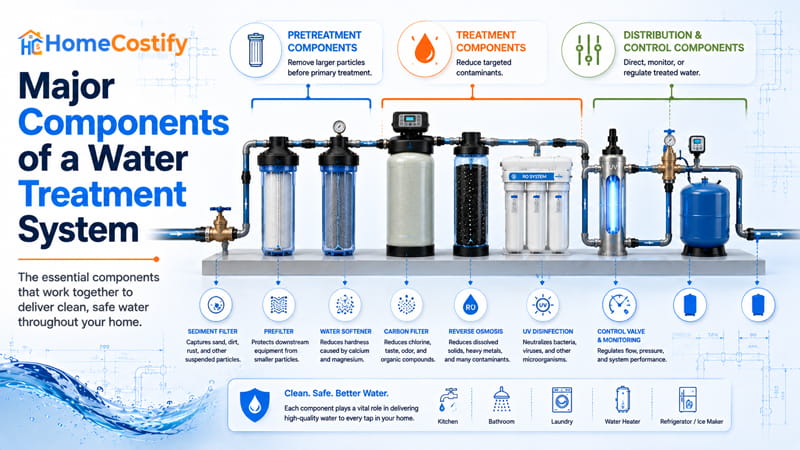
Multiple component groups work inside a residential water treatment system, each handling a different treatment function. Some prepare incoming flow, others reduce targeted contaminants, and another group manages circulation and system control.
| Component Group | Primary Function |
|---|---|
| Pretreatment Components | Remove larger particles before primary treatment |
| Treatment Components | Reduce targeted contaminants |
| Distribution & Control Components | Direct, monitor, or regulate treated water |
Pretreatment Components
Coarse debris reaches pretreatment equipment first. Sediment filters, prefilters, and filter housings intercept sand, rust flakes, dirt, and other visible material entering the treatment path. Early particle separation limits unnecessary loading on the equipment positioned farther downstream. Cleaner incoming flow supports stable operation across the remaining plumbing component groups.
Filter housings form the structural base for pretreatment cartridges. Cartridge style, enclosure size, and replacement format vary between systems, although all belong to the pretreatment category. Their shared purpose centers on preparing incoming flow for the next equipment group rather than performing complete contaminant reduction.
Treatment Components
Primary treatment equipment forms the core of the water treatment system. Carbon units, reverse osmosis units, water softeners, ultraviolet chambers, and other treatment devices belong to this category because each targets a specific contaminant group. Selection depends on laboratory findings and treatment objectives identified during planning.
Multiple treatment units frequently occupy the same installation. Each unit contributes a separate treatment function, creating a coordinated process across the full equipment arrangement. A single cabinet may contain one device, whereas larger installations distribute treatment functions among multiple assemblies serving different objectives.
Distribution and Control Components
Control equipment manages movement, storage, and operating status after treatment has taken place. Bypass valves, shutoff valves, pressure tanks, storage tanks, monitoring gauges, flow meters, and electronic controllers belong to this supporting category. None performs contaminant reduction directly, yet each contributes to stable system operation.
Pressure tanks moderate flow demand during household use. Storage tanks hold treated water until a fixture or appliance draws from the system. Bypass valves isolate treatment equipment during servicing, and monitoring devices display operating status for routine inspection.
Together, these supporting assemblies organize circulation, regulation, storage, and system control without changing the treatment technologies selected for contaminant reduction.
Benefits and Limitations of Water Treatment Systems
Clearer drinking water, reduced chlorine odor, slower mineral deposits, and cleaner household fixtures represent common expectations in residential plumbing.
A water treatment system can deliver those results when its treatment capability corresponds to the characteristics present in the household supply. Practical expectations begin with understanding both the value and the natural limits of residential treatment.
Key Benefits
Daily activities place different demands on household water. Coffee, cooking, bathing, laundry, and appliance operation benefit from different water characteristics.
Proper treatment can produce cleaner drinking water, reduce unwanted taste and odor, slow mineral deposits on fixtures, and support smoother appliance operation. Visible changes vary with the substances present in the incoming supply.
Well-matched treatment can contribute to:
- Cleaner drinking water.
- Reduced chlorine taste and odor.
- Slower mineral deposits on fixtures and household surfaces.
- Better operating conditions for water-using appliances.
- Improved everyday household use.
Common Limitations
Hardness minerals, chlorine residual, suspended particles, dissolved solids, and microorganisms require separate forms of treatment. No single technology covers that full range.
Reverse osmosis, activated carbon, ultraviolet disinfection, sediment filtration, and water softening each target a particular group of water quality concerns.
Realistic expectations follow those capabilities. Equipment intended for hardness minerals cannot perform the work of ultraviolet disinfection, and ultraviolet treatment does not reduce dissolved solids.
Residential treatment delivers the strongest results when the technology aligns with the water characteristics present in the home.
Conclusion
Mineral content, suspended particles, chlorine residual, and other water quality concerns vary from one property to another, shaping how residential treatment fits into a home’s plumbing. Viewing that equipment as a complete subsystem places every treatment technology, component, and treatment step within the larger context of household water use.
Attention belongs on the system as a whole instead of any single product. A filter, softener, ultraviolet unit, or reverse osmosis unit represents only one part of the larger picture. Household water quality is shaped by the way those elements work within the plumbing system, guided by the conditions present in the home’s water supply.
FAQs About Water Treatment System
What are the basics of water treatment?
Water treatment improves water quality by reducing unwanted contaminants through filtration, softening, purification, or disinfection. Residential systems combine different treatment methods based on household water conditions and specific water quality concerns.
What are the 7 methods of water treatment?
The seven standard municipal methods include coagulation, flocculation, sedimentation, filtration, disinfection, sludge treatment, fluoridation where practiced, and pH correction. Residential systems typically focus on household treatment after water enters the property.
What are the 5 stages of water treatment?
A typical residential process includes water entry, pretreatment, primary treatment, optional final treatment, and household distribution. The exact stages vary depending on the system design and water quality objectives.
What chemicals are used in water treatment?
Municipal treatment commonly uses chlorine, chloramine, ozone, coagulants, lime, and pH-adjusting chemicals. Most residential systems improve water quality through physical filtration, softening, or ultraviolet disinfection instead of adding chemicals.
What are the components of a water treatment system?
Most residential systems include pretreatment equipment, treatment components such as filters or softeners, and distribution or control equipment that manages water flow throughout the system.