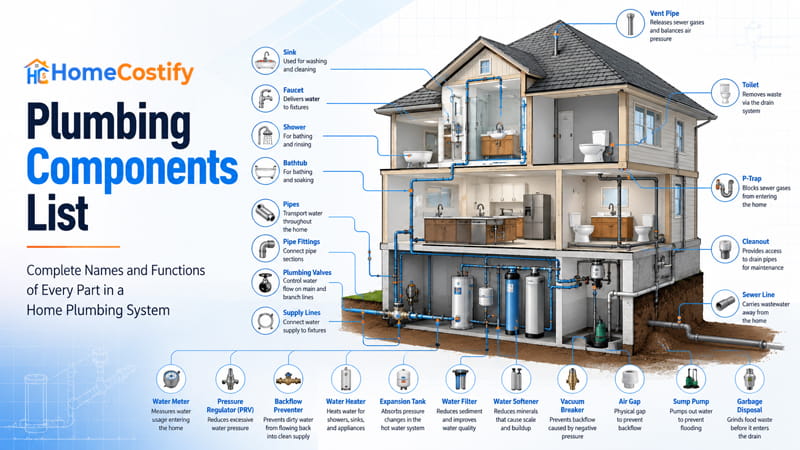
Clean water enters a house under pressure. Wastewater leaves by a separate route. Hot water follows its own path after leaving the heating equipment, so each flow serves a different purpose without sharing the same piping. In between, plumbing components regulate movement, direct circulation, and preserve water quality across residential plumbing from the service connection to the final point of use.
Most people recognize the fixtures they touch every day. The hardware hidden inside walls, beneath floors, and around utility areas rarely receives the same attention. Shut-off devices, distribution hardware, and protective assemblies stay out of sight, yet each occupies a fixed position within the piping layout. Remove one element and the flow pattern no longer matches the original design.
A long alphabetical list says very little about how a residential plumbing network is arranged. Grouping related equipment under the same function creates a clearer path for identifying unfamiliar names and seeing where they fit inside the system.
What Are Plumbing Components?
Plumbing components are the physical parts that convey drinking water, regulate pressure, manage waste discharge, or support water treatment inside a home plumbing system.
The term includes every plumbing fixture and the hardware required for water distribution, shutoff, filtration, and drainage, regardless of whether the equipment stays exposed or concealed.
Kitchen and bathroom fixtures occupy the finished side of a house. Pipe runs, isolation valves, backflow devices, branch fittings, and cleanouts occupy wall cavities, crawl spaces, basements, ceilings, and utility areas.
Most of that hardware stays hidden after construction, yet every connection occupies a fixed location inside the piping layout.
A part qualifies as one of the plumbing system components when it performs a specific mechanical task. A valve isolates a supply line. A fitting changes pipe direction or joins two sections. A filter removes unwanted material from potable water.
A plumbing trap forms a seal that separates occupied rooms from sewer gases. Different names reflect different mechanical duties, even when two products share a similar appearance.
Complete Plumbing Components List With Names and Functions
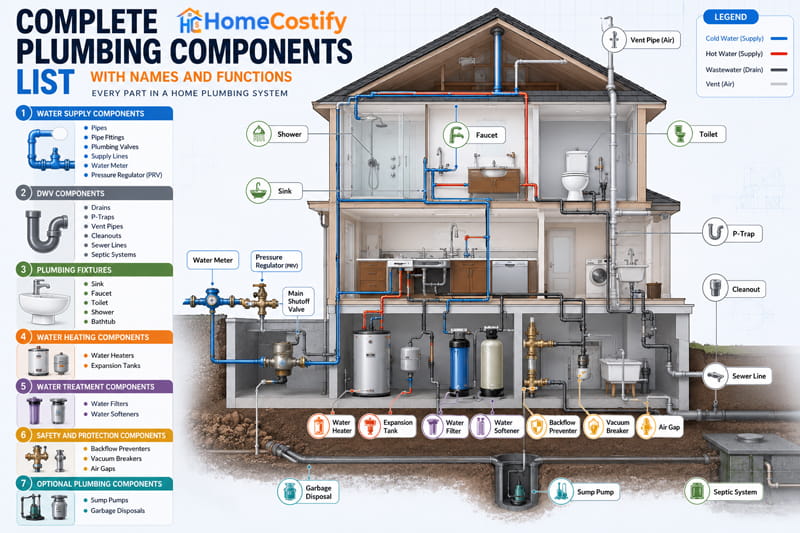
The easiest way to identify parts of a plumbing system is to group them by the job they perform. A functional layout places related plumbing components side by side, making names easier to recognize than a catalog arranged by installation location or product type.
The reference below divides major plumbing system components into functional groups. Each section covers one category, creating a consistent structure for locating unfamiliar terms without searching an alphabetical list.
Category Overview
- Water Supply Components
- Drain, Waste, and Vent (DWV) Components
- Plumbing Fixtures
- Water Heating Components
- Water Treatment Components
- Safety and Protection Components
- Optional Plumbing Components
Water Supply Components
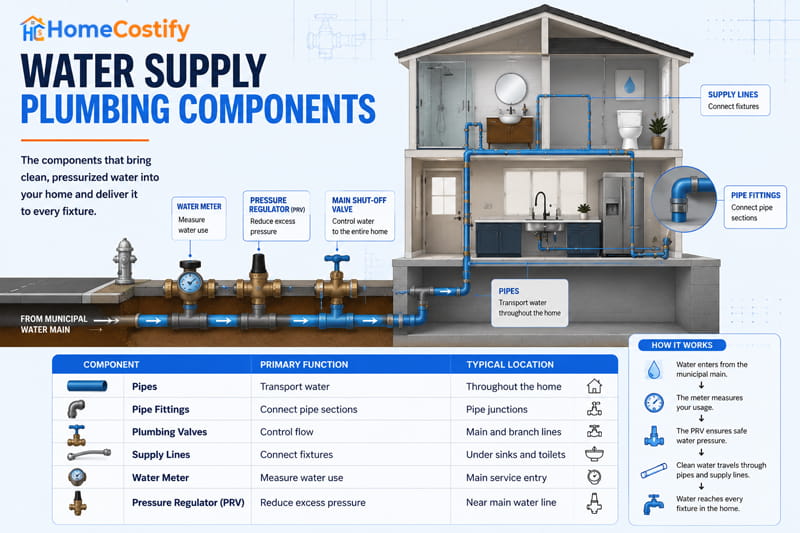
Every faucet, toilet, shower, and appliance receives clean water from the supply side of the plumbing system. The components below cover the piping, controls, measurement, and pressure regulation responsible for that delivery.
| Component | Primary Function | Typical Location |
|---|---|---|
| Pipes | Transport water | Throughout the home |
| Pipe Fittings | Connect pipe sections | Pipe junctions |
| Plumbing Valves | Control flow | Main and branch lines |
| Supply Lines | Connect fixtures | Under sinks and toilets |
| Water Meter | Measure water use | Main service entry |
| Pressure Regulator | Reduce excess pressure | Near the main water line |
No single component determines supply performance on its own. Pipes establish distribution paths, valves regulate movement, supply lines complete fixture connections, meters record consumption, and pressure regulators stabilize incoming pressure. Reliable operation depends on those functions working in combination.
Modern residential plumbing components commonly undergo evaluation against nationally recognized performance and safety standards before entering the market. Certification programs assess material quality, structural performance, and compatibility with drinking water applications, giving manufacturers and consumers an established benchmark for product compliance.
Pipes
Pipes form the primary network for transporting potable water throughout a house. Main lines branch into smaller runs that serve kitchens, bathrooms, laundry areas, and outdoor connections. Their routing establishes the basic framework for water distribution, with pipe fittings joining separate sections and plumbing valves controlling movement at selected points.
Pipe Fittings
Pipe fittings join pipe sections where a straight run cannot continue. Elbows change direction, tees create branch connections, and couplings extend an existing line. Different layouts require different fitting configurations, creating continuous pathways without interrupting normal water movement.
Plumbing Valves
Plumbing valves regulate water movement wiyhin the supply network and isolate selected sections whenever service needs to stop. Their position determines which fixtures continue receiving water and which lines shut off temporarily. Main shut-off valves control the property supply, while branch valves limit isolation to smaller portions of the network.
Supply Lines
Supply lines connect branch piping to faucets, toilets, dishwashers, washing machines, and other fixtures. Flexible connectors simplify alignment where fixed piping cannot terminate at the exact fixture location, although rigid connections still appear in selected applications. Most installations sit beneath sinks, behind toilets, or inside cabinets.
Water Meter
A water meter records household water consumption at the main service entry. Utility providers use meter readings for billing, and unexpected consumption patterns can indicate hidden leakage or continuous fixture operation that deserves closer inspection.
Pressure Regulator (PRV)
A pressure regulator valve (PRV) reduces excessive incoming pressure from the municipal supply or private distribution source. Stable pressure limits unnecessary stress on fixtures, appliances, and supply piping, creating predictable operating conditions across normal household use.
Drain, Waste, and Vent (DWV) Components
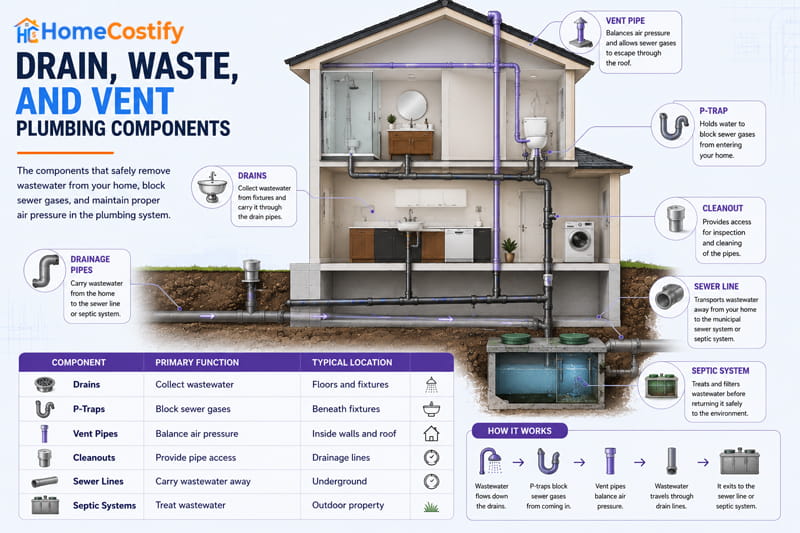
Every sink, shower, bathtub, toilet, and floor drain leaves wastewater behind after daily use. The plumbing components in this section follow that discharge path from the fixture outlet to its final destination, covering collection, air movement, pipe access, and final disposal.
| Component | Primary Function | Typical Location |
|---|---|---|
| Drains | Collect wastewater | Floors and fixtures |
| P-Traps | Block sewer gases | Beneath fixtures |
| Vent Pipes | Balance air pressure | Inside walls and roof |
| Cleanouts | Provide pipe access | Drainage lines |
| Sewer Lines | Carry wastewater away | Underground |
| Septic Systems | Treat wastewater | Outdoor property |
Drainage depends on collection, plumbing venting, access, and final discharge operating as a complete sequence. Removing a trap, blocking a vent, or eliminating cleanout access changes pressure conditions, interrupts wastewater movement, or permits sewer gases to enter occupied spaces.
Drains
Wastewater enters the drainage network by way of drains installed at plumbing fixtures and floor openings. Gravity carries that discharge into drain piping, beginning the flow path along the DWV system network. Fixture outlets mark the transition from water supply to gravity drainage, sending used water toward larger branch and main drain lines.
Drain Traps (P-Traps)
A trap seal forms when water collects inside the curved section of a P-trap. That standing water separates occupied rooms from sewer gases traveling inisde drain piping. P-traps appear beneath sinks and beneath numerous plumbing fixtures where wastewater enters the drainage network.
Vent Pipes
Air enters drain piping from vent pipes, balancing internal pressure as wastewater travels downstream. Stable pressure protects trap seals from siphonage and supports continuous discharge into branch drains and main drain lines. A vent stack extends that air path within the drainage network.
Cleanouts
Cleanouts create access points along drain piping for inspection and service activities. Strategic placement at selected locations gives direct entry into the piping network without removing fixtures or opening finished surfaces. Cleanout access appears along branch drains, building drains, and sewer connections.
Sewer Lines
Underground sewer lines carry household wastewater away from the structure after it leaves the building drain. That piping terminates at either a municipal sewer connection or a private septic system, forming the final conveyance route for residential wastewater beyond the house.
Septic Systems
Properties outside municipal sewer service discharge household wastewater into septic systems located on the site. Solids settle inside the septic tank before partially treated effluent enters the drain field for soil filtration. That process completes on-site residential wastewater disposal without a public sewer connection.
Plumbing Fixtures
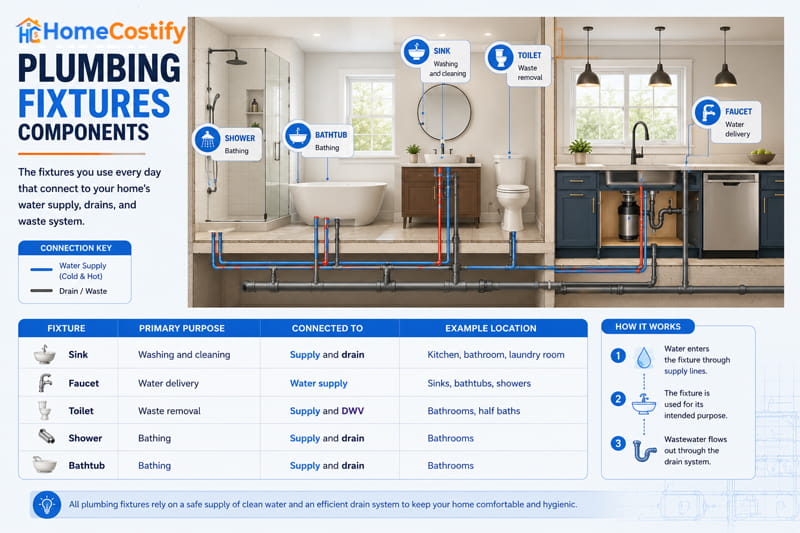
Daily household activities take place at plumbing fixtures positioned inside kitchens, bathrooms, laundry rooms, and utility areas. Visible plumbing components mark the point where occupants draw water or discharge wastewater, linking routine use with the concealed supply and drainage networks introduced in earlier sections.
| Fixture | Primary Purpose | Connected To |
|---|---|---|
| Sink | Washing and cleaning | Supply and drain |
| Faucet | Water delivery | Water supply |
| Toilet | Waste removal | Supply and DWV |
| Shower | Bathing | Supply and drain |
| Bathtub | Bathing | Supply and drain |
Occupants interact with fixtures every day, yet much of their performance depends on concealed plumbing components that regulate pressure, route water, receive wastewater, and support fixture operation beyond finished walls, floors, and cabinets.
Sinks
Kitchen, bathroom, laundry, bar, and utility sinks serve different household tasks, yet all follow the basic fixture arrangement. Fresh water enters at the faucets, and wastewater exits through the drain opening beneath the basin. Among residential plumbing system components, sinks represent one of the most frequently used access points for washing, food preparation, cleanup, and other daily activities.
Faucets
Water reaches sinks, bathtubs, utility basins, and similar fixtures through faucets that regulate discharge at the point of use. Lever, knob, touchless, and pull-down mechanisms operate with different control methods, though all perform the basic task of starting, stopping, or adjusting water delivery for the fixture they serve.
Toilets
Flushing carries human waste from the bowl into the drainage piping during controlled release of stored tank water or a direct-flush mechanism. Supply piping refills the fixture after each cycle, preparing it for the next use. Toilets represent one of the few plumbing parts that operate with both the supply and DWV sides of a residential plumbing network.
Showers
Shower valves regulate temperature and water volume before discharge reaches the shower head. Used water exit via the shower drain and enters the DWV network beneath the floor. Pressure balance, water delivery, and drainage operate as a continuous sequence during normal bathing.
Bathtubs
Bathtubs serve soaking, bathing, and combination bath-shower installations found in residential bathrooms. Supply piping feeds the faucet or tub spout, and wastewater drains into the tub drain after use. Shared plumbing lines permit bathtubs and nearby fixtures to use common supply and drainage branches without duplicating piping.
Water Heating Components
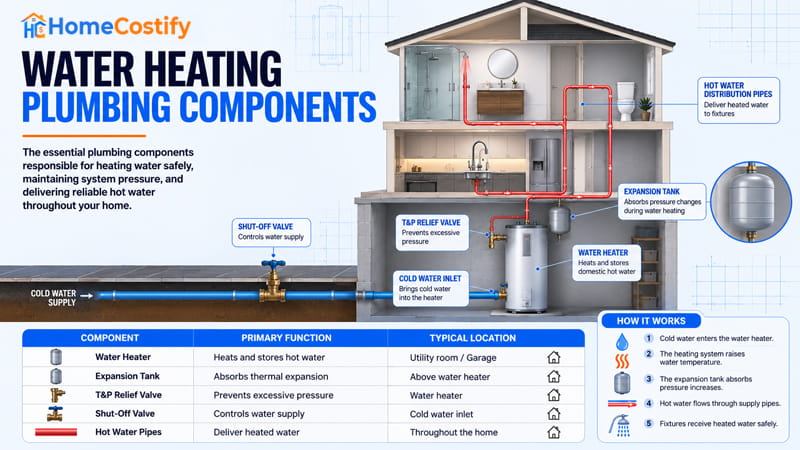
Hot water reaches sinks, showers, bathtubs, and household appliances only after passing dedicated heating equipment. Water heating plumbing components prepare heated water and support pressure control associated with that portion of the residential plumbing network.
Water Heaters
Household hot water originates inside a water heater before entering hot-water supply piping serving plumbing fixtures and appliances. Storage tank models heat and store a ready supply for later use. Tankless units warm water as it moves across the heating chamber, eliminating the storage tank.
Both configurations distribute heated water to kitchens, bathrooms, laundry areas, and other points of use through the hot-water branch network. Among residential plumbing system components, water heaters supply heated water to multiple fixtures from a single source.
Expansion Tanks
Heating water increases in volume because of thermal expansion. Closed water heating systems accommodate that pressure change with an expansion tank installed near the water heater. An internal air chamber absorbs the expanding volume, limiting pressure increases inside hot-water piping. Expansion tanks appear alongside modern water heating equipment where closed plumbing systems require pressure control.
Water Treatment Components
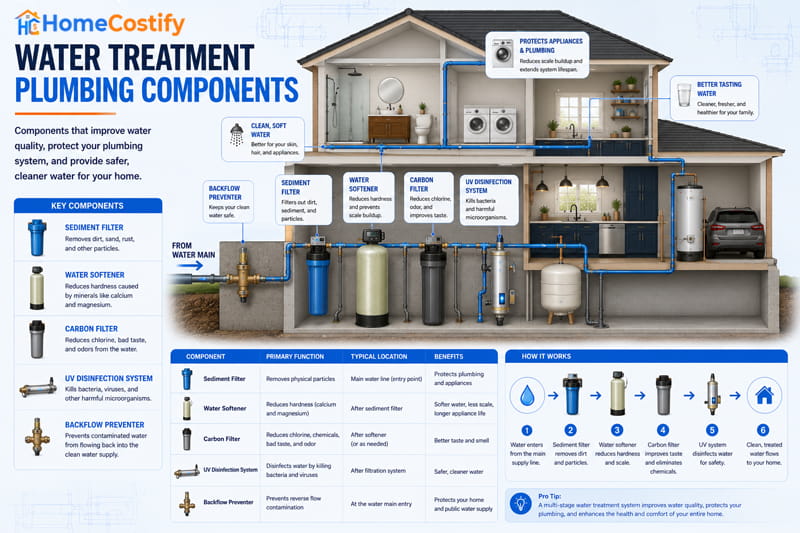
Minerals, sediment, and other impurities enter a home’s water supply long before the first fixture draws water. Water treatment plumbing system components improve incoming water quality filtration or hardness reduction, with each serving a different treatment objective.
Water Filters
Suspended sediment, rust particles, and selected contaminants pass into water filters before reaching plumbing fixtures or household appliances. Installation points vary with the treatment objective, including the main service line, a single fixture, or a specific appliance. Filtration targets unwanted material carried in the incoming supply, leaving hardness minerals to other treatment equipment.
Water Softeners
Calcium and magnesium create hard water that leaves mineral deposits inside fixtures, appliances, and supply piping. Water softeners reduce those minerals through an ion-exchange process before distribution enters the hot and cold water network. Among residential plumbing parts, softeners address hardness, whereas filters target suspended particles or selected contaminants.
Safety and Protection Components
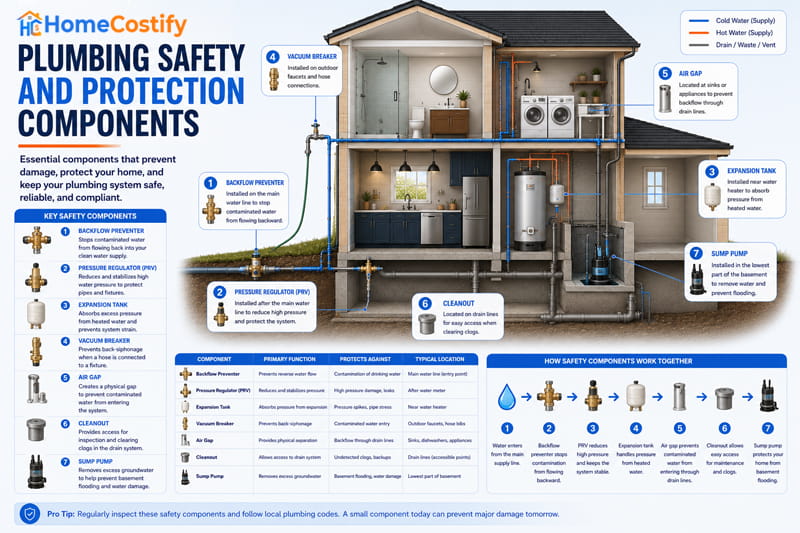
Clean drinking water depends on protective devices that prevent contamination from reaching the potable water supply. Protective plumbing components reduce reverse-flow and contamination risks flow and physical separation, with some installations required by local plumbing codes according to fixture type, equipment, or cross-connection risk.
Backflow Preventers
Reverse flow carries contaminated water toward the potable supply under abnormal pressure conditions. Backflow preventers interrupt that movement at selected residential locations serving irrigation systems, hose connections, fire sprinkler systems, or specialized plumbing equipment. Their primary purpose centers on potable water protection by reducing contamination from backflow events.
Vacuum Breakers
Negative pressure creates back siphonage capable of drawing contaminated water into the supply line. Vacuum breakers interrupt that condition at outdoor faucets, irrigation equipment, and similar connections exposed to cross-connection hazards.
Air Gaps
An air gap places an open vertical space between a potable water outlet and the receiving fixture. Physical separation eliminates direct contact between drinking water and wastewater, forming one of the simplest methods of contamination prevention used with sinks, dishwashers, and other residential fixtures.
Modern plumbing standards recognize backflow preventers, approved air gaps, and comparable protective plumbing components as important safeguards against drinking water contamination when residential plumbing systems follow accepted design practices.
Optional Plumbing Components
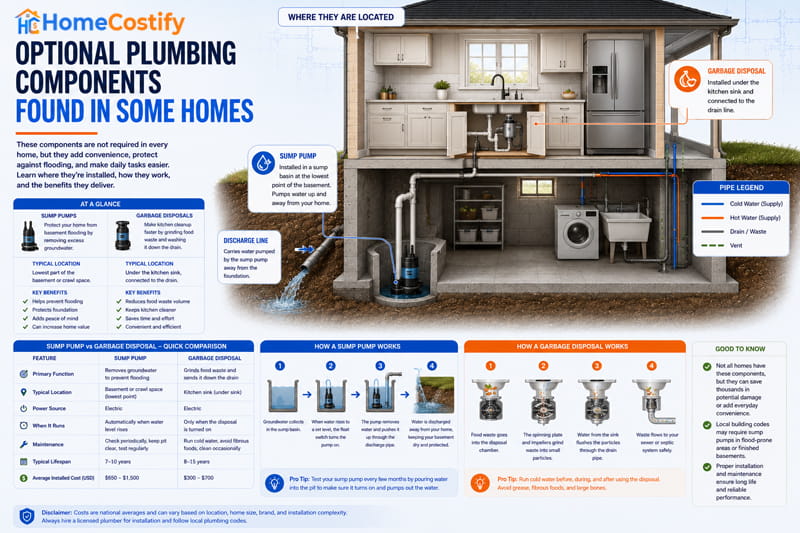
Household plumbing layouts vary according to property conditions, daily routines, and the types of plumbing systems serving a residence. Optional plumbing components appear only where property conditions create a specific need water management or kitchen waste handling beyond the standard residential plumbing layout.
Sump Pumps
Groundwater collects beneath certain homes after heavy rainfall, rising groundwater levels, or poor site drainage. A sump pump removes that collected water from a sump basin before it reaches finished basements or crawl spaces. Among residential plumbing system components, this equipment appears in properties exposed to recurring groundwater accumulation or elevated moisture beneath the structure.
Garbage Disposals
Food scraps pass into a garbage disposal mounted beneath the kitchen sink, where rotating grinding components reduce solid waste into small particles before discharge enters the household drain. This equipment supports kitchens that process routine meal preparation waste without sending large food pieces into the drainage piping.
Homes that commonly include optional plumbing components include:
- Properties with finished basements or crawl spaces requiring flood protection from groundwater accumulation.
- Residences with private plumbing layouts supporting specialized water management requirements.
- Kitchens equipped for routine food waste processing beneath the sink.
Conclusion
Residential plumbing components operate as a collection of specialized categories, with each category handling a distinct function inside the plumbing network instead of relying on only a handful of visible fixtures.
Water distribution, wastewater removal, heating, treatment, and protective devices support different parts of daily plumbing operation, creating a complete residential infrastructure behind walls, beneath floors, and inside utility spaces.
Grouping plumbing components by function gives homeowners a clearer picture of residential plumbing and the way plumbing works from water distribution and wastewater removal to heating, treatment, and protection. Viewing the system through functional categories creates a logical framework for identifying equipment without treating every visible fixture as a separate system.
FAQs About Plumbing Components
What are the most important plumbing components in a house?
Major categories include water distribution, drainage, heating, treatment, and protection equipment. Each category performs a different function within residential plumbing and supports normal household operation.
Are plumbing fixtures considered plumbing components?
Yes. Plumbing fixtures belong to the broader group of plumbing components. Sinks, toilets, showers, and bathtubs serve as the visible endpoints where people use the plumbing network.
Which plumbing components are hidden behind walls?
Water distribution piping, drainage piping, vent piping, shut-off valves, and other control equipment occupy wall cavities, ceilings, utility rooms, or spaces beneath floors.
Do all homes have the same plumbing components?
No. Residential layouts vary according to property design, local utility conditions, water quality concerns, and household requirements. Optional equipment appears only where a specific function serves the property.
What is the difference between plumbing components and plumbing fixtures?
Plumbing components include every part supporting residential plumbing, including piping, valves, treatment equipment, heating equipment, and fixtures. Fixtures represent one category within that larger plumbing network.