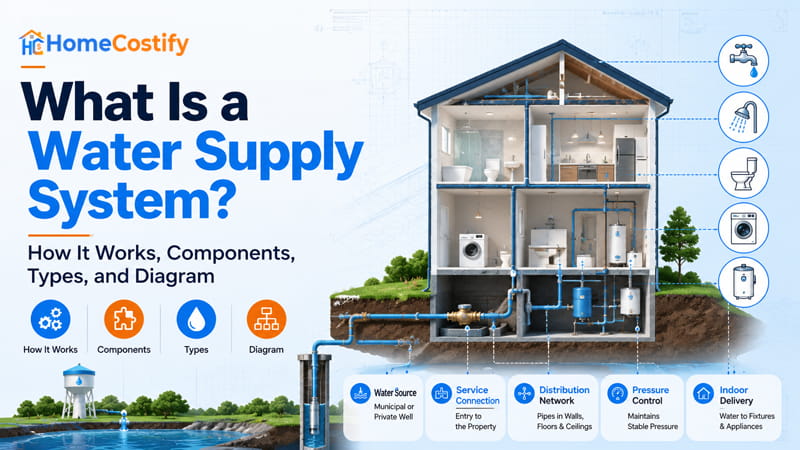
Morning routines begin with a simple turn of a faucet, a shower, or a washing machine starting another load. A water supply system carries clean, pressurized water into a house so daily activities continue without interruption. Water reaches kitchens, bathrooms, laundry rooms, and other points of use without drawing attention to the route it travels.
Faucets, showers, and appliances mark the point where that journey ends. Most of its path lies beneath streets, across property lines, and inside concealed plumbing, leaving little visible evidence of everything required to deliver water indoors.
Clean water travels much farther than the final few feet inside a house. Following that path from its origin to indoor delivery places the residential water supply system within the broader picture of residential plumbing, staying focused on the route water follows instead of public utility engineering.
What Is a Water Supply System?
Modern houses receive safe drinking water in kitchens, bathrooms, laundry areas, and outdoor taps as part of normal daily living. A water supply system refers to the residential plumbing network that carries potable water from the property’s water entry point to locations used for cooking, bathing, cleaning, and similar activities. It supports routine indoor use through a continuous public or private supply.
According to the U.S. Environmental Protection Agency (EPA), public drinking water systems transport treated water through pipes, pumps, valves, and storage facilities until reaching a property’s service connection. At that boundary, responsibility passes to the property owner, and the incoming service becomes part of the private plumbing serving the house.
The home plumbing system includes subsystems that perform separate functions within a house. A residential water supply system occupies the portion responsible for bringing potable water into daily use, leaving wastewater removal, hot water production, and related plumbing functions to dedicated subsystems covered later.
How Does a Water Supply System Work?
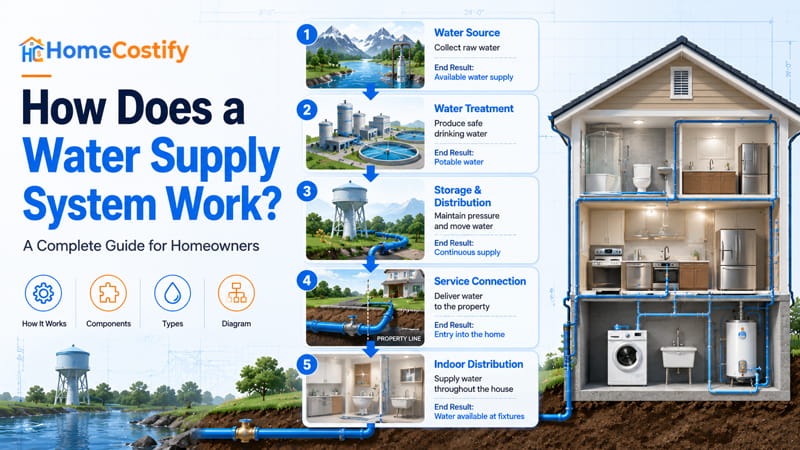
A kitchen faucet delivers safe water with little indication of what takes place beyond the walls. A water supply system follows a continuous route from its original source to indoor use, passing through public infrastructure and private plumbing before reaching familiar household fixtures.
| Stage | Primary Purpose | End Result |
|---|---|---|
| Water Source | Collect raw water | Available water supply |
| Water Treatment | Produce safe drinking water | Potable water |
| Storage & Distribution | Maintain pressure and move water | Continuous supply |
| Service Connection | Deliver water to the property | Entry into the home |
| Indoor Distribution | Supply water throughout the house | Water available at fixtures |
Water Comes From a Source
Rivers, lakes, reservoirs, and underground aquifers supply the raw resources used for daily household needs. A home water supply system receives its incoming supply from either a municipal utility or a private well, depending on local geography and available natural resources.
Cities and suburbs commonly receive municipal water supply collected from nearby surface water or groundwater. Rural properties frequently draw groundwater through private well systems because public utility lines are not available in every location.
Climate, terrain, and regional infrastructure shape those choices from one community to another. Even though the starting point varies, the objective stays consistent: delivering a dependable source for everyday residential use.
Water Is Treated Before Distribution
Public utilities prepare incoming supplies through a Water Treatment System before they enter municipal infrastructure serving homes and businesses. Filtration removes suspended particles, and disinfection addresses bacteria, viruses, and similar microorganisms. The result is potable water that satisfies public drinking standards.
According to the U.S. Environmental Protection Agency (EPA), public drinking water systems generally follow three broad phases. Supplies originate from surface water or groundwater, receive treatment to meet drinking standards, and continue through storage facilities, water mains, and service lines before reaching private plumbing.
Water Travels Through the Distribution Network
Storage reservoirs feed the water distribution network, supplying neighborhoods through large transmission lines linked to the public utility. A water supply system carries treated supplies across the network until they reach local streets and nearby communities. Stable water pressure keeps everyday demand supplied during both quiet and busy periods.
Closer to a residence, a water main branches into a water service line serving a single property. The line terminates at the service connection, marking the point where the public network and private plumbing meet. Storage facilities support steady operating conditions as demand rises and falls across the service area.
Water Reaches Household Plumbing
The main line entering a house divides into cold branch lines serving sinks, toilets, appliances, and other everyday outlets. A residential water supply system directs another portion toward the Water Heating System, creating separate cold and hot water routes for normal household use.
Both lines terminate at Plumbing Fixtures located across the house. Cold outlets receive supply directly from the main distribution line, whereas fixtures requiring hot water draw from the heated line. Cold and hot lines reach different fixtures according to daily demand, creating separate delivery routes for common household tasks.
How a Residential Water Supply System Works Diagram
Water Source
(Municipal Water / Private Well)
│
▼
Water Treatment System
│
▼
Storage & Distribution
│
▼
Service Connection
│
▼
Main Water Line
│
┌──────────────┴──────────────┐
│ │
▼ ▼
Cold Water Distribution Water Heating System
│ │
│ ▼
│ Hot Water Distribution
│ │
└──────────────┬──────────────┘
▼
Plumbing Fixtures
Major Components of a Water Supply System
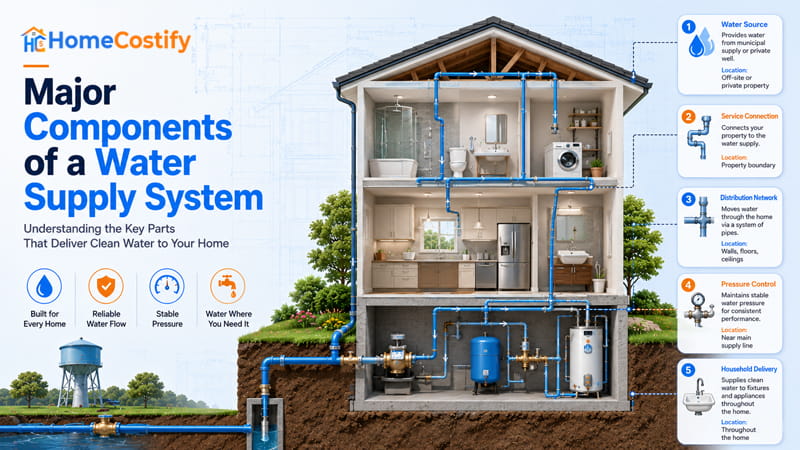
Functional groups divide a water supply system into distinct sections, replacing the idea of one continuous pipeline running across a house. Source collection, property entry, indoor routing, pressure regulation, and household delivery belong to different parts of the network, with each handling a specific task before the next group takes over.
| Component Group | Primary Function | Typical Location |
|---|---|---|
| Water Source | Provides water | Off-site or private property |
| Service Connection | Connects property to supply | Property boundary |
| Distribution Network | Moves water through the home | Walls, floors, ceilings |
| Pressure Control | Maintains stable pressure | Near main supply line |
| Household Delivery | Supplies fixtures and appliances | Throughout the home |
Water Source
Lakes, rivers, reservoirs, and underground aquifers supply the raw resources used by residential plumbing across the country. A home water supply system draws from either a municipal water supply or a private well, with local infrastructure and geography determining which option serves a particular area.
Cities and suburban communities commonly rely on surface water collected from nearby reservoirs, lakes, or rivers. Rural locations frequently obtain groundwater through private wells because public utility service is not available everywhere.
Every functional group described in this section receives its supply from that original source. Differences in location change where the supply originates, although the purpose stays consistent across residential properties.
Service Connection
A property line marks the location where public utility infrastructure ends and private piping begins. The service connection links both sides, creating the physical connection between the utility network and the water service line serving the house.
Public utilities manage infrastructure outside the property, whereas piping beyond the boundary falls under the owner’s responsibility. Although ownership changes, the incoming supply continues into the residential network without passing through another transfer point.
Distribution Network
Wall cavities, floor framing, and ceiling spaces contain the routing that distributes incoming flow across different areas of a house. A water supply system uses a primary line to feed the indoor plumbing network, where numerous plumbing components operate as a coordinated group instead of independent parts.
The main route branches into smaller supply piping serving kitchens, bathrooms, laundry areas, and outdoor locations. Shorter branch lines extend from that primary route, directing flow toward different sections without requiring a separate line for every outlet. Orderly indoor distribution depends on that branching layout, leaving pressure regulation to the next functional group.
Pressure Control
Opening a faucet should produce a steady stream instead of sudden surges or weak flow. A pressure regulator moderates incoming force, keeping water pressure within a practical operating range before it reaches branch piping serving the house.
Stable conditions support consistent flow across kitchens, bathrooms, laundry areas, and outdoor outlets, even when demand changes over the course of the day. Large pressure swings place unnecessary stress on valves, seals, and connected plumbing equipment, making regulation an essential function within the network.
Household Delivery Components
Everyday access begins where branch piping reaches water outlets installed across the house. A household water supply system enters its final functional group at that point, ending the distribution network and preparing for normal household use.
A completed residential water supply system operates through functional groups that collect, transfer, distribute, regulate, and deliver clean water across the house.
Types of Water Supply Systems
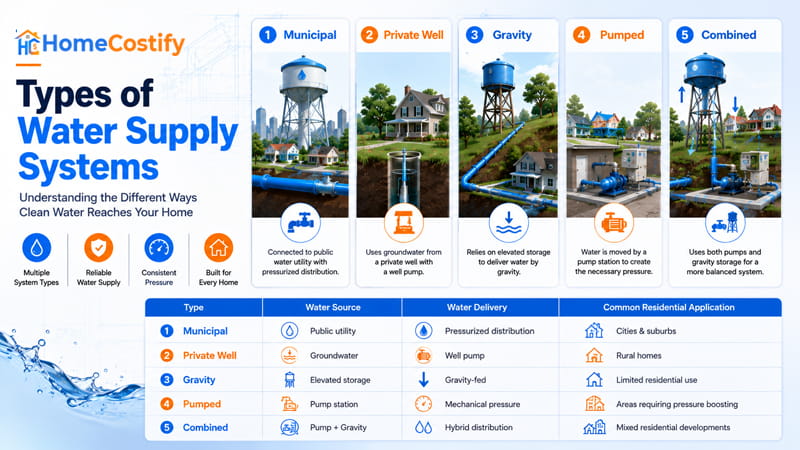
Residential properties use different arrangements based on two factors: where the supply originates and how it reaches indoor plumbing. A water supply system follows the same basic purpose across every category, although the source and delivery method determine the equipment, operating conditions, and overall configuration.
| Type | Water Source | Water Delivery | Common Residential Application |
|---|---|---|---|
| Municipal | Public utility | Pressurized distribution | Cities & suburbs |
| Private Well | Groundwater | Well pump | Rural homes |
| Gravity | Elevated storage | Gravity-fed | Limited residential use |
| Pumped | Pump station | Mechanical pressure | Areas requiring pressure boosting |
| Combined | Pump + Gravity | Hybrid distribution | Mixed residential developments |
Types Based on Water Source
Municipal utilities supply cities and suburban communities with drinking water collected from surface water and groundwater sources beyond residential areas. Within a residential water supply system, public infrastructure handles collection and delivery before water enters private plumbing.
Rural properties commonly obtain groundwater from a private well located on the site. Local geology, aquifer conditions, and utility availability determine which source serves a particular property, creating different residential arrangements without changing daily indoor use.
Types Based on Water Delivery
Natural elevation supplies operating pressure in gravity-fed installations. Elevated storage tanks send water downhill without continuous mechanical assistance, making this arrangement suitable for locations where terrain already supplies enough height for normal residential demand.
Mechanical equipment replaces elevation in a pumped system. Electric pumps generate water pressure for properties where natural elevation cannot sustain steady flow, making this arrangement the standard choice for most modern housing developments.
Some residential developments combine both methods. Elevated storage carries part of the daily demand, and mechanical pumping supplements pressure during heavier use or changing site conditions. A home water supply system built around this hybrid arrangement benefits from both gravity and mechanical assistance.
Source and delivery method represent two separate ways to classify a water supply system.
How the Water Supply System Fits Into Residential Plumbing
Residential plumbing brings multiple functions into a single network, even though each subsystem handles a different job. A water supply system carries clean water toward points of use, followed by heating, everyday use, and wastewater removal as separate plumbing functions operating within the house.
| Plumbing Subsystem | Primary Role |
|---|---|
| Water Supply System | Delivers clean water |
| Water Heating System | Produces hot water |
| Plumbing Fixtures | Uses supplied water |
| DWV System | Removes wastewater |
Clean water enters the house through the main supply line before reaching the household water supply system. Cold-water branches continue directly toward selected Plumbing Fixtures, whereas another branch enters the Water Heating System for temperature adjustment prior to household use.
Kitchen sinks, bathroom faucets, showers, laundry equipment, and similar fixtures receive either cold or hot water according to their intended use. Normal household activities change clean water into wastewater once cooking, bathing, cleaning, or washing takes place.
Used water leaves fixture drains and enters the DWV System, where drainage and plumbing venting perform a completely different plumbing function from the supply network. Fresh water and wastewater follow separate routes inside residential plumbing, keeping delivery and removal independent even though both belong to the same plumbing network.
Viewed as a complete network, a residential water supply system performs only one function within residential plumbing. Heating, fixture use, and wastewater removal belong to separate subsystems operating alongside it.
Common Issues That Can Affect Water Supply Systems
Daily water use does not always feel identical from year to year. A water supply system can show gradual changes in pressure, appearance, or delivery, even without visible damage inside the house.
Common conditions include:
- Reduced water pressure affecting multiple fixtures.
- Hidden leaks that gradually lower available flow.
- Corrosion inside aging plumbing infrastructure.
- Changes in water quality, including clarity, taste, or odor.
- Temporary utility interruptions affecting nearby neighborhoods.
Reduced pressure across multiple fixtures generally points to a condition affecting a larger portion of the supply network than a single outlet. Hidden leaks produce gradual changes because small losses accumulate over extended periods without obvious surface damage.
Corrosion develops inside aging piping and gradually changes interior pipe surfaces. Older plumbing can show visible changes in potable water, including discoloration, metallic taste, or unusual odor, particularly where aging materials remain in service.
Temporary interruptions sometimes originate within public utility infrastructure, yet similar symptoms can appear inside private plumbing. Location determines which side of the property boundary requires attention, even though outward signs can appear very similar.
Public infrastructure and private plumbing both influence day-to-day operation inside a home water supply system.
Conclusion
A faucet, shower, washing machine, or outdoor hose bib reveals only a small portion of the plumbing network serving a house. Water sources, supply lines, pressure control, heating equipment, fixtures, and drainage all contribute separate functions before daily household use can take place.
Utility infrastructure, private plumbing, and household equipment occupy different sections of the network, making accurate evaluation far easier when the complete residential plumbing system is viewed as a collection of related subsystems instead of isolated parts.
FAQs About Water Supply System
What are the four types of water supply systems?
Residential systems are commonly grouped by source and delivery method. Common categories include municipal systems, private well systems, gravity-fed systems, and pumped systems. Some properties also use combined gravity and pumping arrangements.
What are the three components of the water supply system?
A basic residential arrangement includes a water source, a distribution network, and delivery points serving household plumbing. Additional equipment varies according to local infrastructure and property requirements.
How can a water supply system be improved?
Improvement depends on the condition affecting operation. Pressure regulation, pipe replacement, equipment upgrades, or utility-side work all address different situations, so no single method fits every property.
How do you maintain a water supply system?
Routine inspections, prompt leak repairs, pressure monitoring, and periodic plumbing evaluations reduce unexpected problems. Water quality changes and visible corrosion also deserve professional attention when first observed.
What is the difference between a public water system and a private well?
A public water system delivers treated drinking water through utility infrastructure. A private well draws groundwater from the property, placing source equipment under the property owner’s responsibility.