A kitchen sink, a bathroom faucet, a shower, and a toilet become part of ordinary routines without attracting much attention. Plumbing fixtures mark the places where people wash their hands, prepare meals, brush their teeth, bathe, or flush away waste during everyday life.
Behind finished walls and beneath floors, pipes bring clean water to those familiar locations and direct wastewater through hidden drains after every task. Most daily activities begin and end with fixtures that stay in plain sight, even though the plumbing itself receives little notice.
Residential plumbing fixtures include sinks, faucets, toilets, showers, and other commonly used fixtures found in living spaces. Function, interaction with plumbing, and major fixture categories define the scope of this discussion.
What Are Plumbing Fixtures?
Visible plumbing devices used inside a house are known as plumbing fixtures. Their purpose is to deliver clean water, discharge wastewater, or combine both functions at a single location, depending on the type of fixture. According to the International Plumbing Code (IPC), a plumbing fixture is a receptacle or device connected to a building’s water supply system, drainage system, or both.
A fixture may receive potable water, discharge liquid waste, or perform both functions within a residential plumbing system. Sinks, faucets, toilets, showers, bathtubs, floor drains, and laundry tubs all fall within that definition because each serves a specific plumbing function.
The user-operated end of the home plumbing system contains residential plumbing fixtures installed throughout living spaces where water is used or discharged. Pipes transport water between plumbing components, valves regulate flow, fittings join pipe sections, and plumbing traps protect the drainage system.
Fixtures occupy a different position because direct household use takes place there. Opening a faucet, flushing a toilet, or using a sink always involves a fixture, never the concealed plumbing supporting it.
Plumbing codes, inspection reports, construction drawings, manufacturer specifications, and technical references use the term plumbing fixture with a specific meaning. The term does not include every object attached to residential plumbing.
Shutoff valves, pipe runs, fittings, and similar components belong to the supporting installation instead of the fixture itself. Using the correct term removes confusion when reading plumbing documents, following code requirements, or identifying equipment inside a house.
Why Plumbing Fixtures Matter
Cooking, personal hygiene, sanitation, laundry, and cleaning all require a practical way to use water and dispose of wastewater. Household routines continue through sinks, toilets, faucets, showers, and similar fixtures placed where those activities take place.
Good sanitation begins with equipment that separates clean water from liquid waste. A single plumbing fixture serves a specific purpose, whether supplying potable water, carrying wastewater into drainage, or performing both functions.
Safe hygiene practices, indoor sanitation, public health, household convenience, and water conservation all depend on those basic functions instead of product features or appearance.
Plumbing fixtures contribute to residential living by:
- Supplying potable water — Kitchens, bathrooms, and laundry areas receive water where daily tasks take place.
- Supporting sanitary conditions — Toilets, sinks, showers, and related equipment serve routine hygiene without manual water handling.
- Directing wastewater to drainage — Used water leaves occupied spaces through drainage connections after normal use.
- Serving different household purposes — Kitchens, bathrooms, and laundry areas support cooking, personal care, cleaning, laundry, and waste disposal at dedicated fixture locations.
How Plumbing Fixtures Work
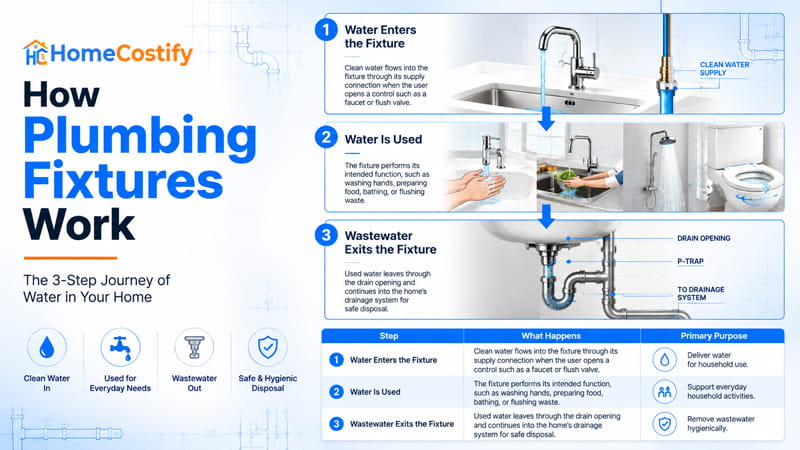
All plumbing fixtures follow a common operating pattern from water entry to wastewater discharge. User operation starts that process with a control, continues with a household task, and finishes when used water leaves the fixture through a drain opening. Differences between sinks, toilets, showers, or faucets do not change those basic steps.
How Water Enters a Plumbing Fixture
A supply connection delivers water into the fixture after a faucet handle, flush valve, push button, or similar control is activated. Hot and cold lines meet at mixing fixtures such as sinks, lavatories, bathtubs, and showers, allowing temperature adjustment before water reaches the outlet.
Toilets follow a different arrangement, sending water into the tank or bowl through a dedicated inlet controlled by internal hardware.
How Water Is Used at the Fixture
Household tasks begin after water reaches the point of use. Washing hands, preparing food, bathing, cleaning surfaces, filling containers, or flushing a toilet all follow the operating principle of a plumbing fixture. Every action takes place at the fixture itself, where water is used for washing, cleaning, bathing, flushing, or food preparation.
How Wastewater Leaves the Fixture
Drain openings collect used water after household tasks finish. Gravity moves wastewater from the fixture into the home’s drainage piping before reaching a dedicated outlet. Sinks, bathtubs, showers, floor drains, and similar fixtures discharge liquid waste from that opening.
Toilets carry both water and waste through a larger outlet matched to their intended function. Wastewater leaves the fixture at the drain opening, completing the basic operating pattern shared by plumbing fixtures.
How Plumbing Fixtures Connect to Residential Plumbing Systems
A plumbing fixture joins incoming water and wastewater drainage at a single location inside a house. Supply lines feed the fixture for normal use. Drain connections carry wastewater away after use, with concealed piping linking both sides of the installation.
Connection to the Water Supply System
The home’s water supply system delivers water to each fixture through an individual supply line matched to its intended use. Faucets, lavatories, bathtubs, and showers draw hot, cold, or mixed water.
Toilet tanks connect only to a cold-water line. Fixture controls regulate flow at the point of use without changing the operation of the distribution network serving the rest of the house.
Connection to the DWV System
Drain outlets transfer used water from a plumbing fixture into the DWV system. Gravity carries that discharge toward the drainage network. Trap connections retain a water seal that blocks sewer gases from returning through the drain.
Fixture drains vary in size and shape, although every outlet performs the identical drainage function required for sanitary wastewater removal.
How Water Heating and Water Treatment Support Plumbing Fixtures
Hot-water fixtures draw heated water from the home’s water heating system whenever a fixture function requires higher temperatures. Showers, bathtubs, lavatories, and kitchen faucets commonly use both hot and cold supplies.
Selected plumbing fixtures may draw treated water after it passes through a water treatment system. Treatment choices reflect local water conditions and fixture compatibility without changing the basic connection shared by residential plumbing.
Types of Plumbing Fixtures
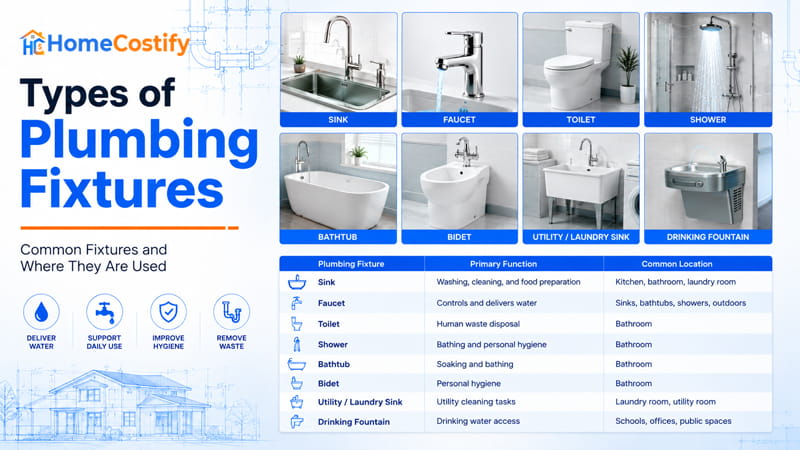
Function offers the simplest way to classify plumbing fixtures found in houses and public buildings. Kitchen tasks, personal hygiene, bathing, sanitation, utility work, and drinking water access each require a different fixture category. The term plumbing fixtures types refers to those functional groups instead of construction details or product variations.
| Plumbing Fixture | Primary Function | Common Location |
|---|---|---|
| Sink | Washing, food preparation, cleaning | Kitchen, bathroom, laundry |
| Faucet | Controls water delivery | Kitchens, bathrooms, outdoors |
| Toilet | Human waste disposal | Bathroom |
| Shower | Bathing | Bathroom |
| Bathtub | Soaking and bathing | Bathroom |
| Bidet | Personal hygiene | Bathroom |
| Utility / Laundry Sink | Cleaning utility items | Laundry room, utility area |
| Drinking Fountain | Drinking water access | Schools, offices, public buildings |
According to ASME plumbing fixture standards, residential and commercial plumbing fixtures include a broad range of products such as sinks, lavatories, bathtubs, shower bases, water closets, bidets, urinals, drinking fountains, and specialty sinks. Each fixture category is evaluated against standardized requirements for materials, construction, performance, and durability before approval for plumbing applications.
Sinks
Daily food preparation, dishwashing, handwashing, and general cleaning place sinks among the busiest fixtures inside a house. Kitchen sinks handle meal-related work, bathroom sinks support personal care, and utility basins accommodate heavier cleaning jobs. Commercial spaces use larger or specialized sinks matched to food service, maintenance, healthcare, or workplace requirements.
Faucets
Water flow starts and stops at the faucet. Handle movement or valve operation controls volume, and mixing mechanisms combine hot and cold supplies where both lines are available. Kitchens, lavatories, bathtubs, outdoor hose connections, and utility areas use faucets suited to the task performed at that location.
Toilets
Indoor sanitation depends on toilets for safe human waste disposal. Flushing carries waste into the drainage system, separating occupied living spaces from sanitary waste collection. Nearly every dwelling includes this fixture as a basic requirement, and commercial buildings install additional units according to occupancy, building use, and plumbing code requirements.
Showers
Standing beneath flowing water defines the shower experience. Rinsing, bathing, and routine body cleansing take place without filling a basin, making showers a practical choice for daily use. Primary bathrooms, guest bathrooms, fitness centers, hotels, and locker rooms commonly dedicate separate shower spaces to regular bathing.
Bathtubs
Full-body soaking distinguishes bathtubs from other bathing fixtures. Water fills the tub and stays in place during bathing, making this category suitable for relaxation, child bathing, therapeutic soaking, and assisted care. Family bathrooms, hotels, and hospitality properties continue to include bathtubs where longer bathing sessions are preferred.
Bidets
Personal cleansing after toilet use forms the primary purpose of a bidet. A controlled water spray cleans the user directly, offering an alternative to toilet paper alone. Premium residences, modern bathroom projects, and regions with long-established bidet use continue to expand this fixture category beyond traditional markets.
Utility and Laundry Fixtures
Heavy cleaning jobs call for larger basins than standard kitchen or bathroom sinks. Utility sinks and laundry tubs handle buckets, mops, paint equipment, gardening tools, pet supplies, and oversized household items that need additional working space.
Laundry rooms, garages, workshops, basements, and utility areas frequently dedicate space to this plumbing fixture category because ordinary residential sinks rarely accommodate those tasks.
Commercial Plumbing Fixtures
Public occupancy introduces fixture categories that rarely appear in single-family homes. Drinking fountains offer convenient access to drinking water in schools, office buildings, transportation terminals, healthcare facilities, and recreational venues.
Urinals address high restroom demand in busy public washrooms, and wash troughs serve multiple users in factories, industrial facilities, schools, and sports complexes.
Common Materials Used for Plumbing Fixtures
Frequent use, installation location, surface exposure, and intended function all influence material selection during fixture manufacturing. Plumbing fixtures combine different materials because a kitchen sink, bathtub, toilet, or faucet does not operate under identical conditions.
Surface finish, corrosion resistance, strength, weight, appearance, and cleaning requirements all contribute to that selection.
- Porcelain — Smooth, nonporous surfaces resist stains and simplify routine cleaning. Toilets and numerous bathroom sinks use porcelain because the finish stays clean with ordinary household use.
- Ceramic — Glazed finishes retain a clean appearance across repeated daily use. Lavatories and specialty sinks commonly use ceramic where a durable finished surface is preferred.
- Stainless Steel — Metal construction withstands moisture, corrosion, and heavy daily use. Kitchen sinks, utility basins, and laundry sinks frequently use stainless steel because the surface tolerates demanding cleaning tasks.
- Brass — High mechanical strength makes brass a common choice for internal faucet parts and related plumbing hardware. Long service life and corrosion resistance suit repeated valve operation.
- Chrome — Bright protective coatings cover brass faucet surfaces, adding corrosion resistance together with a polished exterior finish.
- Acrylic — Lightweight construction and good heat retention make acrylic a popular material for bathtubs and shower units formed in different shapes and sizes.
- Fiberglass — Molded panels produce lightweight bathtub shells and shower surrounds suited to residential construction where lower weight is a practical advantage.
Material choice follows the function of the fixture as well as the conditions surrounding its use. Structural plumbing components follow different engineering requirements than exposed fixtures.
Plumbing Fixtures vs Plumbing Components
Direct contact with household plumbing takes place at exposed fixtures, whereas supporting assemblies stay concealed behind finished surfaces or inside utility spaces. Plumbing fixtures represent the equipment people operate during daily use.
Pipes, valves, fittings, traps, and related plumbing components perform supporting functions without routine user interaction.
| Plumbing Fixtures | Plumbing Components |
|---|---|
| Visible and user-operated | Mostly concealed |
| Deliver and use water | Support water movement and control |
| Receive wastewater | Connect, regulate, or distribute water |
| Examples: sinks, toilets, faucets | Examples: pipes, valves, fittings, traps |
Daily use separates fixtures from the rest of the plumbing installation. Opening a faucet, flushing a toilet, or using a shower involves a plumbing fixture because those devices are intended for direct operation.
Pipe runs, shutoff valves, elbows, tees, couplings, and traps belong to the broader group of plumbing components, where movement, regulation, and distribution take place outside normal household contact.
A complete residential plumbing layout combines exposed fixtures with concealed support equipment. Neither group replaces the other because each serves a different purpose within the installation.
Fixtures occupy the points where household use occurs, whereas plumbing components form the network linking every operating fixture to the home’s plumbing infrastructure.
How Plumbing Fixtures Fit Within a Home Plumbing System
A complete residential plumbing layout follows a continuous path from the incoming supply to final wastewater disposal. Plumbing fixtures occupy the point where those two paths meet, linking daily water use with the drainage route serving the rest of the house.
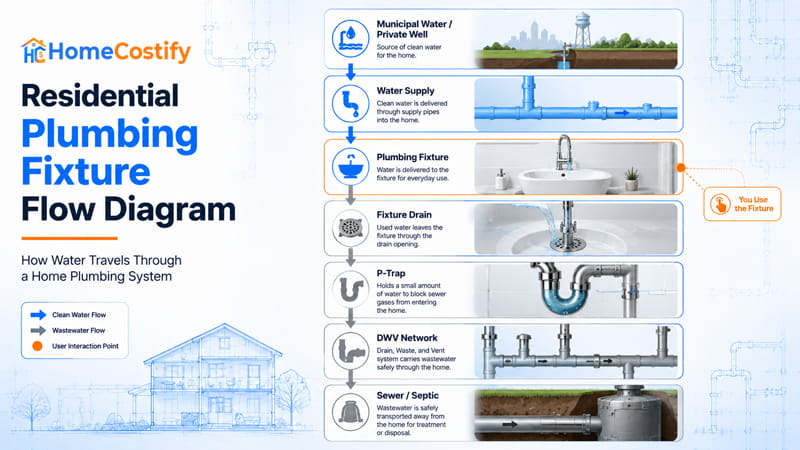
Viewing that layout as a single flow gives each fixture a clear position within the larger installation.
Municipal Water / Private Well
             │
             ▼
       Water Supply
             │
             ▼
     Plumbing Fixture
             │
             ▼
       Fixture Drain
             │
             ▼
          P-Trap
             │
             ▼
       DWV Network
             │
             ▼
       Sewer / Septic
The diagram begins at the municipal supply or a private well, where incoming water enters the house. From that source, the supply line carries water to residential plumbing fixtures used during normal daily activities.
Fixture drains collect used water and direct it toward the P-trap, where a standing water seal separates occupied rooms from sewer gases. Flow then continues into the DWV network before reaching a municipal sewer or a private septic system.
Viewed as a complete route, the fixture marks the transition between incoming supply and outgoing drainage without functioning as either system itself.
Conclusion
Daily household activities take place at fixtures, although much of the plumbing stays out of sight. Pipes, valves, drains, and supporting equipment work alongside those fixtures as parts of a single residential plumbing installation.
Seeing the house as one plumbing layout places each fixture in its proper location. A kitchen sink, toilet, shower, or faucet no longer stands alone because every fixture operates as part of that larger installation.
FAQs About Plumbing Fixtures
What are the most common plumbing fixtures?
Kitchen sinks, bathroom sinks, faucets, toilets, showers, and bathtubs represent the most common residential plumbing fixtures. Utility sinks and laundry tubs also appear in many homes.
What is an example of a plumbing fixture?
A kitchen sink is a common plumbing fixture because it supports washing, food preparation, and cleaning through direct household use.
What is the difference between plumbing fixtures and fittings?
Fixtures are user-operated devices such as sinks and toilets. Fittings refer to supporting parts, including elbows, tees, couplings, and similar connectors used within the plumbing installation.
Is a toilet a fixture?
Yes. A toilet is a plumbing fixture because it serves as the user-operated point for sanitary waste disposal within a residential plumbing installation.
Is a lavatory a fixture?
Yes. A lavatory is a plumbing fixture commonly installed in bathrooms for handwashing, personal care, and other routine hygiene activities.