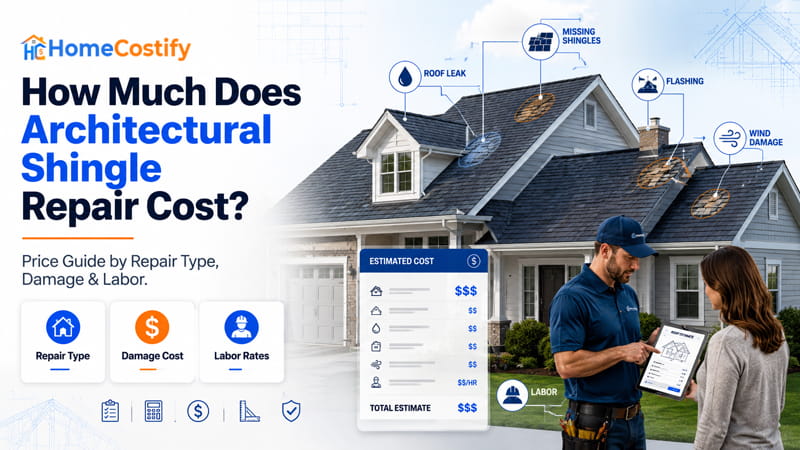
A few missing shingles after a windstorm or a water stain spreading across a ceiling can leave a roof looking far worse than it actually is. Architectural shingle repair cost is tied to the scope of the work, not simply to the number of damaged shingles visible from the ground.
A localized repair can restore the affected area without turning the project into a full roof replacement, though the damaged section still needs a careful inspection before any estimate is prepared.
Small repairs and larger repair projects can begin with similar signs, yet the final estimate reflects what roofing crews find once the affected section has been evaluated.
This guide stays focused on repair costs, showing how repair scope, inspection findings, and field conditions shape the estimate.
Average Architectural Shingle Repair Cost

National pricing gives a useful benchmark when reviewing roofing quotations. Architectural shingle repair cost across the United States commonly ranges from $150 to $2,000, placing most residential repairs somewhere between those limits.
Roofing companies build quotations from the work identified at the jobsite, not from the size of the house. Matching surface damage can still produce very different numbers once the work area has been measured.
| Repair Type | Estimated Cost |
|---|---|
| Minor Repair | $150–$400 |
| Standard Repair | $400–$900 |
| Major Repair | $900–$1,750 |
| Extensive Repair | Up to $5,800 |
| Labor | $45–$100 per hour |
| Emergency Service | Additional $100–$300 |
National Average Repair Costs
Published pricing surveys place a typical roof repair cost for architectural shingles between $150 and $2,000, with about $750 representing a mid-range project.
Material quantity, roof layout, and working hours drive architectural shingle roof repair cost in different directions. A small service visit and a broad restoration rarely consume identical resources, so the cost of roof repair spans a wide range instead of settling on a single number.
Labor Costs and Minimum Service Charges
Service calls begin with expenses unrelated to shingle quantity. Vehicle dispatch, fuel, scheduling, equipment loading, and arrival at the property already consume part of the operating budget.
Mobilization, travel, site setup, and inspection form the minimum charge found on architectural shingle repairs. Crew wages represent only part of the invoice, with roofing labor cost covering preparation and on-site operations as well.
How Repair Area Affects Architectural Shingle Repair Costs

Roofing contractors base a repair estimate on the portion scheduled for work instead of the home’s total roof size. Architectural shingle repair cost reflects the scope of work scheduled for the visit. Travel, setup, and inspection require nearly the same preparation regardless of how much surface needs attention.
| Damaged Area | Typical Repair Cost | Typical Scope |
|---|---|---|
| Under 20 sq. ft. | $150–$450 | A few damaged shingles |
| 20–100 sq. ft. | $450–$1,000 | One localized roof section |
| Over 100 sq. ft. | $1,000–$2,500+ | Multiple repair areas |
Small Localized Repairs
Replacing only a handful of shingles still requires a scheduled visit. Localized roof damage covers little surface, yet equipment, travel, and site preparation remain part of the appointment from the moment the crew arrives.
Inspection takes place first, followed by unloading tools and preparing the work location. Material quantity represents only part of the quotation, so compact jobs still carry a minimum charge.
Medium Repair Areas
A larger working space gives the crew an opportunity to complete additional repairs without returning on another day. Extra shingles can be installed during the same visit, leaving equipment and materials in place.
Repeated travel and another setup are no longer necessary inside a single work zone. Architectural shingle roof repair cost rises with added materials and production hours, although one roof estimate still covers the visit as a whole.
Large Repair Areas
Work extending into multiple locations no longer fits the pace of a short service visit. Crews spend more time moving equipment, repositioning materials, and coordinating tasks between separate sections of the roof.
Architectural shingle repairs covering multiple sections require additional shingle bundles, larger crews, repeated material deliveries, and longer production schedules. Crew hours continue to accumulate as work spreads from one repair location to another, leaving larger projects with substantially higher quotations than compact service visits.
Architectural Shingle Repair Cost by Damage Type
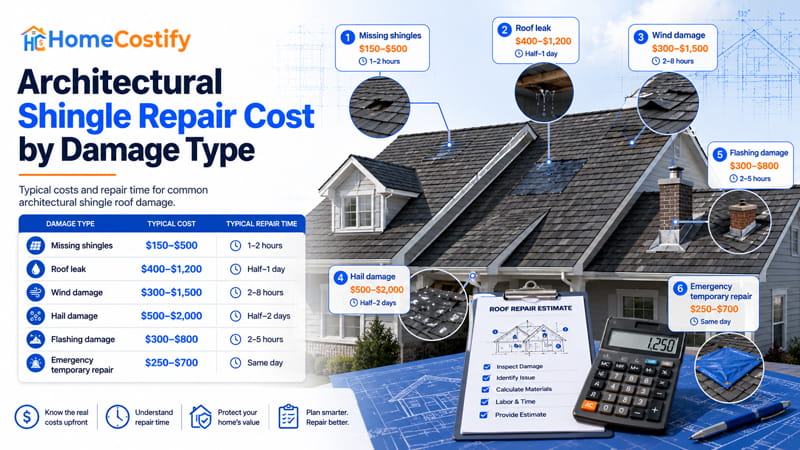
A roof with only a few missing shingles can cost far less to repair than another showing little change from the ground. Architectural shingle repair cost usually follows the type of damage uncovered during the inspection, since water intrusion, hidden movement beneath surrounding shingles, or temporary weather protection can expand the work long before permanent repairs begin.
| Damage Type | Typical Cost | Typical Repair Time |
|---|---|---|
| Missing shingles | $150–$500 | 1–2 hours |
| Roof leak | $400–$1,200 | Half–1 day |
| Wind damage | $300–$1,500 | 2–8 hours |
| Hail damage | $500–$2,000 | Half–2 days |
| Flashing damage | $300–$800 | 2–5 hours |
| Emergency temporary repair | $250–$700 | Same day |
Missing Shingles
A handful of missing shingles usually falls into the lowest repair range, particularly when the surrounding roofing remains intact. Detached tabs scattered across a limited area rarely require extensive corrective work, although the affected location still receives a careful review before replacement begins.
Replacing visible pieces finishes only part of the job. Architectural shingle roof repair cost can rise after nearby seal strips, adjacent shingles, or hidden edge lifting reveal additional separation around the original opening. That surrounding review carries greater weight than the number of shingles lying on the ground, which is why missing shingles repair cost varies from one service call to another.
Repair scope expands once nearby shingles show weakened adhesion or partial lifting. What first appears to be a small opening can extend into a wider corrective job after materials around the opening no longer lock together as intended
Roof Leak Repairs
Damp insulation, dark roof decking, or attic moisture can develop well away from the visible stain, leaving the source hidden during the first inspection.
Finding that entry point consumes part of the repair. Architectural asphalt shingle repair frequently includes tracing the path of water beneath the shingles until the source is confirmed, which is why roof leak repair cost usually exceeds the price of replacing exposed roofing materials alone.
Water can travel along roof decking before reaching the attic or ceiling below. Drips inside the house may sit several feet from the original opening, leading roofing contractors to inspect a much larger portion of the roof around the stain.
Wind Damage Repairs
Lifted edges, missing tabs, and damage concentrated near roof edges or ridges frequently indicate that uplift forces acted across a wider section than the missing pieces suggest.
Research from the Insurance Institute for Business & Home Safety (IBHS) shows that wind can weaken seal strips before shingles separate completely. Architectural roof shingle repair frequently includes checking nearby seal strips and adjacent shingles for hidden lifting, leaving wind damage roof repair based on the full inspection area instead of the shingles already missing.
A roof can lose only a few shingles and still require a wider inspection. Wind pressure may weaken nearby adhesive bonds without leaving obvious surface damage, leading roofing contractors to extend the evaluation beyond the first visible opening before deciding how much corrective work belongs in the repair.
Hail Damage Repairs
Dark impact marks and scattered granule loss rarely follow a straight pattern across the shingles. A few visible strikes can sit beside other impact points that leave little surface change yet still damage the protective layer covering the shingles.
Granule loss exposes the asphalt layer to direct sunlight and weathering, raising architectural shingle repair cost beyond a simple surface correction. Roofing contractors evaluating hail damage roof repair expand the inspection until the full pattern of impact marks has been documented, not only the locations showing the deepest bruising.
Roofing crews examine the full storm path across the affected slopes, since isolated impact marks seldom represent the complete extent of the damage.
Flashing Damage Repairs
Water entering around a chimney, sidewall, or roof penetration frequently points toward damaged flashing instead of failed shingles. Metal pieces at those intersections direct water away from vulnerable joints, making careful access part of the repair process.
Removing surrounding shingles commonly becomes necessary before flashing can be repositioned or replaced. Architectural shingle repairs involving these waterproof junctions include dismantling and rebuilding the adjacent waterproof assembly, leaving flashing repair cost driven by the extra roofing roofing work required around the metal components rather than the flashing itself.
Flashing damage introduces another pricing variable beyond the damage pattern alone.
Emergency Roof Repairs
Storm damage can leave exposed underlayment or open roof decking within minutes. Emergency crews respond by securing the affected section with tarps or temporary waterproof coverings, limiting additional water entry until permanent roofing work can be scheduled.
Fast response forms a large share of architectural shingle repair cost during emergency calls. Priority dispatch, temporary weather protection, and rapid stabilization shape emergency roof repair pricing, even though the damaged shingles or flashing may remain untouched until a later visit.
Emergency stabilization marks the beginning of the repair process, not the final stage. Permanent repair costs cannot be calculated until temporary coverings are removed and the full extent of the damage is visible.
Architectural Shingle Repair Cost by Roof Component
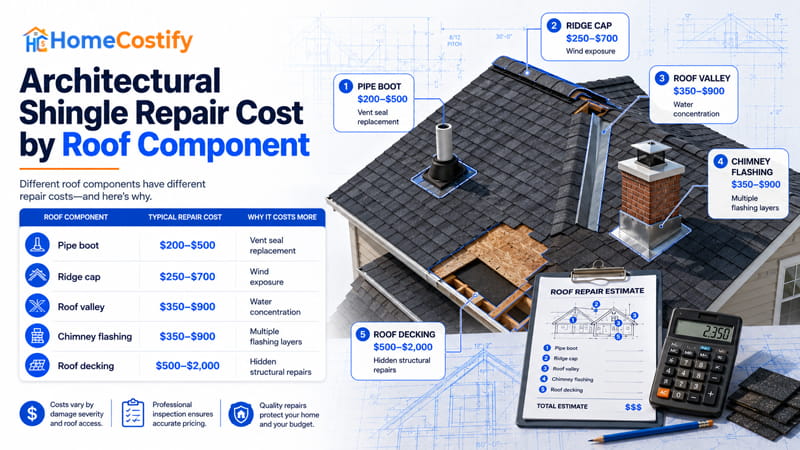
Architectural shingle repair cost can change once vent penetrations, ridge lines, valleys, flashing assemblies, or structural layers become part of the repair, since those roof components frequently require shingles to be lifted, removed, or reinstalled before permanent repairs can be completed.
| Roof Component | Typical Repair Cost | Why It Costs More |
|---|---|---|
| Pipe boot | $200–$500 | Vent seal replacement |
| Ridge cap | $250–$700 | Wind exposure |
| Roof valley | $350–$900 | Water concentration |
| Chimney flashing | $350–$900 | Multiple flashing layers |
| Roof decking | $500–$2,000 | Hidden structural repairs |
Pipe Boot Repairs
A pipe boot seals the opening surrounding a plumbing vent where it passes through the roof covering. The flexible rubber collar surrounds the pipe, leaving the repair confined to a single roof penetration instead of spreading across a larger roofing assembly.
Sun exposure gradually hardens the rubber until small cracks form around the pipe opening. Repair commonly involves lifting only a limited number of shingles, replacing the worn pipe boot, and restoring the seal before fastening the surrounding materials back into place.
Most projects finish without dismantling broad roof sections, leaving this component among the least complex repairs found on architectural shingle roofs.
Ridge Cap Repairs
A ridge cap runs along the highest point of the roof, covering the joint formed by opposing roof planes. Exposure at that position leaves the ridge under constant pressure from changing weather, and repairs frequently extend along the ridgeline instead of stopping at a single cap.
Matching alignment across the ridgeline takes longer than replacing an ordinary field shingle. Architectural roof shingle repair along the ridge commonly involves removing and reinstalling multiple ridge caps so the finished surface follows a continuous line without visible gaps or uneven spacing.
Repair length follows the ridgeline rather than a single damaged cap. Extending the work across that upper joint adds time even when only a short section receives new materials, leaving ridge repairs above the cost of replacing standard field shingles.
Roof Valley Repairs
A roof valley forms where two roof slopes meet, channeling runoff into a narrow path during every rainfall. Shingles from both sides overlap at that intersection, placing the waterproofing assembly beneath multiple roofing layers instead of a single surface.
Reaching the valley commonly requires lifting shingles from both roof planes before corrective work can begin. Architectural shingle repair cost rises as dismantling and rebuilding extend across both sides of the channel, leaving roof valley projects driven by the amount of roofing removed instead of the exposed metal alone.
Much of the final charge comes from separating overlapping shingles, restoring the water channel, and reinstalling the roofing layers in the correct sequence across the intersection.
Chimney Flashing Repairs
A chimney flashing assembly sits at the junction between masonry and the roof covering, forming a waterproof transition between two building materials. Step flashing and counter flashing overlap at that junction, leaving multiple waterproof layers stacked beneath the surrounding shingles.
The International Code Council requires flashing installations to follow the manufacturer’s installation instructions where applicable. During architectural shingle repairs, shingles around the chimney are commonly lifted or removed so the flashing assembly can be rebuilt in the correct order, preserving continuous waterproof protection instead of patching only the exposed metal.
Labor at the chimney extends beyond replacing flashing pieces. Step flashing, counter flashing, masonry joints, and surrounding shingles all return to their original sequence during reassembly. Time spent rebuilding that waterproof transition accounts for a large share of the total repair bill.
Roof Decking Repairs
Roof decking repair takes place beneath the shingles, hidden from view until the roof covering has been removed. Plywood or OSB panels support the roofing materials above, leaving their condition unknown during a ground-level inspection.
Lifting shingles exposes the structural surface for the first time, allowing architectural shingle roof repair cost to reflect the decking that actually requires replacement instead of the area first visible from outside. Soft wood, moisture damage, or deteriorated panels can expand the amount of corrective work once the sheathing is uncovered.
Decking sits below every finished roofing layer, making its condition impossible to confirm from the surface alone. Repair planning moves to the next stage after that structural layer becomes visible, where roof access, material matching, and site conditions begin influencing the final quotation.
Factors That Affect Architectural Shingle Repair Costs

Roof geometry, access conditions, material availability, and regional pricing all shape architectural shingle repair cost. Matching repair scopes do not guarantee identical quotations.
| Cost Factor | Typical Cost Impact |
|---|---|
| Steep roof pitch | +10–20% |
| Limited roof access | +5–15% |
| Difficult material matching | +$50–$250 |
| Multi-story home | Higher labor time |
| Seasonal demand | Varies by region |
Roof Pitch and Accessibility
Steeper roofs demand slower movement, careful footing, and additional safety precautions. Limited roof accessibility can restrict where ladders, staging, and equipment are positioned, turning a straightforward service call into a longer operation across the roof.
Safety equipment, staging, and controlled movement occupy extra crew time during architectural roof shingle repair. A steep roof pitch can require repeated repositioning across the roof, leaving progress slower than work performed on low-slope residential roofs.
Material quantity may stay unchanged. Extra time comes from working conditions and access limitations instead of additional roofing products.
Material Matching
Fresh replacement shingles rarely match an older roof straight from the bundle. Years of sunlight, weather exposure, and discontinued product lines leave neighboring shingles with different color tones and surface texture.
Locating matching shingles sometimes requires searching beyond local inventory, particularly when older architectural asphalt shingles are no longer stocked.
Differences in architectural shingles colors, architectural shingle dimensions, and architectural shingle materials still shape architectural shingle repairs, including jobs limited to a small section of the roof.
A sound repair can still remain visually noticeable. Color variation and profile differences may draw attention long after the roofing work has been completed.
Local Labor Market
Crew availability, regional demand, and seasonal scheduling influence pricing across different markets. A local roofing contractor serving a busy area may quote different amounts from another company performing comparable roofing work elsewhere.
Regional demand and crew availability can raise or lower architectural shingle repair cost from one market to another. Local competition, scheduling pressure, and roofing labor cost all contribute to pricing differences.Additional findings beneath the shingles can introduce another layer of cost once the roof covering has been opened.
Hidden Costs Homeowners Often Overlook
A roof inspection cannot verify everything hidden below damaged shingles. Architectural shingle repair cost occasionally changes after the roof covering is opened, exposing moisture, deteriorated roofing layers, or structural conditions that remained concealed during the first site visit.
| Hidden Cost | Typical Cost |
|---|---|
| Underlayment replacement | $300–$1,000 |
| Roof decking repair | $500–$2,000 |
| Structural framing repairs | $800–$3,000 |
| Mold remediation | Varies |
Hidden Structural Damage
Visible damage tells only part of the story. Moisture inside the roofing assembly, weakened wood, or deteriorated supporting layers may stay concealed behind intact shingles, leaving hidden roof damage impossible to verify during an exterior inspection.
Removing the damaged covering gives crews their first view of those concealed conditions. Expanding architectural shingle repairs under those circumstances does not automatically indicate unnecessary upselling. The revised invoice should reflect conditions documented after the roofing system has been opened, not assumptions made from ground level.
Additional Materials
Opening the repair location may expose products absent from the original quotation. Underlayment replacement, fresh fasteners, sealing products, or related accessories sometimes become necessary before the roofing assembly can be closed again.
Those materials rarely dominate the invoice. Their purpose is restoring the roofing system to a complete weather-resistant condition after damaged layers have been removed, even though they were never visible during the initial inspection.
Change Orders During Repairs
A written change order records new findings uncovered during the project and updates the quotation before supplemental work begins. Clear documentation gives homeowners an opportunity to review added tasks before approving additional charges.
Homeowners should request photographs, written descriptions, and revised pricing before accepting changes to architectural shingle roof repair cost. A condition such as roof decking repair belongs in that documentation only when visible evidence supports the expanded scope of work.
Does Homeowners Insurance Cover Architectural Shingle Repairs?
Homeowners insurance evaluates the cause of roof damage before considering the repair bill. Architectural shingle repair cost alone rarely decides coverage, making the source of the loss an important factor when deciding whether contacting the insurer is worthwhile.
| Cause of Damage | Typically Covered? | Notes |
|---|---|---|
| Wind damage | ✅ Usually | Subject to deductible |
| Hail damage | ✅ Usually | Inspection often required |
| Fallen tree branch | ✅ Usually | Covered event required |
| Fire damage | ✅ Usually | Policy dependent |
| Normal aging | ❌ No | Maintenance issue |
| Wear and tear | ❌ No | Expected deterioration |
| Poor maintenance | ❌ No | Preventable condition |
Damage Usually Covered
Homeowners policies generally focus on sudden, accidental events classified as covered perils. A storm, fallen tree limb, or fire fits that category far more readily than gradual deterioration developing over time.
Wind, hail, fallen branches, and fire frequently qualify for a roof insurance claim when policy terms recognize the event as a covered peril. Approval for architectural roof shingle repair still rests on policy language and the findings recorded during the insurer’s inspection.
Coverage decisions center on the origin of the loss. A sudden event fits insurance protection far differently than deterioration progressing over months or years.
Damage Insurance Usually Won’t Cover
Gradual deterioration falls outside the purpose of most homeowners policies. Wear and tear, aging materials, and neglected upkeep generally remain part of routine ownership rather than an insured loss.
Deferred roof maintenance, installation deficiencies, and expected aging commonly leave architectural shingle repairs outside policy coverage. Those conditions develop gradually instead of resulting from a covered event recognized by the insurance contract.
Routine upkeep remains the homeowner’s responsibility. Insurance protection generally begins with accidental loss rather than predictable deterioration.
When Filing a Claim Makes Financial Sense
A repair estimate has greater value after it is compared with the policy’s insurance deductible. Small projects sometimes produce little financial benefit once the deductible has been applied, making a roof estimate an important reference before opening a claim.
Comparing the deductible with architectural shingle repair cost gives homeowners a clearer basis for deciding whether filing a claim is worthwhile. Projects with modest repair bills may leave little reimbursement after deductible obligations have been satisfied.
Photographs, inspection records, and written findings strengthen the review process. Clear documentation gives the insurance adjuster a factual basis for evaluating the reported loss before reaching a coverage decision.
How Roofing Contractors Estimate Architectural Shingle Repair Costs
Architectural shingle repair cost is built from field observations, identified repair requirements, material needs, and project conditions recorded during the site visit before pricing is prepared.
| Estimate Item | Why Contractors Check It |
|---|---|
| Roof inspection | Confirms visible and hidden damage |
| Scope of repair | Defines labor and materials |
| Material availability | Determines sourcing time |
| Roof access | Affects setup requirements |
| Minimum service charge | Covers inspection, travel, and mobilization |
Roof Inspection
A roof inspection establishes the foundation for the proposal. Surface conditions, moisture indicators, and roofing irregularities receive a field review so the estimator understands which locations require attention and which sections remain unaffected.
Inspection findings guide architectural roof shingle repair planning far better than counting missing shingles alone. Field notes identify the operations required to complete the project, allowing material quantities and crew requirements to match the actual job rather than first impressions.
Scope of Work
A proposal reflects the operations identified during the site visit, not simply the damaged area visible from the ground. Material quantities, expected crew tasks, and the sequence of roofing operations all become part of the repair estimate.
Two proposals can differ after estimators identify different project requirements. One quotation may include lifting and reinstalling surrounding shingles, installing architectural shingles where necessary, or restoring adjacent sections needed to complete architectural shingle repairs correctly, even though both companies inspected the same property.
Minimum Service Charges
Dispatching a crew involves operating expenses long before replacement materials reach the property. Travel, project scheduling, equipment preparation, and crew mobilization all contribute to the minimum service charge applied by a roofing contractor.
How to Reduce Architectural Shingle Repair Costs Without Sacrificing Quality
Lower repair bills come from informed decisions, not simply from accepting the lowest proposal. Architectural shingle repair cost stays easier to control when roof problems receive prompt attention and written proposals receive careful review before any agreement is signed.
Prevent Damage From Getting Worse
A limited problem carries fewer consequences than water entering through the roof for weeks or months. Moisture moving past the damaged opening can affect underlying layers, turning a modest roof repair cost into a project requiring substantially greater effort.
Early action limits how far moisture can travel through the roofing system. Delaying architectural shingle repairs gives water additional opportunities to spread beyond the original opening, increasing the amount of work required even though the first signs appeared relatively minor.
Compare Roofing Estimates Carefully
Written proposals deserve comparison long before prices become the deciding factor. A complete roof estimate identifies the planned tasks, included materials, cleanup responsibilities, and any services forming part of the quoted project.
Price differences do not automatically indicate better or poorer value. Comparing architectural shingle repair cost alongside the work included in a free roofing estimate gives homeowners a clearer picture of what each proposal actually delivers.
- Compare the scope of work before comparing prices.
- Confirm whether cleanup and debris disposal are included.
- Ask whether follow-up inspections are included.
- Verify whether matching shingles are part of the quoted work.
- Request written clarification for any allowance covering concealed conditions.
When to Call a Roofing Professional Immediately
Ignoring serious roofing problems can turn a localized issue into a much larger project. Architectural shingle repair cost stays easier to manage when warning signs receive prompt professional attention, reducing opportunities for water intrusion and limiting damage to a smaller portion of the roofing system.
Signs the Damage Can’t Wait
Some conditions leave little room for delay. Active leaks, multiple missing shingles following storm damage, or obvious changes in the roof structure signal that the situation has moved beyond routine observation and deserves evaluation by a roofing contractor.
Rapid action limits how far moisture can travel through the roofing system and reduces the chance that architectural shingle repairs extend into a much larger project. Even the best architectural shingles cannot prevent damage from severe storms, fallen trees, or structural movement, making an emergency roof repair assessment appropriate whenever those warning signs are present.
Call a roofing professional immediately if:
- Water is actively entering the attic or living space.
- Multiple architectural shingles are missing after a storm.
- Roof decking feels soft or begins to sag.
- Flashing has separated around a chimney or exterior wall.
- Daylight is visible through the roof structure.
Repair vs. Replacement: Which Option Makes More Financial Sense?
Limited roof damage does not automatically justify replacing the roofing system. Architectural shingle repair cost frequently delivers stronger financial value when the affected area stays confined, yet repeated repair bills across different sections can gradually outweigh the benefit of preserving the existing roof.
| Roof Condition | Better Choice | Why |
|---|---|---|
| Localized storm damage | Repair | Damage is limited |
| One isolated leak | Repair | Underlying roof remains sound |
| Multiple recurring leaks | Depends | Repeated repairs add up |
| Extensive aging | Replacement | Remaining service life is limited |
| Widespread structural damage | Replacement | Repairs may not address the root problem |
When Repairs Make Sense
Repair remains a practical financial choice when problems stay confined to a limited portion of the roof. Localized storm damage, a single isolated issue, or a newer roofing system in otherwise sound condition rarely justifies replacing sections that continue performing as intended.
Under those conditions, architectural shingle repairs preserve a functional roofing system without replacing materials that still deliver reliable protection. Financial value comes from correcting the affected location while leaving healthy portions untouched.
Recurring problems across different sections deserve a broader financial review. Repeated invoices deserve consideration alongside future repair needs instead of evaluating each visit as an isolated expense.
When Replacement Becomes More Practical
Replacement enters the conversation after recurring repairs spread across the roof or deterioration affects large portions of the roofing system. At that point, each new invoice represents another investment in materials approaching the end of their useful service.
A practical decision compares future architectural shingle repair cost with long-term ownership value, not simply today’s invoice.
That evaluation may include architectural shingles lifespan, expected architectural shingles cost, and projected architectural shingle replacement cost as reference points for future spending rather than immediate purchase decisions.
Neither repair nor replacement fits every property. The stronger financial choice matches the roof’s current condition and the total ownership expense expected over the coming years.
Conclusion
Architectural shingle repair cost reflects far more than the number of damaged shingles. Repair pricing changes with the type of damage, the roof component involved, and the amount of work required to restore the roofing system to proper condition.
A professional inspection gives homeowners the strongest foundation for making a repair decision. Comparing written proposals, reviewing the planned work, and addressing problems promptly can limit future expenses and preserve sections of the roof that continue performing well.
Frequently Asked Questions
Can architectural shingles be repaired?
Yes. Localized problems such as missing shingles, damaged flashing, or minor leaks can often be repaired without replacing the entire roof if the underlying structure remains sound.
Can you roof over architectural shingles?
Sometimes. The decision depends on the condition of the existing roof, local building code requirements, and the manufacturer’s installation recommendations for the roofing system.
Will architectural shingles flatten out?
Minor unevenness after installation can settle with time as the shingles adjust to weather conditions. Persistent buckling or distortion deserves a professional roof inspection.
How to spot damage on architectural shingles?
Check for missing or cracked shingles, granule loss, lifted flashing, exposed fasteners, and water stains inside the attic or ceiling. Those warning signs justify a closer professional evaluation.
How to maintain architectural shingles?
Inspect the roof regularly, remove leaves and debris, keep gutters flowing freely, and address minor defects promptly to reduce the chance of larger repairs later.