Electricity flows through household circuits during normal use, with protective limits built into the system. Circuit breakers serve as automatic protective devices, opening a circuit if electrical conditions move outside a safe operating range. Their basic job is simple: interrupt current when continued flow could place the circuit at risk.
A wall switch responds to a person’s decision to turn power on or off. A breaker can open the circuit without manual operation, creating an interruption during ordinary household use. Its protective function comes into play when current needs to stop without a person controlling the switch.
A sudden loss of power can carry useful information. The protective device has responded to an electrical condition by opening the path for current. A trip alone cannot identify the source or prove device failure. The interruption points to a condition within the circuit that warrants further attention.
What Is a Circuit Breaker?
A circuit breaker is an automatically operated protective switch within residential electrical distribution. The term circuit breaker electrical places the device within the supply path serving the home. Under unsafe electrical conditions, it interrupts current.
What Does a Circuit Breaker Do?
Normal operation lets current pass toward its loads. Circuit breakers interrupt that flow at a protective control point under abnormal electrical conditions. A manual switch changes power through deliberate operation.
What Does a Circuit Breaker Protect?
Protection centers on wiring and circuit conductors. The U.S. Consumer Product Safety Commission states that properly rated breakers and fuses protect branch circuits by disconnecting electrical current above a safe level.
Outlets, lighting, and appliances draw electricity through these paths. Electrical circuit breakers address protection at the circuit level, with no guarantee against every electrical hazard affecting a connected appliance.
Where Does the Breaker Fit in a Home’s Electrical Path?
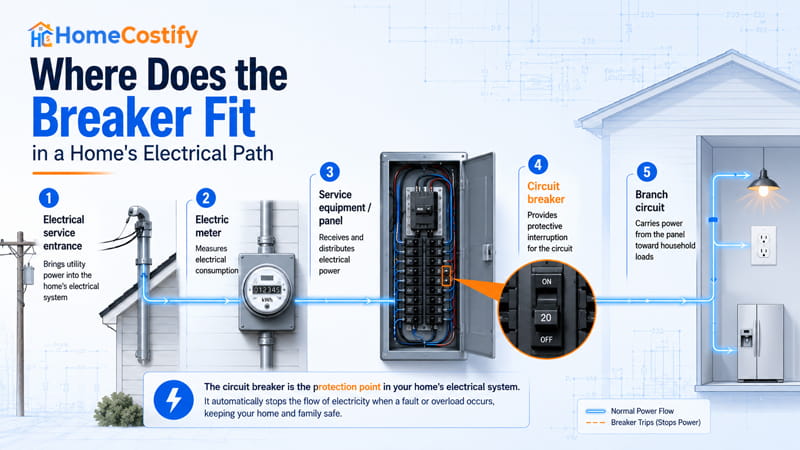
| Residential Electrical Path | Primary Role |
|---|---|
| Electrical service entrance | Brings utility power into the home’s electrical system |
| Electric meter | Measures electrical consumption |
| Service equipment / panel | Receives and distributes electrical power |
| Circuit breaker | Provides protective interruption for the circuit |
| Branch circuit | Carries power from the panel toward household loads |
Utility power enters through the electrical service entrance and passes the electric meter. Service equipment distributes that supply into the home electric system, with electrical system components occupying distinct points along the path. From the panel, a branch circuit carries electricity toward household loads.
How Does a Circuit Breaker Work?
With the contacts closed, current passes through the breaker during normal operation. Circuit breakers enter an interruption state after an electrical condition activates the trip mechanism.
Contact separation then stops current in the affected circuit. The operating process moves from a closed conductive route to an open circuit.
Electricity Flows Through the Breaker
An energized circuit presents a continuous conductive route across closed contacts. Current passes across those contact surfaces, and electrical circuit breakers carry the load along the circuit.
The trip mechanism stays engaged during normal operation. Electricity continues toward downstream loads as long as operating conditions stay within the intended range.
The Breaker Detects Abnormal Current
A change in current brings the response mechanism into action. Excessive current produces a thermal response, whereas a rapid rise produces a magnetic response.
Conventional thermal-magnetic operation uses these two response pathways without treating them as separate breaker types. The circuit breaker electrical assembly responds according to the current condition.
Thermal Response to Sustained Overcurrent
Sustained overcurrent produces heat in a bimetal strip. According to the U.S. Consumer Product Safety Commission, a conventional thermal-magnetic breaker uses a bimetal strip for sustained overcurrent.
As the strip heats and bends, it eventually releases the contacts. That movement releases the trip mechanism and opens the circuit. Response timing varies with breaker characteristics and current conditions.
Magnetic Response to a Sudden High-Current Event
A rapid rise in current produces a strong electromagnetic effect inside the breaker. Magnetic force releases the trip mechanism rapidly, sending the contacts toward an open position.
Electric circuit breakers respond much faster to a high-current event than to sustained thermal heating. No fixed response time applies across breaker designs.
The Trip Mechanism Opens the Contacts
Release of the latch frees the contact assembly. The contacts separate, breaking the conductive route and stopping current in the protected circuit.
Contact opening produces an electrical arc, so the breaker manages the arc as the contacts move apart. The physical separation marks the point where the conductive route is interrupted.
The Circuit Remains Off Until Reset
Open contacts leave the affected circuit without electrical supply. The breaker stays in its tripped state until an appropriate reset action returns it to its operating position. Detailed reset steps belong to the reset section. At this stage, the operating process ends with the affected circuit still without power.
Why Does a Circuit Breaker Trip?
A trip signals an electrical condition outside normal operation. Circuit breakers interrupt current for different conditions, including excessive demand, sudden faults, ground-related current, and arcing. A single interruption is insufficient to establish breaker failure.
| Trip Condition | What Is Happening | Protection Context |
|---|---|---|
| Overload | Sustained excessive current | Thermal response |
| Short circuit | Very high current through an unintended low-resistance path | Magnetic response |
| Ground fault | Current takes an unintended path toward ground | Ground-fault protection |
| Arc fault | Electrical arcing creates a hazardous condition | Arc-fault protection |
Overload
Several appliances operating on a branch circuit push demand above the circuit’s intended range for an extended period. The combined load pushes current upward and leaves it elevated. Electrical circuit breakers respond as current moves beyond the circuit’s intended operating range.
An electrical outlet serving several active appliances can form part of such a load pattern. Multiple appliances alone do not confirm an overload.
Short Circuit
A short circuit forms an unintended low-resistance path. Current rises sharply along that fault route, producing a rapid electrical event. The circuit breaker electrical response follows a different pattern: a fault path produces a sudden rise in current instead of gradual load accumulation.
A wiring fault is a possible source, yet the trip pattern does not identify where the fault began.
Ground Fault
Normal current follows its intended route through the circuit. A ground fault sends part of that current toward ground along an unintended route. GFCI protection addresses this condition because unwanted current paths raise shock risk.
The grounding system forms part of the home’s electrical safety framework, but it does not mean every trip comes from a grounding problem.
Arc Fault
Electrical arcing produces a hazardous condition with behavior distinct from ordinary overcurrent. AFCI protection was developed to detect characteristics associated with arcing faults and interrupt the circuit under those conditions.
According to the U.S. Consumer Product Safety Commission, AFCI technology serves this detection and interruption function. Electric circuit breakers with AFCI protection address arcing characteristics that conventional overcurrent protection does not cover.
Faulty Appliance, Wiring, or Breaker
A repeated trip shifts attention toward the possible source. A connected appliance, damaged wiring, or a persistent circuit condition could be involved. A light switch can form part of the affected electrical load, yet its presence does not establish the source.
A faulty breaker remains another possibility after other sources receive consideration. A single trip cannot identify the source with certainty.
Diagnostic Interpretation
- Multiple loads operating: Possible overload from elevated demand.
- Trip as a device starts: Possible fault or short circuit associated with that device.
- GFCI or AFCI trip: Attention belongs on the specific protection condition.
- Repeated trips: Treat the pattern as a problem signal, not a reason for repeated resets.
What Are the Common Types of Circuit Breakers?

Pole arrangement describes how a device serves a circuit, whereas protection function indicates the hazard addressed. Different labels describe separate attributes of a breaker, so the categories are not competing choices.
| Breaker Type | Classification Basis | Primary Role | Typical Residential Context |
|---|---|---|---|
| Standard | Protection function | Conventional overcurrent protection | General residential circuits |
| Single-pole | Pole arrangement | Controls one pole | Common 120V household circuits |
| Double-pole | Pole arrangement | Controls two poles together | Common 240V residential loads |
| AFCI | Protection function | Arc-fault protection | Circuits requiring arc-fault protection |
| GFCI | Protection function | Ground-fault protection | Circuits requiring ground-fault protection |
| Dual-function | Protection function | AFCI + GFCI protection | Circuits requiring both protections |
Standard and Single-Pole Breakers
Standard Protection
Conventional overcurrent protection forms the baseline for general residential circuits. The term “standard” describes the protective function, not the number of poles. Electrical circuit breakers in this category address excessive current without assigning a particular pole configuration.
Single-Pole Configuration
Pole count describes physical configuration. A single-pole unit controls a single pole and commonly serves 120V circuits in U.S. homes. Its classification concerns arrangement, not specialized protection capability.
Double-Pole Breakers
Two-pole configuration brings coordinated control across two poles. A 240V residential load commonly uses this arrangement, with examples including electric ranges, clothes dryers, water heaters, and HVAC equipment. Electric circuit breakers with this configuration serve larger household loads without turning the discussion into a wiring guide.
AFCI Protection
Arc-fault protection adds a specialized safety function to conventional overcurrent protection. AFCI-equipped units respond to electrical arcing characteristics that meet their protection criteria. The category describes protection capability, not pole configuration.
GFCI Protection
Current imbalance forms the key concept behind GFCI protection. A GFCI monitors for an imbalance associated with an unintended current path and interrupts the supply once its threshold is met.
Circuit breaker electrical terminology can refer to equipment carrying ground-fault protection, with reduced electric-shock risk as its central residential purpose.
Dual-Function Breakers
A dual-function device combines AFCI and GFCI protection within a single unit. Such equipment fits residential applications requiring both protection functions without assigning separate devices to each capability.
Where MCB and MCCB Fit
MCB means miniature circuit breaker, a term common in broader international electrical terminology. U.S. homeowners more commonly encounter descriptions based on panel compatibility, amperage, pole count, and protection function.
MCCB means molded case circuit breaker. The term generally points toward higher-current commercial, industrial, or larger distribution applications, placing it outside ordinary residential branch-circuit terminology.
Protection Snapshot
- Standard protection → conventional overcurrent conditions.
- AFCI protection → hazardous arcing characteristics.
- GFCI protection → ground-fault and current-imbalance conditions.
- Dual-function protection → AFCI and GFCI functions.
How to Read a Residential Circuit Breaker
Markings on the device show its rating, pole count, handle state, and served circuit. Circuit breakers carry identification details that a homeowner can read without entering the panel.
Amp Rating and Pole Count
The amperage printed on the face indicates rated current. Pole count shows the controlled configuration, giving electrical circuit breakers a basic arrangement reference. Single-pole and double-pole labels need simple recognition here.
A marked rating should match the intended circuit design. A higher number does not make the setup safer. Frequent trips call for attention to the existing configuration.
ON, OFF, and TRIPPED Positions
Handle position gives a clue about operating state. ON indicates energized operation, OFF indicates an intentionally opened circuit, and a tripped handle signals protective interruption.
Sudden power loss makes state recognition useful. An intentionally switched-off circuit has a different context from a tripped handle. Handle position alone does not reveal the cause.
Panel Markings and Internal Connections
Panel directories link a breaker location with a room, appliance, or served area. Inside an electrical service panel, labels give homeowners a reference for the marked device.
A bus bar forms part of the distribution structure, and a service disconnect serves a separate function. Panel compatibility involves requirements beyond the amperage printed on the device.
How to Reset a Tripped Circuit Breaker?
A sudden loss of power warrants a safety check prior to reset action. The device should only be operated from a safe position without obvious signs of electrical danger. Restored power does not confirm that the underlying issue has disappeared.
Before Resetting
Think about what was running when power stopped. Recent appliance use, unusual equipment behavior, or a localized loss gives useful context. Electrical circuit breakers do not justify panel access or electrical testing.
Relevant equipment should be switched off or unplugged under safe conditions. Damaged, hot, smoking, or scorched equipment should not be handled. Load reduction takes priority over restoring power.
Resetting the Breaker
A tripped handle sometimes sits between its normal positions. Move the handle fully to OFF, then return it to ON according to product design. The circuit breaker electrical state then warrants observation from a safe position.
Power returning confirms restoration of operation. It does not establish that the original issue has been corrected. Normal household use provides the setting for observation, without deliberate overloading or repeated testing.
If the Breaker Trips Again
A second interruption needs attention. Possible sources include equipment, wiring, circuit, or device problems. The trip pattern does not identify the source.
Stop reset attempts if the handle will not stay ON. Smoke, scorching, burning odor, unusual heat, or visible damage marks a stopping point. Qualified electrical evaluation is appropriate.
- Trips again immediately after reset.
- Handle will not stay ON.
- Smoke, scorching, burning odor, or unusual heat is present.
- Damage appears around the device or panel.
Circuit Breaker Diagram and Electrical Symbol
Electrical drawings use diagrams and symbols to represent equipment and relationships. A diagram maps system connections, whereas a symbol gives a device a graphical form. Circuit breakers therefore receive different representations across drawing standards and configurations.
Simple Circuit Breaker Diagram

The main power path runs from the Utility Grid through CT and the central device toward DG and Load. Three-phase lines carry the power flow across the drawing.
CT represents current measurement, with PT units positioned around the central device for voltage measurement. Dashed lines link these measurement elements with the DSP block.
The DSP block is labeled Relay + Communication + Monitoring / Diagnostics. Its outputs lead to Measurement and Communication.
Taken as a whole, the drawing links power flow with protection/interruption, measurement, monitoring, communication, DG, and Load.
Circuit Breaker Symbol
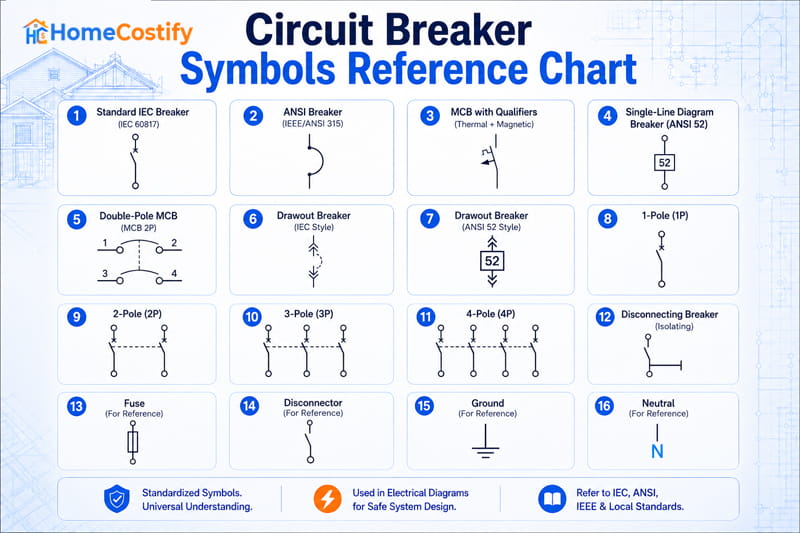
The reference chart groups several graphical conventions. Standard IEC Breaker follows IEC 60617, ANSI Breaker follows IEEE/ANSI 315, and the MCB entry carries thermal and magnetic qualifiers.
Pole representations range from 1P to 4P. Additional switching elements show the higher pole counts.
Double-Pole MCB, IEC drawout, ANSI 52 drawout, and Disconnecting Breaker use distinct graphical forms. Their markings convey configuration or operating arrangement.
Fuse, Disconnector, Ground, and Neutral sit in the reference group. These four marks support drawing interpretation without representing additional breaker variants.
Circuit Breaker Safety and Basic Maintenance
A clear space around the electrical panel gives homeowners room to identify equipment safely. Circuit breakers need no internal access for basic household monitoring. Useful labels, visible warning signs, and sensible limits define routine care.
Keep the Panel Accessible and Clearly Labeled
Boxes, stored items, or furniture should not block the area surrounding the panel. Clear directories also link marked positions with rooms, equipment, or household areas, reducing confusion during an electrical event. Electrical circuit breakers become easier to identify when panel labels remain legible and accurate.
Labels deserve occasional attention too. A faded room name or outdated equipment reference can send someone toward the wrong switch during an urgent situation. Practical safety starts with clear identification, not internal inspection.
Watch for Signs of Electrical Problems
Unusual odor, buzzing, crackling, discoloration, scorching, or unexpected heat deserves attention. Damaged equipment near a household connection adds another warning sign. None of these observations identifies a specific defect by itself.
Patterns carry useful context. Repeated interruptions, recurring odor, or repeated unusual sounds around the same area warrant further evaluation, even if household power returns afterward.
Know Where DIY Ends
CPSC consumer home-wiring guidance separates general safety information from repairs involving specific electrical defects. Identifying and repairing particular electrical problems belongs to qualified professionals. Homeowners should not remove panel covers, alter ratings, bypass protective devices, or work around energized internal components.
Visual checks have a clear boundary. Keeping the area clear, preserving accurate labels, and noticing warning signs are reasonable household tasks; diagnosis or repair involving internal electrical components calls for qualified evaluation.
When Should a Circuit Breaker Be Replaced?
A tripping device does not automatically need replacement. Circuit breakers perform protective functions under legitimate electrical problems, so device failure becomes a separate question. Physical damage, abnormal operation, or persistent malfunction deserve closer assessment.
Signs of a Faulty Breaker
Scorching, damaged housing, unusual physical behavior, or failure to stay engaged can point toward a device problem. Persistent irregular operation adds another concern. A single symptom still lacks enough evidence for a definite diagnosis.
External electrical problems deserve consideration too. A device performing its protective function is not necessarily defective. Suspicion rises after other sources have been addressed or ruled out and abnormal behavior continues.
Why Replacement Is Not Just Matching Amperage
A replacement choice involves panel requirements, pole arrangement, breaker type, manufacturer compatibility, listing information, and the electrical characteristics of the installation. The amperage marking is only part of that picture.
Qualified electrical work is appropriate for diagnosis and replacement. The selected device needs compatibility with the panel and system, not simply a matching number on its face.
Circuit Breaker vs. Fuse
Both devices interrupt electrical current under excessive-current conditions. Their interruption methods differ, and the difference becomes clear after protective operation.
Resettable vs. Sacrificial Operation
A breaker is generally resettable after the underlying situation has been addressed. A fuse uses a fusible element that opens the path and sacrifices that element during operation.
The homeowner sees a practical difference. A breaker returns to service through its operating control, whereas an operated fuse requires replacement before service resumes.
Practical Homeowner Distinction
The visible distinction comes after operation. A resettable device offers a path back to service through its control, whereas a fuse needs a new fusible element.
Conclusion
A breaker has value beyond restoring or cutting household power. Its protective function places an interruption between normal electrical use and conditions that can place a circuit under unsafe stress.
A single trip can occur as part of that protective action. Repeated or immediate trips, especially alongside unusual signs, warrant further evaluation of the electrical condition involved.
Homeowners can read visible markings, identify the handle state, and perform a basic reset when conditions are safe. Electrical diagnosis and repair belong with qualified professionals when the issue extends beyond those simple checks.
FAQs About Circuit Breakers
What is a circuit breaker used for?
It interrupts electrical current when excessive flow or another protected condition occurs. The interruption primarily safeguards circuit wiring from unsafe electrical conditions.
What is in a circuit breaker?
Core parts include contacts, a trip mechanism, thermal and magnetic elements, terminals, and a protective housing. Their arrangement varies by breaker construction.
What are the four types of circuit breakers?
A common residential framing includes standard, AFCI, GFCI, and dual-function categories. These labels describe protection functions, not every possible breaker classification.
What is a 4 pole circuit breaker?
A 4-pole breaker controls four poles through coordinated switching. Such equipment is associated more closely with multi-phase electrical applications than typical U.S. residential branch circuits.
What is RCB and MCB?
MCB means miniature circuit breaker. RCB can refer to residual-current protection terminology, with usage varying by market. The two terms do not describe equivalent functions.