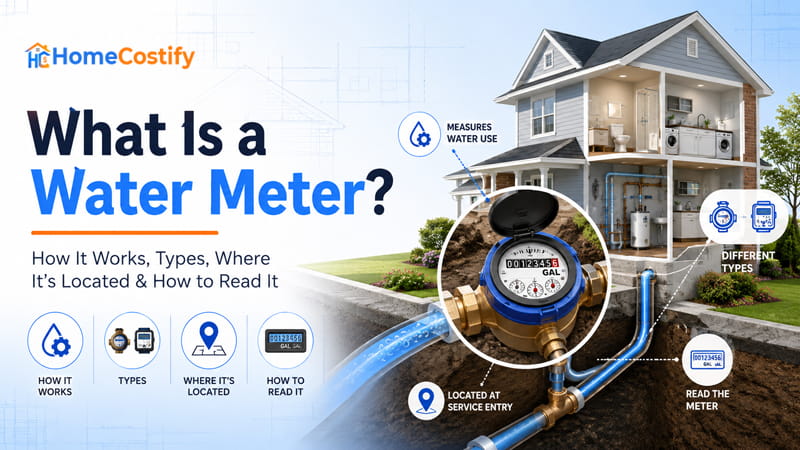
A home does not use the same amount of water throughout the day. Showering, dishwashing, appliances, and outdoor fixtures create different levels of demand. A water meter turns that changing use into a recorded total for the property.
The device sits at the incoming service before water enters the home’s plumbing. Fixtures draw from the supply after this point, linking incoming water with downstream household use.
For U.S. homeowners, the register offers a simple reference for accumulated use. Its number represents the amount recorded so far, not the rate of movement at a given instant.
What Is a Water Meter?
A water meter records the volume delivered to a property through its service connection. The register adds each measured increment to a continuing total. That total represents use accumulated during the period being observed.
Utility records can retain those totals as part of a property’s usage history. Homeowners can compare readings from separate periods and notice differences in household demand. Occupancy, seasonal routines, irrigation, and appliance use can all influence those differences.
Volume and flow serve different measurement purposes. Flow describes a rate, while volume describes an amount accumulated over time. Household demand can vary throughout the day, while the register retains the quantity associated with that use.
Water meter measurement concerns the accumulated quantity represented by the register. A flow measurement instead concerns movement at a particular rate. The two describe different aspects of the same supply without serving the same measurement purpose.
What Is the Purpose of a Water Meter?
Measured water use gives the utility and homeowner a consistent record of consumption. That record ties activity at the property to a defined period.
For utilities, measured consumption provides a basis for tracking demand across their service areas. Each property contributes usage information under the same general measurement framework. The record supports utility operations without requiring consumption to be estimated from individual household activities.
Homeowners gain a history against which normal demand can be viewed. Occupancy, irrigation, appliances, seasonal habits, and daily routines can affect one period differently from another. Comparing those periods can reveal whether household use has remained relatively stable or shifted noticeably.
A change in consumption does not establish a specific cause. Increased irrigation or additional occupants can raise consumption. An unintended source can produce a similar pattern. The unusual pattern simply provides a reason to investigate further.
Where Is a Water Meter Located?
Residential installations do not follow one universal location. The property layout and utility configuration determine whether the meter is outdoors or within the building. Access conditions can also depend on the surrounding structure.
Typical Outdoor Water Meter Location
Outdoor installations commonly place the meter toward the front portion of the property. The box is often near a curb or sidewalk, usually below ground level. A buried enclosure protects the equipment while leaving its upper surface accessible.
The lid is usually the most obvious physical clue. Its position points to the equipment beneath the surface. Local practices and property layouts determine the precise placement, so nearby residences may not have identical arrangements.
Indoor Water Meter Locations
An interior installation is possible when the service enters the building through a suitable utility area. Basements are one common setting, particularly where the incoming line enters below the main living spaces.
Mechanical rooms and dedicated utility spaces serve a similar role. Building design and the service entry determine the location, which varies substantially between homes.
What Is Around the Meter?
The surrounding installation often provides clues before the equipment itself becomes visible. Markings around the installation often reveal its purpose before the equipment itself becomes visible.
Inside the enclosure, the register or display offers a more direct identifying feature. Local utility markings can provide additional context, including a water meter symbol where the provider uses one.
How Does a Water Meter Fit Into a Home’s Plumbing System?
The home’s supply follows a connected path from the utility distribution network toward the fixtures inside the building. The meter occupies one stage along that route, before the incoming supply reaches premise plumbing.
| Position | Component | Role |
|---|---|---|
| 1 | Water main | Carries water through the utility distribution network |
| 2 | Service connection | Connects the property’s service to the utility distribution system |
| 3 | Water service line | Carries water from the main toward the property |
| 4 | Water meter | Records the volume passing into the property |
| 5 | Household plumbing | Distributes water to fixtures and appliances |
From the Water Main to the Service Connection
The water supply system distributes water through a larger main serving the surrounding area. An individual property joins that network at its service connection. From this junction, the water service line follows the route toward the building.
A curb stop or similar component can appear along this route, depending on the installation. Such components form part of the transition from the broader distribution network to the property’s dedicated service.
From the Meter to Household Plumbing
Once the service reaches the property, piping carries the supply toward different parts of the building. The parts of a plumbing system include the pipes and other plumbing components that distribute it to individual endpoints.
Faucets, toilets, showers, water heaters, appliances, and other fixtures draw from these branches. The meter lies before those individual endpoints, so its position encompasses water entering the downstream plumbing rather than separate quantities for each fixture.
Why the Meter’s Position Matters
The meter provides a practical reference within the transition from utility-side infrastructure to the customer’s plumbing. EPA materials place service meters near the service-line inlet, where water enters the building. Ownership and maintenance duties, however, depend on the local utility and service arrangement.
How Does a Water Meter Work?
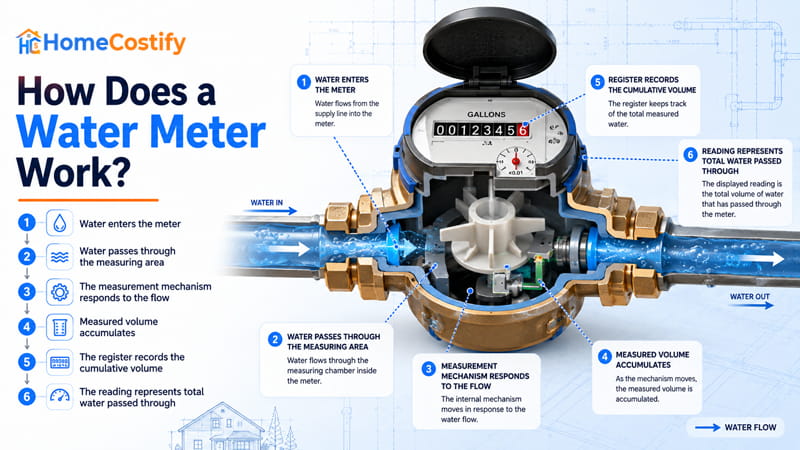
Water entering a home first reaches the meter’s measuring area. Activity within that area produces successive measurements, which accumulate on the register as use continues.
Water Flow Through the Meter
The supply enters the meter and reaches the internal chamber used for measurement. Passage through this area creates the physical input for the measuring process. Each measured increment contributes to the quantity associated with household use.
Water pressure supplies the force that moves water through the home plumbing system. Flow describes movement at a particular rate, while volume describes an amount accumulated over time. Pressure itself is not the quantity recorded by a conventional meter. Keeping those concepts separate helps distinguish the force driving the supply from the amount ultimately recorded.
How the Meter Records Volume
Measurement occurs in increments rather than as one final calculation. Each increment joins the existing total, so continued use adds to the amount represented on the register. The displayed value therefore reflects all measured use accumulated up to that point.
A water meter measurement concerns this cumulative quantity. The cumulative volume increases as additional use occurs. USGS compares cumulative meters with odometers because both preserve an accumulated total over continued use. The water meter register presents that value according to its designated water meter units, such as gallons or cubic feet.
From Measured Volume to a Meter Reading
The register presents the accumulated quantity as a visible numerical value. A homeowner sees the total recorded up to that point rather than a direct indication of current flow.
A later observation provides another value from the same register. The difference between those two values represents use during the intervening period. The actual subtraction belongs to the later meter-reading procedure.
What Are the Main Types of Water Meters?
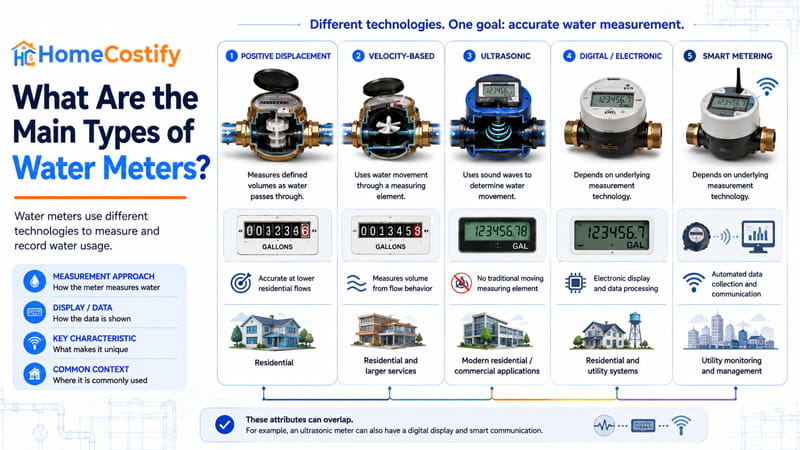
“Type” can describe the principle used to measure water, the way information is processed, or the ability to communicate data. These attributes can overlap within one configuration.
| Type / Configuration | Measurement Approach | Display / Data | Key Characteristic | Common Context |
|---|---|---|---|---|
| Positive displacement | Measures defined volumes as water passes through | Mechanical or electronic register | Accurate at lower residential flows | Residential |
| Velocity-based | Uses water movement through a measuring element | Mechanical or electronic register | Measures volume from flow behavior | Residential and larger services |
| Ultrasonic | Uses sound waves to determine water movement | Electronic | No traditional moving measuring element | Modern residential/commercial applications |
| Digital / electronic | Depends on underlying measurement technology | Digital register | Electronic display and data processing | Residential and utility systems |
| Smart metering | Depends on underlying measurement technology | Digital/communicating system | Automated data collection and communication | Utility monitoring |
Mechanical Water Meters
Physical movement is central to a mechanical water meter. An internal assembly responds to the passage of water, and that response corresponds with the quantity delivered. This design has a long history in residential utility applications.
Positive displacement models use defined spaces within the measuring assembly. Velocity meters instead relate the measured amount to movement through the device. A multi-jet meter belongs to this latter group and is commonly used in residential service.
Digital and Electronic Water Meters
Digital refers primarily to the handling and presentation of information. A digital water meter presents the recorded result on a numerical display, while electronic circuitry processes the associated signal. Additional functions depend on the particular configuration.
The display format does not establish the underlying measurement principle. An electronic water meter can incorporate different methods beneath its digital interface. Smart capability represents another layer because it concerns communication and data handling rather than the display alone.
Ultrasonic Water Meters
Sound waves provide the basis for an ultrasonic water meter. Acoustic signals interact with the supply, and the system uses those signals to determine movement. No traditional moving measuring assembly is required for this approach.
Electronic processing converts the resulting information into a usable output. This configuration appears in modern residential and commercial applications where electronic operation forms part of the installation.
Smart Water Meters
Smart capability centers on communication rather than a separate measurement principle. A smart water meter can collect usage data automatically and transmit it to a remote system. Automated meter reading reduces dependence on manual collection, while AMI supports more frequent data exchange.
AMR and AMI describe communication arrangements, not one specific way of measuring water. A device can therefore combine ultrasonic measurement, digital output, and remote communication within the same configuration.
What Water Meter Size Is Common for Homes?
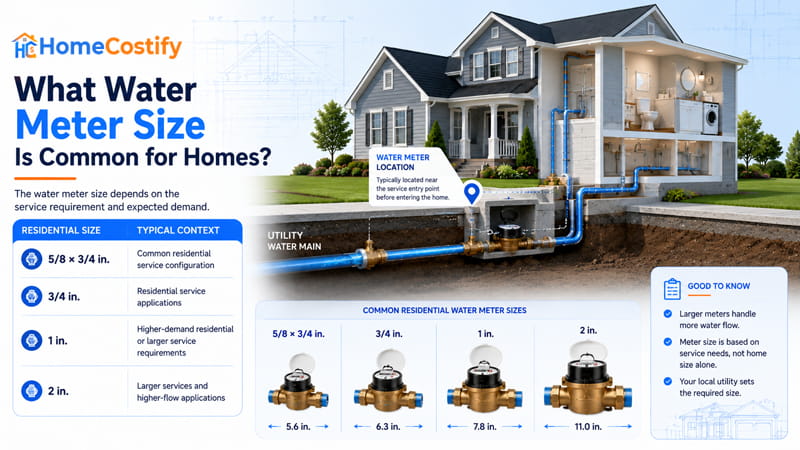
Residential installations use several nominal sizes. Size describes the service configuration, rather than ranking one option above another. The appropriate dimension depends on expected demand and local service requirements.
| Residential Size | Typical Context |
|---|---|
| 5/8 × 3/4 in. | Common residential service configuration |
| 3/4 in. | Residential service applications |
| 1 in. | Higher-demand residential or larger service requirements |
| 2 in. | Larger services and higher-flow applications |
The nominal dimension refers to the connection and service arrangement. A residential water meter with a larger size is not automatically a better choice. Its relevance comes from the demand and configuration the installation must accommodate.
Fixture demand, irrigation, service specifications, and property layout can all affect sizing. A water meter 1 inch or water meter 2 inch may appear on higher-demand services, while smaller configurations remain common in ordinary residential applications. The utility’s specifications ultimately determine the appropriate size.
How to Read a Water Meter
Reading the register starts with identifying the displayed total and its unit. The display may also contain information about current flow, so those values should not be treated as interchangeable.
| Meter Display | What to Identify | Why It Matters |
|---|---|---|
| Mechanical register | Number sequence/dials | Shows accumulated usage |
| Digital display | Numerical reading | Provides a direct usage value |
| Flow indicator | Current movement/flow | Useful for checking unexpected use |
| Unit label | Gallons or cubic feet | Defines what the number represents |
Reading a Mechanical or Analog Meter
The dial arrangement determines how the displayed total is read. Several numbered dials can appear on one register, while other designs use a simpler sequence. Follow the fixed order of the digits, then check the unit marking beside them.
The resulting number represents accumulated use. It does not describe current demand. A water meter number also needs its unit before the quantity can be understood correctly.
Reading a Digital Water Meter
Numerical displays generally present the accumulated total directly. Some electronic registers cycle through multiple screens, meaning the visible value can change from one display to another.
Check the screen label before recording the value. A digital water meter reading may include flow-related information alongside the cumulative total. Anyone learning how to read digital water meter displays should first determine which screen contains the stored usage figure.
Understanding Water Meter Reading Units
A displayed number has no useful quantity without its unit. U.S. installations commonly show gallons or cubic feet. Some utilities express larger quantities using CCF or HCF.
The unit label establishes how the displayed value should be interpreted. This matters when comparing readings or calculating usage. Utility records can also follow a billing convention different from the format shown directly on the register.
How to Calculate Water Used From Two Readings
Two readings establish the amount used between their respective dates. Subtract the earlier value from the later one:
Current reading − Previous reading = Usage for the period
The result uses the same unit shown by the register. No conversion is needed unless the two values use different units.
Water Meter vs. Water Flow Meter
The terms overlap in everyday discussion because both concern water movement. Their measurement purposes are different. One tracks accumulated consumption, while the other commonly focuses on flow rate.
| Water Meter | Water Flow Meter |
|---|---|
| Commonly used to track cumulative water consumption | Often used to monitor flow rate or process conditions |
| Frequently associated with utility billing | Common in broader industrial and technical applications |
| Records accumulated volume | May emphasize instantaneous or changing flow |
| Common residential utility application | Wider industrial and technical applications |
Confusion arises when the same supply is viewed from different measurement purposes. A flow meter can report a rate or show how that rate changes. Utility metering instead concerns the accumulated amount associated with service use.
The distinction matters to homeowners because a utility account generally depends on consumption over a billing period. A flow-rate value alone does not establish that quantity. Both devices can therefore concern the same supply while serving different operational purposes.
How Is Water Meter Usage Used for Billing?
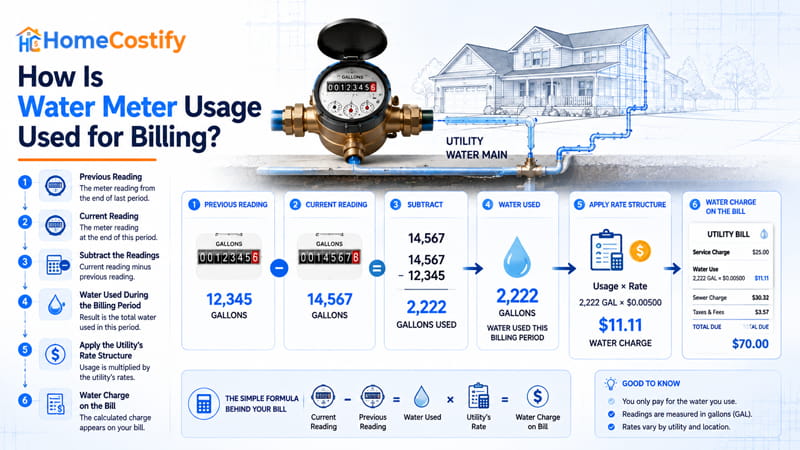
Meter readings provide the usage information a utility applies to a billing period. That amount becomes one component of the customer’s account under the applicable local rate structure.
Period consumption comes from two readings taken at different points in time. The earlier value establishes the beginning, while the later value marks the end. Their difference represents use during that interval. The register’s stated unit carries through the calculation.
Gallons and cubic feet are common U.S. conventions. Larger quantities may appear as CCF or HCF, depending on the utility. One CCF equals 100 cubic feet. Utilities can present consumption differently, so the same physical use may appear in different formats.
The final charge does not necessarily depend on consumption alone. A utility may combine a fixed service charge with a volume-based rate. Tiered pricing, minimum charges, and other local fees can also apply. Similar consumption therefore does not guarantee identical bills.
Water meter consumption supplies the usage component, while the local rate structure determines how that amount affects the account.
Can a Water Meter Help Detect Leaks?
A meter can reveal unexpected use when the home has no intentional demand. Activity during a quiet period provides a reason to investigate what is drawing water.
Checking for Unexpected Water Flow
Stop normal use throughout the home before checking the display. Turn off faucets, showers, appliances, and outdoor fixtures. Irrigation and other scheduled uses should remain inactive during the observation.
Once intentional demand has stopped, watch the display or flow indicator. Some installations show movement directly, while electronic systems can signal ongoing activity differently.
Continued activity means water is still being used somewhere in the system. The observation becomes more useful when no household activity explains it.
What Continued Meter Movement Can Mean
Unexpected activity does not establish a plumbing leak by itself. A slowly leaking toilet can cause continued use, while scheduled irrigation may operate without anyone present. Outdoor fixtures and appliances can produce similar activity.
Some problems appear only at certain times. An intermittent toilet issue, irrigation cycle, or appliance operation could end before the observation begins. Pressure conditions can also influence when certain problems become noticeable. Unexplained activity therefore warrants further investigation rather than an immediate diagnosis.
A brief check can miss use that occurs periodically. Repeating the observation during quiet conditions provides more evidence about the pattern. The result points to unexplained consumption, but it does not identify the specific source.
Conclusion
The home’s water path provides the clearest way to understand the meter’s role. Utility supply reaches the property, passes the measurement point, and continues into household plumbing.
The register records accumulated use associated with that property. Its location explains where the recorded consumption enters the home’s system. From there, the same information connects with location, billing, and investigation of unexpected use without treating the device as an isolated component.
FAQs About Water Meters
How Do I Find Where My Water Meter Is?
Start near the curb, sidewalk, or the area where the service enters the property. An outdoor box is often the easiest clue.
How Do I Know if My Water Meter Is Inside or Outside?
Check the outdoor meter box first. If nothing appears there, look near a basement, mechanical space, or other utility area inside.
How Do I Check a Water Meter?
Note the displayed total and its unit. Check whether the display also shows a flow indication, and avoid altering utility equipment.
What Is a Standard Water Meter?
There is no single universal model. A residential water meter can vary by utility, service size, measurement technology, and installation requirements.
Which Meter Is Used to Measure Water?
Residential utilities commonly use devices designed to record cumulative water volume. Mechanical and electronic designs are among the common categories.