A shingle package usually puts a wind rating next to the product information. For a wind-resistant roof, that number is only one part of the picture. Shingles, fasteners, sealing strips, roof edges, and the rest of the roofing assembly face the wind as a connected system.
The rating itself comes from a defined test method. ASTM D3161 and ASTM D7158 use different testing approaches and classification systems. Product literature also ties the rating to a particular product and installation configuration, so the ASTM standard and the manufacturer’s specifications belong alongside the wind-speed figure when reading the rating.
What Is a Wind-Resistant Roof?
A wind-resistant roof is designed to withstand the forces produced by strong winds while keeping its roofing components in place. Wind exposure varies across the roof. Edges and corners face airflow differently from areas closer to the center of a roof plane, making these locations more vulnerable to uplift.
Wind uplift is the upward force created by wind acting on the roof. Strong gusts can lift shingle edges and tabs, especially where the roofing reaches an exposed perimeter. The attachment between the shingles and roof deck provides resistance to that movement. As uplift increases, a weak connection can allow shingles to lift, move, or separate.
Wind resistance describes a defined level of performance under specified conditions. A rating represents the conditions associated with the tested product and its configuration. Severe weather can produce greater exposure, longer-duration gusts, or other conditions that lead to movement or damage beyond the documented performance.
What Makes a Roof Wind Resistant?
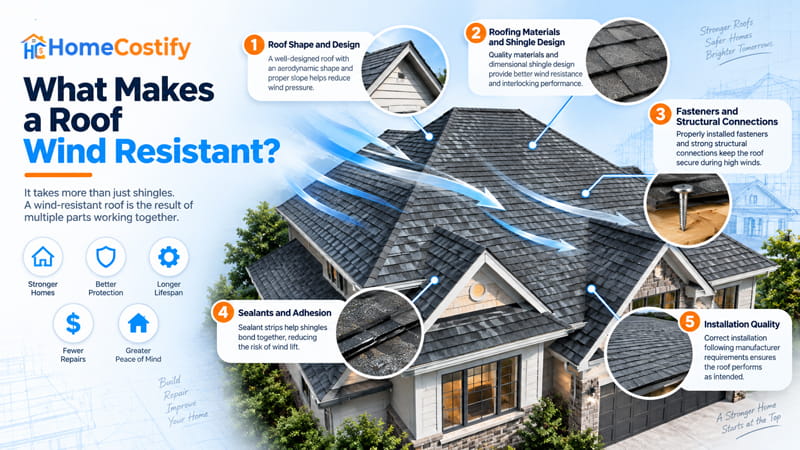
A roof’s response to strong wind begins with its overall design and the way its components are joined. The shape of the roof, the arrangement of its surfaces, and the strength of its connections all come into play when moving air reaches the roofing system.
Roof Shape and Design
A gable roof has two sloped planes with a vertical gable end, while a hip roof slopes downward on all sides. The difference changes the surfaces presented to moving air. Roof slope and overhang further change the roof’s exposed geometry.
The roof perimeter receives more direct airflow than areas farther from the edge. Shingles at the edge sit at the boundary of the roof plane, while corners expose the covering to changes in airflow direction. These locations have different exposure from shingles closer to the center of the roof.
Roofing Materials and Shingle Design
Shingles vary in thickness, rigidity, profile, and construction. A 3-tab shingle has a different exposed shape and construction from a laminated architectural product, even though both use asphalt as their primary roofing material.
The sealing strip is another physical feature built into many asphalt shingles. It bonds the overlapping sections after installation and helps keep the shingle courses joined together. Product specifications are needed to distinguish the construction and requirements of one shingle from another within the same material category.
Fasteners and Structural Connections
Nails provide the mechanical connection between the shingles and roof deck. Their placement determines where the covering is attached to the deck, while the deck itself transfers loads into the roof framing.
The connection continues below the roof surface. Roof framing connects to the walls, and roof-to-wall connections transfer forces into the supporting structure. The complete path therefore runs from the exposed covering through the deck and framing to the building below.
Sealants and Adhesion
Adhesive and mechanical fastening perform different jobs within an asphalt shingle installation. Nails secure the material to the deck. The sealant strip bonds the overlapping shingle sections, keeping the edges secured after installation.
The location of the adhesive matters as well. It sits beneath the portion of the shingle designed to overlap the course below. Proper contact allows the bond to form across the intended area rather than leaving sections unsecured.
Installation Quality
Installation determines whether the physical features of the product are present in the finished roof. Manufacturer instructions specify the required fastening pattern, placement, sealing details, and other product-specific conditions.
A missing nail, misplaced fastener, or incomplete adhesive bond changes the installed assembly from the configuration described by the manufacturer. The same shingle can consequently have different attachment conditions depending on how it was installed.
How Are Wind-Resistant Shingles Tested?
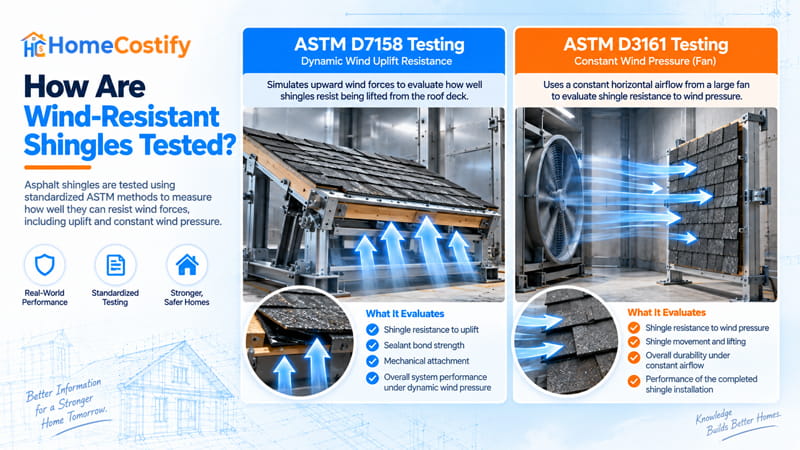
Standardized wind tests expose roofing products to controlled airflow and record how the shingles respond. ASTM D7158 and ASTM D3161 use different test approaches, so their classifications belong to the specific method used to obtain them.
ASTM D7158 Test Method
ASTM D7158 evaluates a shingle under wind uplift within a defined test setup. The assessment focuses on the shingle’s resistance as uplift acts on the product, with its attachment and sealing characteristics included in the tested configuration.
Before testing, the shingles are installed according to the applicable manufacturer requirements. The resulting classification describes behavior measured under the conditions established by the standard. It applies to that test framework rather than to unrestricted wind exposure.
ASTM D3161 Test Method
ASTM D3161 uses fans to produce airflow across roofing products mounted on test panels. Air moves horizontally over the exposed surface while the test observes movement or lifting of the roofing material.
The controlled airflow gives the test a repeatable way to examine how the product responds when subjected to wind. Its results are tied to the conditions and procedure established by ASTM D3161.
What Testing Can and Cannot Tell You
The D7158 classification framework includes specific assumptions about the conditions where its result applies. These include exposure categories B or C, a mean roof height of 60 feet or less, and no topographic wind-speed-up effects. Conditions outside those assumptions may require additional calculation or engineering consideration.
A laboratory test also cannot reproduce every condition surrounding an installed roof. Building shape, nearby surroundings, installation quality, and the rest of the roof assembly affect the forces reaching the shingles.
How Are Roof Shingles Rated for Wind Resistance?
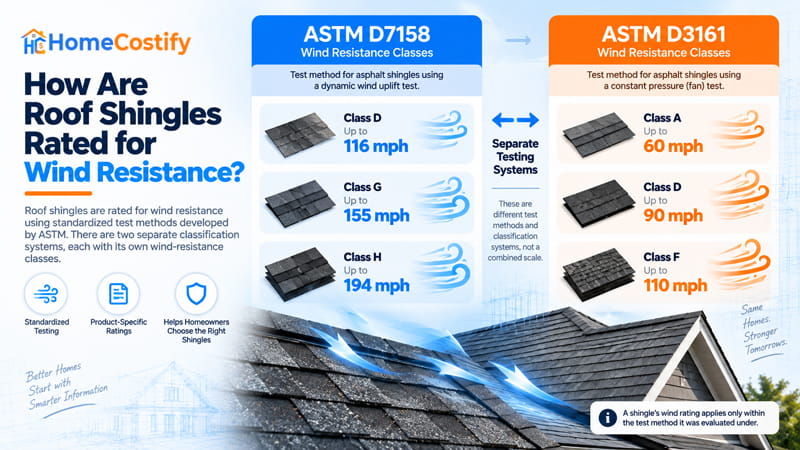
A shingle wind rating consists of an ASTM standard, a classification, and a corresponding wind-speed designation. A product listed as Class G under ASTM D7158 at 120 mph, for example, belongs to the D7158 classification system and its specified test conditions. The 120 mph figure should be read with the ASTM standard and class rather than treated as a universal wind limit for every roof.
ASTM Wind Resistance Classifications
Two ASTM standards commonly appear in shingle wind-resistance documentation: ASTM D3161 and ASTM D7158. Their classification scales use different letter designations and wind-speed values, so the standard must be read alongside the class.
ASTM D3161 (Fan-Induced Wind Test)
ASTM D3161 uses fan-generated airflow to evaluate how shingles respond to high-speed wind.
- Class A: Rated up to 60 mph
- Class D: Rated up to 90 mph
- Class F: Rated up to 110 mph, the highest classification in this test
ASTM D7158 (Uplift Force Test)
ASTM D7158 uses an uplift-based evaluation in which the wind-related forces acting on the shingle are assessed within the conditions defined by the standard.
- Class D: Rated up to 90 mph
- Class G: Rated up to 120 mph
- Class H: Rated up to 150 mph, the highest classification in this test
How to Read the Rating Correctly
Read the ASTM standard, class, and wind-speed designation as one entry. Class D under ASTM D3161 and Class D under ASTM D7158 are different classifications, even though both use the letter D.
The ASTM reference tells you which classification scale the letter and wind-speed figure belong to. Without that reference, the number alone lacks the context needed to interpret the rating.
Wind Resistance of Different Types of Shingles
Shingles vary in construction, material, and stated wind-rating range. The figures below cover common roofing materials and shingle designs, with differences in both listed ratings and physical construction.
Asphalt Shingles
3-Tab Shingles
3-tab shingles have a relatively thin, flat profile. Listed ratings fall around 60 to 70 mph. Compared with heavier asphalt designs, 3-tab shingles use a simpler and lighter construction.
Architectural (Dimensional) Shingles
Architectural shingles use a multi-layered, dimensional design rather than the flat profile of a 3-tab shingle. Listed ratings range from roughly 90 to 130 mph. Exact figures vary by product, so manufacturer specifications should be checked for an individual shingle.
Premium / Designer Shingles
Premium and designer shingles occupy the upper end of the asphalt range, with listed ratings reaching 130+ mph. Some products carry ASTM Class G or H designations under the applicable standard. Classification and wind-speed values vary by product.
Alternative Shingle Materials
Metal Shingles
Metal shingles are listed around 140 to 150 mph in the provided material. Interlocking panels connect adjoining sections across the roof surface, creating a different attachment arrangement from individual asphalt shingles. Wind resistance is one characteristic used when comparing metal roofing, while impact resistant shingles address protection from impact.
Cedar Shakes & Shingles
Cedar shakes and shingles are listed at roughly 170 to 245 mph with proper maintenance and installation. The stated range comes with conditions related to upkeep and installation. Cedar also has material characteristics that differ from asphalt, including considerations related to fire-resistant roofing.
Clay and Concrete Tiles
Clay tiles and concrete tiles are listed at roughly 125 mph in the provided material. Their substantial construction and installation method set them apart from asphalt shingles and other lightweight coverings. Applicable ratings remain tied to the specific product and conditions stated for it.
How to Tell the Wind Rating of Roof Shingles
Find the wind rating in the documents supplied for the specific shingle product. Check the product name first, then match the wind speed or classification with its ASTM reference and installation requirements.
Packaging and Product Literature
Check the shingle package, product data sheet, installation instructions, and technical literature. Look for a stated wind speed, ASTM classification, or both. Match the information with the exact product name and model when several documents or product lines are involved.
Manufacturer Specifications
Manufacturer specifications contain product-level details that a general material category cannot cover. Check the applicable ASTM standard, classification, wind-speed designation, and installation requirements. Two products within the same asphalt shingle category can have different ratings and installation specifications.
ASTM Classification
Read the ASTM reference alongside the classification. ASTM D7158 and ASTM D3161 use different classification systems, so the same letter can represent different ratings under the two standards. A class should always be read within its stated ASTM standard.
Installation Requirements
Read the installation instructions with the rating information. Check fastener placement, fastening requirements, sealing details, and other product-specific instructions. The listed rating applies to the installation configuration specified for the product.
Wind-Resistant Roof vs Windproof Roof
“Wind resistant” describes a roof built to withstand wind within a defined level of exposure. “Windproof” suggests complete protection from wind. The distinction matters because roofing products and assemblies are tested and described within specific conditions, while actual storms can produce a much wider range of exposure.
Wind Resistant
“Wind resistant” refers to measurable resistance under defined conditions. A roofing product may carry a wind classification or stated wind speed based on its applicable test method and installation requirements. The claim concerns the conditions associated with the product and its installation.
Windproof
“Windproof” implies a level of protection with little or no vulnerability to wind. Roofing materials are not immune to forces created by severe weather, so absolute wording creates a broader expectation than a defined wind-resistance rating.
Why No Roof Is Completely Windproof
Wind conditions change from one storm to another. Direction, turbulence, duration, building location, roof geometry, and surrounding structures all affect the airflow reaching a roof. Severe exposure can place loads on the roofing assembly beyond the conditions represented by a product rating.
A wind-resistant roof can still experience lifted or damaged shingles during an extreme wind event. Wind resistance describes a defined level of performance; it does not make the roof immune to damage.
Conclusion
When checking a roof for wind resistance, start with the exact shingle product and its stated wind rating. Confirm the ASTM standard behind the classification, then check the manufacturer’s installation requirements, including fastening and sealing details. Finally, consider the roof’s shape, exposed edges, and local wind conditions.
A rating on its own is not enough to describe how an installed roof will perform. Matching the product, rating, installation, and roof conditions gives homeowners a more practical way to assess wind protection and compare roofing options.
FAQs About Wind-Resistant Roof
What Is a Good Wind Rating for Roof Shingles?
A suitable rating depends on the roof, product, ASTM standard, and local wind exposure. Check the manufacturer’s specifications rather than relying on one universal number.
What Is the Highest Wind Rating for Shingles?
ASTM D7158 lists Class H as its highest classification, with ratings up to 150 mph. ASTM D3161 uses a different classification scale.
Are Architectural Shingles Wind Resistant?
Yes. Many architectural shingles have documented wind ratings, but values vary by product. Check the specific shingle’s manufacturer specifications and installation requirements.
How Much Wind Can Roof Shingles Withstand?
Wind ratings vary by product and testing standard. The listed speed applies to the conditions associated with the product and its specified installation.
Are 3-Tab Shingles Wind Resistant?
Some 3-tab shingles carry wind-resistance ratings. Check the specific product’s stated classification and installation requirements because ratings vary among 3-tab products.