A roof can look solid from the ground and still raise questions when strong winds are part of the local weather. Homeowners may see a wind rating on a shingle package and assume it tells them whether they have a wind-resistant roof. It does not answer every question about performance during severe exposure.
Choosing roofing for windy conditions requires more than finding the highest figure on a product label. The rating, its testing basis, and the roofing system each deserve separate attention. Product claims can also use similar terminology while referring to different measures of performance.
For someone comparing roofing options, the practical question is simple: what actually makes a roof suitable for demanding wind exposure? That question requires looking beyond the number printed on a package.
What Is a Wind-Resistant Roof?
Wind resistance describes how a roof holds up when moving air places force on its exposed surfaces. The issue is not simply whether shingles remain visible after a storm. A roof needs to retain its intended condition while wind acts across the structure.
Air moving over and around the roof can create different pressure levels. That pressure can produce an upward force on roofing surfaces. The effect is called wind uplift. Strong exposure may move roofing materials when the forces acting on them exceed the resistance provided by the roof system.
A roof does not experience those forces as a collection of unrelated products. Shingles, fastened sections, and other connected elements work together as an assembly. Movement in one area can affect adjoining parts. For that reason, wind performance belongs to the roof system rather than to a single visible component alone.
The label wind-resistant also has a narrower meaning than many homeowners assume. It describes resistance under particular performance conditions, not absolute protection from severe weather.
Even well-rated wind-resistant roofing can experience movement or damage when exposure becomes extreme or conditions differ from those used to establish its performance. “Wind-resistant” is therefore a measure of capability, not a guarantee against failure.
What Makes a Roof Wind Resistant?
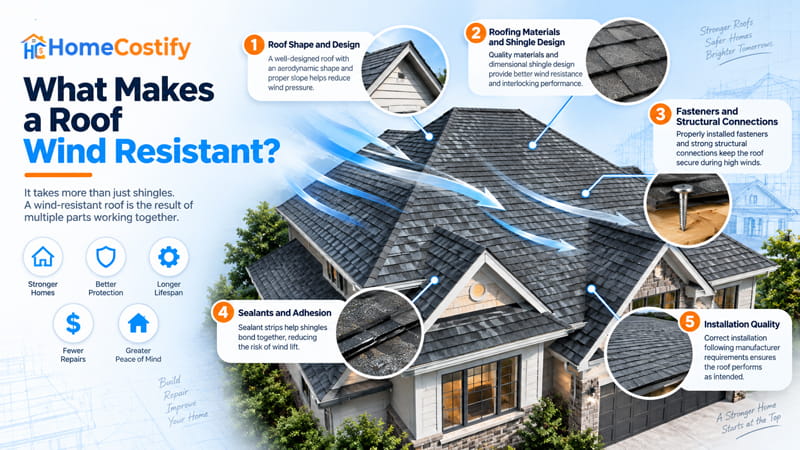
Wind-resistant roofing depends on cooperation among the different elements that make up a roof. No single characteristic explains the behavior of the entire roof. Shape, materials, connections, surface restraint, and installation each have a place in that interaction.
Roof Shape and Design
The form of a roof changes the surfaces that moving air encounters. A gable roof presents broad sloped planes and an exposed gable end, while a hip roof turns those slopes around the building. Roof slope and overhang alter the shape and extent of surfaces exposed to wind.
Exposed roof edges face airflow differently from areas farther toward the roof’s interior. Their position at the perimeter leaves them directly exposed to surrounding air movement. Uplift can become more consequential near these localized areas, particularly where shingle material meets the roof’s outer boundary.
Roofing Materials and Shingle Design
A roofing product brings its own construction characteristics to the roof. Rigidity, shape, profile, and sealing behavior affect the way individual pieces react to wind. Products use different physical characteristics to resist displacement or separation.
Material type provides only a broad description of a roofing product. Two products made from the same material can have different construction and wind-performance specifications. Manufacturer specifications provide the more useful product-level information for distinguishing those differences.
Fasteners and Structural Connections
Mechanical fasteners secure roofing material to the roof deck and create a physical connection beneath the exposed surface. Forces reaching the covering pass through these attachment points into the roof assembly. The fastening arrangement therefore forms one link within the larger load path.
The load path continues beyond the roof covering toward the supporting structure. Roof-to-wall connections help transfer forces from the upper portion of the building into its structural frame. Their role extends wind resistance beyond the materials visible from outside.
Sealants and Adhesion
A sealant strip can bond overlapping portions of shingle material and provide additional restraint against lifting. This adhesive bond works alongside mechanical attachment, reducing the tendency of adjoining pieces to separate under wind pressure.
Installation Quality
A product’s specified wind performance depends on the configuration described by its manufacturer. Wind-resistant roofing therefore relies on installation that follows those applicable requirements. Changes from the specified configuration can alter how the finished assembly responds compared with the expected product performance.
How Are Wind-Resistant Shingles Tested?
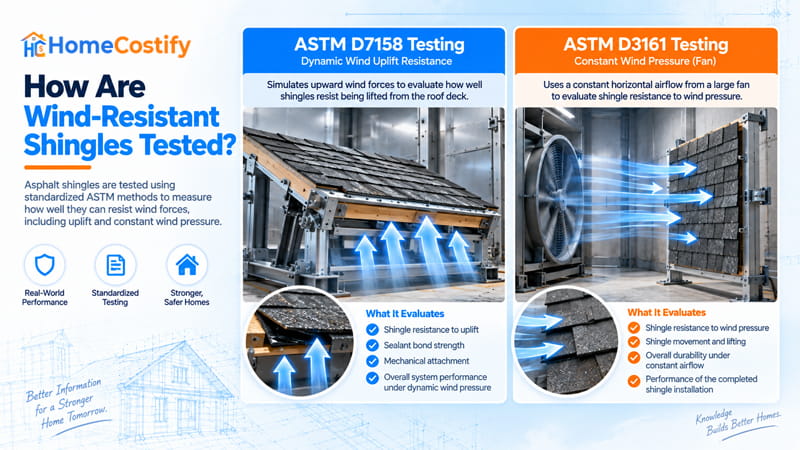
Standardized wind tests place roofing products under specified airflow and observe their behavior. The test method matters because ASTM standards use different approaches to evaluate resistance. Each resulting classification belongs to the method that produced it.
ASTM D7158 Test Method
ASTM D7158 evaluates a shingle against wind uplift forces within a specified test setup. The assessment examines the shingle’s resistance as uplift acts upon it. Attachment and sealing characteristics form part of the configuration used during evaluation.
The shingles are installed according to applicable manufacturer requirements before testing begins. Their measured behavior reflects the parameters established by the method. The classification applies within that testing framework, rather than serving as a measure of unrestricted wind resistance.
ASTM D3161 Test Method
ASTM D3161 uses fan-induced wind to create controlled airflow across roofing products. The products are placed on test panels while horizontal air moves over their surface. The test observes whether portions lift or move under those conditions. This gives wind-resistant shingles a defined setting for evaluating their reaction to moving air.
What Testing Can and Cannot Tell You
The D7158 classification framework includes specific assumptions about the setting where its result applies. These include exposure categories B or C, a mean roof height of 60 feet or less, and no topographic wind-speed-up effects. A wind rating on shingles may need additional calculation or engineering consideration outside those assumptions.
Natural wind rarely matches a laboratory setting in every respect. Building shape, surrounding conditions, installation quality, and the broader roof assembly can alter forces reaching installed shingles. Laboratory results describe behavior within the test framework. They cannot guarantee identical behavior during every wind event or predict all forms of wind damage to shingles.
How Are Roof Shingles Rated for Wind Resistance?
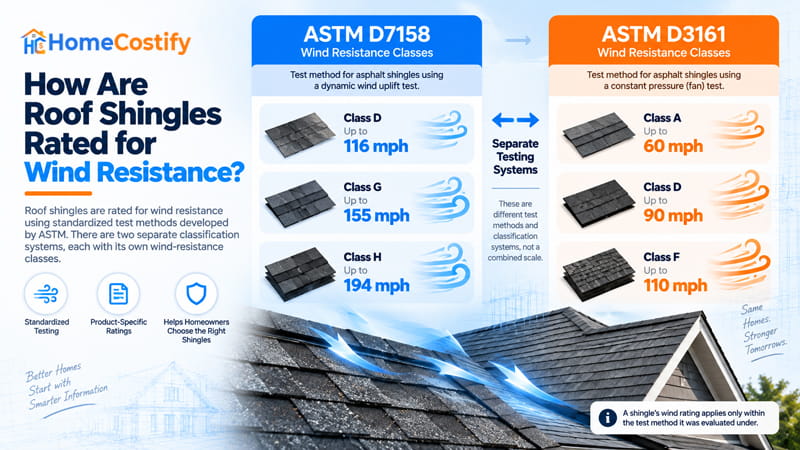
A wind rating on shingles indicates the classification assigned under a particular ASTM standard. The designation connects the tested product with a defined wind-resistance category. Its stated wind speed belongs to that classification framework rather than representing a universal capacity for every roof.
ASTM Wind Resistance Classifications
Two ASTM standards commonly appear in shingle wind-resistance documentation: ASTM D3161 and ASTM D7158. Each uses its own classification scale and corresponding wind-speed designations. Their classes should remain associated with the standard that defines them.
ASTM D3161 (Fan-Induced Wind Test)
Subjects shingles to high-speed wind fans to see if the tabs lift.
- Class A: Rated up to 60 mph
- Class D: Rated up to 90 mph
- Class F: Rated up to 110 mph (highest rating for this test)
ASTM D7158 (Uplift Force Test)
Measures the calculated uplift resistance forces based on air flow and geometry.
- Class D: Rated up to 90 mph
- Class G: Rated up to 120 mph
- Class H: Rated up to 150 mph (highest rating for this test)
How to Read the Rating Correctly
A class and its wind-speed designation need the accompanying ASTM reference for proper interpretation. The same letter can appear within separate standards without carrying the same meaning. Reading the designation within its stated framework prevents the two classification scales from being treated as one universal ranking.
Wind Resistance of Different Types of Shingles
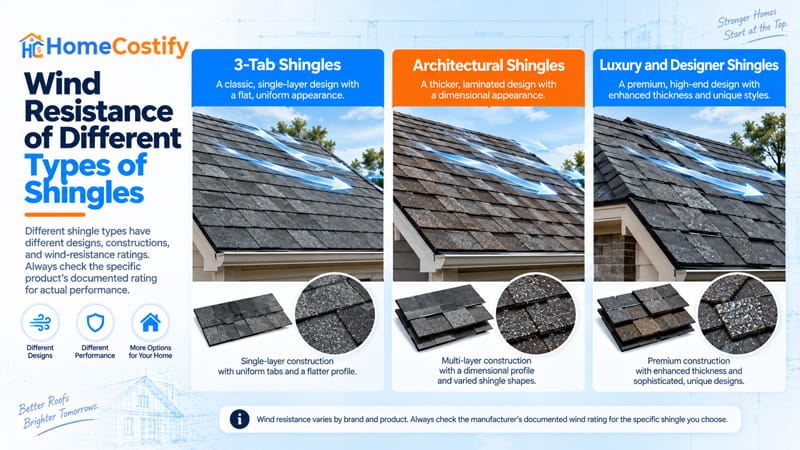
Wind-resistant shingles differ in construction, material, and stated wind-resistance levels. Basic asphalt designs occupy lower ranges, while heavier designs reach higher figures. Finding the best roofing for high winds requires looking beyond the rating and considering material characteristics as well.
Asphalt Shingles
3-Tab Shingles
A thin, relatively flat profile characterizes 3-tab shingles. Their listed range falls around 60 to 70 mph. This lighter construction offers less resistance to lifting than more substantial asphalt designs under strong gusts.
Architectural (Dimensional) Shingles
Architectural shingles feature a multi-layered, dimensional profile. Their stated range runs from roughly 90 to 130 mph. Greater thickness and layered construction give these wind-resistant shingles a more substantial profile. The exact rating remains specific to the individual product.
Premium / Designer Shingles
Premium and designer shingles occupy the upper end of the asphalt range. Listed ratings reach 130+ mph, with some products meeting ASTM Class G or H. These higher classifications apply only to products carrying the relevant designation.
Alternative Shingle Materials
Metal Shingles
Metal shingles are listed around 140 to 150 mph in the provided material. Interlocking panels create a connected surface that helps resist uplift. Other characteristics can also matter when comparing them, including the use of impact resistant shingles for additional impact protection.
Cedar Shakes & Shingles
Cedar shakes and shingles are listed at roughly 170 to 245 mph with proper maintenance and installation. That range carries conditions related to upkeep and installation. Cedar also differs from asphalt in other material characteristics, including considerations relevant to fire-resistant roofing.
Clay and Concrete Tiles
Clay tiles and concrete tiles are listed at roughly 125 mph in the provided material. Their substantial construction gives them a distinct position among the materials discussed here. The actual rating remains specific to the documented product and applicable conditions.
How to Tell the Wind Rating of Roof Shingles
A wind-performance claim needs to be traceable to the specific roofing product. For a wind-resistant roof, the relevant rating comes from product-specific records rather than the material category.
Packaging and Product Literature
Look for wind information on the package, product data sheet, installation instructions, or technical literature. Some documents contain greater technical detail than others. The product name or line links those records to the shingles being evaluated. Manufacturer specifications can then clarify the information relevant to that product.
Manufacturer Specifications
Manufacturer specifications identify details that broad material descriptions cannot establish. A document may name the applicable wind-test standard and the product’s documented result. Two products within the same asphalt shingle or architectural shingle category can carry separate specifications. The manufacturer’s published information therefore provides the appropriate reference for the product under review.
ASTM Classification
Start with the ASTM reference before interpreting the documented result. Product literature may cite ASTM D7158 or ASTM D3161, and each standard has its own classification framework. A wind rating on shingles must stay within the standard identified in the documentation. The two frameworks are not interchangeable.
Installation Requirements
The published rating relates to a specified product configuration. Installation instructions describe the conditions associated with that configuration. These details form part of the product’s documented wind performance. Checking them alongside the stated rating keeps the assessment tied to the configuration evaluated for that product.
Wind-Resistant Roof vs Windproof Roof
“Wind resistant” signals qualified protection, while “windproof” suggests near-absolute protection. The two terms therefore set different expectations for roof protection in windy conditions.
Wind Resistant
“Wind resistant” indicates that a roofing assembly has a defined level of resistance under specified conditions. The claim describes expected behavior within those limits, rather than immunity from wind-related damage. For wind-resistant roofing, the relevant scope comes from the particular performance claim being evaluated.
Windproof
“Windproof” carries a more absolute meaning than a qualified resistance claim. The word suggests that wind cannot cause meaningful failure or damage. Natural exposure rarely fits such certainty because surrounding conditions can change the outcome. A homeowner should therefore treat absolute wording with caution.
Why No Roof Is Completely Windproof
Natural wind events vary in direction, turbulence, duration, and surrounding exposure. Those variables can create circumstances beyond the conditions represented by a product description. Even a wind-resistant roof can experience shingle failure during severe or unusual exposure.
Conclusion
A wind rating is one piece of information in assessing a roof’s ability to handle wind. For a wind-resistant roof, its meaning rests on the stated standard, roof characteristics, installation, and surrounding exposure. Reading the rating within that context gives homeowners a more realistic basis for judging wind protection.
FAQs About Wind-Resistant Roof
What Is a Good Wind Rating for Roof Shingles?
There is no single rating that qualifies as good for every roof. The relevant classification depends on the applicable ASTM framework and the conditions being evaluated. A documented result needs that context before its suitability can be judged.
What Is the Highest Wind Rating for Shingles?
No universal highest rating exists across separate testing frameworks. ASTM D7158 uses Class H as its highest classification. That designation should remain within D7158 rather than being ranked against classifications from another standard.
Are Architectural Shingles Wind Resistant?
Yes, architectural shingles can offer wind-resistant performance. The relevant capability depends on the specific product and its documented classification. The category name itself cannot establish one universal rating for every architectural shingle.
How Much Wind Can Roof Shingles Withstand?
No single wind amount applies to every shingle. The answer depends on the product, applicable standard, installation, and surrounding conditions. A laboratory classification also cannot serve as a universal guarantee for real-world wind exposure.
Are 3-Tab Shingles Wind Resistant?
Some 3-tab shingles have documented wind-resistant performance. Their relevant capability comes from the product’s stated rating and associated installation requirements. That information varies among products, so the category itself provides no universal wind threshold.