Replacing an existing clay tile roof calls for a larger financial decision than purchasing individual replacement tiles. The clay tile roof replacement cost represents the commitment tied to that project, not simply the price of new material. The homeowner is evaluating a complete roofing project rather than a material purchase.
A quoted amount belongs to the particular property and scope being priced. Its meaning depends on the work included, so the figure cannot serve as a universal benchmark for every clay-covered roof. The same headline price can mean different things when the underlying project scope changes.
An overall budget reference gives that decision a useful starting point. A homeowner needs a realistic picture of the project’s financial scale before evaluating a replacement proposal.
Clay Tile Roof Replacement Cost at a Glance
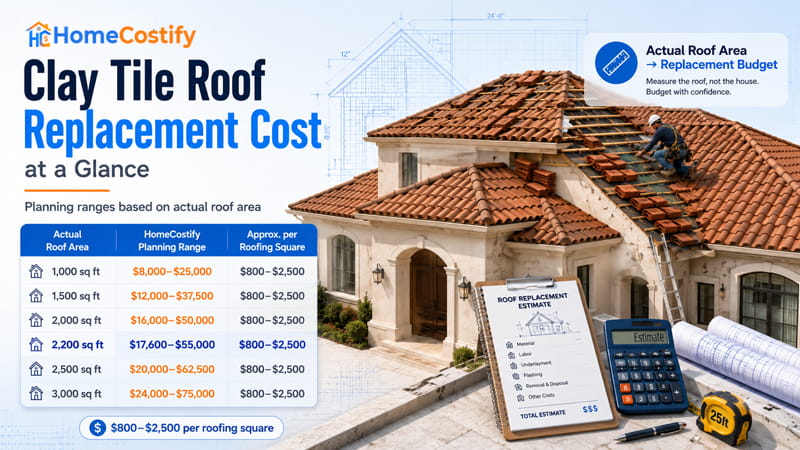
A useful budget snapshot starts with the measured roof area and the corresponding total expenditure shown below.
| Actual roof area | Planning range | Approx. per roofing square |
|---|---|---|
| 1,000 sq ft | $8,000–$25,000 | $800–$2,500 |
| 1,500 sq ft | $12,000–$37,500 | $800–$2,500 |
| 2,000 sq ft | $16,000–$50,000 | $800–$2,500 |
| 2,200 sq ft | $17,600–$55,000 | $800–$2,500 |
| 2,500 sq ft | $20,000–$62,500 | $800–$2,500 |
| 3,000 sq ft | $24,000–$75,000 | $800–$2,500 |
HomeCostify planning framework based on a broad $8–$25 per actual roof sq ft installed range, informed by multiple published cost sources. This is a budgeting reference, not a national average or guaranteed contractor price.
Larger roof areas correspond to larger total ranges because more roofing surface requires coverage. The range provides a useful reference for the overall clay tile roof cost associated with the covered surface.
A home’s floor area tells you how much living space sits below the roof. It does not tell you the roof’s measured surface. A 2,200-square-foot home, for instance, can have a different roofing area than its floor footprint. Slopes, extensions, and overhangs add or reduce covered surface. The measured roof area is the quantity used for the calculations above.
Clay Tile Roof Replacement Cost by Tile Type

Clay tile is not a single standardized roofing product. Profile, configuration, and production method can shift the working replacement range considerably.
| Clay tile type | Working replacement cost | Approx. per roofing square | Main pricing consideration |
|---|---|---|---|
| Interlocking | $11–$13/sq ft | $1,100–$1,300 | Profile configuration and fitting |
| Spanish / S-tile | $12–$15/sq ft | $1,200–$1,500 | Curved profile and profile-specific fitting |
| Mission / true barrel | $14–$20/sq ft | $1,400–$2,000 | More demanding profile and handling |
| French / specialty | $15–$22/sq ft | $1,500–$2,200 | Specialty sourcing and matching |
| Flat clay | $14–$22/sq ft | $1,400–$2,200 | Layout and fitting requirements |
| Custom / reproduction | $20–$30+/sq ft | $2,000–$3,000+ | Custom production and matching |
These are HomeCostify working market ranges synthesized from current cost research, not fixed national prices.
Interlocking profiles generally sit toward the lower end of the working range shown above. Spanish and S-tile designs occupy a higher band, followed by Mission, barrel, and specialty profiles. For a broader comparison, clay roof tile types differ in shape, configuration, and production characteristics, all of which can influence the quoted price.
Profile geometry also changes how individual pieces meet across the roof. Spanish and S-tile forms use curved surfaces, while Mission and barrel profiles create more pronounced shapes. Piece dimensions, layout, and matching accessories can affect fitting requirements, making clay roof tile dimensions relevant when comparing products with different profiles.
Custom and reproduction projects belong in a separate category. Matching an older roof may require a particular shape, color, finish, or dimensional profile that is no longer readily stocked. Clay tile roof colors can also matter when a replacement needs to blend with an established roof appearance. Production setup, limited availability, and longer lead times can push the final price higher.
Published cost research and manufacturer or supplier information are especially useful for older or uncommon profiles, where readily available retail pricing may provide little guidance.
Clay Tile Roof Replacement Cost per Square Foot

Contractors commonly express roofing prices by square foot or roofing square. For a full clay tile replacement, the useful comparison starts with the actual roof area being replaced.
| Replacement pricing unit | Working cost range | Equivalent pricing |
|---|---|---|
| Per sq ft | $8–$25/sq ft | — |
| Per roofing square | $800–$2,500/square | 1 square = 100 sq ft |
| 10 roofing squares | $8,000–$25,000 | 1,000 sq ft |
| 20 roofing squares | $16,000–$50,000 | 2,000 sq ft |
| 22 roofing squares | $17,600–$55,000 | 2,200 sq ft |
| 25 roofing squares | $20,000–$62,500 | 2,500 sq ft |
The unit rate changes only the way the same quantity is expressed. Multiply a per-square-foot rate by 100 to obtain its equivalent roofing-square rate. Divide a per-square rate by 100 to return to its square-foot equivalent.
A contractor quoting the clay tile roof replacement cost per square can therefore use a different unit without changing the underlying rate.
What a Per-Square Price Actually Covers
Two estimates can use the same per-square unit and still describe different work. One may include removal, disposal, installation, underlayment, flashing, and cleanup, while another places some of those items outside the base price.
The inclusions deserve attention before unit prices are compared. Allowances can cover parts of the replacement scope that sit outside the base figure. A lower per-square amount can reflect a narrower scope, not a cheaper complete replacement.
Clay Tile Roof Replacement Cost by Roof Size

Roof size turns a unit rate into a project-scale budget. The measured roofing surface determines how many roofing squares enter the calculation.
| Actual roof area | Roofing squares | Planning replacement budget |
|---|---|---|
| 1,000 sq ft | 10 | $8,000–$25,000 |
| 1,500 sq ft | 15 | $12,000–$37,500 |
| 2,000 sq ft | 20 | $16,000–$50,000 |
| 2,200 sq ft | 22 | $17,600–$55,000 |
| 2,500 sq ft | 25 | $20,000–$62,500 |
| 3,000 sq ft | 30 | $24,000–$75,000 |
Planning calculations based on the broad $8–$25 per actual roof sq ft working range. Actual contractor pricing depends on project scope and site conditions.
A larger surface requires more roofing material and a greater quantity of installation work, so the total planning figure rises with coverage.
A home’s floor area is not the same measurement as its roof surface. A 2,200-square-foot home, for example, can have a different roofing area than its floor footprint. Pitch, multiple roof planes, and overhangs change the amount of surface requiring coverage.
The mandatory basis for the clay tile roof replacement cost by square footage is the measured roof area, not the home’s interior size.
Roof area establishes the quantity baseline, but it does not describe the entire job. Two roofs with similar measurements can have different configurations and installation requirements. Size sets the project scale; the final scope still depends on the physical roof being replaced.
What Does a Full Clay Tile Roof Replacement Include?
A complete roof renewal involves the old roofing, the supporting layers, and the new covering. Removal, inspection, repairs, and reconstruction define the work between the old roof and its replacement.
Removing the Existing Roofing
Clay tiles form the first layer to come off during a full tear-off. Materials beneath them may leave the roof as well, depending on the planned scope and their condition.
Removing those layers exposes portions of the roof that cannot be fully examined from above. A clay tile roof replacement therefore starts with more than removing the visible covering.
Inspecting the Roof Assembly
With the covering out of the way, the roof deck and sheathing become accessible for examination. Inspectors look for deterioration, physical damage, and problems with the way the deck is attached. Structural capacity can also require evaluation where the roof system depends on adequate support.
According to the U.S. Department of Energy’s Building America Solution Center, replacement projects can involve damaged sheathing, roof-deck attachment, and structural support for clay or concrete tile.
Rebuilding the Replacement System
The new roof begins with the layers beneath the tile. Underlayment sits below the finished covering, and flashing addresses locations where water-management details require renewed components. New clay tile supplies the visible exterior surface. Fastening connects the covering to the supporting layers and completes the basic roof assembly.
How Long Does a Clay Tile Roof Replacement Take?
The schedule begins before materials arrive on site. Material procurement and preparation set the starting point. Weather, site conditions, and inspections shape the days spent on the roof.
| Project stage | Typical timing consideration |
|---|---|
| Inspection & planning | Before tear-off begins |
| Material procurement | Can delay start when tile is specialty or custom |
| Tear-off | Depends on roof size and existing layers |
| Deck/underlayment work | Depends on conditions uncovered |
| Tile installation | Main field-work phase |
| Finishing & inspection | Final project stage |
Several days are spent on removal, repairs, and tile installation at the roof. Total project time can stretch further because permitting, procurement, scheduling, weather, and inspection sit outside daily installation activity.
Custom or reproduction tiles can lengthen the wait before crews begin installing clay tile roof materials. The crew’s field days and the project’s calendar duration are not necessarily the same measure.
What Happens When the Existing Clay Tile Roof Comes Off?
A roof surface can conceal problems that cannot be judged fully from ground level. Opening the roof can change the clay tile roof replacement cost if newly discovered conditions require additional work.
What the Tear-Off Can Reveal
The first pieces removed are usually the clay tiles themselves. Older pieces can crack during handling, especially where years of exposure have weakened them. Beneath the covering, previously inaccessible roofing layers can be examined directly.
Their physical state provides information unavailable from the intact surface. Fastening methods and signs of earlier installation work can come into view as the roof opens. The growing pile of removed material also gives a clearer indication of the tear-off volume.
Findings That Can Change the Scope
- Broken or fragile tiles: Damaged pieces reduce the quantity suitable for reuse or reinstallation.
- Previously concealed deterioration: Newly exposed damage can introduce corrective work into the project scope.
- Difficult access: Restricted access can complicate movement and handling as removed materials leave the roof.
- Actual removal volume: The quantity removed determines the material load requiring handling and disposal.
Salvaging Reusable Clay Tiles
Recovered tiles deserve assessment before replacement material is finalized. Their physical state is only one part of the evaluation. Profile, shape, finish, and color determine how closely recovered pieces can match the roof.
A close match has greater value on an older roof where comparable products are difficult to source. Some pieces will still be unsuitable because damage or deterioration has compromised their usefulness.
According to IIBEC, salvaged clay tile can provide an economical source of well-matched replacement material when suitable pieces are available. Their suitability depends on characteristics such as type, configuration, finish, color range, and condition.
Underlayment, Flashing and Roof Deck Costs
Three parts beneath the clay tile can create separate charges when their condition calls for replacement. For a clay tile roof replacement cost, underlayment, flashing, and decking each follow a different pricing basis.
| Component | Working cost range | Typical pricing basis | When it becomes an added cost |
|---|---|---|---|
| Underlayment replacement | $0.75–$4/sq ft | Roof area | Existing membrane needs replacement |
| Flashing work | $1.50–$9/LF+ | Linear foot/detail | Existing flashing is damaged, inadequate, or being replaced |
| Roof decking | $2–$5/sq ft | Affected roof area | Rot, deterioration, or unsuitable sheathing is found |
Clay Tile Roof Underlayment Replacement
Underlayment sits beneath the clay tile and helps manage water that reaches the layers below. During replacement, the membrane can require renewal if its condition no longer suits the roof.
The clay tile roof underlayment replacement cost runs approximately $0.75–$4 per square foot when priced separately. Material selection and membrane type can move the amount within that range. The figure applies to the underlayment portion, not the complete replacement.
Flashing Replacement
Valleys, penetrations, eaves, and roof-wall transitions create points where water-control details require dedicated protection. Flashing work follows a different measurement from the main roof covering. Pricing commonly uses linear feet or individual details rather than the entire roof area.
The clay tile roof flashing replacement cost can fall around $1.50–$9 per linear foot, with complete detail replacement potentially higher. Scope, access, and the number of affected locations determine the final amount.
Roof Deck and Sheathing
The deck provides the substrate beneath the roofing layers, so damaged sections require attention when their condition compromises the finished roof. Decking replacement commonly falls around $2–$5 per square foot of affected area.
The clay tile roof decking replacement cost applies only to the portion requiring renewal, not automatically to the whole surface. Broader structural work belongs to a separate category, particularly where the supporting structure requires evaluation for tile loads.
Why Clay Tile Roof Replacement Estimates Can Differ
A replacement estimate represents a financial commitment tied to a specific roofing project. The amount on the page can differ even when the projects appear broadly comparable.
Roof Geometry and Access
Hips and valleys introduce additional detailing points across the roof. Individual penetrations create more areas where the crew must work around existing features. Multiple roof planes can complicate movement between work areas, especially when materials and equipment must reach different sections.
A steep roof pitch can make footing, handling, and material movement more demanding. Difficult staging locations create another practical constraint when supplies cannot be positioned close to the active work area.
The physical layout therefore influences how much effort the replacement requires, even with similar measured roof areas.
Existing Condition
Two properties with comparable dimensions can present very different working conditions. One roof might need limited corrective work alongside the planned replacement. Another could require additional repairs because affected components are no longer suitable for continued use.
The size of the affected area matters as well. A small damaged section calls for less corrective work than widespread deterioration across the roof.
Local Project Requirements
Location can introduce requirements that do not apply uniformly across every roofing project. Permit requirements vary by jurisdiction, while local provisions can impose conditions beyond baseline code requirements.
High-wind areas may require specific roofing systems or approved products. Product approvals can matter where local rules restrict which materials or systems qualify for the project.
How Contractors Build a Clay Tile Roof Replacement Estimate
A contractor’s total reflects the work priced into the proposal. The individual items matter because they show what the quoted amount actually covers.
Quote Checklist
The line items below provide a practical reference for checking a clay tile roof replacement quote.
| Estimate item | What to verify |
|---|---|
| Removal | Existing roofing removal is included or clearly excluded |
| Disposal | Hauling and disposal responsibilities are stated |
| New clay tile | Product, profile, and quantity are identified |
| Underlayment | Replacement allowance or included coverage is specified |
| Flashing | Included details and replacement assumptions are stated |
| Roof deck | Repair or replacement allowance is identified |
| Structural work | Any structural scope is separately described |
| Labor | Installation labor is included in the quoted amount |
| Permits | Responsibility for permit-related charges is stated |
| Cleanup | Jobsite cleanup and debris removal are addressed |
| Warranty | Material and workmanship coverage are identified |
The purpose of this checklist is comparison, not another way to calculate the total. Missing line items can make two apparently similar quotes represent different levels of coverage.
Base Scope vs. Conditional Costs
A base scope contains work the contractor has priced as part of the planned project. Conditional allowances cover items that depend on conditions or selections that are not fully established at quoting time.
A change order serves a different purpose. It records additional work that falls outside the agreed scope and receives approval before the added work proceeds. Keeping these categories separate makes the quoted total easier to interpret.
Comparing Two Quotes
A lower total does not automatically represent the better value. One contractor might include broader allowances, while another might exclude deck repairs, flashing, cleanup, or certain accessories.
Scope should be matched before the headline totals are compared. Tile product, underlayment, flashing, warranty coverage, and cleanup can all change what each price actually represents.
When reviewing competing proposals, verify these points:
- Confirm that both quotes describe the same tile product and profile.
- Check whether underlayment and flashing assumptions match.
- Identify allowances, exclusions, and potential change-order items.
- Compare deck repair provisions rather than assuming identical coverage.
- Review warranty, permit, and cleanup responsibilities.
Repair, Restoration or Full Replacement?
Not every damaged clay tile roof calls for complete replacement. The extent of damage and the state of the underlying assembly point toward the appropriate intervention.
| Observed condition | More appropriate direction |
|---|---|
| Isolated broken or missing tiles with a sound underlying system | Repair |
| Usable tile with deteriorated underlying components | Restoration / lift-and-relay may be considered |
| Widespread tile failure across the roof | Full replacement becomes more relevant |
| Significant decking or structural deterioration | Broader replacement scope may be necessary |
When Repair Makes More Sense
A few damaged tiles do not necessarily justify disturbing the rest of the covering. Targeted repair suits a roof where the surrounding assembly still performs adequately and the problem stays localized.
The clay tile roof repair cost then concerns the affected portion rather than an entirely new covering. Matching material can influence the decision, especially on older roofs with less common profiles.
When Restoration or Full Replacement Becomes More Relevant
Some roofs have usable tiles paired with deteriorated layers beneath them. Lift-and-relay or restoration can preserve suitable covering material while addressing those underlying problems. The clay tile roof lifespan offers useful context, but age alone cannot establish the right intervention.
Widespread tile damage or substantial deterioration across multiple roof components points toward a broader rebuild. Continued spot repairs become less practical as the extent of failed material grows.
Final Takeaway
The starting budget comes from the measured roof area, while tile selection sets the broader pricing envelope. Conditions found across the roof can then determine whether the original scope needs additional work.
A useful proposal makes its assumptions, inclusions, exclusions, and conditional work clear. Comparing equivalent scope matters more than comparing headline totals alone. Repair or restoration also deserves consideration when the roof remains suitable for a targeted intervention.
FAQs About Clay Tile Roof Replacement Cost
How much does it cost to replace a clay tile roof?
A broad planning range is $8–$25 per actual roof sq ft installed. Final pricing depends on roof area and the scope required for the project.
What drives the cost of clay tile roof replacement?
Tile type, roof area, labor difficulty, existing conditions, and additional component work can all influence the final project price.
Can existing clay roof tiles be reused during replacement?
Yes, suitable tiles can be reused when their condition, profile, finish, color, and matching potential support continued use. Damaged pieces may not qualify.
How long does clay tile roof replacement take?
Physical roofing work can span several working days, while procurement, permitting, scheduling, weather, and concealed repairs can lengthen the overall calendar period.
When should a clay tile roof be replaced instead of repaired?
Widespread failure or substantial rebuilding needs favor full replacement. Isolated damage may remain suitable for repair when the underlying system is serviceable.