The first cold snap of the season often changes how a house feels overnight. Rooms that seemed perfectly comfortable a few weeks earlier can suddenly feel cooler, especially in the morning before the sun has had time to warm exterior walls and windows. In many parts of the country, home heating systems become one of the hardest-working mechanical systems in the house once winter settles in.
Cold weather affects far more than comfort. A heating system may run longer, energy use can climb, and temperature differences between rooms often become easier to notice. Bedrooms located above garages, spaces near large windows, and areas farthest from the main heat source are usually among the first places where uneven temperatures show up.
Winter does not arrive in the same way everywhere. A house in northern Maine faces challenges that rarely exist along the Gulf Coast, while homes across the Midwest and Mountain West may spend months relying on steady indoor heat. For many households, heating is not something that gets used occasionally during cold weather. It becomes part of the daily routine for a large portion of the year.
The effects extend beyond the living room thermostat. Indoor temperatures influence utility costs, plumbing reliability, and the condition of materials hidden behind walls, ceilings, and floors. When a house loses heat faster than it can be replaced, the consequences often appear in several places at once.
What Are Home Heating Systems?
The easiest way to notice the value of a heating system is when it stops doing its job. A house can lose warmth surprisingly fast during a stretch of freezing weather, especially after sunset when outdoor temperatures continue falling. Rooms near exterior walls often feel the change first. Hallways cool down. Floors become colder underfoot.
A home heating system is the collection of equipment that replaces that lost heat and keeps indoor spaces at a livable temperature throughout the winter season. The equipment itself can look very different from one house to another. A newer suburban home may rely on a gas furnace hidden inside a utility room, while an older property in New England might still use a boiler connected to radiators that have been heating the house for decades. Heat pumps and electric heating equipment are also common in many parts of the country.
The equipment may vary, but the reason it exists does not. Every winter, heat continuously escapes through walls, ceilings, windows, doors, and other parts of the building envelope. The colder it gets outside, the faster that heat loss can occur. Without a source of replacement heat, indoor temperatures would gradually move closer to outdoor conditions.
The term home heating systems is often grouped together with HVAC equipment, although they are not exactly the same thing. Heating equipment focuses on one specific task: keeping the house warm during cold weather. HVAC covers a much broader range of indoor climate functions, including cooling, ventilation, air circulation, and temperature control throughout the year.
A house heating system can operate on its own or alongside cooling equipment. Some houses use completely separate equipment for heating and air conditioning. Others combine both functions into a larger HVAC arrangement that shares major components such as ductwork and controls.
Regardless of the fuel source sitting behind the equipment, every residential heating system follows the same general path. Heat is produced or collected, moved into occupied spaces, and adjusted as indoor conditions change throughout the day. That cycle may repeat dozens of times during a single winter day without attracting much attention from the people living inside the house.
Why Home Heating Systems Matter
A house often reveals its weak points during winter. Drafts that seemed insignificant in the fall become easier to notice. Certain rooms never seem to warm up completely. Utility bills begin climbing. Small issues that remain hidden for much of the year tend to become more visible once cold weather settles in.
Reliable heating influences far more than indoor temperature. Comfort, energy use, plumbing protection, and the condition of the building itself are all connected to how well a house maintains warmth during the coldest months of the year.
Maintaining Indoor Comfort
A thermostat reading does not always tell the whole story. Two houses can display exactly the same temperature while feeling completely different inside.
The difference often comes from how evenly heat is distributed throughout the living space. An upstairs bedroom may cool faster than the main floor. A finished basement can feel several degrees cooler than nearby rooms. Areas near large windows frequently react to outdoor temperatures more quickly than interior spaces.
These temperature differences become easier to notice during overnight cold snaps and windy winter days. Some rooms warm up quickly. Others lag behind.
Reliable home heating equipment helps keep those swings under control by replacing lost heat at a consistent rate. The result is a house that feels more predictable from room to room rather than one that alternates between warm and chilly spaces throughout the day.
Protecting Homes During Cold Weather
Winter weather places stress on more than the people living inside the house. Plumbing systems, wall cavities, attics, crawl spaces, and other enclosed areas are affected as temperatures drop.
Frozen pipes remain one of the most expensive cold-weather problems faced by homeowners. Water expands when it freezes. That expansion can crack pipes hidden behind walls or inside unconditioned spaces. The actual damage is often discovered later when temperatures rise and water begins leaking into surrounding materials.
Moisture can also become an issue during prolonged cold periods. Warm indoor air naturally carries water vapor. When that air reaches colder surfaces, condensation can form. The process is usually gradual. Damage often develops long before it becomes visible.
Stable indoor temperatures reduce the likelihood of these conditions developing in the first place. Heating equipment plays a major role in maintaining that stability throughout the winter season.
Influencing Energy Consumption
For many households, heating represents one of the largest utility expenses of the year. The relationship becomes especially noticeable during long winters when equipment operates daily for months at a time.
The heating equipment itself is only part of the equation. Insulation levels, air leakage, window quality, duct condition, and local climate all influence how much energy a house consumes. Two homes with similar square footage can produce very different utility bills once those factors are taken into account.
A house that loses heat quickly forces equipment to run longer and more often. Extra runtime usually translates into higher fuel or electricity use. Over the course of an entire season, the difference can become substantial.
Well-designed heating systems for homes maintain indoor temperatures with fewer extremes and less wasted energy. The impact may not seem dramatic on a single winter day. Across an entire heating season, however, those gains can add up to meaningful reductions in overall energy consumption.
Categories of Home Heating Systems

Walk through neighborhoods across the United States and the heating equipment hidden inside those houses can look surprisingly different. A century-old home in Boston may still rely on radiators connected to a boiler, while a newer house in Texas is more likely to use a heat pump paired with ductwork.
Climate, fuel availability, construction trends, and local energy costs have all shaped the way homes are heated today.
Air-Based Heating Systems
Warm air moving through vents is the heating experience most people recognize immediately. As soon as the equipment starts running, conditioned air travels through ductwork and enters living spaces through supply registers located throughout the house.
Forced-air systems dominate a large portion of the residential market. Furnaces and heat pumps are commonly paired with this approach because the same duct network can often be used for both heating and cooling.
Some older houses contain gravity furnaces, a technology that predates modern blower systems. These installations relied on a simple principle. Warm air naturally rises while cooler air settles lower in the house. Although they are far less common today, examples can still be found in certain historic homes.
Heat pumps also fall into the air-based category when warmth reaches rooms through ducts or indoor air-handling units. The equipment generating that warmth may be different from a gas furnace, but the experience inside the house feels familiar. Warm air enters occupied spaces and circulates throughout the home.
Water-Based Heating Systems
Not every house relies on moving air to stay warm during winter. In many homes, heated water carries warmth from the mechanical room to occupied spaces.
Boiler and radiator installations remain common in older housing stock throughout colder parts of the country. The heat feels steady and gradual. Instead of air blowing from vents, warmth radiates from heated surfaces positioned throughout the house.
Hot water baseboard systems follow a similar concept. Heated water moves through piping concealed behind long baseboard units installed along room perimeters. These units are often located beneath windows or along exterior walls where heat loss tends to be greatest.
Radiant floor heating takes the idea one step further. Tubing installed beneath finished flooring circulates warm water throughout the house. The result feels noticeably different from forced-air heating. Floors remain warm to the touch, and heat rises gently through the living space.
Electric and Alternative Heating Systems
Electric resistance heating creates warmth directly from electricity. Baseboard heaters, wall-mounted units, and certain room heaters all use this approach. The equipment itself is often straightforward, which is one reason electric heating remains common in some regions.
Solar heating occupies a much smaller segment of the residential market. These systems capture solar energy and incorporate it into a home’s heating strategy through a variety of design approaches.
Some houses combine multiple technologies rather than relying on a single heat source. A heat pump may handle much of the workload during moderate weather, while a secondary fuel source takes over during periods of extreme cold. This arrangement is commonly referred to as a hybrid system.
Wood and pellet heating remain popular in certain rural areas where fuel is readily available and long-standing heating traditions continue. While these systems represent a smaller share of modern residential heating, they still play a role in the broader landscape of heating system types.
The wide range of home heating systems types seen today reflects the diversity of American housing. No single approach dominates every region. Weather conditions, fuel markets, housing age, and homeowner priorities all influence which types of heating systems for homes become common in a particular area.
Common Home Heating System Categories
The most common types of heating systems can be grouped according to their heat source and distribution method.
| Heating System | Category | Typical Energy Source | Heat Distribution Method |
|---|---|---|---|
| Forced-Air System | Air-Based | Gas, Oil, Electric | Ductwork |
| Gravity Air Furnace | Air-Based | Coal, Gas | Natural Air Movement |
| Heat Pump | Air-Based | Electricity | Ducts or Indoor Units |
| Boiler & Radiator | Water-Based | Gas, Oil, Electric | Radiators |
| Hot Water Baseboard | Water-Based | Gas, Oil, Electric | Baseboards |
| In-Floor Radiant Heating | Water-Based / Electric | Water or Electricity | Heated Floors |
| Electric Resistance Heating | Electric | Electricity | Baseboards or Wall Units |
| Active Solar Heating | Renewable | Solar Energy | Multiple Methods |
| Hybrid Heating System | Mixed | Multiple Sources | Ductwork |
| Wood & Pellet Heating | Biomass | Wood or Pellets | Direct Heat |
How Home Heating Systems Deliver Warmth
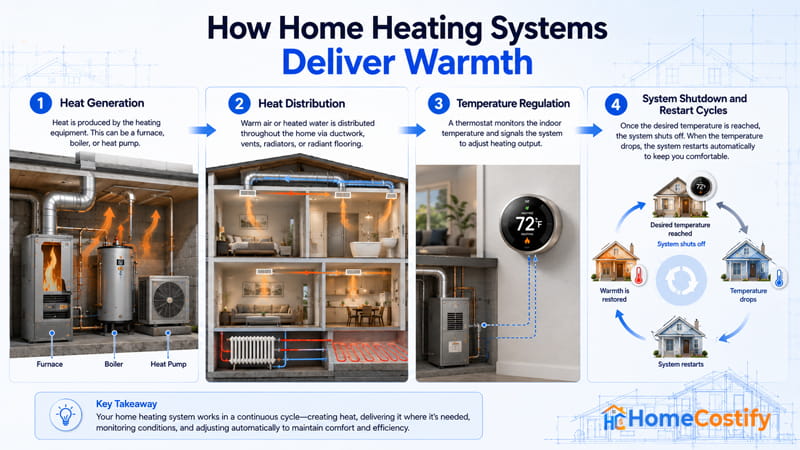
A house loses heat every minute during cold weather. Walls, windows, ceilings, and doors all allow some heat to escape. The job of a heating system is to replace that lost warmth quickly enough to keep indoor temperatures within a comfortable range.
Looking at how home heating systems work starts with a simple idea. Heat leaves the house throughout the day, and the equipment must continuously replace that lost warmth to maintain comfortable indoor conditions.
Heat Generation
Everything starts with a source of heat. A furnace burns fuel inside a combustion chamber. Electric resistance equipment converts electricity directly into warmth. Heat pumps pull thermal energy from outdoor air or the ground and move it indoors.
The equipment may operate in very different ways behind the scenes, yet each approach serves the same purpose. Indoor spaces need a steady supply of heat whenever outdoor temperatures begin pulling warmth from the house.
Heat Distribution
Once heat is available, it has to reach the rooms where people live.
In a forced-air installation, heated air travels through ducts before entering rooms through supply vents. Hydronic systems use heated water instead. That water circulates through radiators, baseboards, or radiant floor tubing positioned throughout the house.
The delivery method influences how a house feels during winter. Warm air from vents creates a different experience than heat rising from a floor surface or radiating from cast-iron radiators.
Temperature Regulation
Indoor temperatures are constantly changing. Sunlight entering through windows, outdoor weather shifts, cooking activities, and occupancy levels all influence how quickly a house gains or loses heat.
The thermostat acts as the system’s decision-maker. When indoor temperatures fall below the selected setting, a signal is sent to start a heating cycle. Once the desired temperature is reached, the equipment shuts down.
System Shutdown and Restart Cycles
Heating equipment rarely runs without interruption. After indoor temperatures reach the target setting, the system pauses while the house gradually loses heat to the outdoors.
As temperatures drift downward again, another heating cycle begins. This pattern repeats throughout the day and night. Some cycles are brief. Others last much longer during severe cold weather.
That continuous pattern of warming, cooling, and reheating is what allows modern heating systems to maintain stable indoor temperatures despite changing outdoor conditions.
Comfort, Efficiency, and Heating Performance
A heating system can keep a house warm and still consume more energy than necessary. The difference often becomes noticeable during winter when utility bills begin arriving month after month.
Two homes may experience similar weather conditions, yet one household spends considerably more on heating than the other. Equipment choice plays a role, but it is only part of the story.
What Makes a Heating System Efficient?
Efficiency comes down to how much energy enters the system compared with how much usable heat reaches occupied rooms. Some equipment extracts more heat from a fuel source before that energy leaves through exhaust gases. Other systems reduce waste by transferring heat rather than creating it through combustion.
Fuel use is one piece of the equation. A furnace that burns large amounts of natural gas without delivering consistent indoor warmth will generally cost more to operate than equipment that converts a greater share of that fuel into usable heat. The same principle applies to electricity.
Heat delivery matters as well. A house may contain an energy efficient heating system, yet comfort can still suffer when duct leaks, insulation gaps, or airflow restrictions prevent heat from reaching the rooms where it is needed. Warmth lost before it reaches living spaces is energy that has already been paid for.
Equipment runtime offers another clue. Systems that run continuously during moderate winter weather often face a larger workload than systems operating under balanced conditions.
Common Efficiency Ratings
Several industry ratings are used to compare heating equipment.
- AFUE, or Annual Fuel Utilization Efficiency, is commonly used for furnaces and boilers. The rating measures how much fuel is converted into usable heat over a heating season. A higher AFUE percentage generally indicates less wasted fuel.
- HSPF2 is associated with a heat pump. The rating measures seasonal heating efficiency under updated testing procedures and allows homeowners to compare one model against another.
- ENERGY STAR certification identifies products that meet efficiency standards established through federal guidelines. While certification does not guarantee lower utility bills on its own, it provides a useful benchmark when comparing equipment options.
According to the U.S. Department of Energy, modern air-source heat pump systems can reduce heating electricity use by up to 75% compared with electric resistance heating. Improvements in cold-climate technology have also expanded their use in regions that experience regular freezing temperatures.
Why Home Insulation Matters
Even highly efficient equipment faces an uphill battle when heat escapes too quickly.
The building envelope acts as the boundary between conditioned indoor spaces and outdoor weather. Walls, ceilings, windows, doors, and floors all influence how rapidly a house loses heat during winter.
Poor insulation increases the workload placed on heating equipment. Warm air leaves the structure more quickly, forcing longer operating cycles to maintain the same indoor temperature.
The relationship becomes especially noticeable with an electric heating system, where extended runtime often translates directly into higher electricity consumption. Reducing heat loss can lower demand on the equipment and improve overall heating performance throughout the season.
How Long Do Home Heating Systems Last?

Most heating equipment is expected to remain in service for many years, but no system lasts forever. Wear accumulates gradually. Motors age, heat exchangers endure repeated temperature changes, and mechanical components experience thousands of operating cycles each year.
Average Lifespan of Common Systems
A gas furnace commonly remains in service for 15 to 20 years when properly maintained. Boilers often remain operational even longer and frequently reach the 20- to 30-year range.
A residential heat pump typically operates for 10 to 15 years, although local climate and usage patterns can influence actual service life. Systems that provide both heating and cooling often accumulate operating hours more quickly than equipment used only during winter.
| System | Typical Lifespan |
|---|---|
| Furnace | 15–20 Years |
| Boiler | 20–30 Years |
| Heat Pump | 10–15 Years |
| Electric Resistance Heating | 20–30 Years |
| Geothermal Heat Pump | 20–25 Years |
| Geothermal Ground Loop | 50+ Years |
Note: Actual lifespan depends on maintenance, installation quality, usage patterns, and climate conditions.
Factors That Affect Lifespan
The most important influences include maintenance, annual workload, and climate conditions.
Equipment operating in regions with long winters often accumulates more runtime than equipment installed in milder climates. Dirty filters, neglected service issues, and airflow restrictions can also accelerate wear.
The overall heating system lifespan often reflects years of small decisions rather than a single major event.
According to information from the U.S. Department of Energy, a geothermal heat pump ranks among the longest-lasting residential heating technologies. Indoor equipment may remain operational for roughly two decades, while properly installed underground loop systems can remain in service for more than 50 years.
Common Signs a Heating System Needs Attention
Heating equipment rarely stops working without warning. In many cases, smaller changes appear first and become more noticeable as the problem develops.
Uneven Heating
Rooms that once felt comfortable may begin warming at different rates. One bedroom may remain cool while nearby areas reach the desired temperature without difficulty.
Unusual Noises
Rattling, grinding, banging, or squealing sounds often indicate mechanical wear or airflow-related concerns. New noises are usually worth investigating.
Rising Energy Bills
A sudden increase in winter utility costs can signal developing heating system problems, particularly when weather conditions remain similar to previous years.
Frequent Cycling
Equipment that starts and stops repeatedly throughout the day may be experiencing airflow restrictions, thermostat issues, or sizing concerns.
Reduced Comfort Levels
Comfort changes are often among the earliest home heating issues occupants notice. Rooms may take longer to warm up, temperatures may fluctuate more frequently, or the house may never seem to reach the desired setting despite extended equipment operation.
Small symptoms do not always indicate major repairs. They often signal that the system would benefit from inspection before minor concerns develop into larger problems.
Basic Home Heating System Maintenance
Heating equipment works hardest when winter temperatures remain low for days or weeks at a time. During those periods, small maintenance issues can become much easier to notice. Airflow may weaken, rooms may warm more slowly, and utility costs can begin creeping upward. Regular heating system maintenance helps keep those issues from developing into larger repairs.
Replacing or Cleaning Filters
Few maintenance tasks are simpler than checking air filters, yet it is also one of the most frequently overlooked.
As dust, pet hair, and airborne particles accumulate, airflow becomes more restricted. The equipment must work harder to move air through the system, which can increase operating strain and reduce heating effectiveness. Dirty filters may also affect indoor air quality by allowing contaminants to circulate throughout living spaces.
Many households benefit from checking filters every month during periods of heavy use. Some filters require replacement, while others are designed for cleaning and reuse.
Inspecting Thermostats and Controls
Temperature complaints are not always caused by the heating equipment itself. Sometimes the issue starts with the controls responsible for managing system operation.
A thermostat that is incorrectly programmed may keep temperatures lower than intended during certain hours of the day. Calibration issues can also create a gap between the displayed temperature and actual room conditions.
Seasonal checks take only a few minutes. Confirming schedules, reviewing settings, and verifying accurate temperature readings can prevent unnecessary service calls while supporting effective home heating maintenance practices.
Checking Vents, Registers, and Radiators
Furniture placement, rugs, curtains, and household clutter can sometimes interfere with heat delivery.
A supply register blocked by a couch or large cabinet cannot distribute warm air effectively. The same principle applies to radiators hidden behind furniture or decorative covers. Heat still leaves the equipment, but less of it reaches occupied areas where it is needed.
Periodic visual inspections often reveal simple issues that affect comfort. A room that feels colder than the rest of the house may not have an equipment problem at all. Restricted airflow is frequently part of the story.
Scheduling Professional Maintenance
Not every maintenance task can be handled during a quick walk-through of the house.
Annual inspections give technicians an opportunity to examine components that homeowners rarely see. Electrical connections, burners, motors, heat exchangers, safety controls, and other internal parts benefit from periodic evaluation.
Preventive service appointments also provide an opportunity to identify developing wear before it leads to unexpected breakdowns. Consistent heating system maintenance often costs far less than emergency repairs performed during the middle of winter.
Basic Heating Maintenance Checklist
| Maintenance Task | Recommended Frequency |
|---|---|
| Replace Filters | Every 1–3 Months |
| Check Thermostat Settings | Seasonally |
| Inspect Vents and Registers | Seasonally |
| Professional Inspection | Annually |
Conclusion
Winter comfort depends on much more than a thermostat setting. Modern home heating systems include a wide range of technologies, from furnaces and boilers to heat pumps, radiant heating, and electric heating equipment. Each approach delivers warmth in a slightly different way, yet all share the same purpose: maintaining livable indoor conditions when outdoor temperatures fall.
The variety of heating systems for homes available today gives homeowners more choices than ever before. Equipment selection matters, but efficiency, insulation quality, and regular care often influence long-term results just as much.
Routine home heating maintenance helps preserve performance, while periodic inspections can identify developing concerns before they become expensive repairs. Even the most advanced equipment relies on proper installation and ongoing care to perform at its best.
Among all the mechanical systems found in a house, few have a greater impact on winter comfort than well-maintained home heating systems.
FAQs About Home Heating System
What is the most efficient type of home heating?
Modern heat pumps are often among the most efficient residential heating options, particularly in regions with moderate to cold winters.
What is the heating system in a house called?
The general term is a home heating system, which may include a furnace, boiler, heat pump, or electric heating equipment.
What is the best method of heating a house?
The answer depends on climate, energy costs, insulation levels, and the home’s design.
What is the safest indoor heating method?
Properly installed and maintained systems that meet local codes are generally considered safe.
What is the healthiest way to heat a house?
A system that maintains stable temperatures while supporting good indoor air quality is often the most comfortable choice.