Have you ever wondered why a lamp turns on the moment you flip a switch or why a coffee maker starts heating as soon as you plug it in? Behind that simple action, how does home electricity works involves far more than a wire running from the utility company to a wall outlet.
By the time electricity reaches a kitchen outlet or bedroom light fixture, it has already crossed transmission lines, passed through utility equipment, entered the service line, and reached the breaker panel inside the house.
None of those parts are visible during everyday use, yet each one affects where electricity goes and how it reaches the right circuit.
What Is a Home Electrical System?
A home electrical system combines the service entrance, meter, breaker panel, branch circuits, outlets, switches, and other parts into one network. Electricity enters from the utility, moves across each section in sequence, and reaches the places where power is needed.
By contrast, electrical wiring refers only to the conductors that carry current. Wiring forms one portion of the electrical system in a house, but it does not include the equipment that measures, routes, or controls power.
Viewing home electricity work from this wider perspective makes it easier to follow the sections ahead. The electrical system house depends on every part working in sequence so electricity reaches its destination safely.
That same principle shapes how household electricity works across household electrical system layouts and other residential electrical systems, even though floor plans and electrical loads may differ from one house to another.
How Does Home Electricity Work From the Grid to Your House?

Power does not appear at a wall outlet the moment a utility company generates it. A long delivery path comes first. Every stage changes, routes, or prepares the electrical supply before it reaches a house at a voltage suitable for daily use.
Following that path gives a much clearer picture of home electricity work and shows how each part of the network passes electricity to the next without skipping a step.
Electricity Is Generated at Power Plants
The journey begins at a power plant, where generators produce AC power. The spinning motion inside the generator creates alternating current, which becomes the standard form of electricity carried across the national grid.
The source of that energy may come from natural gas, coal, nuclear fuel, hydroelectric dams, wind, or solar facilities. No matter where the energy originates, the electricity entering the transmission network follows the same basic principle.
From there, the output joins the larger utility power grid. Thousands of miles of wires and equipment carry electricity toward cities, suburbs, and rural communities every hour of the day. That first stage marks the beginning of home electricity work, even though the power remains far from any house.
High-Voltage Transmission Moves Electricity Long Distances
Electricity travels across high-voltage transmission lines before reaching local neighborhoods. Raising the voltage allows large amounts of electricity to move across long distances with lower energy loss. Sending the same amount of electricity at a lower voltage would waste far more energy as heat inside the conductors.
Steel towers support these transmission lines across open land, highways, rivers, and mountains. Long-distance travel ends once the electricity reaches a local substation serving nearby communities.
Distribution Transformers Reduce Voltage for Residential Use
Inside the substation, equipment prepares electricity for neighborhood distribution. The voltage drops from transmission levels to distribution levels, making local delivery possible.
A nearby distribution transformer, sometimes called a utility transformer, performs another voltage reduction before electricity enters nearby houses. That final adjustment produces the familiar 120/240-volt split-phase power used across most U.S. homes.
This stage answers a common question about how electricity works in a home. Appliances do not receive transmission voltage because it has already been reduced long before the electricity reaches the neighborhood.
Electricity Reaches Your Home Through the Service Line
The last portion of the trip begins with the service connection serving the house. Electricity may arrive through an overhead service drop extending from a utility pole or through an underground service lateral buried below ground.
Both paths terminate at the service entrance, where electricity enters the home electrical system. A typical U.S. service includes two hot conductors and one neutral conductor. Those wires carry residential electricity from the utility into the house, preparing it for distribution through the interior electrical system.
Anyone asking how does house electricity work is really tracing this complete journey, beginning at the power plant and ending at the service entrance.
| Stage | Primary Function |
|---|---|
| Power Plant | Generates AC electricity |
| Transmission Lines | Carry electricity over long distances |
| Substation | Routes electricity to local distribution |
| Distribution Transformer | Reduces voltage for homes |
| Service Line | Delivers electricity to the residence |
How Electricity Enters and Moves Through Your Home

Electricity has reached the house, but it still has more distance to cover before a lamp lights up or a refrigerator starts running. Power follows a fixed route after passing the service entrance.
Each piece of equipment directs electricity toward the next destination until it reaches the circuits supplying everyday devices. Seeing that path from beginning to end gives a clearer picture of home electricity work inside a typical U.S. house.
Electricity Passes Through the Electric Meter
The first stop is the electric meter mounted outside the house or inside a meter enclosure, depending on local utility practices. This device records how much electricity passes into the house over time. Monthly utility bills come from those readings rather than from the breaker panel or wall outlets.
In most parts of the United States, the utility company owns the meter even though it sits on private property. Utility crews install, inspect, replace, or service the meter whenever work becomes necessary.
That arrangement keeps electricity usage measurements consistent across the local service area. Seeing the meter at the front or side of the house often marks the first visible clue of home electricity work after electricity leaves the neighborhood distribution network.
The Main Breaker Panel Receives Incoming Power
From the meter, electricity enters the main breaker panel, often called the electrical panel, service panel, or load center. The main breaker sits at the top of the panel and can disconnect incoming power from the house with one switch. Below it, metal bus bars distribute electricity to the circuit breakers supplying different parts of the house.
According to the Electrical Safety Foundation International (ESFI), the National Electrical Code (NFPA 70) serves as the primary U.S. standard for the safe installation of residential electrical wiring and equipment.
States adopt the NEC through their own regulations, giving electricians and inspectors a common technical reference for wiring methods, grounding, circuit protection, and equipment installation intended to reduce electrical shock, fire, and other hazards.
This section of the house electrical system acts as the central distribution point. Every branch leaving the panel receives power from this location, giving a practical example of how home electricity works after electricity enters the house.
Branch Circuits Deliver Power Throughout the House
Electricity leaves the panel through a branch circuit serving a specific area or purpose. One circuit may supply bedroom outlets. Another feeds lighting fixtures. Larger appliances often use a dedicated circuit sized for higher electrical demand.
Circuit layouts vary from one house to another, although the basic flow remains the same. Electricians match breaker size, wire gauge, and expected electrical load before installing home wiring. That planning allows electricity to reach each destination through the correct path.
Seeing those circuits spread across the house gives another practical example of home electricity work and shows how electricity works at home beyond the main panel.
Electricity Reaches Outlets, Switches, and Appliances
The final destination is the point where people use electricity every day. A standard electrical outlet, also called a receptacle, supplies portable devices, televisions, lamps, and kitchen equipment. An electrical switch opens or closes a circuit controlling ceiling lights, wall sconces, or exterior fixtures. Fixed appliances receive electricity through their assigned circuits based on power requirements.
By the time electricity reaches those devices, it has already traveled from the utility grid through the meter, panel, breakers, and branch wiring. That complete route forms the practical foundation of home electricity work.
It also answers common questions about how home electricity works without turning the home electrical wiring hidden inside walls into a mystery.
| Component | What It Does |
|---|---|
| Electric Meter | Measures electricity usage |
| Main Breaker Panel | Receives and distributes power |
| Branch Circuits | Carry electricity to different areas |
| Outlets | Supply electricity to devices |
| Switches | Open or close electrical circuits |
How Electrical Circuits Keep Electricity Flowing
Electricity reaches the breaker panel, yet a lamp still stays dark until one condition is met. Current needs a complete loop. Once that loop exists, electricity leaves the panel, passes through wiring, moves across a device, and returns to its source.
Break that loop at any point and the current stops. That simple principle sits behind home electricity work and answers a question people often have about how electricity works in a house.
The Hot Wire Delivers Electrical Current
The hot wire carries energized current from the breaker panel toward a light fixture, receptacle, or appliance. Voltage remains present on this conductor whenever the breaker stays on, even if nothing is running at the far end of the circuit.
Picture a bedroom lamp plugged into a receptacle. Electricity leaves the panel through the hot conductor first. It travels inside household electrical wiring, reaches the outlet, then waits for the switch or appliance to complete the circuit. Without that first path, electricity never reaches the device.
Every branch leaving the panel contains a hot conductor matched to the breaker protecting that circuit. That arrangement forms another part of home electricity work, moving electrical energy from the panel toward the place where people use it every day.
The Neutral Wire Completes the Circuit
The trip does not end after electricity reaches a lamp or appliance. Current must return to its source. The neutral wire serves that purpose by carrying electricity back after it passes through the connected load.
Think about a table lamp switched on during the evening. Current enters through the hot wire, flows across the bulb filament, then leaves through the neutral conductor. Once that return route exists, the circuit becomes a closed electrical loop. Remove the neutral conductor from that loop and the bulb no longer lights because electricity has no continuous return path.
That return conductor often receives less attention than the hot wire, yet both remain necessary for normal electrical current flow. Their combined movement creates the electricity flow powering lights, televisions, computers, and countless other devices. It also gives a practical picture of how household electricity works inside a typical American home.
The Ground Wire Protects Against Electrical Faults
The ground wire serves a different purpose. Under normal conditions, it carries no operating current. Its value becomes clear only after something goes wrong.
Imagine a damaged wire touching the metal frame of a washing machine. Without a safe path back to the panel, that metal surface could remain energized. The grounding system gives fault current a direct route back toward the electrical source. That sudden surge allows the protective device to react before the fault continues.
A properly installed grounding conductor remains part of home electrical wiring basics even though it stays inactive during ordinary operation. It exists for abnormal conditions, not daily electricity use.
Why Electricity Stops When You Turn Off a Switch
A wall switch changes one small section of the circuit. Press the switch on, internal contacts touch each other, creating a closed circuit. Electricity now follows a complete electrical path from the panel to the light and back again.
Flip the switch off and those contacts separate. The circuit becomes open. Current can no longer complete its return route, so the light goes dark. Nothing changes at the utility transformer or breaker panel. Only one small gap inside the switch interrupts the loop.
That everyday action completes another piece of home electricity work. Electricity moves only after every part of the circuit forms one continuous loop. Break that loop, and current stops.
How Circuit Breakers Protect Your Home Electrical System
Electricity must remain within the limits of the wiring carrying it. Excess current generates heat, and heat can damage insulation, wiring, or electrical equipment long before visible warning signs appear.
A circuit breaker guards each branch circuit by disconnecting power once current rises beyond the breaker’s rating. That protective function completes another part of home electricity work.
Based on guidance from the National Fire Protection Association (NFPA), electrical safety begins with a residential electrical system installed in accordance with the National Electrical Code. Proper grounding, circuit protection, and code-compliant wiring reduce electrical hazards across the home.
How Circuit Breakers Detect Electrical Problems
A breaker does not calculate monthly electricity usage. The electric meter handles that job. The breaker monitors the amount of current passing through its circuit. Current exceeding the rated limit triggers an internal trip mechanism, opening the circuit before excessive heat continues building inside the wiring.
Common Reasons a Breaker Trips
Circuit overload remains a common cause. Running high-demand appliances from one branch circuit can push current beyond the breaker rating. A short circuit develops after energized conductors contact another conductor or grounded metal.
A ground fault sends current toward ground through an unintended route. Modern electrical systems may also include GFCI and AFCI protection for locations facing higher shock or arc risks, adding another layer of electrical safety.
What Happens After a Breaker Trips
Once a breaker trips, electricity stops flowing through that circuit. Lights turn off, receptacles lose power, and connected equipment shuts down. The interruption limits heat inside the wiring and lowers the chance of damage from an electrical fault.
Resetting the breaker without finding the original cause often leads to another trip. Repeated tripping, a burning smell, scorch marks, or visible damage around the panel calls for inspection by a licensed electrician.
A healthy home electrical system depends on wiring and protective devices working as intended, completing another part of home electricity work and illustrating how home electricity works under normal conditions and during electrical faults.
Why Do Homes Use Both 120V and 240V Electricity?
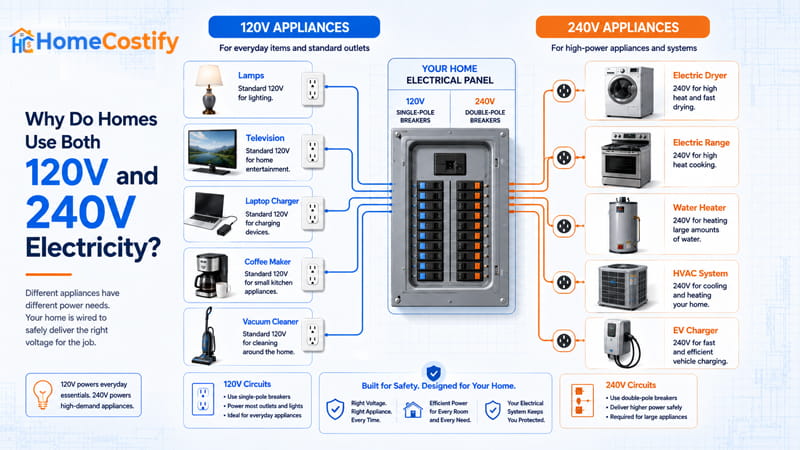
A ceiling fan, laptop charger, electric dryer, and central air conditioner all use electricity, yet they do not draw power the same way. The electrical service entering a typical U.S. house delivers two voltage levels.
That arrangement allows everyday electronics and high-demand equipment to operate from the same service without placing every appliance on identical voltage. This part of home electricity work often surprises people because both voltages arrive through the same 120/240 volt service.
How 120-Volt Circuits Power Everyday Devices
Most rooms inside a house depend on 120-volt circuits. Lamps, televisions, desktop computers, game consoles, phone chargers, coffee makers, and countless other everyday products receive electricity from these branch circuits. Their power demand stays low enough that a standard 120-volt supply handles normal operation without difficulty.
Inside the service panel, split-phase power supplies one hot conductor and one neutral conductor for these circuits. Electricity travels through standard branch wiring before reaching receptacles and light fixtures placed around the house. That arrangement forms a familiar part of how electricity works at home, even though most people never see the wiring hidden behind finished walls.
Portable appliances also fall into this category. Vacuum cleaners, toasters, microwave ovens, and similar equipment plug into ordinary receptacles because their electrical load fits within the limits of a standard household circuit. Daily use of household electricity depends heavily on these 120-volt circuits.
Why Large Appliances Need 240 Volts
High-demand equipment draws much more power than a lamp or television. Electric dryers, electric ranges, storage water heaters, heat pumps, central air conditioners, and EV chargers often operate on 240 volts.
Higher voltage allows those appliances to receive the power they require without drawing the same current a 120-volt circuit would need for identical wattage. Lower current reduces stress on conductors serving those appliances. Large equipment also receives power through a dedicated circuit, keeping that electrical demand separate from general lighting and receptacle circuits.
This arrangement forms another part of home electricity work. Both voltage levels originate from the same residential split phase electrical service entering the house. The difference appears at the breaker panel, where circuits receive either 120 volts or 240 volts according to the equipment they serve.
| 120V Appliances | 240V Appliances |
|---|---|
| Lamps | Electric Dryer |
| Television | Electric Range |
| Laptop Charger | Water Heater |
| Coffee Maker | HVAC System |
| Vacuum Cleaner | EV Charger |
Conclusion
Electricity travels much farther than most people realize before reaching a light switch or wall outlet. It begins at the utility grid, passes through transmission equipment, enters the service line, flows into the breaker panel, and reaches branch circuits supplying lights, receptacles, and appliances.
Every section contributes to home electricity work, creating a continuous route from the electrical source to the equipment people use each day.
A home electrical system includes much more than wires hidden inside walls. The meter records electricity usage. The breaker panel distributes incoming power. Branch circuits carry electricity across the house, and protective devices interrupt dangerous faults before wiring suffers damage.
That sequence forms the electrical system in house found across the United States and reflects the structure of a typical residential electrical system.
Following that complete path gives a clearer picture of how home electricity works. Even though most electrical equipment stays out of sight, every part serves a purpose before electricity reaches the next outlet, light fixture, or appliance.
FAQs About How Does Home Electricity Work?
How do we use electricity at home?
Electricity powers lighting, kitchen appliances, electronics, heating, cooling equipment, and countless everyday devices through branch circuits that receive power from the main electrical panel.
How does electricity work step by step?
Electricity travels from the utility grid to a transformer, enters the house through the service line, passes the panel, moves through branch circuits, reaches electrical devices, then returns through the circuit.
What wastes the most electricity in a house?
Heating, air conditioning, electric water heaters, clothes dryers, and older refrigerators usually consume more electricity than lighting or portable electronics because of their larger power demand.
What is the cheapest time of day to use electricity?
The answer depends on the electric utility. Homes with time-of-use pricing often pay lower rates during off-peak hours, commonly late evening or overnight.
Is it cheaper to leave lights on?
No. Turning lights off when they are not needed usually uses less electricity than leaving them on, especially with incandescent and halogen bulbs.