
A 78°F setting is one of the most familiar recommendations for summer cooling. The best temperature to set thermostat in summer can use that figure as a practical reference, not a rule every household must follow. What works indoors depends partly on the conditions people actually experience throughout the day.
Comfort inside the house comes from more than the number displayed on the wall. Sun exposure can warm certain rooms, while moisture and limited air movement can make the space feel less pleasant. Air distribution becomes important when cooled air does not reach every area evenly.
Daily routines add another consideration, since occupied rooms need attention that empty spaces do not. Individual tolerance affects occupants’ response to a particular indoor temperature. A useful summer target starts with the thermostat, but the indoor experience determines whether that target actually works.
What Is the Best Temperature to Set Your Thermostat in Summer?
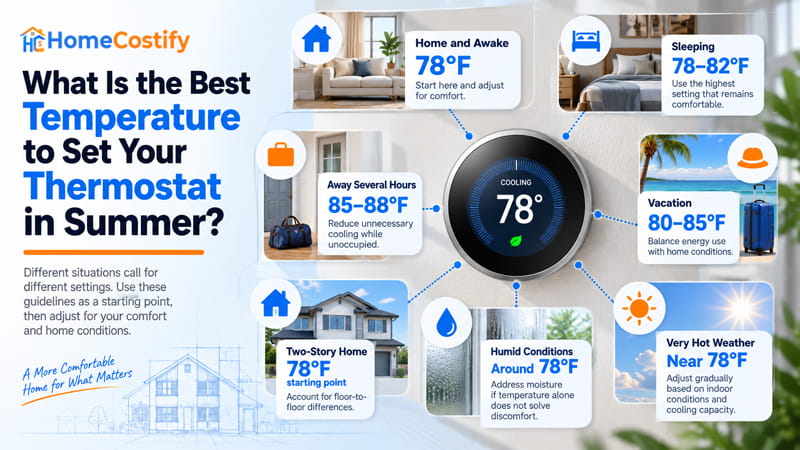
For most occupied homes, 78°F provides a practical starting temperature for summer cooling. The table below puts that figure into common household situations without treating any one setting as universal.
| Situation | Starting Temperature | What to Consider |
|---|---|---|
| Home and awake | 78°F | Begin here and judge indoor comfort |
| Sleeping | 78–82°F | A warmer room may remain comfortable at night |
| Away for several hours | 85°F | Less cooling is needed while the house is empty |
| Away for several days | 80–85°F | Balance reduced cooling with reasonable indoor conditions |
The figures above give you a place to begin, not a rule to follow all day. Choose the listed setting that corresponds to the current situation, then pay attention to the result. A room already meeting the occupants’ comfort needs gains little from a lower number simply because one is available.
The thermostat controls a chosen indoor temperature, but its display cannot show every condition affecting the room. Sunlight and uneven cooling can alter conditions from one room to another.
Before changing the setting again, consider what is happening indoors. If people feel comfortable, there is little reason to keep lowering the temperature. Persistent discomfort calls for a closer look at the room rather than an automatic drop in the setpoint.
Begin with the situation that best describes the household, then keep the setting that provides acceptable comfort without unnecessary adjustment.
Why 78°F Is a Good Starting Point, but Not a Universal Setting
The 78°F recommendation is not simply a number chosen for comfort. Its continued use also relates to how much energy air conditioning requires at different conditions. This makes the recommendation worth examining from an efficiency perspective before considering when another setting may be appropriate.
How 78°F Can Reduce Summer Cooling Costs
The gap between indoor and outdoor temperatures affects the work required from an air conditioner. A smaller differential means less heat removal is needed to maintain the desired indoor condition. Raising the thermostat narrows that gap, leaving less cooling demand for the system to handle.
DOE guidance puts a measurable cost range behind this relationship. Operating at 78°F instead of 72°F can save about 6% to 18% on cooling expenses. For a summer thermostat setting, the difference shows how a higher target can materially affect energy use. The reported range represents potential energy savings, with actual results varying by home.
Why 78°F Is a Baseline, Not a Requirement
The recommendation serves as an efficiency-oriented reference after the energy tradeoff is understood. The best thermostat setting for summer can differ from that reference without contradicting the underlying energy principle. Its purpose is to give homeowners a reasonable reference for evaluating summer operation.
Looking at HVAC use across seasons can also help you save on your heating bill, even though the 78°F reference here applies specifically to summer cooling.
Energy efficiency and personal comfort do not use the same threshold. A choice that favors lower energy use may not suit an occupant’s preferred conditions. The two decisions can point toward different settings without making either consideration irrelevant.
What the 78°F Evidence Does—and Does Not—Prove
The available evidence supports the use of higher summer settings for reducing air-conditioning energy use. It does not identify a single temperature as the preferred choice for comfort. This limitation keeps the evidence focused on energy performance, not household preference.
The evidence does not establish a preferred temperature for comfort. Its role is narrower: it supports the energy case for using a higher setting during summer. This conclusion supports using 78°F as an efficiency reference without turning the figure into a requirement.
What Changes the Right Summer Thermostat Setting?

The number on a thermostat represents a measured point within the home, not the complete indoor thermal environment. Occupants respond to the broader surroundings they encounter across living spaces.
Humidity and Moisture
Moisture in the indoor air changes how occupants experience a given temperature. Relative humidity affects the body’s ability to release heat, which can alter thermal comfort without any change at the thermostat. The ideal summer thermostat temperature is consequently tied to more than the measured air temperature.
EPA material adapted from ASHRAE demonstrates this effect through different summer comfort ranges. At 30% RH, the range is roughly 74–80°F; at 50% RH, it shifts to 73–79°F. With 60% RH, the range narrows to about 72.5–78°F. These figures show how changes in relative humidity can alter the temperature range associated with comfort.
Airflow and Temperature Distribution
Air movement creates a cooling sensation at the body, even though the thermostat remains at the same setpoint. Moving air helps heat leave the skin more readily. Perceived comfort can change while the measured temperature stays unchanged.
A thermostat reflects the air around its sensing point. Conditions elsewhere in the home can differ because rooms receive conditioned air in different ways. A thermostat setting for summer may not describe those variations accurately. Distance from vents, airflow patterns, and sun exposure can all contribute to spatial differences.
Sunlight, Insulation, and Indoor Heat
Sunlight entering through windows adds heat to specific parts of a home. Solar gain can make those areas place a greater demand on the cooling system. The effect is often localized, depending on which surfaces receive direct exposure.
The building envelope limits how much outdoor heat reaches the interior. A summer thermostat setting does not determine the entire cooling load by itself. Insulation and windows affect the amount entering the home, while cooking, lighting, and electronics generate additional internal heat. The AC must remove the combined load created by these sources.
How Should You Adjust the Thermostat for Different Occupancy?
The people in a home are not present under the same circumstances all day. Their presence changes the purpose behind a thermostat decision at different points in the day. Occupancy is therefore a useful basis for determining when the home’s cooling needs a different approach.
When the House Is Occupied
Active use makes immediate comfort the relevant reference for the home. People present in the house need conditions that support normal household activities. The occupied state becomes the basis for deciding how the space should be maintained.
When Everyone Is Sleeping
Sleep creates a distinct period of use because occupants remain at rest for several hours. What should thermostat be set at in summer depends on the nighttime comfort requirement rather than daytime activity. A sleep environment can warrant its own decision without requiring one universal temperature.
When the House Is Empty
With nobody home, maintaining the same level of immediate comfort is no longer necessary. Active cooling can be reduced during a temporary absence, since the space does not need to support current household use.
For an absence lasting several hours, a 7–10°F increase offers a practical starting framework. The thermostat setting for summer still needs to reflect the home’s characteristics and current conditions. This approach provides a guide without creating a fixed rule for every property.
When You’re Away for Several Days
A multi-day absence changes the objective because normal household use has stopped for much longer. Vacation decisions focus on keeping the unused home within reasonable conditions instead of maintaining its usual occupied state.
The property itself sets practical limits on the adjustment. Climate, moisture risk, building characteristics, and absence duration can all influence the appropriate approach. These considerations remain relevant even with no occupants present.
How Does a Two-Story Home Change Summer Thermostat Settings?

A two-story house can develop different temperature patterns across its levels, particularly during periods of sustained summer heat. Warmth may accumulate upstairs while lower areas remain closer to the conditions measured by the thermostat. The result is a home where a single target does not necessarily produce the same experience everywhere.
Why Upstairs Can Feel Hotter
Upper floors commonly retain more warmth because heated air moves upward and collects near higher parts of the building. The upper level may also receive greater exposure through its roof and surrounding surfaces, adding to the temperature difference between floors. These effects can combine with the home’s existing heat distribution, leaving bedrooms or living areas upstairs warmer than rooms below.
The result does not automatically mean that the entire house needs a lower thermostat setting. A warmer upper floor can instead indicate that temperatures are distributed unevenly across the structure.
When One Thermostat Controls Uneven Conditions
The thermostat’s location determines which part of the house provides the measurement used to control cooling. A device downstairs, for example, guides the system from that level while occupants upstairs may experience another indoor environment.
This limitation matters because a control point cannot account equally for every room. Lowering the setpoint may cool the area around the thermostat more aggressively without resolving the underlying floor-to-floor imbalance.
How Zoning Changes the Approach
Zoning addresses this issue by dividing the property into separately controlled areas. Each zone can respond to its designated floor or section instead of relying on one measurement for the whole house. A dual-zone thermostat can support this arrangement, giving upstairs and downstairs areas greater control over their individual cooling needs.
What If 78°F Still Feels Too Hot?
A reasonable setting can still leave parts of a home uncomfortable during summer. Persistent discomfort is a signal to examine the result, not simply request a colder target. The cause may lie outside the number displayed by the thermostat.
Check Humidity Before Lowering the Temperature
A room can feel unpleasant despite a measured temperature that seems reasonable. Damp air points toward excess moisture as a possible source of that experience. A colder thermostat target does not automatically remove moisture from the space.
Temperature and moisture create different forms of discomfort. If the room feels cool enough but the air remains damp, moisture control becomes the more relevant concern. Lowering the temperature again does little when excess moisture remains the underlying issue.
Check Airflow and Cooling Performance
Weak airflow, persistently warm rooms, or difficulty reaching the desired indoor temperature provide observable signs of inadequate cooling delivery. These symptoms shift attention toward system performance rather than the number chosen at the thermostat.
If the AC cannot deliver the expected result, investigation should come before another change to the thermostat. Repeatedly requesting colder operation does not correct a delivery problem. The thermostat setting for summer is therefore not the appropriate place to focus when the system itself is falling short.
Check Heat Gain and Thermostat Location
Discomfort limited to particular rooms provides a more localized signal. A room that repeatedly warms during periods of added heat can point toward localized heat gain. That pattern does not justify changing the target for every room in the house.
The sensor itself can affect the control decision if its surroundings do not represent the occupied areas. A nearby heat source can influence its measurement. The resulting response then reflects the sensor’s immediate location instead of the rooms occupants are trying to keep comfortable.
How Can You Save More Without Constantly Lowering the Thermostat?
Keeping unnecessary heat out of the home reduces the amount the AC needs to remove. This lowers cooling demand without requiring a colder indoor target. The approach shifts attention from thermostat changes to the sources adding heat inside the building.
Reduce the Load
Heat entering through the building or generated indoors adds to the cooling burden during summer. Removing avoidable sources gives the AC less heat to handle during periods of high demand.
- Ceiling fans: Increased air movement can make occupants feel cooler without requiring a lower thermostat setting.
- Window shading: Shades and coverings limit direct sunlight from entering rooms during strong afternoon exposure.
- Internal heat sources: Unneeded lights and heat-producing electronics add warmth that the AC must remove.
A smaller cooling demand requires less electricity for the same period of operation. Over the summer, that reduction can help lower your electric bill without constant changes to the summer thermostat setting. The thermostat remains one energy lever, while the amount of heat entering or accumulating indoors provides another.
How Should You Use a Thermostat Schedule in Summer?

A thermostat schedule turns recurring household routines into preset temperature changes that happen automatically. Instead of making the same adjustment manually each day, the schedule applies those decisions at the times already built into the routine.
Match Settings to Your Actual Routine
A useful schedule follows what the household actually does. Generic clock times can become counterproductive if they do not match daily patterns. Recommended thermostat settings work better when their timing reflects real use of the home.
Let Smart Features Handle Temperature Changes
Smart thermostats can take scheduling beyond fixed clock times. Occupancy patterns, programmed routines, and temperature behavior can inform automatic changes throughout the day. This adaptive approach reduces the need for manual intervention without replacing the homeowner’s underlying decisions.
What Is the Lowest You Can Set Your Thermostat in Summer?
The thermostat can usually be set below the 78°F reference used elsewhere in this guide. That lower limit, however, answers a different question from choosing a sensible operating temperature. The lowest available number is not automatically the best choice.
A lower setpoint asks the cooling system to maintain a colder indoor environment. It does not guarantee a proportional improvement in comfort, particularly when another factor is limiting the home’s cooling result.
72°F can be a personal preference for summer cooling, but it is not necessarily the most practical default. A colder setting increases cooling demand, and the additional energy use does not guarantee a noticeable comfort benefit. For what should thermostat be set at in summer, personal preference matters, but the lowest possible number should not become the automatic target.
This summer-focused question is different from deciding the temperature to set thermostat in winter, where the objective is heating rather than cooling. Similarly, finding the cheapest way to heat a house is a separate seasonal efficiency question and should not determine a summer cooling setpoint.
Common Summer Thermostat Mistakes
Thermostat behavior can undermine an otherwise sensible summer approach. The thermostat setting for summer works best when adjustments respond to actual household needs instead of becoming automatic reactions to every change in indoor comfort.
- Dropping the thermostat dramatically after returning to a hot house: A lower target does not make the AC cool the house faster. It simply creates a colder destination for the system to reach.
- Treating 78°F as a mandatory number: A fixed target can override actual comfort instead of treating 78°F as a flexible reference.
- Using the thermostat to compensate for obvious airflow problems: A colder target should not replace attention to persistent distribution or cooling-performance problems.
- Ignoring humidity when the home feels damp: Changing the temperature alone does not necessarily resolve moisture-related discomfort.
- Lowering the whole house because one area is warmer: A localized problem does not automatically justify changing the setting everywhere.
The Best Summer Thermostat Setting Is the Highest Comfortable One
The most useful summer principle is simple: choose the highest thermostat setting that remains acceptably comfortable under the home’s actual circumstances. There is no need to pursue a colder number if the existing setting already meets that threshold.
A practical baseline provides a place to begin, but the final decision comes from the result inside the home. If a change becomes necessary, make it for a clear reason and observe what happens afterward. This keeps thermostat decisions tied to actual comfort instead of chasing a particular number.
FAQs About Best Temperature to Set Thermostat in Summer
What temperature should I set my thermostat in summer?
78°F is a practical starting point for summer cooling, but the best choice depends on whether that temperature remains comfortable in your home.
What temperature should I set my thermostat in summer at night?
A somewhat higher nighttime setting can work when it remains comfortable for everyone sleeping in the home and does not disrupt normal sleep.
What temperature should I set my thermostat when away in summer?
A 7–10°F increase provides a practical starting framework for several-hour absences, rather than requiring the same occupied setting while nobody is home.
What temperature should I leave my thermostat on while on vacation?
Around 80–85°F can serve as a practical vacation starting range, although climate, moisture, and property characteristics affect the appropriate choice.
Is 72°F too low for AC in summer?
72°F can suit personal preference, but it is below the efficiency reference used in this guide and can increase cooling demand without guaranteeing better comfort.