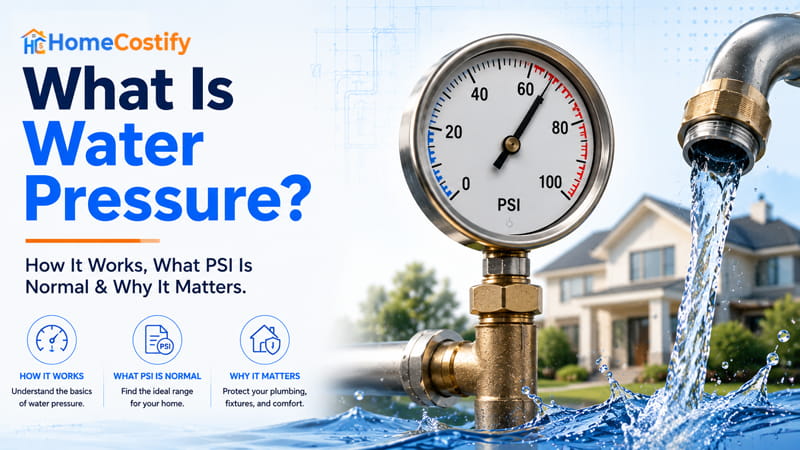
A shower can feel noticeably weaker than a nearby faucet, even within the same home. A fixture may deliver a strong stream, yet another struggles during ordinary use. For a homeowner, water pressure seems like the obvious explanation, but the outlet reveals only the final water delivery.
A pressure reading provides the available push, while flow indicates how much water moves through the system. What happens between the supply and outlet can change what reaches the fixture. A gauge captures the pressure at its measurement point; the water reaching the outlet reflects the final delivery.
What Is Water Pressure?
In residential plumbing, water pressure describes the push acting on water inside the system. Pressure relates force to the area receiving it. For U.S. homeowners, PSI, or pounds per square inch, is the standard unit used to express pressure. The measurement shows how much force acts across each square inch of the measured area.
Inside a home’s piping, pressure provides the energy that helps water move when an opening allows it to travel. Water can remain under pressure even when no fixture is running. The piping holds stored pressure until water has a path toward an outlet. A reading taken at a particular section applies to that location. Another section can show a different value.
Flow measures the quantity of water that moves over time. Water flow rate expresses that quantity, commonly as gallons per minute. Pressure and flow are connected, but they answer different measurement questions. Pressure concerns the push available to move water. Flow concerns the volume passing through a given path during a set period.
How Does Water Pressure Work in a House?
Pressure in a house depends on its source and the network carrying water. Public systems, private wells, pumps, and elevated storage provide the initial pressure condition. From the property connection onward, piping carries that supply toward household points of use.
Where Water Pressure Comes From
A municipal water supply delivers treated water under pressure to connected properties. Water towers and reservoirs use elevation to create pressure through the height of stored water. Pumping infrastructure can supplement that effect when elevation alone cannot provide enough pressure for the surrounding service area.
A private well uses pumps to move groundwater into the home’s supply system. Pressure-storage equipment helps keep usable pressure available between pump cycles. In some properties, gravity also contributes when stored water sits above the area being supplied. The source differs from municipal service, but both arrangements provide the force needed to move water into the home.
How Water Reaches Fixtures
Water enters a property through the service connection. The water meter marks an important point along the incoming path. From there, the supply continues toward the water supply system, where the property’s distribution network begins.
Supply lines carry incoming water toward the interior branches of the home plumbing system. Those branches divide the supply among separate paths serving household fixtures. This basic layout helps explain how does plumbing work in a house: water enters through the connection, branches through the piping, and reaches individual fixtures.
- Water source — establishes where the household supply originates and the pressure entering the property.
- Water meter — measures consumption and forms part of the property’s incoming supply path.
- Supply lines — carry water from the connection toward the interior network.
- Interior piping — divides the supply among branches serving different areas.
- Fixtures — provide the final points where household water becomes available.
What Affects Water Pressure in a Home?
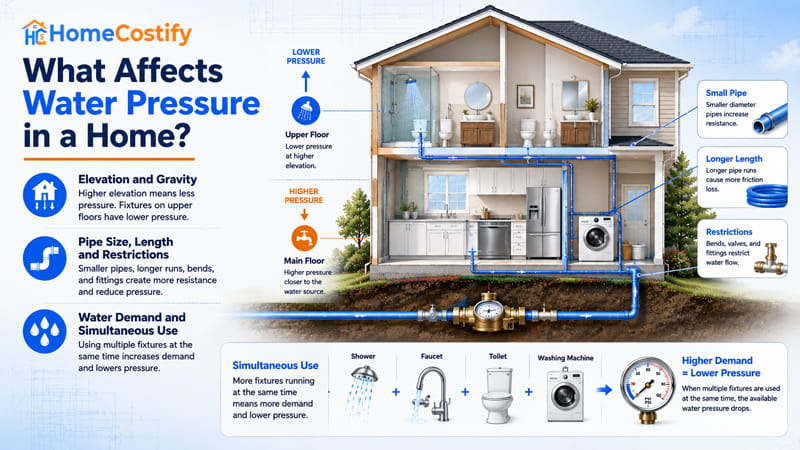
Pressure at the property connection does not guarantee the same pressure elsewhere in the house. Vertical rise, pipe resistance, equipment restrictions, and household demand can all affect what reaches a fixture. Their effects vary with the fixture’s location and the amount of water being used.
Elevation and Gravity
Vertical rise requires energy as water moves from one level of a house to another. Greater elevation separates a fixture from the supply point and leaves less pressure at that higher position. The difference becomes relevant wherever water must climb through multiple levels.
An upper-floor fixture sits farther above the incoming connection than a fixture downstairs. In a two-story house, the vertical separation is greater for fixtures on the upper level. That added height places more distance between the supply point and the fixture.
Pipe Size, Length and Restrictions
A long pipe run creates more friction along its length. Smaller pipe diameters offer less room for passage, increasing resistance. Fittings and bends add further friction wherever the route changes direction.
Filters, softeners, and similar equipment add resistance to the plumbing. A restriction at one of these components affects pressure farther along the line. The incoming service point can still show its original reading. Internal buildup inside a pipe can narrow the passage and affect delivery.
Water Demand and Simultaneous Use
Several fixtures operating together place greater demand on the home’s plumbing. A shower, faucet, or washing machine draws from the network during the same period. Pressure at the points of use reflects that added demand while the fixtures are operating.
A shower running alone draws from the household network. Opening a faucet adds another active fixture to the demand. Starting the washing machine increases the total draw. The shower then operates under a higher household load than it faced by itself.
Water Pressure vs. Water Flow: What’s the Difference?
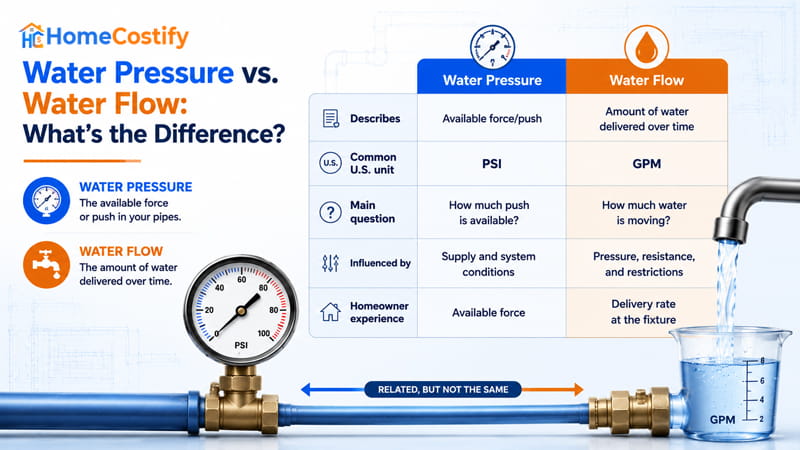
Pressure and flow are related, but they do not describe the same measurement. The table below separates the two by what each measurement captures and how homeowners encounter it.
| Measurement | Water Pressure | Water Flow |
|---|---|---|
| Describes | Available force/push | Amount of water delivered over time |
| Common U.S. unit | PSI | GPM |
| Main question | How much push is available? | How much water is moving? |
| Influenced by | Supply and system conditions | Pressure, resistance, and restrictions |
| Homeowner experience | Available force | Delivery rate at the fixture |
A pressure value indicates the push present in the system. Flow rate expresses the quantity passing a point during a specified period. PSI and GPM represent different measurements, even though pressure helps drive flow. The distinction matters because a numerical pressure value does not directly state how much water will pass through the system.
A physical route connects pressure at one point with water reaching another. Resistance and restrictions along that route can reduce the amount delivered downstream. A reading taken upstream does not tell you how much water will arrive farther along the network. Pressure loss between the two points can change the final delivery.
For a homeowner, a pressure reading applies to the place where it was taken. It does not tell you the exact quantity reaching every outlet. The route from supply to destination also affects what arrives. A gauge records pressure, while flow reflects the amount of water passing through.
How Water Pressure Affects Faucets, Showers and Appliances
A fixture gives homeowners a direct view of water delivery during ordinary use. Spray pattern, stream strength, and filling speed make changes easier to notice. The pressure reaching the fixture and the amount delivered both affect the result. Fixture design also influences how that water emerges.
Showerheads turn incoming water into a spray pattern. Reduced delivery may appear as weaker coverage or less spray strength. At a faucet, stream strength affects how quickly a container fills.
Internal fixture design controls how water is distributed at the outlet. Similar delivery amounts can produce different results between fixtures. A broad spray may narrow as delivery falls, while a stream can lose some of its usual force.
Appliances provide less immediate visual feedback, yet their operating cycles still depend on water delivery. Washing machines and dishwashers need water during their filling stages. A toilet tank offers another household reference through refill time. Slower filling alone does not establish a problem with the incoming supply.
- Shower: Spray strength and coverage provide visible clues during normal use.
- Faucet: Container filling makes the delivery rate easy to observe.
- Toilet: Refill time shows how quickly water enters the tank.
- Appliances: Filling cycles depend on sufficient water at the appliance connection.
What Is Normal Water Pressure for a House?
A pressure number needs context before it can be judged as normal or unusual. The purpose of the number matters, as does where and under what conditions it was obtained. Performance guidance and plumbing-code thresholds serve different purposes.
Understanding the 45–60 PSI Range
According to the U.S. EPA WaterSense program, incoming water pressure around 45–60 PSI is associated with the range where water-using fixtures can operate at their best. This reference concerns pressure entering the property, not a guarantee for every fixture inside the home.
That range works as a performance benchmark, not a universal cutoff for every house. Location, elevation, demand, and distribution can affect the pressure experienced at individual fixtures. A reading outside 45–60 PSI does not automatically indicate a problem with the plumbing.
Why 80 PSI Is a Different Threshold
The 80 PSI figure serves a different purpose in residential plumbing. Under the International Plumbing Code, static water pressure above 80 PSI requires approved pressure-reducing equipment to lower it to 80 PSI or less. The plumbing code establishes this threshold, with a pressure regulator serving as one form of pressure-reducing equipment.
The two numbers answer different questions. The 45–60 PSI range relates to fixture performance, while 80 PSI marks a regulatory threshold for static pressure. Pressure above 60 PSI is not automatically unsafe, and 80 PSI is not a target that homes should aim to reach.
Low vs. High Water Pressure: What the Conditions Mean
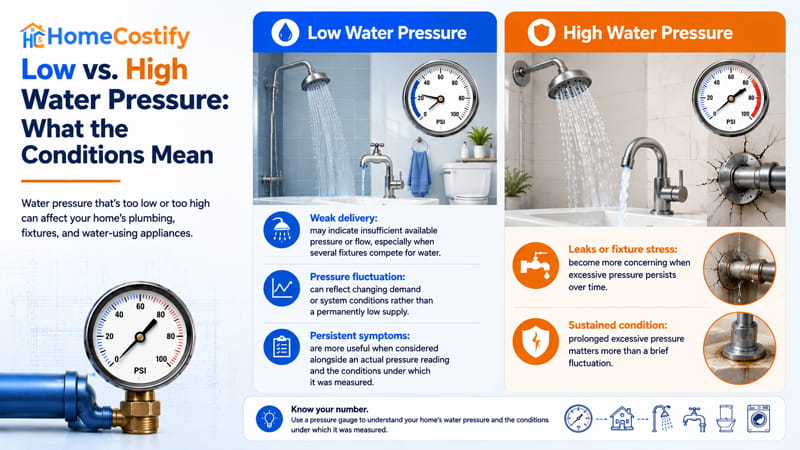
A weak stream or slow fill can signal insufficient pressure during household use. Excessive pressure presents a different concern, placing greater strain on plumbing components. Each can affect the plumbing in a different way.
Low Water Pressure
Weak streams, slower filling, and reduced shower performance are common signs homeowners may notice. Low water pressure in a house often becomes more noticeable during heavier household use, especially with several points of use active. The result is weaker delivery rather than a complete loss of water.
Supply limitations, restrictions, leaks, elevation, and changing demand could all contribute to this pattern. A symptom alone does not reveal which factor is responsible. The broader plumbing arrangement helps put an unusual drop in delivery into context.
High Water Pressure
Plumbing components receive greater stress when pressure stays above their intended operating conditions. Water pressure at excessive levels can place added strain on fixtures, connections, seals, and other parts. Persistent exposure may increase the potential for leaks and premature wear.
A brief fluctuation does not carry the same significance as sustained excessive pressure. Duration matters when excessive pressure persists. A brief change during active use does not carry the same meaning as pressure that stays elevated while the system is idle.
- Weak delivery: May point to insufficient available pressure or flow, especially during periods of heavier household use.
- Pressure fluctuation: Can reflect changing demand or other system factors rather than a permanently low supply.
- Leaks or fixture stress: Persistent excessive pressure increases concern about continued component wear.
- Persistent symptoms: Have greater interpretive value when considered alongside a pressure reading and whether water was flowing at the time.
Static vs. Dynamic Water Pressure
A quiet plumbing system gives a different reading from one serving active household use. With no fixture drawing water, the pressure reflects the system before water begins moving. Once demand starts, the reading can change as water travels through the piping.
With no fixture drawing water, static water pressure represents the pressure present while the plumbing is relatively still. The reading provides a baseline for the pressure available before active use begins. No water is moving through the system at that moment.
Opening a fixture starts water movement through the piping. Resistance along the route produces pressure loss, so dynamic water pressure may differ from the static value. The size of that difference depends on the resistance in the route and the demand placed on the plumbing.
For homeowners, the circumstances surrounding a reading matter. A static value does not necessarily match the pressure present during active use. A water pressure reading should be interpreted according to whether the plumbing was idle or serving active demand.
How Is Water Pressure Measured?
A pressure gauge gives a numerical reading at the connection where it is attached. Location matters because pressure can differ elsewhere in the house. Water use can affect the value shown during active demand.
Reading Pressure With a Gauge
A residential pressure gauge attaches to a suitable hose connection on the plumbing. A water pressure test at that connection shows the pressure present there. The gauge records pressure at that location, not at every outlet in the house.
For a static reading, no fixture should be drawing water at the time of observation. During active use, the gauge can show a different value. Readings from separate locations may also reveal differences across the plumbing network.
Why a Pressure Reading Doesn’t Tell the Whole Story
A gauge records pressure at a specific location and time. It does not measure the quantity reaching every fixture. Elevation, restrictions, and household demand can affect delivery farther along the plumbing. The number remains useful, but it applies to the location and moment measured.
Water Pressure Units: PSI, Bar and kPa
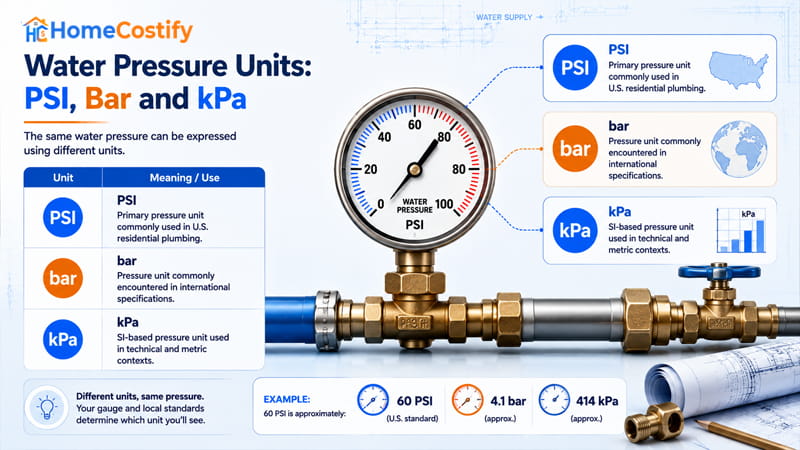
Pressure can appear under several unit systems on gauges, equipment specifications, and technical documents. U.S. homeowners most often encounter PSI in residential plumbing.
| Unit | Meaning / Use |
|---|---|
| PSI | Common pressure unit in U.S. residential plumbing |
| bar | Pressure unit often found in international specifications |
| kPa | SI-based unit used in metric and technical contexts |
For U.S. homeowners, water pressure units usually appear as PSI on a gauge or specification. The unit tells you how the numerical value is expressed. A number without its unit does not provide a complete pressure reading.
Bar and kPa commonly appear on equipment sold for international markets. Their presence does not mean the plumbing operates under a different type of pressure. They express the same physical quantity using another unit system.
Water Pressure Formula and Elevation
A column of water creates pressure according to its height, density, and gravity. Greater vertical height produces a greater hydrostatic effect from the water above a given point. Elevation therefore becomes relevant whenever the supply and point of use sit at different levels.
The relationship appears in the water pressure formula, which connects water density, gravity, and height. Each variable represents part of the physical relationship between a water column and the pressure it produces. The formula explains the elevation effect without accounting for other losses in the plumbing.
Consider a fixture on an upper floor of a house. Its vertical separation from the supply point is greater than that of a lower fixture. For water pressure for a two-story house, that added height helps explain the pressure difference associated with elevation. Other plumbing factors can still affect the pressure at the fixture.
Bottom Line: What Your Water Pressure Number Really Tells You
A pressure number applies to the place and moment where the measurement was taken. Location, elevation, and household demand can change the pressure available elsewhere in the plumbing. The number is useful, but it does not describe the entire house by itself.
Supply establishes the pressure entering the property. Elevation and resistance alter what is available along the route, while demand can change the pressure during use. Flow reflects the quantity that reaches a point of use. The fixture then turns that delivery into the experience a homeowner actually notices.
FAQs About Water Pressure
What Is a Water Pressure Called?
The usual term is water pressure. Residential measurements may use PSI, while bar and kPa appear on international gauges and technical specifications.
How Can I Fix My Water Pressure in My House?
First determine whether pressure is low or high, then obtain a pressure reading. That information helps narrow possible supply or plumbing causes.
How Strong Is Water Pressure?
Residential pressure varies between properties and systems. EPA WaterSense associates 45–60 PSI incoming pressure with best fixture performance, rather than requiring every home to match it.
What Would 6000 PSI Do to a Human?
6,000 PSI is far beyond residential plumbing pressure. Exposure at that level can cause catastrophic injury and is not comparable with ordinary household pressure.
Is 1.5 Bar Water Pressure Good?
1.5 bar is approximately 22 PSI. That falls below the 45–60 PSI range associated with best fixture performance by EPA WaterSense, without automatically meaning the system is unsafe.