Two bids for the same metal roofing replacement cost can land far apart on the page. One contractor might bundle removal and hauling into the quoted amount. Another might place those charges on separate lines. A price difference alone says little about fairness.
Once old covering comes off, the work takes a different shape. Debris needs hauling, exposed sheathing needs inspection, and crew time enters the project. Additional trim or other site-specific work can also appear once production begins.
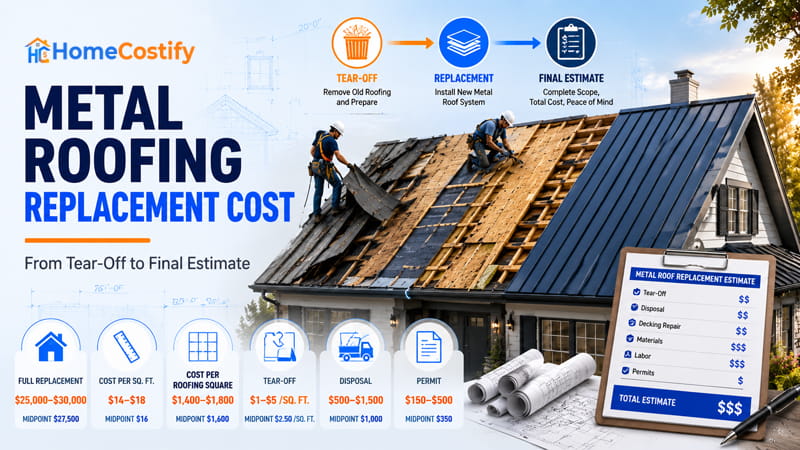
For a starting budget, HomeCostify’s review of contractor pricing puts a typical full metal roofing replacement cost at $25,000–$30,000 nationwide. The midpoint is $27,500.
The roof area carries greater pricing weight than the home’s floor area. A contractor’s listed work then determines where the final amount lands.
Metal Roofing Replacement Cost at a Glance

Before a final bid arrives, a preliminary budget needs a usable range. A full replacement may appear as a project total, a square-foot rate, or a roofing-square amount. Each format measures the same job from a different angle.
| Cost Measure | HomeCostify Planning Range | Planning Midpoint |
|---|---|---|
| Full metal roof replacement | $25,000–$30,000 | $27,500 |
| Cost per sq. ft. | $14–$18 | $16 |
| Cost per roofing square | $1,400–$1,800 | $1,600 |
| Tear-off | $1–$5/sq. ft. | $2.50/sq. ft. |
| Disposal | $500–$1,500 | $1,000 |
| Permit | $150–$500 | $350 |
Planning figures are budgeting references, not guaranteed contractor quotes. Installed-price methods may include different combinations of labor, supplies, underlayment, flashing, cleanup, or other components. Do not add the amounts together automatically.
HomeCostify’s review of contractor pricing puts a typical full replacement at $25,000–$30,000 nationwide. The midpoint is $27,500. For the average metal roof replacement cost, that range gives a preliminary budget before an actual bid arrives.
The $14–$18 rate connects a preliminary budget with the measured roof area. Use the home’s floor area only as a reference, not as the calculation basis. At the $16 midpoint, metal roofing cost becomes a quick check against a preliminary total.
Contractors also use roofing squares to present unit rates. One square covers 100 square feet, producing a planning range of $1,400–$1,800 per square. The $1,600 midpoint puts metal roof replacement cost per square into familiar estimate terminology.
What a Full Metal Roof Replacement Includes
New panels represent only one stage of a full replacement. Existing covering must be removed, underlying layers checked, and a new weather-resistant assembly completed with finishing work and cleanup.
The U.S. Environmental Protection Agency describes roof replacement as work involving removal of existing roofing and, where needed, defective deck sheathing, insulation, or other components. Removed materials also require handling and disposal, so the project extends beyond purchasing new roof covering.
Existing Roof Tear-Off and Removal
Old roofing comes off before a new assembly can take its place. During a metal roof replacement cost assessment, removal belongs within the project scope because crews must strip existing layers and handle material exposed during tear-off.
Multiple layers add more material to remove. Restricted access, steep slopes, and multi-level sections can slow movement around the work area. Material handling also becomes harder where roof access is limited.
Disposal and Debris Handling
Removed roofing does not disappear after tear-off. Containers, hauling, and disposal enter the picture, while local waste rules can affect how removal is handled. A metal roofing repair cost comparison can look different because repair work usually leaves a smaller volume of discarded material.
Decking, Underlayment, and New Metal System
With old covering removed, exposed sheathing can be checked for damaged sections. A full metal roof replacement cost can include deck work if deterioration appears after the old covering comes off. Underlayment adds another weather barrier beneath the new covering.
The finished assembly contains more than panels. Fasteners or clips secure the covering, while flashing and trim finish edges, penetrations, and transitions. Weatherproofing details and final cleanup complete the project.
Full Replacement Scope May Include
- Existing roof removal and debris handling
- Roof deck inspection and defective sheathing replacement where required
- Underlayment and weatherproofing components
- Metal panels, fasteners or clips, trim, and flashing
- Labor, permits, cleanup, and project-specific requirements
Metal Roof Replacement Cost by Roof Size

A metal roof measurement starts at the planes receiving the new covering. Floor plans give a horizontal footprint, but sloped sections occupy a different amount of surface. Eaves, hips, valleys, dormers, and separate roof sections add measurable coverage beyond the outline of the house.
Estimated Replacement Cost by Actual Roof Area
Apply the $14–$18 planning range to measured roof surface, then convert the result into roofing squares. At $16 per square foot, every 100 square feet carries a $1,600 planning midpoint.
| Actual Roof Area | Roofing Squares | Planning Replacement Cost |
|---|---|---|
| 1,000 sq. ft. | 10 | $14,000–$18,000 |
| 1,500 sq. ft. | 15 | $21,000–$27,000 |
| 2,000 sq. ft. | 20 | $28,000–$36,000 |
| 2,500 sq. ft. | 25 | $35,000–$45,000 |
| 3,000 sq. ft. | 30 | $42,000–$54,000 |
Planning calculations use measured roof area × $14–$18 per sq. ft. They are budgeting references, not guaranteed contractor quotes.
Look at the 1,000-square-foot row first: 10 squares at $1,400–$1,800 per square. The 2,000-square-foot row doubles both measurements, reaching 20 squares and $28,000–$36,000. Metal roof replacement cost per square gives the unit reference behind those totals.
Larger roof planes call for more panels and underlayment beneath them. Fasteners, clips, and other field materials rise with the coverage required across those sections. Labor also spans a wider work area, placing roof size at the start of the preliminary calculation.
Why House Size Is Not the Same as Roof Area
A 2,000-square-foot floor plan tells you how much space sits inside the walls. It does not trace every exterior roof plane. Sloped sections, eaves, and multiple tiers add coverage outside the horizontal footprint, which changes metal roof replacement cost by size.
Panel counts become more specific at the roof itself. Usable dimensions vary around valleys, hips, dormers, penetrations, and cut edges. Metal roofing dimensions give the measurement basis for ordering panels, with field measurements settling the required quantity.
A pair of roofs can share similar square footage yet present different layouts. One roof can have several intersecting planes; another can span broad, uninterrupted sections. Metal roof replacement cost sets the size-based baseline; measured configuration and remaining project conditions still shape the final amount.
Metal Roof Replacement Cost by Material and System
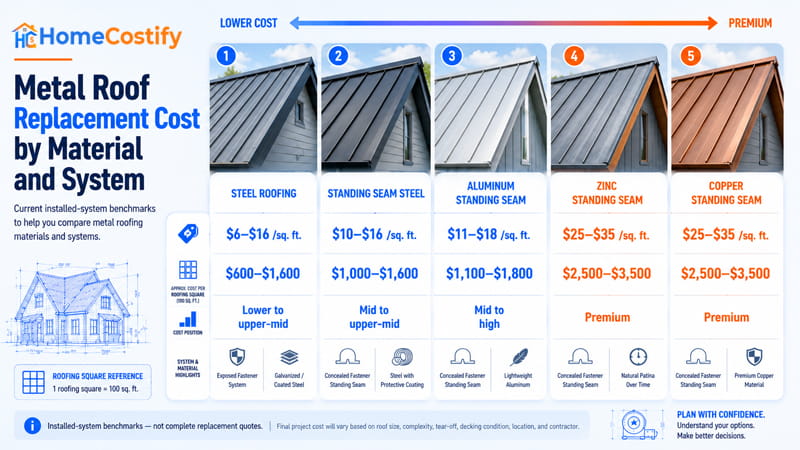
Steel, aluminum, standing seam, copper, and zinc bring different price levels to a roofing project. Steel systems can differ in gauge, coating, profile, fastening, fabrication, and field labor requirements. A roof with the same measured area can carry a very different installed-system price after the material and configuration are selected.
The U.S. Forest Service separates architectural and structural metal systems in its roofing guidance. Steel, aluminum, zinc, and copper appear among its architectural metal roofing materials, with material selection tied to initial cost. Its historical dollar amounts are not used as a pricing benchmark.
| Metal Material / System | Current Installed Benchmark | Approx. Cost per Roofing Square | Cost Position |
|---|---|---|---|
| Steel roofing | $6–$16/sq. ft. | $600–$1,600 | Lower to upper-mid |
| Standing seam steel | $10–$16/sq. ft. | $1,000–$1,600 | Mid to upper-mid |
| Aluminum standing seam | $11–$18/sq. ft. | $1,100–$1,800 | Mid to high |
| Zinc standing seam | $25–$35/sq. ft. | $2,500–$3,500 | Premium |
| Copper standing seam | $25–$35/sq. ft. | $2,500–$3,500 | Premium |
These are installed-system benchmarks, not complete replacement quotes. Tear-off, disposal, decking, permits, flashing, cleanup, or related items may already sit inside a contractor’s figure. Do not add every category to the table values.
Steel Metal Roof Replacement Cost
Steel is used across exposed-fastener and concealed-fastening residential systems. Coatings and finishes create another layer of product choice. Metal roofing colors enter that decision alongside profile, gauge, and fastening style.
Gauge, coating, and panel profile can alter fabrication requirements. Fastening style adds another variable. Concealed clips, for example, differ from exposed fasteners. Metal roof replacement cost reflects those specifications alongside the steel itself.
Aluminum Metal Roof Replacement Cost
Coastal exposure can make aluminum a relevant candidate for a roofing project. Coastal exposure can make corrosion resistance a stronger consideration, while current installed benchmarks put aluminum standing seam in a higher price range than steel. Metal roof replacement price also reflects finish, system design, and site requirements.
Standing Seam Metal Roof Replacement Cost
Raised seams form the visible distinction between standing seam and exposed-fastener profiles. Panels connect through concealed clips or related fastening components, with fabrication tied to the selected configuration. Panel dimensions matter most around edges, seams, and detailed sections.
Complex detailing can add fabrication steps and field labor. Transitions, intersections, and other demanding sections require closer coordination during fabrication and installation. Current market data places standing seam across a broad range by metal type, so metal roof replacement cost per square foot varies with the selected system.
Premium Metal Systems
Copper and zinc carry much higher material costs than standard steel systems. Fabrication requirements and system-specific work can raise the installed amount further. Metal roofing material types therefore need to be evaluated as separate pricing categories rather than treated as one product class.
Purchase price is only one consideration over the years a roofing system remains in service. A higher initial outlay may make more sense for a longer ownership period. Metal roof lifespan adds another consideration for buyers weighing a premium system against their expected ownership period.
Metal Roof Replacement Labor Cost
Crew productivity can vary considerably from one replacement job to another. Roof size gives only part of the picture. Access, height, pitch, layout, system details, and regional wage levels can change the hours required for similar assignments.
For budgeting, $3–$12 per sq. ft. gives a practical labor range, with about $7 per sq. ft. as a working reference. Site conditions and contractor pricing methods can push metal roof replacement cost outside that range.
- Planning range: $3–$12 per sq. ft.
- Working reference: about $7 per sq. ft.
- Pricing basis: budgeting reference rather than a guaranteed labor quote.
Steeper slopes slow movement across the work area and can require additional handling time. Multi-story homes also create longer routes for staging materials. Hips, valleys, separate roof sections, and restricted access can add more movement between work areas.
Flashing, trim, penetrations, and fastening details can require specialized field work. Installing metal roofing around detailed sections calls for precise fitting, particularly with concealed fastening and custom transitions. The crew may also spend more time working around penetrations, trim, and flashing.
Published installed rates sometimes include labor within the quoted amount. Other estimates place crew charges on a separate line. A published rate may already carry the labor charge, so adding another allowance would count the same expense twice.
Metal Roof Tear-Off, Disposal & Decking Cost Breakdown

An existing roof creates expenses absent from a new structure covered with metal panels. Old covering must be removed and discarded, while exposed sheathing needs inspection for damage. Each stage carries its own pricing basis.
Metal Roof Tear-Off Cost
A planning allowance of $1–$5 per sq. ft. gives roughly $2.50 per sq. ft. as a working reference for removal. Metal roof replacement cost includes this existing-covering expense if the old assembly must be stripped. Multiple layers can increase the volume headed for removal.
Several layers of old roofing change the amount of material handled at the jobsite. Restricted access can make removal less straightforward, while roof height and attachment methods add physical demands. Metal roof removal cost can differ between homes with comparable dimensions.
Metal Roof Disposal Cost
Removed shingles, panels, underlayment, and other debris eventually need a destination. A $500–$1,500 allowance, with about $1,000 as a working reference, covers containers, hauling, handling, and disposal in the planning framework. Metal roof replacement cost per square can be difficult to interpret if disposal already sits inside the quoted rate.
Contractors may combine debris handling with tear-off or show it as a separate charge. The estimate’s structure determines whether that allowance has already been accounted for.
Decking Replacement Cost
Exposed sheathing reveals conditions hidden beneath the old covering. The $2–$5 per sq. ft. range applies to required replacement, while localized damage can call for an allowance of $500–$2,000. Metal roof decking replacement cost should not be calculated across the entire roof unless damaged sections actually require replacement.
Damage inside the sheathing stays hidden until the old covering comes off. Contractors can address such findings through an allowance, unit price, or change-order provision. The metal roof replacement estimate should state how additional sheathing work will be priced before approval.
Other Costs That Can Change a Replacement Estimate
Local rules and site conditions can add charges outside the core replacement scope. Permit fees, roof details, access limitations, and regional pricing conditions each arise from different circumstances.
Permits and Inspection Requirements
A $150–$500 allowance gives a practical range for permitting, with about $350 as a working reference. Metal roof replacement cost can include municipal fees tied to project valuation and local requirements. Inspection-related charges can also vary by jurisdiction, so the same project does not carry one universal permit amount.
Flashing, Trim, and Roof Penetrations
Chimneys, skylights, valleys, wall junctions, and pipe penetrations create areas where standard panel coverage needs additional detailing. Metal roof replacement price can pick up another $500–$2,000 if flashing, trim, or related components require alteration or replacement. The allowance applies only where those details call for added scope.
Accessibility, Pitch, and Local Labor Market
Limited staging space changes how materials reach the work area. Multi-story buildings can lengthen the route between ground-level storage and the roof, while restricted access can call for additional equipment.
Steeper slopes place different demands on movement and material handling. Complex layouts also introduce more fitting around changes in direction and roof sections. Regional wage conditions can produce different pricing for comparable assignments despite similar physical dimensions.
How to Read a Metal Roof Replacement Estimate
A quoted total means little without the details underneath it. Measurement, included components, uncertain items, and product specifications all shape what a contractor is actually offering.
What a Homeowner Should Be Able to Identify
- Actual roof area and roofing squares
- Metal material, gauge, profile, coating, and fastening system
- Tear-off, disposal, and cleanup
- Underlayment, flashing, trim, and penetrations
- Decking allowance or unit price
- Permit responsibility
- Manufacturer and workmanship warranties
- Change-order terms
Check the Roof Measurement and Roofing Squares
Start with the quantities written in the proposal. Actual roof area should have a clear relationship with the stated roofing squares, giving the quoted unit rate a measurable basis. Metal roof replacement cost per square foot is easier to assess once the quantity behind the rate is visible. Interior floor area should not substitute for the measured roof surface.
Check the Tear-Off and Disposal Scope
Removal language deserves a closer look. Metal roof replacement cost can include stripping existing layers, hauling debris, and cleanup, but a phrase such as “removal included” leaves important details unstated. The proposal should identify known layers and show who handles disposal, hauling, and site cleanup.
Check the Metal System Specifications
Two proposals can show similar quantities while describing different products. Material, gauge, panel profile, coating, and fastening details give the quoted metal system a defined specification. Metal roof replacement cost is easier to compare if both proposals describe comparable assemblies rather than relying on product names alone.
Check Decking, Flashing, Allowances, and Warranty
Some charges cannot be fixed until concealed conditions become visible. An allowance or unit price can set the basis for added decking or detail work, while change-order terms establish how those additions receive approval. Average metal roof replacement cost becomes less useful if a quote leaves substantial conditional items undefined.
Manufacturer and contractor warranties address different responsibilities. The first concerns the roofing product and its stated coverage; the second concerns workmanship performed by the contractor. A proposal should identify both parties clearly, along with the warranty attached to each responsibility.
How to Compare Metal Roof Replacement Quotes
Two contractor estimates can land far apart despite describing the same type of full roof replacement. The useful comparison starts underneath the headline total: measured quantities, included work, system specifications, allowances, warranties, and exclusions must line up before the figures mean much.
Quote Comparison Matrix
| Estimate Item | Quote A — What to Verify | Quote B — What to Verify | Comparison Question |
|---|---|---|---|
| Roof area | Measured area and roofing squares | Measured area and roofing squares | Are both based on the same measured roof? |
| Metal system | Material, gauge, profile, coating, fastening | Material, gauge, profile, coating, fastening | Are the specifications genuinely comparable? |
| Tear-off | Included scope and number of layers | Included scope and number of layers | Are both contractors removing the same existing roof? |
| Disposal | Included or separately priced | Included or separately priced | Is debris handling treated the same way? |
| Decking | Allowance, unit price, or excluded | Allowance, unit price, or excluded | How is hidden damage handled? |
| Underlayment | Product/specification identified | Product/specification identified | Are the weatherproofing specifications equivalent? |
| Flashing/trim | Included scope | Included scope | Are roof details treated consistently? |
| Permits | Contractor responsibility or owner responsibility | Contractor responsibility or owner responsibility | Who pays and handles permitting? |
| Warranty | Manufacturer + workmanship coverage | Manufacturer + workmanship coverage | Are warranty responsibilities comparable? |
| Exclusions | Listed exclusions | Listed exclusions | What work is not included in each total? |
A low bid deserves a closer look if another submission carries more clearly defined work. Searching for the best metal roofing does not settle the comparison if one proposal leaves removal, substrate work, or other items outside its total.
Once the two submissions describe comparable work, attention can move toward system specifications, allowances, exclusions, and warranty responsibilities. The metal roof replacement cost can then be weighed against the actual obligations written into each proposal..
A large gap that remains unexplained deserves clarification before a contract is approved. Missing work can surface later as added charges, especially where an allowance or exclusion leaves room for interpretation. Written answers can show whether the difference comes from an actual specification change or an omitted part of the job.
Metal Roof Replacement Timeline
A full replacement starts taking shape before a crew reaches the house. Inspection, measurement, material ordering, permits, and scheduling occupy part of the calendar. The physical roofing phase comes later, and its start depends partly on material availability and crew scheduling.
Pre-Replacement Planning
At the preparation stage, the existing covering is inspected and measured, while the contractor develops the written proposal and project scope.
Material selection and ordering follow, with permits or local approvals handled where required. The metal roof replacement cost enters the schedule indirectly because the written proposal must be settled before procurement and scheduling can move ahead.
Tear-Off Through Final Cleanup
Crew arrival marks the beginning of physical production. Existing covering comes off first, followed by inspection of the exposed deck and any required substrate work. New metal roofing is then fitted at a high level, with flashing, trim, cleanup, and applicable final inspection bringing the job toward closeout.
The metal roof replacement price can appear on the paperwork long before this stage, but the calendar depends on the sequence of physical work.
Weather interruptions can stop exterior production. Material lead times can also push the start date or interrupt progress if a required component is unavailable. Hidden decking damage can add another work phase after removal, while complex roof layouts can extend production time. Permit issues can create another scheduling obstacle.
Insurance and Metal Roof Replacement Costs
Insurance changes the homeowner’s payment picture, but the policy determines where that change applies. Cause of loss, exclusions, valuation terms, and deductible all matter in a roof replacement claim. The contractor’s amount and insurer’s approved scope do not necessarily match.
When Insurance May Pay for Replacement
A storm, hail event, wind damage, or another covered peril can lead to a different coverage question than ordinary aging.
In that situation, the metal roof replacement cost becomes relevant only after the policy terms and loss circumstances are considered. Age alone does not establish coverage. Exclusions and claim conditions still govern the outcome.
Deductibles and Out-of-Pocket Cost
After an insurer determines its covered portion, the homeowner can still have a remaining balance. The deductible reduces the amount paid under the policy, while excluded items can leave additional charges outside the claim. For metal roof replacement cost per square, separate the homeowner’s balance from the insurer’s payment.
ACV, RCV, and Code-Related Costs
The valuation method can produce another difference between reimbursement and the contractor’s replacement figure. ACV generally reflects depreciation, while RCV is based on replacement-cost coverage subject to policy terms and claim requirements.
Additional RCV payment can depend on timing and conditions. Code-related upgrades also depend on applicable ordinance-or-law coverage.
What Factors Have the Biggest Impact on Replacement Cost?
A large gap between two totals calls for a closer look at what each contractor included. Check the biggest difference first. It could come from the measured roof area, the selected system, existing conditions, labor demands, or local requirements. The metal roof replacement cost makes more sense once the reason for the gap is visible.
Major Cost Drivers
- Actual roof area — Did the measured replacement surface change?
- Metal system — Are the material and system specifications genuinely comparable?
- Roof complexity — Does the layout require more detailing or difficult production work?
- Existing roof condition — Are additional removal or substrate issues included?
- Accessibility — Does the property restrict staging or crew movement?
- Local labor market — Are wage conditions different in the project location?
- Flashing and penetrations — Does the structure contain more detail work than the baseline?
- Permit requirements — Does the jurisdiction impose additional requirements?
A higher total deserves closer attention if one measurable variable differs between proposals. Check whether the change affects quantity, labor effort, included scope, or administrative requirements. The metal roof replacement cost itself does not explain the variance; the underlying change does.
Project priorities can shift from one property to another. Roof size might dominate one comparison, while system specifications or existing conditions carry greater weight elsewhere.
Looking at the metal roofing replacement cost through the changed conditions prevents a generic driver list from becoming a fixed pricing formula.
Final Takeaway
A useful budget starts with the measured surface, not the home’s floor area. The metal roof replacement cost only has meaning beside a defined scope, since removal, substrate work, system specifications, and other inclusions can differ between proposals.
Use the planning information to set expectations, then compare it against the measured quantity and complete work described by the contractor.
Before signing, make sure competing proposals describe comparable systems and clearly state allowances, exclusions, and warranty responsibilities. Unresolved differences deserve clarification, especially where additional charges could arise after work begins.
The stronger choice is not automatically the lowest total. It is the proposal whose scope, specifications, and potential extra charges are clear enough to support the commitment.
FAQs About Metal Roofing Replacement Cost
How to calculate the cost of a metal roof replacement?
Multiply the actual roof area by the applicable installed rate, then account for conditional items. For metal roofing replacement cost, check whether tear-off, decking, permits, and disposal already appear in the quoted rate.
What is the most expensive part of replacing a metal roof?
The new roofing system and labor are usually major planned expenses. Extensive decking damage can add substantially if deteriorated sections require replacement.
What is the biggest problem with metal roofs?
Common trouble points include poor installation, expansion and contraction, corrosion, fastener issues, and incompatible detailing. Results depend heavily on system choice, workmanship, and environment.
What is the average cost to replace a metal roof in Florida?
Florida pricing depends on roof size, material, local labor conditions, complexity, wind-related requirements, and permitting. A single statewide figure would not represent every residential project accurately.
How many metal roof panels do I need?
Panel quantity depends on measured dimensions, coverage width and length, overlaps, valleys, hips, roof geometry, and waste allowance. Final quantities require project-specific measurements.