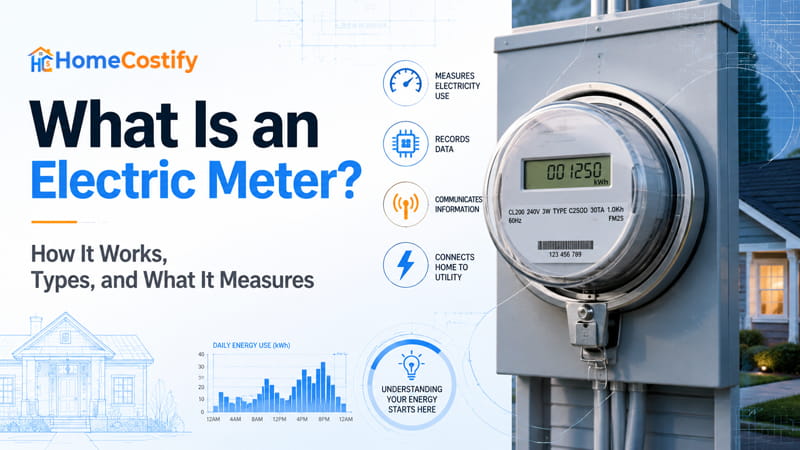
The number you see on a meter changes as electricity is used throughout the home. Accumulated energy use appears on the display as household consumption builds, with the electric meter recording the resulting total. Each reading captures household use at a specific stage, creating a reference for comparison with a later reading.
Homes can have different metering technologies and service configurations. Equipment placement also varies according to how utility service reaches the property. For a homeowner, the reading belongs to that particular installation, so its physical setting provides part of the context behind the recorded value.
What Is an Electric Meter?
Installed at the service connection, an electric meter records household energy use as consumption accumulates. The resulting figure represents accumulated consumption, with the utility using the recorded amount to track electricity use for billing. A residential electricity meter performs this basic measurement function without describing how the internal equipment produces its reading.
Recorded consumption has practical value on both sides of the utility connection. During a billing period, the electricity meter supplies usage data associated with the property’s service account. The homeowner can use the accumulated figure as a record of household energy consumption.
Distribution begins farther inside the residence, where electrical equipment routes power toward circuits and appliances. Metering concerns the amount of energy recorded at the incoming service point.
At the property, incoming electrical service reaches the metering point before power moves into the home’s distribution arrangement. From there, the home electric system carries electricity toward equipment serving different parts of the residence.
Electrical system components handle distribution or protection farther along the service path. Home metering centers on measurement at this point in the electrical arrangement.
What an Electric Meter Measures
Power and energy describe different quantities. Power indicates the rate of electrical use at a given moment; energy records the amount accumulated through use. Appliance ratings use watts or kilowatts, whereas household consumption is expressed in watt-hours or kilowatt-hours. Within electric meter measurement, kWh represents accumulated energy, not instantaneous power.
According to the U.S. Energy Information Administration (EIA), watts measure electrical power at an instant, whereas watt-hours measure electricity consumed across a period of use. Utilities generally record customer electricity use in kilowatt-hours (kWh), with 1 kWh representing 1 kilowatt used for an hour. A 40-watt light running for five hours uses 200 watt-hours, or 0.2 kWh.
- Watt/kilowatt: rate at which electrical power is being used.
- Watt-hour/kilowatt-hour: electrical energy accumulated through a period of use.
- kWh reading: accumulated energy recorded by the metering system.
Household consumption adds to the accumulated total shown on the electricity meter display. A meter reading reflects energy recorded from the relevant starting point, not a monthly counter that returns to zero.
Billing periods divide usage for account purposes; they do not require the displayed cumulative figure to reset. The recorded total can span multiple billing periods.
Comparing two readings can show how much electricity consumption occurred between those readings. A higher figure means additional energy entered the accumulated total during that interval. Electric meters cannot identify the appliance responsible from the displayed amount alone.
Nor does a changing kWh figure show instantaneous power demand at a particular moment. The interval can span an hour, a day, or a billing cycle.
Main Types of Electric Meters

Meter classification can follow measurement technology, data communication, energy-flow direction, or electrical service configuration. A mechanical design differs from an electronic model, yet a digital unit can also include smart communication. Flow direction and phase arrangement add separate classification layers.
| Meter Type | How It Records Electricity Use | Distinguishing Feature | Common Residential Context |
|---|---|---|---|
| Analog / Electromechanical | Mechanical disc movement drives a register | Spinning metal disc and mechanical dials | Older residential installations |
| Digital / Electronic | Electronic sensing and processing produces a numerical reading | Digital display without a spinning disc | Modern residential service |
| Smart Meter | Electronic measurement with stored and transmitted data | Communication capability beyond measurement | Utility advanced metering systems |
| Bidirectional Meter | Records energy flowing in either direction | Tracks imported and exported electricity | Homes with solar or distributed generation |
| Single-Phase Meter | Measures electricity within a single-phase service arrangement | Matches the applicable phase configuration | Many U.S. homes |
| Three-Phase Meter | Measures electricity within a three-phase service arrangement | Matches three-phase electrical service | Some residential, agricultural, and specialized properties |
Categories can overlap. A digital unit can carry smart functions, and a solar-equipped home can use bidirectional metering with communication capability. Single-phase and three-phase describe the electrical service configuration, not the display technology.
Analog or Electromechanical Meters
A spinning metal or aluminum disc identifies the traditional old electric meter. Electrical activity drives its rotation, with mechanical gearing transferring movement to a register. Direct dial observation was the familiar reading method for this technology.
How an Analog Electric Meter Measures Electricity
Voltage and current produce electromagnetic effects inside the mechanism. These effects drive the disc, then gearing transfers its rotation to the register.
Digital or Electronic Meters
Electronic sensing replaced the spinning disc found in older designs. Internal circuitry processes electrical measurements and produces a numerical value on the display. Electronic storage can retain usage information as well. Terms such as electric meter digital and digital electric meter refer to this general category.
How a Digital Electric Meter Measures Electricity
Sensors detect electrical conditions, then circuitry processes the resulting signals. Stored information supports the numerical value shown on the display.
Smart Electric Meters
Communication capability separates smart metering from basic electronic designs. Electronic collection can transmit usage information to the utility without requiring an electric meter reader at the property. Measurement remains the core function, with data communication adding a separate pathway for selected usage information.
How a Smart Meter Measures and Communicates Electricity Use
Electronic measurement captures usage, internal storage retains selected information, and communication equipment sends data to the utility. Measurement and transmission serve separate functions.
Bidirectional Meters for Solar
Electricity can travel from the grid toward a property or move outward from local generation. A bidirectional meter records both directions, making this arrangement relevant to homes with solar generation or other distributed energy resources.
How a Bidirectional Meter Tracks Electricity Flow
Grid-supplied electricity represents incoming flow. Exported electricity travels from the property toward the grid, with both directions represented in the resulting records.
Single-Phase and Three-Phase Meters
Service configuration adds another classification layer. Single-phase service is common in U.S. homes, whereas three-phase arrangements serve some residential, agricultural, and specialized properties. A 3-phase electric meter matches three-phase service, while the term three phase meter refers to the same configuration category. Display technology can still be digital or smart.
How an Electric Meter Works
Voltage and current form the electrical conditions present at the metering point. Power describes the rate associated with those conditions. Continued household use adds energy to the recorded total, which later appears as a cumulative reading and enters the utility’s data record.
Electrical Conditions at the Metering Point
Electrical potential across the service is expressed as voltage. Current describes the flow passing through the metering point.
Voltage and current set the conditions used to quantify power at the metering point. An electric meter measurement begins with electrical conditions representing supply to the property, before household loads use that power.
Power and Energy Measurement
Power describes a rate of electrical energy use. A load operating for a period adds energy to the total associated with that power level. The electricity meter records this accumulated quantity in kilowatt-hours, the practical unit used for household energy consumption.
A high-power load operating briefly can produce less energy than a lower-power load running for a longer period. Duration and power level both affect the amount recorded.
Recording the Cumulative Reading
The measured energy value enters the recording stage once the quantity has been established. Older equipment can use a mechanical register, whereas newer designs store the figure electronically and show it on a display.
The displayed figure represents recorded energy accumulated through household use, not the load operating at that moment. The difference between two readings represents energy consumed between the recorded values.
From Meter Reading to Utility Data
A recorded figure can enter a utility record through manual collection or electronic communication. Utility systems can use the usage figure supplied through the electrical meter, with collection methods controlling data delivery.
Customer records can associate the captured amount with the applicable service. How do electricity meters work at this stage? The measurement has already produced the value; this stage concerns collection and storage of the resulting data.
Electric Meter Components

A metering assembly brings several functions into a compact structure. Measurement hardware senses electrical use, recording hardware presents the result, terminals interface with conductors, and communication hardware handles data transfer on equipped systems.
| Component | Primary Function | What Homeowners May See | Measurement Relationship |
|---|---|---|---|
| Meter Register / Display | Presents the recorded value | Mechanical dials or digital numbers | Shows the accumulated result |
| Measurement Mechanism | Detects electrical use | Usually hidden from view | Produces the measurement result |
| Electrical Terminals / Connections | Interfaces with service conductors | Service-side connection points | Places the device within the measured electrical path |
| Communication Module | Transfers selected meter data | Usually integrated inside smart equipment | Communicates recorded information without performing measurement |
A visible display shows the result, but it does not reveal the sensing hardware behind it. Communication hardware adds data transmission, and service connections interface with conductors; these functions remain separate from the measurement function.
Meter Register and Display
Mechanical dials present recorded values on older equipment. Numerical screens serve this purpose on a digital electric meter, with some displays cycling through additional values or status information. The meter reading comes from recorded measurement data, not from the screen itself.
Measurement Mechanism
Behind the visible register sits hardware responsible for electrical sensing and processing. Older electromechanical equipment uses a disc-driven arrangement, whereas modern units use electronic circuitry. The resulting measurement passes to the recording or display stage.
Electrical Terminals and Connections
Service conductors interface with the device through terminals or similar connection points. This interface places the meter within the electrical path associated with supplied power. Configuration varies with the service arrangement and equipment, without changing the basic separation between connection hardware and sensing hardware.
Communication Components
Selected usage information can travel through a communication module on an equipped electricity meter. Transmission hardware handles data movement, and an electric meter reader is not required for every collection arrangement. Communication hardware supplements measurement; it does not perform the sensing function.
Electric Meter Location in a Home Electrical System
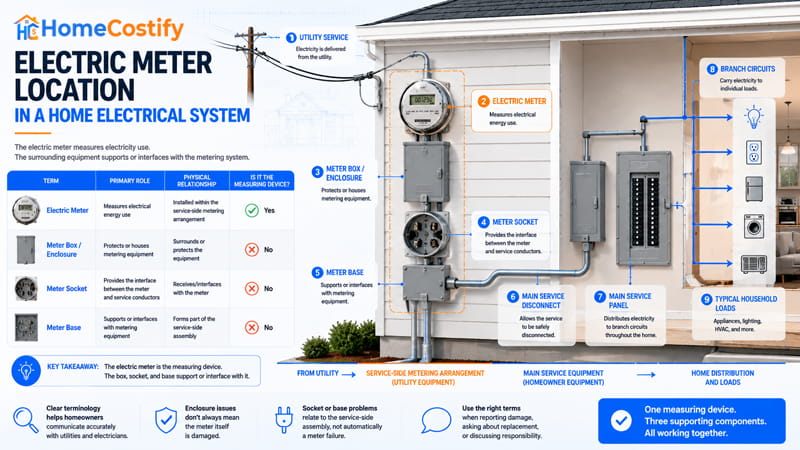
Utility electricity enters a property through the service connection before reaching the home’s distribution equipment. The metering point sits along this path, with service-side hardware surrounding or interfacing with the measuring device. Farther inside, distribution equipment sends electrical supply toward household circuits.
The Electrical Service Entrance
At the property boundary, utility service enters through the electrical service entrance. Residential arrangements often place the electric meter on an exterior wall or another accessible location near the incoming supply.
The electric meter home position sits between utility service and downstream equipment, marking the point where supplied electricity is recorded. Its location can vary with the property’s service arrangement.
Meter Box, Meter Socket, and Meter Base
Visible hardware around the measuring device can cause terminology confusion. The electricity meter itself records energy, but the surrounding assembly has separate purposes.
| Term | Primary Role | Physical Relationship |
|---|---|---|
| Electric meter | Measures electrical energy | Measuring device within the service assembly |
| Meter box / enclosure | Protects or houses equipment | Surrounds the metering equipment |
| Meter socket | Interfaces with service conductors | Receives the meter |
| Meter base | Supports or interfaces with equipment | Forms part of the service-side assembly |
A damaged enclosure does not automatically indicate damage to the measuring device. Socket or base issues concern the service-side assembly, so accurate terminology matters when reporting damage or discussing service work.
The Main Service Panel and Service Disconnect
Downstream from the metering point sits the electrical service panel, where incoming supply enters the home’s distribution equipment. The service disconnect provides a means to disconnect that supply. Inside the panel, a bus bar forms part of the distribution path, and the grounding system serves a separate electrical safety function. Electric meters sit upstream from these distribution components.
From the Panel to Branch Circuits and Loads
Service equipment sends electricity into the home’s branch-circuit network. A circuit breaker protects its associated circuit, and a branch circuit carries supply to household loads. Farther along the system, an electrical outlet or light switch provides a point for using or controlling electricity.
- Utility service: brings electrical supply to the property.
- Metering point: records supplied electrical energy.
- Service equipment: distributes incoming supply through the home’s circuits.
How to Read an Electric Meter
A useful meter reading starts with finding the cumulative usage figure and writing it down accurately. Analog dials require pointer interpretation, whereas digital screens require attention to labels and units.
Reading an Analog Meter
Dial positions carry the information on an old electric meter. Start at the first dial and work across the register in its displayed order. Check the pointer against nearby numerals. A pointer between two numbers generally corresponds to the lower figure, subject to the dial’s direction.
Some dials move clockwise and others counterclockwise. Record the resulting figure as the baseline. This is the basic how to read kilowatt-hour meter process.
Reading a Digital Meter
A numerical screen can show consumption alongside status information or other values. Find the figure paired with a kWh label or another consumption indicator.
The digital electric meter display can cycle through different screens, so position alone does not identify the needed value. Check the unit before writing down the figure. This step separates electricity consumption from codes or unrelated display information.
Calculating Electricity Used Between Readings
Two recorded figures turn a meter reading into an interval comparison. Use the current figure and subtract the previous figure:
Current reading − previous reading = electricity used
For example:
- Previous reading: 12,450 kWh
- Current reading: 12,730 kWh
- Electricity used: 280 kWh
A electricity meter comparison shows energy consumed between the recorded dates. Reading meter electricity usage in this way gives a consumption figure, not a dollar amount. The utility bill can contain charges beyond the quantity of electricity consumed.
How Utilities Use Electric Meter Readings
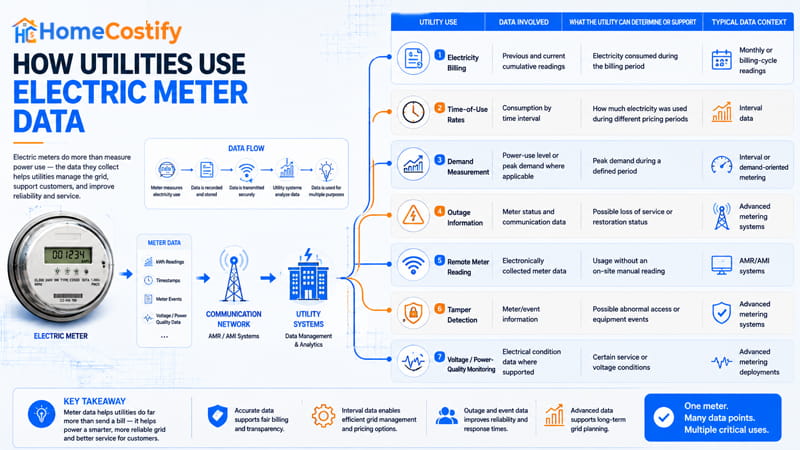
Usage information collected from a residence can serve several utility functions. Billing is the familiar application, yet interval data can support time-based pricing, demand tracking, outage information, and other operational needs. Available functions depend on the metering infrastructure and utility deployment.
| Utility Use | Data Involved | Utility Application | Typical Data Context |
|---|---|---|---|
| Electricity Billing | Previous and current cumulative readings | Electricity consumed during a billing period | Billing-cycle readings |
| Time-of-Use Rates | Consumption by time interval | Usage during pricing periods | Interval data |
| Demand Measurement | Power-use level or peak demand | Peak demand during a defined period | Demand-oriented data |
| Outage Information | Meter status and communication data | Possible service loss or restoration status | Advanced systems |
| Remote Meter Reading | Electronically collected usage data | Usage collection without an on-site visit | AMR/AMI systems |
| Tamper Detection | Meter and event information | Possible abnormal access or equipment events | Advanced systems |
| Voltage / Power-Quality Monitoring | Electrical condition data | Selected service conditions | Advanced deployments |
The available data set varies with the system serving the property. Basic arrangements can produce periodic consumption figures, whereas advanced infrastructure can collect information at shorter intervals and support additional utility functions. DOE documentation cites collection periods ranging from monthly data to five-minute intervals for advanced metering systems.
Meter Readings and Electricity Billing
Two figures form the basis for calculating usage within a billing period. The current value minus the previous value produces electricity consumed during that period. An electric meter supplies the underlying figures used in electricity billing, with the meter reading serving as the usage record.
Applicable rates are then applied according to the utility’s billing structure. Charges on a bill can include components beyond electricity consumption itself.
Usage Data, Time-of-Use, and Demand
A cumulative total does not show when electricity was consumed. Interval electricity meter data can separate usage into defined periods, supporting time-of-use pricing and other rate structures.
Demand-oriented records address peak power-use levels, which differs from cumulative consumption. The required data granularity therefore follows the tariff or pricing arrangement.
Advanced Meter Data and Grid Operations
Higher-frequency electrical meter data can support utility operations beyond billing. Advanced systems can supply outage notifications, remote service functions, tamper information, and voltage or power-quality data.
DOE material documents capabilities such as on-demand readings, outage detection, tamper notification, and voltage monitoring within advanced metering deployments.
Smart Meter Communication and AMI
AMR generally refers to automated meter reading or data collection. AMI describes a broader infrastructure involving communication and data-management capabilities.
A smart meter within such a system does not automatically transmit information continuously in real time; collection frequency varies by deployment. DOE project documentation shows systems supporting daily, hourly, and shorter reporting intervals.
Electric Meter Considerations for Homeowners
A homeowner can observe the meter and its visible condition without servicing the equipment. Questions about damage, unusual consumption, relocation, or replacement can involve utility control and local service requirements.
Property ownership does not automatically settle responsibility for a residential electrical meter. Utility arrangements vary by location, and service-side hardware can fall under utility control or other designated arrangements. Before altering anything, confirm responsibility with the applicable provider.
Cracked covers, exposed parts, or other visible damage warrant a report. Opening the enclosure or attempting a repair can cross into service work reserved for authorized personnel.
Common Homeowner Situations
- Damaged meter: Report visible damage without opening the enclosure or attempting repairs.
- Suspected inaccurate reading: Compare recent usage history, then ask the utility about its review process.
- Meter relocation: Contact the utility before changing the service-side arrangement.
- Replacement: Confirm who controls the equipment and which party is authorized to perform the work.
A sudden increase in consumption does not automatically indicate a faulty device. Recent usage history can reveal whether the change follows an unusual household pattern. For an electricity meter, relocation or replacement can affect the service arrangement, so coordination should precede physical changes.
Conclusion
Electricity used inside a home eventually becomes a recorded figure at the service connection. An electric meter sits at that point, turning household consumption into information associated with the property’s utility service.
The technology behind the device can differ, as can its physical arrangement and data capabilities. For homeowners, the useful perspective is simple: the number on the display represents accumulated use, and its place within the electrical service gives that number its practical meaning.
Electric Meter FAQ
Is it an electric metre or meter?
Meter is the standard American English spelling. Metre is primarily the British English form and does not refer to different equipment.
Can I legally fit my own electric meter?
Installation or alteration requirements vary by utility and jurisdiction. Confirm the applicable requirements with the utility or local authority before undertaking service-side work.
How to check kWh on meter?
Find the cumulative kWh value on the display or register. Digital units should be checked for the relevant label or unit; analog dials require careful reading.
How many kWh is 1 unit?
One electricity unit commonly means 1 kWh. Billing terminology can differ between markets and utility systems.
How much kWh per day is normal?
There is no universal daily household figure. An electric meter records electricity usage shaped by household size, climate, HVAC demand, appliances, and occupancy.