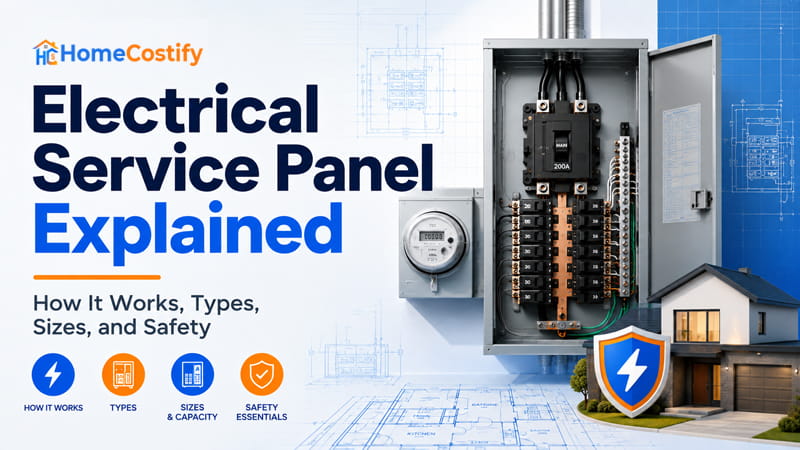
Homeowners encounter service equipment during inspections, maintenance planning, and electrical projects. The electrical service panel shows key details about the power setup installed at the property. Its markings include information about the equipment and its rated service.
The ampere marking states the equipment’s rated capacity. It does not show how much capacity is still available for added loads. Existing loads and the installed configuration affect that figure.
A homeowner can start with three facts: what equipment is installed, what rating is listed, and what electrical needs the house currently has. That information puts the panel in practical terms without moving into internal electrical work.
What Is an Electrical Service Panel?
Residential electrical terminology appears on product labels, inspection records, and trade documents. The wording can differ by setting, yet the equipment being described belongs to the home’s service and distribution arrangement.
A residential electrical panel serves as central distribution equipment for a home’s electrical service. An electrical service panel directs power toward circuits serving lighting, receptacles, appliances, and other household uses. Circuit protection and service control form part of its purpose. It is not simply a box that houses breakers.
Homeowners encounter several names for this equipment. A breaker box is a familiar term, breaker panel is another, and load center refers to certain residential equipment. Main panel generally refers to the primary distribution unit serving a home’s circuits.
In that terminology, an electrical main service panel refers to service equipment associated with the primary distribution arrangement. The wording changes across documents and conversations, so context matters when interpreting a label.
The home electric system includes the panel between incoming service and downstream circuits. Power passes through this equipment before reaching outlets, switches, and other electrical system components used around the residence. A home electrical panel belongs to the distribution network, not the final point where household power is consumed.
Where the Electrical Service Panel Fits in a Home Electrical System
A home’s electrical path runs from utility service through metering and distribution equipment to the circuits serving household devices. Incoming service reaches the panel before electricity continues toward downstream use.
From the Electrical Service Entrance to the Electric Meter
Utility electricity reaches the property through the electrical service entrance, where the utility supply meets the home’s service arrangement. The electric meter measures consumption associated with the residence. That measurement stage comes ahead of the main distribution equipment in a typical residential setup.
The meter records electricity used by the home for utility monitoring and billing. ESFI identifies the meter as the device that measures household consumption and places the service panel farther along the electrical path as the central distribution location.
The electrical service panel directs supply toward downstream circuits. In this arrangement, the electrical main service panel follows the metering stage and serves as the main distribution equipment.
From the Service Panel to Branch Circuits and Loads
An electrical outlet gives household equipment a connection to its circuit. A light switch controls lighting within its wiring. Appliances and fixed loads draw electricity through circuits assigned to their respective locations.
The main electrical service panel sends distribution into a branch circuit for a defined portion of the residence. That circuit might supply receptacles, lighting, fixed equipment, or other permitted loads. Household devices mark the downstream end of that path, where electricity reaches its point of use.
How an Electrical Service Panel Works
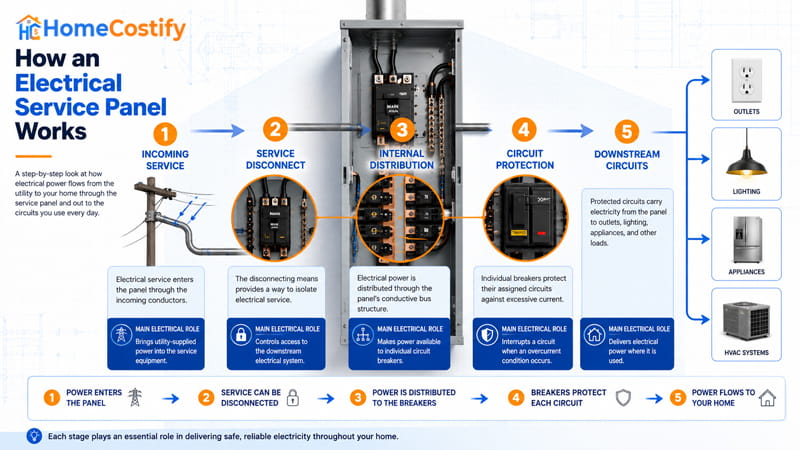
Utility-supplied electricity enters the enclosure, passes through service control, reaches the conductive distribution structure, and continues toward protected circuits. The functions differ at each stage.
Incoming Power Reaches the Panel
Utility-supplied conductors bring electricity into the service equipment. Incoming supply enters the electrical service panel before reaching the internal distribution path. The conductors form the entry stage, with circuit-protection devices farther along the path.
The Service Disconnect and Main Distribution
The service disconnect separates downstream wiring from the incoming supply when isolation is required. Its physical location varies among residential configurations.
The primary distribution function in such a setup is associated with an electrical main service panel. The two terms describe related functions, but they do not define every installation.
Power Distribution Through the Bus Bar
A bus bar carries the conductive path between incoming supply and breaker positions. Circuit breakers attach to this structure according to the panel configuration. Power reaches the positions assigned to branch-circuit protection through this internal path.
Circuit-Level Protection
Excessive current triggers protective action within a circuit. A circuit breaker interrupts its assigned circuit when current reaches its protective limit. Circuit protection within the electrical service panel covers these separate paths. AFCI and GFCI devices add specialized protection for specific electrical hazards beyond basic overcurrent interruption.
Electrical Service Panel Components: What’s Inside?
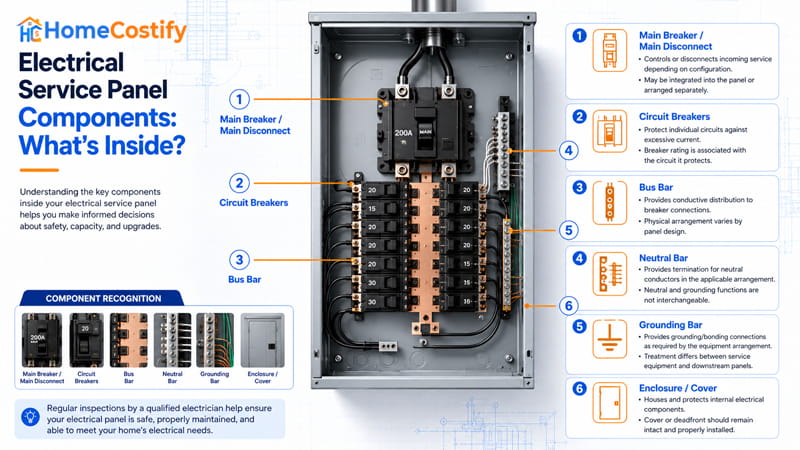
A residential panel contains distinct parts with separate functions. The main disconnect controls service, breakers protect branch circuits, conductive bars carry current, and the enclosure shields energized parts.
| Component | Primary Function | What Homeowners Should Know |
|---|---|---|
| Main breaker / main disconnect | Controls or disconnects incoming service, depending on configuration | It can be built into the panel or located separately |
| Circuit breakers | Protect branch circuits against excessive current | Its rating relates to the circuit it protects |
| Bus bar | Carries current to breaker connections | Physical layout varies by design |
| Neutral bar | Terminates neutral conductors where applicable | Neutral and grounding functions differ |
| Grounding bar | Handles grounding and bonding connections where applicable | Treatment differs between service and downstream panels |
| Enclosure / cover | Shields internal parts | The cover or deadfront should remain intact |
Main Breaker or Main Disconnect
The main disconnect handles service-level isolation. Within an electrical service panel, a main breaker can combine overcurrent protection with a means of disconnecting the incoming supply. A main-lug configuration places the disconnecting means elsewhere, so an internal main breaker is not present in every setup.
Circuit Breakers
Branch-circuit protection comes from individual breakers assigned to specific circuits. A circuit breaker interrupts current when an overcurrent condition reaches its protective threshold. Its rating relates to the circuit it protects, not the service rating for the whole panel.
Bus Bar
A bus bar is a conductive metal component inside the enclosure. Breakers connect to its conductive structure according to the panel’s physical design. Bus layouts differ between models and configurations.
Neutral and Grounding Connections
Normal line-to-neutral loads use the neutral conductor as a current-return path. Grounding and bonding serve fault-protection functions, not normal load return. The grounding system has a separate purpose. In electrical service panels, neutral and grounding connections can follow different configurations based on the equipment’s position in the system.
Panel Enclosure and Cover
The enclosure forms the physical boundary around internal parts. A main electrical service panel has a cover or deadfront that separates occupants from energized components. Missing or damaged covers warrant assessment by a qualified electrician.
Component Recognition
- Exterior labeling can show the manufacturer, model, ratings, and circuit directory.
- The cover or deadfront should remain installed and intact.
- Energized internal parts are not appropriate homeowner inspection points.
- Visible enclosure or cover damage calls for assessment by a qualified electrician.
Types of Electrical Service Panels

Residential panels differ by disconnect location, assembly layout, and position within the home’s power network. Amperage is a separate specification.
| Panel Type | Main Characteristic | Typical Role | Key Distinction |
|---|---|---|---|
| Main breaker panel | Main breaker is integrated | Primary service or distribution | Disconnect is within the enclosure |
| Main lug panel | Main lugs replace an integrated main breaker | Downstream distribution in applicable setups | Disconnecting means sits elsewhere |
| Meter-main panel | Metering and service functions share an assembly | Residential service installations | Combines metering and service functions |
| Subpanel | Supplied from another panel or feeder | Adds circuit spaces | Does not automatically raise utility service rating |
Main Breaker Panels
An integrated main breaker identifies this configuration. In a typical setup, the electrical main service panel places the primary disconnect within its enclosure. The breaker can combine disconnecting and service-level overcurrent functions. Its amp rating is a separate specification.
Main Lug Panels
Main lugs form the connection points for conductors at the panel. The disconnecting means sits elsewhere in configurations built that way. A main-lug panel is not automatically a subpanel. Its classification comes from its configuration and position within the electrical system.
Meter-Main Panels
A combined exterior assembly brings metering and service functions into a coordinated unit. This setup can reduce the need for separate exterior enclosures at the property. Utility requirements and the service design determine whether a meter-main configuration fits the installation.
Subpanels
Additional circuit space is the practical reason for adding a subpanel. The downstream unit is supplied from another panel or feeder, with an electrical service panel forming the upstream source in applicable setups. Added space does not raise the property’s utility service rating by itself.
Neutral and grounding treatment follows the requirements for downstream distribution.
Electrical Panel Sizes, Ratings, and Capacity
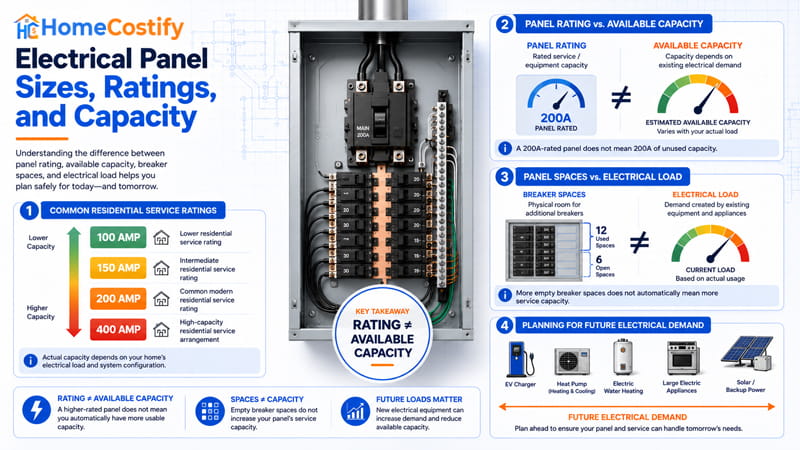
The ampere figure printed on a panel identifies a rated level of electrical service. It does not answer questions about existing demand, unused circuit space, or future equipment needs.
| Residential Service Rating | What It Indicates | Homeowner Context |
|---|---|---|
| 100 amp | Lower residential service rating | Common in older or smaller homes with modest demand |
| 150 amp | Intermediate residential service rating | Sits between 100A and 200A service levels |
| 200 amp | Common modern residential service rating | Adequacy still depends on calculated load |
| 400 amp | High-capacity residential service arrangement | Relevant where demand is unusually high or major loads are planned |
U.S. Department of Energy Building Science Education materials assess panel size and capabilities alongside existing loads and service-capacity needs. Their guidance applies when homeowners consider additional circuits or equipment, including heat pumps.
Common Residential Service Ratings
An ampere figure identifies the rated capacity of the service. The term electrical service panel sizes covers rating levels such as 100A, 150A, 200A, and 400A. A higher figure does not automatically make a configuration preferable. Household demand and installation requirements determine whether a given rating fits the property.
Panel Rating vs. Available Capacity
Existing household demand already occupies part of the available electrical capacity. The electrical service panel carries a rated figure, but that number is not a counter showing unused amperage. A new major load requires assessment of the current load profile and calculated demand. A 200A rating, for example, does not mean 200A sits unused for new equipment.
Panel Spaces and Electrical Load
Empty breaker positions indicate physical room inside the enclosure. They do not establish spare service capacity. A crowded enclosure and limited electrical capacity are separate concerns.
Physical space asks whether another circuit position exists; electrical service panel sizes address a different question when rating and capacity enter the decision. New high-demand equipment can expose the gap between available positions and usable capacity.
Planning for Future Electrical Demand
Planned household additions can change the future demand profile. EV charging, heat pumps, and electric water heating can add substantial demand, and larger appliances, solar, or backup equipment can affect planning.
An electrical main service panel should therefore be considered alongside foreseeable electrical loads before a larger service configuration is selected.
Factors That Affect Capacity Decisions
- Existing electrical load
- Calculated service load
- Available breaker spaces
- Planned high-demand equipment
- Existing service equipment and conductor limitations
- Local requirements for proposed electrical work
Physical room, rated capacity, current demand, and future additions answer separate questions. An empty breaker position does not establish that the home’s electrical service can support a new load.
Electrical Service Panel Clearance and Code Considerations
A clear working area leaves room for qualified personnel to inspect, operate, or service the equipment. Local code adoption determines the requirements that apply to a particular installation.
The usable area around the electrical service panel needs enough room for service work. Furniture, stored items, and appliances can block that area. A narrow path beside the enclosure adds another physical obstacle for anyone working there.
Access also depends on what sits around the installation. Permanent storage, furniture, or appliances can restrict movement near the enclosure. The working area should remain free of household items that interfere with inspection or service.
The National Electrical Code supplies model requirements for electrical installations. Local jurisdictions adopt those provisions, sometimes with amendments that apply within their boundaries.
Electrical service panel sizes do not set a universal clearance rule by themselves. Project-specific work calls for the requirements adopted by the applicable jurisdiction.
Electrical Service Panel Safety: Warning Signs Homeowners Should Notice
Unusual heat, damaged surfaces, strange sounds, and burning odors deserve attention around household electrical equipment. External observations require no removal of the cover or contact with internal parts.
Warmth, scorching, discoloration, corrosion, or water damage are visible conditions worth noting around an electrical service panel. Buzzing, sizzling, and crackling add another concern. A burning smell or repeated breaker trips calls for professional evaluation.
Warning Signs
- Burning smell or visible scorching — overheating or damaged electrical equipment should not be treated as cosmetic damage.
- Buzzing, sizzling, or crackling — unusual sounds warrant professional evaluation.
- Repeated breaker trips — recurring trips can point to an unresolved circuit or equipment problem.
- Flickering or dimming lights — the source could sit elsewhere in the home’s electrical system.
- Corrosion or water damage — moisture can damage the enclosure and surrounding electrical equipment.
- Unusual warmth — abnormal heat is not normal operation and should not prompt a homeowner to open the enclosure.
The Electrical Safety Foundation International lists dimming or flickering lights, unusual sizzling or buzzing, and repeatedly tripping breakers among warning signs that warrant contact with a qualified electrician.
The cover and deadfront should stay in place during casual homeowner observation. Internal conductors carry energized power, so touching them or changing breaker sizes is not appropriate. A visible symptom does not identify the failed component.
Persistent symptoms deserve professional attention. Scorching, physical damage, corrosion, burning odors, abnormal heat, and repeated trips warrant assessment even when electrical service panels continue supplying household power. The concern is the underlying condition, not simply the visible symptom.
When an Electrical Service Panel May Need an Upgrade
An upgrade can address different conditions. Safety defects, limited circuit space, service capacity, and planned additions point toward different project scopes.
Safety and Equipment Problems
Physical damage to the enclosure or internal parts warrants professional assessment. An electrical service panel showing scorching, corrosion, or physical deterioration presents a condition that needs qualified attention.
Faulty installation presents another basis for corrective work. A panel’s age by itself does not answer whether replacement is necessary.
Capacity and Circuit-Space Limitations
A shortage of usable breaker spaces presents a different issue from insufficient service capacity. Empty positions do not prove that additional demand fits within available capacity.
A subpanel adds distribution space in an applicable setup, yet it does not increase the property’s utility service rating. The limitation found during assessment points toward the appropriate scope of work.
New Electrical Loads and Home Improvements
A renovation, home addition, or new appliance can raise household demand. An electrical main service panel enters the assessment for proposed loads involving EV charging, a heat pump, electric water heating, solar, or backup power.
Project scope comes first: added circuits, a subpanel, service changes, or full replacement represent different levels of work.
The selected scope forms the basis for electrical service panel replacement cost. DOE Building Science Education materials link panel assessment with new appliances, existing loads, and service capacity.
Conclusion
An ampere rating describes the rated service capability, not the unused capacity sitting behind that number. Breaker spaces answer a physical question; service capacity answers an electrical demand question.
Physical condition adds another consideration, since damaged or deteriorated equipment can affect the decision even when the listed rating appears adequate.
Existing household demand belongs beside planned loads when a homeowner considers future changes. EV charging, a heat pump, a renovation, or new electric appliances can alter that demand.
For an electrical service panel, the practical decision comes from the home’s present needs, future plans, equipment condition, and available capacity. Technical changes inside service equipment call for evaluation from a qualified electrician.
Frequently Asked Questions
What is the 80% rule for electrical panels?
The 80% concept generally concerns continuous loads and applicable conductor or overcurrent protection requirements. It is not a blanket limit for every panel.
What is a 3-phase electrical panel?
Three-phase service uses three alternating-current phases and is common in commercial and industrial settings. Single-family homes more commonly use single-phase service.
What are the most common electrical panels?
Residential configurations include main breaker panels, main-lug arrangements, meter-main equipment, and subpanels. An electrical service panel fits within these common residential configurations.
What is a Form 4 electrical panel?
Form 4 describes an internal separation arrangement used with certain low-voltage switchboards or switchgear. It is not a typical residential panel classification.
What are the two types of panels?
Residential distribution has multiple configurations. A primary service panel and a downstream subpanel represent two common positions within that arrangement.