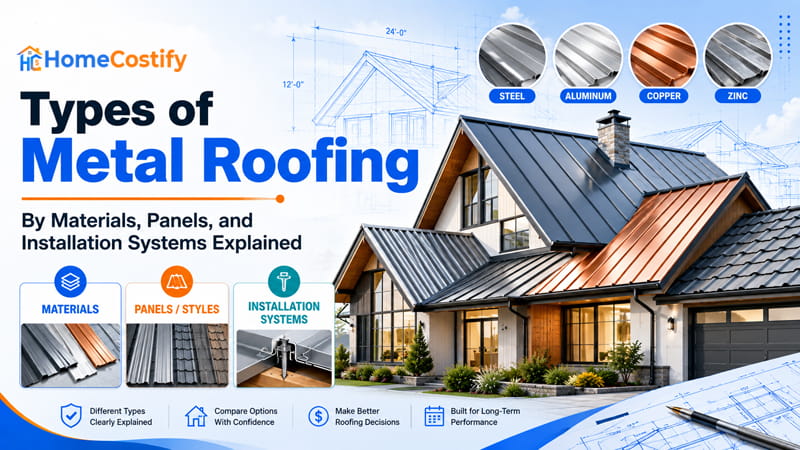
When homeowners talk about a metal roof “type,” they are not always talking about the metal itself. Types of metal roofing refer to the material, the panel or style, and the installation system. Each category answers a different question about the roof: what it is made from, what form it takes, or how it is attached.
For example, consider a metal roof specified with Galvalume steel, a standing seam, and concealed fasteners. A product page may focus on the visible roof design. Another source may address its material or installation.
The terminology changes with the subject being discussed, but the roof remains the same. A single specification includes several descriptions without treating them as competing choices.
How Many Types of Metal Roofing Are There?

There are 13 category entries across three classification dimensions: four by material, six by panel or style, and three by installation system. The count reflects how the roof is being classified, not how many separate roofs exist.
| Classification | Number | Included Types |
|---|---|---|
| By Material | 4 | Steel, Aluminum, Copper, Zinc |
| By Panel / Style | 6 | Standing Seam, Corrugated, Ribbed / Exposed-Fastener, Metal Shingles, Metal Tiles, Stone-Coated Steel |
| By Installation System | 3 | Concealed-Fastener, Exposed-Fastener, Interlocking |
Material, panel or style, and installation system describe different properties of a roofing assembly. Material classification follows composition or substrate. Panel/style classification concerns physical form.
The framework behind types of metal roofing separates those properties from the attachment method. Installation classification covers how the roofing is attached, completing the three classification dimensions.
Galvalume steel belongs to the material category. Standing seam falls within panel/style. Concealed fasteners represent the installation category. These labels can occur within the same specification, which is where metal roofing types overlap across classification dimensions.
The labels remain tied to their respective categories rather than becoming separate roofing choices. A configuration can carry several classifications without creating a new category for every combination.
Types of Metal Roofing by Materials

Material is the part of the roofing assembly that sets its underlying physical behavior. Substrate choice affects weight, corrosion response, surface weathering, fabrication, and appearance. Coatings and finishes can change how a surface behaves without creating a separate material category.
Residential metal roofing uses steel, aluminum, copper, and zinc as the four material categories in this guide. Steel commonly uses metallic coatings for protection. Aluminum, copper, and zinc respond differently to corrosion and weathering.
| Material | Defining Characteristics | Broad Service-Life Benchmark | Current Installed Cost Benchmark |
|---|---|---|---|
| Steel | Strong, widely available; commonly galvanized or Galvalume-coated | 40–50+ years | $6–$16/sq. ft. |
| Aluminum | Lightweight; high corrosion resistance; useful in marine environments | 40–50+ years | $11–$18/sq. ft. for aluminum standing seam |
| Copper | Natural metal; develops patina; premium architectural appearance | 50+ years | $25–$35/sq. ft. for copper standing seam |
| Zinc | Natural patina; high corrosion resistance; premium material | 50+ years | $25–$35/sq. ft. for zinc standing seam |
Steel Roofing
Steel provides a strong substrate and is widely available for residential roofing. Its place among metal roofing material types also reflects the role of its protective surface. The base metal and its coating perform different jobs. Gauge and product specification influence the finished system as well.
Galvanized steel carries a zinc coating over the steel surface. Galvalume uses an aluminum-zinc coating instead. Both approaches protect the underlying steel from corrosion, but they use different coating compositions.
Aluminum Roofing
Aluminum weighs less than steel, which affects how the material is handled during fabrication. Among metal roof types, this lighter substrate creates a distinct consideration for the roofing system. The finished roof still includes more than the substrate itself. Product specifications and fabrication methods influence the weight of the completed system.
Coastal exposure brings another consideration. Salt air creates corrosion concerns for susceptible metals. Aluminum has strong corrosion resistance, which makes it relevant in marine and coastal settings. Physical impact presents a separate concern because aluminum can dent more readily than steel.
Copper Roofing
Copper changes as weather acts on its surface. Its color develops over time, and the resulting patina becomes part of its architectural character. This evolving surface gives copper a different identity among types of metal roofs without reducing the material to a simple color choice.
Copper suits designs where the roof contributes to the building’s visual expression. Fabrication and detailing become important when the material has a prominent architectural role. The finished appearance depends on how the copper is incorporated into the surrounding design, including the details that shape its visible edges and transitions.
Zinc Roofing
Zinc develops a protective patina as the surface weathers. That layer contributes to corrosion management. Meanwhile, the visible surface continues to evolve as weathering progresses.
Minor surface damage can weather over as the patina develops, although this does not mean zinc physically repairs every scratch. The weathering process gives roof metal types another material-specific distinction.
Fabrication deserves attention with zinc because its material behavior affects detailing and movement. Appropriate fabrication accounts for those characteristics, and specialist experience can matter on projects where the material requires careful handling. Material selection also involves workmanship without turning zinc into an installation-system category.
Types of Metal Roofing Panels

Panel form describes the roof’s visible configuration and the way its units are arranged. Profile, seam shape, unit size, surface texture, and orientation influence the finished appearance. A single material can take several panel forms, giving physical configuration its own place in the classification.
| Panel / Style | Defining Form | Fastener Relationship | Typical Residential Character |
|---|---|---|---|
| Standing Seam | Long vertical panels with raised seams | Usually concealed | Modern, clean |
| Corrugated Metal | Repeating wave profile | Usually exposed | Rustic, utilitarian |
| Ribbed / Exposed-Fastener | Ribs and valleys, often trapezoidal | Exposed | Practical, functional |
| Metal Shingles | Individual stamped/interlocking units | Product-dependent | Traditional |
| Metal Tiles | Tile-shaped formed units | Product-dependent | Traditional/architectural |
| Stone-Coated Steel | Granular-coated steel panels | Product-dependent | Shingle/tile appearance |
Standing Seam Metal Roofing
Long panels extend from the eave toward the ridge, creating strong vertical lines. Raised seams mark the boundaries between adjacent panels. The orientation creates a continuous linear appearance that suits contemporary architectural forms. Standing seam represents one of the major metal roofing types through its vertical geometry and raised seam structure.
Two seam configurations commonly appear: snap-lock and mechanically seamed panels. Snap-lock edges connect through their shaped seam design. Mechanical seaming forms the joined edges after the panels are positioned.
Panel width changes the visual rhythm created by the seams. Metal roofing dimensions influence the number of visible divisions on a roof plane. Narrow panels create more frequent seam lines. Wider panels produce fewer visible divisions. Roof shape and panel width therefore work together to determine the pattern seen from below.
Corrugated Metal Roofing
Repeating waves give corrugated panels their recognizable profile. Among types of metal roofs, corrugated roofing stands out through curved or rounded sheet geometry.
Long sheets meet at overlapping edges during roof coverage. The sheet-based construction differs from individual stamped units used by shingle-style products. Exposed fasteners often remain visible on the surface. Residential uses commonly include rustic homes, agricultural buildings, garages, and accessory structures.
Ribbed / Exposed-Fastener Panels
Straight ribs and recessed valleys create the characteristic geometry of ribbed panels. Trapezoidal profiles are common, producing sharper lines than rounded corrugations. Raised sections establish the profile. Recessed areas create separation between neighboring ribs.
PBR and R-panel are names homeowners may encounter in product listings. Manufacturers and markets use profile terminology differently, so “ribbed” serves as a broader descriptive label. A specific product name does not automatically represent all roof metal types within the category.
Corrugated and ribbed panels can share visible fasteners. Their profile geometry provides the more useful distinction. Corrugated sheets use repeating rounded waves, whereas ribbed designs rely on straighter ribs and valleys. Fastener visibility alone does not establish the panel profile.
Metal Shingles
Individual stamped pieces distinguish metal shingles from long-sheet roofing. Interlocking edges connect neighboring units, creating repeated shapes over the roof. The unit-based arrangement gives types of roofing metal a different physical structure from continuous panels.
Shingle profiles can reproduce familiar residential roofing appearances. Some resemble asphalt shingles. Others take visual cues from slate or wood shakes. Shape, texture, and surface pattern determine how closely the finished roof resembles the traditional material.
Painted and stone-coated finishes introduce another visual variable. Color selection affects the appearance of the individual units and the overall roof. For homeowners comparing metal roofing colors, finish choice matters alongside the stamped shingle profile.
Metal Tiles
Formed metal tiles use deeper shapes that create visible dimensional relief. Repeated tile forms establish a familiar relationship with clay or concrete tile roofing. The profile depth contributes to the shadow pattern and visual mass of the finished roof.
Mediterranean, Spanish, and traditional homes can accommodate tile-shaped metal roofing particularly well. Among metal roof types, this category preserves the visual language associated with tile without requiring conventional tile units. The formed profile carries much of that architectural identity.
Stone-Coated Steel Panels
Stone-coated steel starts with a steel base and receives an acrylic coating. Stone granules become embedded in the coating, producing the textured surface associated with the product. The granules provide texture; they do not make the roofing material itself stone.
Several profiles can receive this surface treatment. Manufacturers produce shingle, shake, and tile forms with the granular finish. The term stone-coated steel therefore covers a surface treatment that can appear on multiple formed profiles. A shingle profile and a tile profile can share the same granular finish. Their formed shapes still produce different roof appearances.
Types of Metal Roofing by Installation System
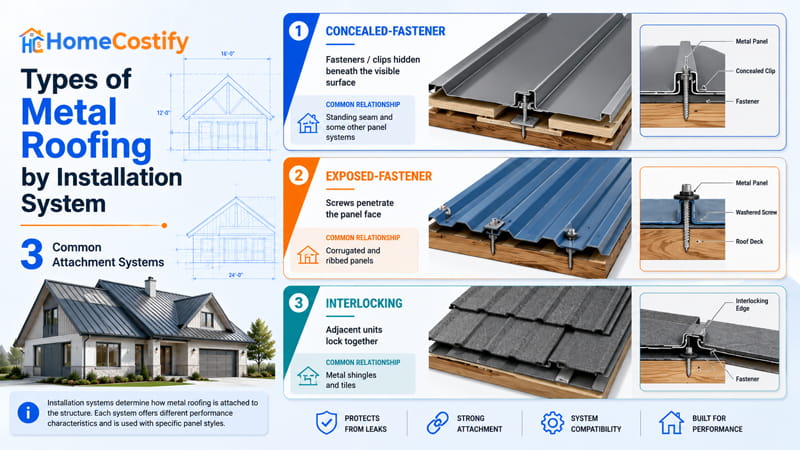
The attachment method determines how roofing components connect with the supporting structure. Screw, clip, or edge placement then follows that connection method.
| Installation System | Attachment Method | Common Relationship |
|---|---|---|
| Concealed-Fastener | Fasteners or clips hidden beneath the exterior surface | Standing seam and some other panel systems |
| Exposed-Fastener | Screws penetrate the panel face | Corrugated and ribbed panels |
| Interlocking | Adjacent units lock together | Metal shingles and tiles |
Concealed-Fastener Systems
Clips or fasteners sit beneath the exterior surface, keeping most hardware out of view. The result is a more continuous appearance, with fewer visible screw heads. Before installing metal roofing, the fastening arrangement must match the specific product design.
Temperature changes affect metal movement throughout the day and across seasonal conditions. Expansion and contraction place movement demands on the connection details. Clips and seam configurations accommodate that movement according to the product design. The amount and direction of movement depend on the panel system and its detailing.
Hardware positioned beneath the exterior leaves fewer penetrations visible from above. The seam arrangement still guides water toward the intended drainage paths. For metal roofing types, surface continuity depends on accurate fabrication and precise installation around seams and connection locations. Those details become especially important where several components meet.
Exposed-Fastener Systems
Metal roof types include systems where screws pass through the exterior face of the sheet. Washers surround each penetration and help seal the fastening location. Screw heads remain visible after the roofing is secured.
Outdoor exposure places the screws and washers directly in the weather. Their condition becomes an inspection point during maintenance. Changes around these components can affect the connection over time, depending on product design and exposure.
Corrugated and ribbed profiles commonly use face-fastening arrangements. Sheet overlaps, screw placement, and profile geometry work together within the finished roof. Panel style and installation method describe separate characteristics, even when manufacturers commonly combine them.
Interlocking Systems
Edges form the connection between neighboring pieces in an interlocking arrangement. Each unit engages with the next, producing a linked sequence of shingles or tiles.
The phrase types of roofing metal describes the attachment arrangement. The individual unit supplies the visible profile. A shingle and a tile can use related edge connections while retaining different physical forms.
Individual shingles or tiles change the way a damaged piece is handled. A replacement can involve one unit instead of removing a long sheet. The actual repair approach depends on the product and its specific connection details.
How Different Types of Metal Roofing Compare
A roofing combination brings material, panel/style, and installation choices into one specification. Their interaction shapes the roof’s practical character, appearance, and ownership considerations.
| Option | Material | Panel / Style | Installation | Service-Life Benchmark | Current Installed Cost Benchmark | Appearance | Maintenance Context |
|---|---|---|---|---|---|---|---|
| Steel standing seam | Steel | Standing seam | Concealed | 40–50+ years* | $10–$16/sq. ft. | Modern | Low routine surface maintenance; inspect details |
| Aluminum standing seam | Aluminum | Standing seam | Concealed | 40–50+ years* | $11–$18/sq. ft. | Modern | Strong corrosion resistance; marine suitability |
| Corrugated steel | Steel | Corrugated | Exposed | 40–50+ years* | Use steel benchmark: $6–$16/sq. ft. | Rustic/utilitarian | Fasteners and washers deserve inspection |
| Metal shingles | Steel/aluminum depending on product | Shingle | Interlocking/product-dependent | 50+ years is a broad quality-metal benchmark | Product-specific; no standalone range | Traditional | Depends on finish and system |
| Zinc standing seam | Zinc | Standing seam | Concealed | 50+ years* | $25–$35/sq. ft. | Natural/patina | Patina develops over time |
| Copper standing seam | Copper | Standing seam | Concealed | 50+ years* | $25–$35/sq. ft. | Natural/patina | Appearance changes through weathering |
Material Trade-Off
Steel occupies a broad mainstream position because it supports many roofing configurations. Aluminum enters the comparison more strongly where corrosion exposure influences the project.
Copper and zinc sit toward the higher-end material segment, bringing different architectural and ownership considerations. Metal roofing cost becomes one dimension of that material decision, not the sole measure of its position.
Panel and Installation Trade-Off
The roof configuration changes when panel style and attachment method change together. Planning for metal roofing replacement cost therefore depends on the complete configuration, not one label alone.
Standing seam and corrugated roofs create different visual expressions. Shingle and tile formats bring another architectural character to the exterior. Attachment choices affect maintenance exposure. Panel style and installation method need separate consideration within one specification.
Ownership Trade-Off
Initial investment becomes easier to interpret once the intended ownership period enters the comparison. A homeowner keeping the property for decades faces a different horizon from someone planning an earlier replacement.
Metal roof lifespan provides one reference point for that timeline, alongside maintenance exposure and potential replacement timing. Service life does not establish value by itself; the ownership period gives those factors their practical context.
Maintenance and Project Variables
Actual project conditions can shift the ownership experience even when two roofs carry similar labels. Metal roofing repair cost can reflect roof complexity, access, installation quality, product specification, existing conditions, and local labor.
Penetrations and detailing create project-specific requirements. Published benchmarks provide a reference point. Actual project scope depends on conditions at the property.
What can change the actual project figure?
- Roof geometry and complexity — Complicated layouts can require additional labor and detailing.
- Local labor conditions — Regional labor rates affect installed pricing.
- Coating, gauge, and product specification — Product configuration changes material and labor requirements.
- Existing roof condition — Tear-off or substrate issues can expand project scope.
- Access and staging — Difficult access can increase handling and setup work.
- Installation details — Penetrations, edges, transitions, and project-specific detailing affect labor.
How to Choose a Type of Metal Roofing
The right combination depends on the property’s environment, architecture, budget, ownership horizon, and project conditions.
Climate and Exposure
Salt air, moisture, snow, heat, and severe weather place different demands on a roof. Local exposure also changes which materials deserve closer consideration. Coastal locations present a stronger corrosion concern than many inland settings. These factors help narrow the types of metal roofs worth evaluating for a particular property.
Salt exposure deserves a closer look in coastal areas. MRA guidance points homeowners toward corrosion-resistant alloys such as aluminum, zinc, and copper. Product specifications still matter because alloy selection alone does not determine suitability. Installation details deserve attention in marine environments.
Roof Design and Appearance
The home’s architectural style provides an important reference for choosing among metal roofing types. Clean vertical lines can complement modern architecture, while shingle, tile, or shake expressions often suit traditional designs. Roof profile affects visual weight, especially where large roof planes remain prominent from the street.
Finish changes how the roof interacts with the rest of the exterior. Color coordination should account for siding, trim, masonry, and other visible materials. Surface treatments can alter how the roof reads from a distance. The profile and finish therefore need to work as a visual combination.
Budget and Long-Term Ownership
Upfront investment reflects more than the material itself. System configuration, profile, roof complexity, and local labor all contribute to the initial project price. Published benchmarks provide useful planning references, but the property’s specifications determine the actual figure.
Ownership period changes how a homeowner evaluates future expenses. Someone planning a shorter stay may place greater emphasis on initial investment. For longer ownership, maintenance and replacement timing become more relevant. Metal roofing types need to be considered against the expected service period, not viewed through initial price alone.
Installation and Maintenance Requirements
Complex roof geometry can increase coordination demands during installation. Multiple planes, valleys, penetrations, and transitions require careful detailing. Existing conditions can add work around the substrate and connection areas. Future inspection access deserves consideration before the system is selected.
Contractor familiarity with the chosen system affects execution quality. Correct detailing, fastening requirements, substrate conditions, and inspection access all belong in the selection process. There is no universally best metal roofing system apart from the property’s requirements and the installer’s ability to execute it correctly.
Conclusion
A metal roof can be classified by its material, physical form, or attachment method. Steel, aluminum, copper, and zinc describe the material layer. Standing seam, corrugated, shingle, and tile describe the physical form. The installation system adds another layer by identifying how the roofing connects to the structure.
Several factors deserve attention before choosing a combination. Climate, coastal exposure, architectural style, appearance, budget, ownership horizon, installation complexity, and future maintenance access can all affect the decision.
For homeowners, understanding the classification makes comparisons easier to follow. It prevents different categories from being treated as competing options when they actually describe separate parts of the same roofing specification.
FAQs About Types of Metal Roof
What is the best grade of metal roofing?
For steel roofing, Grade 80 offers higher strength than lower grades, but the appropriate grade depends on panel design, structural requirements, and roofing system.
What is the most popular type of metal roof?
Standing seam is one of the most popular residential metal roofing systems, while exposed-fastener panels remain common where lower upfront cost matters.
What is the most expensive type of metal roof?
Copper roofing is generally the most expensive mainstream metal roofing material, reflecting its premium appearance, long service life, and material cost.
What is the cheapest type of metal roofing?
Corrugated and exposed-fastener steel roofing generally sit toward the lower end of metal roofing prices, depending on gauge, coating, installation, and roof complexity.
What is the Types of Metal Roofing for Residential Homes?
Common residential options include standing seam, metal shingles, metal tiles, corrugated panels, and stone-coated steel, using materials such as steel and aluminum.