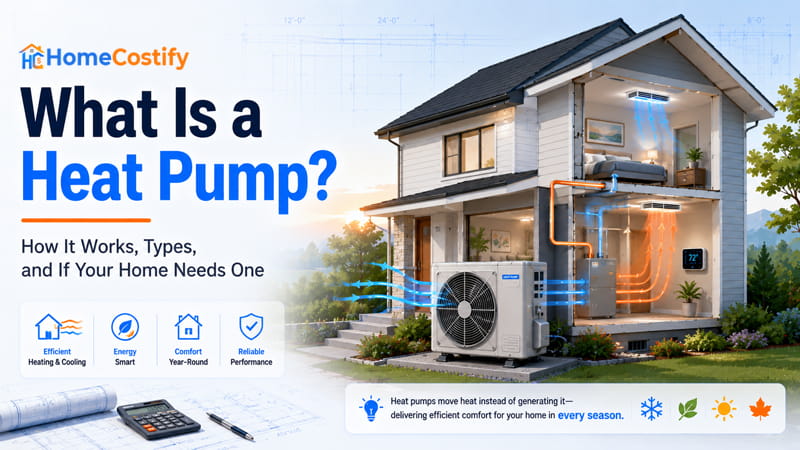
Thermal energy can move instead of being produced exactly where warmth is needed. A heat pump applies that principle to residential heating. Heat transfer allows available energy to serve a space without requiring warmth to originate there. The concept begins with energy moving from one part of the environment toward a place where it can be used.
Direction gives heat movement another dimension. Thermal energy can travel toward an interior space or move away from it. A residential system can use either direction according to the thermal task at hand. The direction of movement changes the role that transferred energy serves inside the home.
The home provides the setting where this technology operates. Indoor spaces interact with the surrounding environment, while air, surfaces, and outdoor conditions surround the area being served.
What Is a Heat Pump?
A heat pump is mechanical residential equipment that uses a refrigeration-based process. The technology provides household heating through that process. Its purpose is defined by the way the system operates, rather than by a particular physical design.
In practical terms, what is a heat pump? It works with thermal energy already present outside the space receiving it. That energy becomes available for useful heating through the operation of the system. The basic concept does not depend on understanding individual components.
Thermal energy provides the resource involved in this process. Heat describes thermal energy as it is transferred for a heating purpose. The system can draw that resource from an external source and make it available for indoor heating. The source itself depends on the design being used.
A heat source supplies the thermal energy that enters the process. Its location lies outside the interior receiving the transferred energy, although its physical form varies by system design. Different configurations can draw energy from different environmental sources. Those source categories belong to the broader classification of heat pumps.
The word “pump” refers to the action performed on the thermal resource. A pump moves something toward a useful purpose, and in this case the resource is thermal energy. The name describes the fundamental action without specifying a particular system configuration.
What Is the Role of a Heat Pump in an HVAC System?
Residential heating and cooling relies on a broader arrangement rather than a single appliance. HVAC describes that overall system, including the equipment responsible for indoor heating and cooling. A heat pump occupies one place in that larger architecture.
Cooling is one of the services a residential HVAC system can provide. A heat pump can remove unwanted heat from the house during cooling operation. That places it among home air conditioning systems, even though the same unit can provide heating as well.
On the heating side, residential HVAC serves the opposite comfort need. The heat pump can supply heat to the home and therefore belongs among home heating systems. Its approach differs from appliances that generate heat directly, although both provide heating for the household.
A furnace provides a clear example of equipment designed specifically for residential heating. It generates heat for delivery into the home rather than transferring existing thermal energy. The two systems therefore perform different heating tasks within the broader HVAC architecture.
How Does a Heat Pump Work?
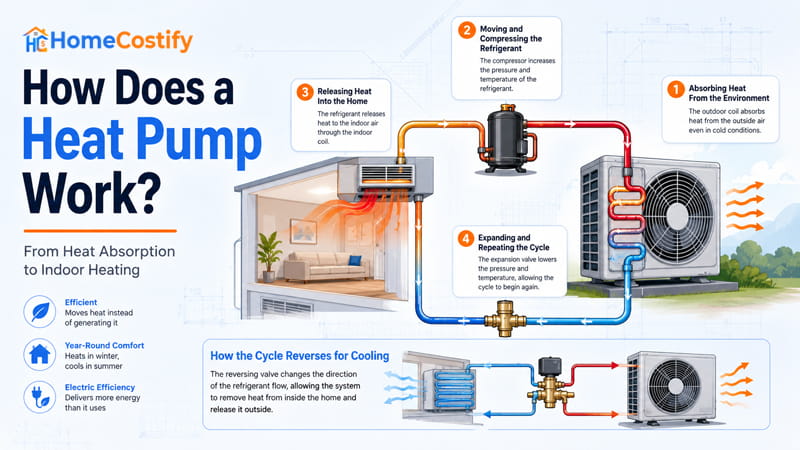
A heat pump performs thermal transfer through a continuous refrigeration cycle. Refrigerant acts as the working medium throughout the process. As it circulates through the circuit, its condition changes at several points along the cycle.
Step 1: Absorbing Heat From the Environment
The heat source provides available thermal energy for the refrigeration process. Outdoor air, ground, or water can supply that energy, depending on system design. A heat exchanger forms the transfer point between the source and refrigerant. Energy crosses that boundary into the refrigerant, which carries it forward through the circuit.
Step 2: Moving and Compressing the Refrigerant
The compressor receives the refrigerant after it has absorbed energy. Mechanical compression raises the refrigerant’s pressure and, with it, its temperature. The refrigerant therefore reaches a higher-energy state suitable for the next transfer stage. Pressure and temperature changes prepare the medium to release energy at a later point in the circuit.
Step 3: Releasing Heat Into the Home
The higher-temperature refrigerant reaches another heat exchanger after compression. There, thermal energy passes from the refrigerant into indoor air or another distribution medium. The exchanger creates the boundary where energy leaves the refrigeration circuit. The exact medium depends on the system configuration, but the transfer occurs at this interface.
Step 4: Expanding and Repeating the Cycle
An expansion valve reduces the refrigerant’s pressure after energy has been released. That pressure reduction changes its temperature and physical state. The resulting state allows the refrigerant to absorb energy again when it reaches the source-side exchanger. The circuit can repeat these changes continuously during operation.
How the Cycle Reverses for Cooling
A reversing valve changes refrigerant flow direction when the system switches to cooling mode. The two heat-transfer locations then exchange their roles. Indoor heat becomes the energy being collected, while the outdoor exchanger becomes the release point.
This is the basic principle behind how an air conditioner work in a house, where unwanted indoor heat must leave the living space. A heat pump uses the same refrigeration hardware for that directional change. Cooling therefore depends on changing flow direction rather than creating a separate mechanical cycle.
What Are the Main Types of Heat Pumps?
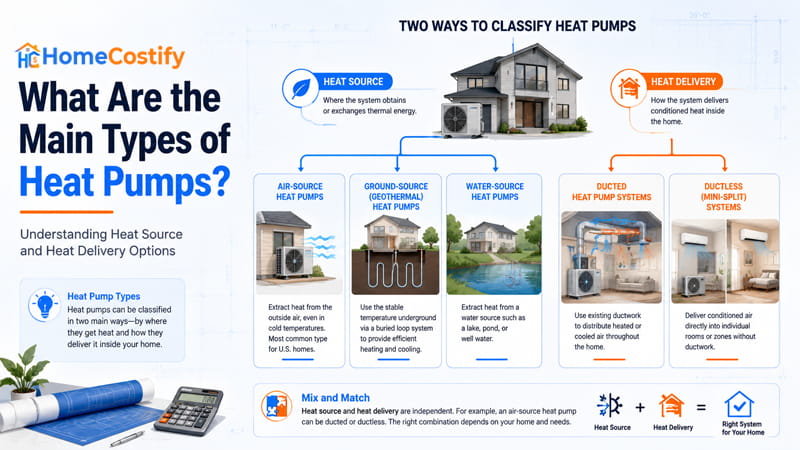
Descriptions of heat pumps can emphasize different aspects of the technology. That emphasis can change how similar systems are grouped and described across residential applications.
| Classification | What It Describes | Examples |
|---|---|---|
| Heat source | Where the system obtains or exchanges thermal energy | Air-source, ground-source/geothermal, water-source |
| Heat delivery | How the system delivers conditioned heat inside the home | Ducted, ductless/mini-split |
Air-Source Heat Pumps
Outdoor air serves as the thermal exchange source for an air-source heat pump. Energy is exchanged with the surrounding air through the outdoor heat exchanger. Outdoor temperatures influence the available thermal resource.
This source relationship defines the air-source classification. It does not determine whether indoor delivery uses ductwork or individual indoor units.
Ground-Source and Geothermal Heat Pumps
A ground loop connects the system to an underground thermal exchange arrangement. Ground-source systems exchange energy with the ground through that loop or a related underground setup. The ground provides the external thermal resource for the system.
Residential applications commonly use the term geothermal for this category. The loop allows the system to exchange energy with a large area below the surface.
Water-Source Heat Pumps
Water provides the external exchange source in a water-source system. The arrangement may involve a suitable water body or a circulating water loop, exdepending on system design. The water itself serves as the thermal exchange medium outside the conditioned space.
What defines the category is the use of water for external thermal exchange. The specific water arrangement can therefore vary between systems.
Ducted and Ductless Configurations
Delivery method describes a separate classification from the thermal source. Ducted systems send conditioned air through ductwork, while ductless configurations deliver it without a conventional duct network. An air-source heat pump, for example, can use either arrangement.
The same source category can therefore appear with more than one delivery configuration. This distinction matters when interpreting broader air conditioning systems types. A single system can have both a source classification and a delivery classification.
How Does a Heat Pump Heat a Home?
Moving thermal energy to the indoor side of a system is only part of the job in a home. That energy still has to reach occupied spaces through a suitable delivery configuration.
Ducted Heat Pump Systems
An indoor air handler conditions air before sending it through the home’s distribution network. Its role is to move that conditioned air toward the spaces being served.
Ductwork carries the conditioned air from the indoor unit to different areas of the home. Each branch provides a path toward rooms that require heating, making this arrangement part of how heating work in a house reaches occupied spaces.
A thermostat provides the control point for the desired indoor temperature. Its setting determines when heating is called for in the spaces under its control.
Existing ducts may sometimes serve a new ducted heat pump when their condition and design are appropriate. Their presence alone does not establish that the network suits the new system.
Ductless Heat Pump Systems
An indoor unit releases conditioned heat directly into the space it serves. This approach removes the need for a conventional duct network between the outdoor unit and each occupied area.
Multiple indoor units can connect to one outdoor unit in a multi-zone configuration. Each unit serves its assigned area, allowing separate spaces to receive conditioned heat through the same overall arrangement.
How Efficient Is a Heat Pump?
A heat pump can deliver useful heating with less electrical energy than direct electric heating because it transfers thermal energy. Its actual performance still varies with its operating environment.
Why Heat Transfer Has an Efficiency Advantage
Electricity powers the process and enables thermal energy to move from one location to another. The electrical input therefore does not need to become the entire heating output.
Existing thermal energy contributes to what reaches the indoor space. This gives heat transfer an efficiency advantage over a process that converts electrical input directly into heat.
The U.S. Department of Energy notes that heat pumps can typically deliver about 2 to 5 units of heat for each unit of energy used to move it. Actual results vary with temperature and other factors affecting performance.
This benchmark reflects the role of transferred thermal energy in the heating output. It is a typical performance range, not a guaranteed result for every home or operating situation.
What Efficiency Ratings Measure
Several metrics describe different aspects of heat pump performance. COP describes performance under a particular operating condition, while HSPF2 represents seasonal heating performance. SEER2 represents seasonal cooling performance.
Together, these measures provide different views of heat pump efficiency rather than one universal figure. DOE uses HSPF2 and SEER2 under its current testing framework for covered central systems.
Why Rated Performance Can Differ in Practice
Efficiency ratings come from defined testing procedures. Actual performance can change with temperature, system load, airflow, installation conditions, and control behavior.
Those factors can alter performance in an occupied home. A single rating therefore cannot describe every operating situation, making the relationship between the installed design and the home important to real-world performance.
Do Heat Pumps Work in Cold Weather?
Heat pumps designed for cold conditions can continue providing heating when outdoor temperatures fall below freezing. Their performance can change as outdoor temperatures decline. The extent of that change depends on how the technology operates at lower temperatures.
Why Cold Conditions Are More Demanding
As outdoor temperatures fall, the temperature difference across which thermal energy must move becomes larger. That greater temperature lift places a greater burden on heat transfer through the refrigeration process. Heating performance can consequently decline as outdoor temperatures continue to fall.
According to ENERGY STAR, a qualifying cold-climate heat pump must achieve a COP of at least 1.75 at 5°F. It must also retain at least 70% of its heating capacity at 5°F. The comparison uses its rated capacity at 47°F as the reference point.
These criteria show why both low-temperature efficiency and retained capacity matter in a cold climate heat pump. They define qualification for the ENERGY STAR Cold Climate designation. They do not guarantee identical performance from every system in a real home.
When Heating Demand Becomes More Demanding
Available heating capacity can decline as the temperature difference between the source and home becomes larger. Some systems use auxiliary heat when additional output is needed to meet the home’s heating demand. Dual-fuel arrangements can combine a heat pump with another heating technology when controls call for it.
What Affects Heat Pump Performance in a Home?
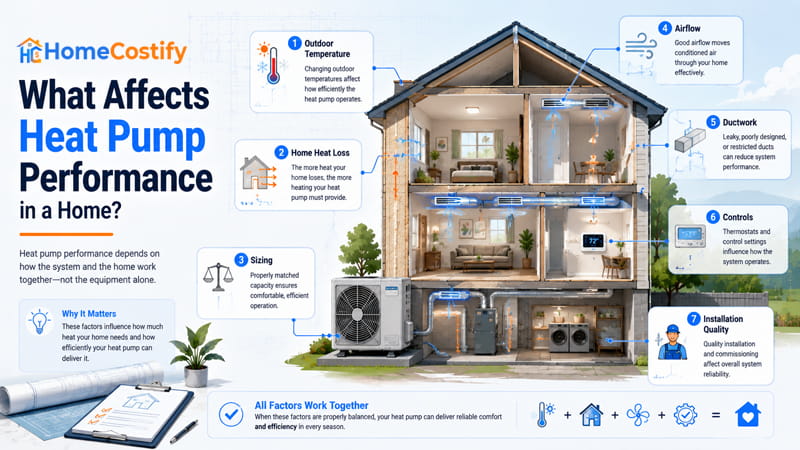
A heat pump does not operate independently of the house around it. The result homeowners experience depends on the home’s heating demand and how the installed system responds during everyday operation.
| Factor | Why it matters |
|---|---|
| Outdoor temperature | Changes operating conditions |
| Home heat loss | Determines heating demand |
| Sizing | Affects capacity and operation |
| Airflow | Affects heat delivery |
| Ductwork | Can affect distribution |
| Controls | Influence system operation |
| Installation quality | Affects overall system setup |
Heat escaping through the building creates a heating demand that must be replaced. A home with greater heat loss requires more output to maintain the desired indoor temperature. The installed system therefore operates within the context of the home’s actual heating load.
Available capacity needs to correspond reasonably to the home’s heating requirements. Heat pump sizing connects that demand with the output available from the installed unit. Undersizing can leave insufficient output during periods of high demand. Oversizing can also affect operating behavior and comfort rather than automatically producing a better result.
Restricted airflow can limit how effectively conditioned air moves through the distribution system. Duct leakage can reduce the amount reaching its intended destination. Imbalanced distribution may then create noticeable comfort differences between areas of the home.
The building enclosure also influences how much conditioned energy the home retains. Insulation affects how readily heat moves through that enclosure, while air leakage can increase energy loss. Windows and other envelope characteristics contribute to the home’s overall heating demand.
Control logic influences how the installed setup responds to changing indoor conditions. Refrigerant charge and commissioning also affect whether the installation operates as intended. Installation quality can determine how closely actual operation matches expected characteristics.
What Are the Main Advantages and Disadvantages of Heat Pumps?
A heat pump offers several useful characteristics for residential heating and cooling. Its practical fit also depends on the home, expected performance, and project requirements. Understanding the disadvantages of heat pumps alongside the benefits provides a more balanced starting point for homeowners.
Pros
- Heating and cooling in one system: Reversible operation can serve seasonal heating and cooling needs through the same installation.
- Heat-transfer efficiency: Transferring available thermal energy can use less energy than directly generating heat when the technology performs as intended.
- Flexible configurations: Ducted and ductless arrangements accommodate different home layouts and comfort requirements.
- Electric operation: Residential heating can occur without combustion at the point of use.
Cons
- Performance varies with conditions: Heating output and efficiency can change as outdoor conditions and household demand change.
- System matching matters: Capacity, distribution, controls, and the home’s characteristics influence practical operation.
- Project requirements vary: Existing infrastructure can affect the work required to integrate the new setup.
- Upfront considerations: The project involves more than selecting a product because the home’s existing systems and physical characteristics can affect its scope.
What Should Homeowners Know Before Choosing a Heat Pump?
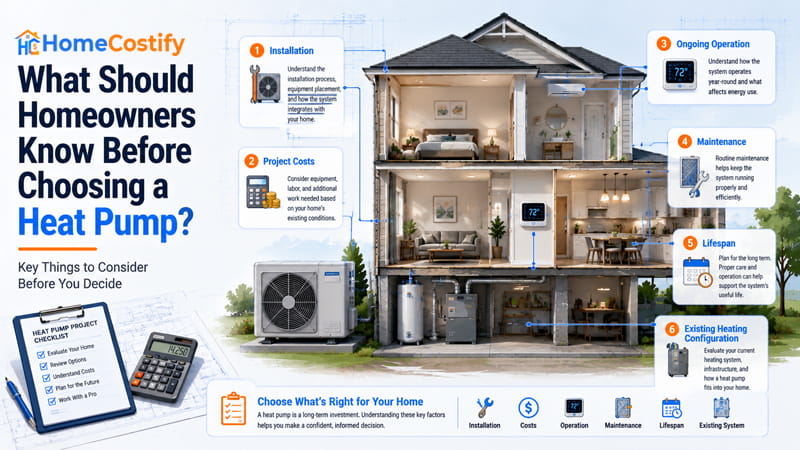
Choosing a heat pump involves more than selecting a product. The project also depends on the home’s existing configuration, required integration work, and responsibilities that continue after installation.
Installation brings the required components into the home’s existing or planned configuration. Indoor and outdoor components may require an appropriate distribution arrangement, depending on the house. Existing infrastructure can shape the scope and complexity of a heat pump installation.
Project spending extends beyond the purchase itself. Labor and integration work can contribute to the total, while existing conditions may affect the amount of work required. The purchase price represents only one part of heat pump installation costs for a residential project.
Electricity use continues throughout normal operation. Heating and cooling demand, climate, system performance, and thermostat settings all influence consumption. These factors can make heat pump operating costs differ between homes with otherwise similar configurations.
Maintenance remains part of ownership after installation. Airflow, filters, and overall operating condition can influence how the setup performs over time. Those responsibilities form part of heat pump maintenance throughout its service life.
Residential heating and cooling equipment has a finite service life, and several aspects of ownership can influence its longevity. Operation, installation, and maintenance all contribute to how it ages. A product’s heat pump lifespan is consequently a lifecycle consideration rather than a fixed promise.
The home’s current heating arrangement provides another piece of project context. Existing equipment and distribution infrastructure can influence whether the work involves adaptation, replacement, or a new configuration. The home’s heating systems types can also shape the options available for integrating new equipment.
Final Takeaway
A heat-transfer system has to function within the residential setting where it operates. Moving thermal energy provides the foundation, but that process cannot be separated from the house it serves.
The most useful way to view the technology is through the relationship between its design and the property. Performance ultimately depends on whether that combination suits the home’s requirements and the circumstances in which it will operate.
FAQs About Heat Pumps
Is a Heat Pump Better Than an AC?
A heat pump provides both heating and cooling, while a conventional air conditioner primarily provides cooling. The appropriate choice depends on the home’s comfort needs.
What Is the Downside to a Heat Pump?
Its output and efficiency can change with temperature and workload. The way the installation is configured can also influence the results experienced inside the home.
Why Do People Not Like Heat Pumps?
Some homeowners may dislike the technology when its behavior differs from their expectations. Mismatches involving capacity, installation, controls, or the property can contribute to dissatisfaction.
What Is the Major Problem of a Heat Pump?
No single problem affects every installation. More serious performance issues can emerge when the design, property, and operating requirements do not work well together.
Why Is My House So Cold With a Heat Pump?
A cold home may reflect insufficient capacity, restricted airflow, uneven distribution, substantial heat loss, or demanding outdoor temperatures. The actual cause depends on the situation.