Architectural shingles catch attention through their layered profile and textured surface. A common question follows soon afterward: what are architectural shingles made of? Asphalt comes to mind first, yet the finished roofing product contains a carefully arranged combination of specialized components that form a single assembly.
The textured face gives way to stacked construction, with each layer occupying its own place from top to bottom. Architectural shingle materials form a composite product whose internal structure cannot be judged from the finished roof alone.
A roof can display clean shadow lines, rich color, and pronounced depth across every slope, yet none of those visual details reveal how the shingle is built inside. From street level, attention naturally falls on the finished profile. The layered construction stays out of sight until a shingle is viewed in cross-section.
What Are Architectural Shingles Made Of?
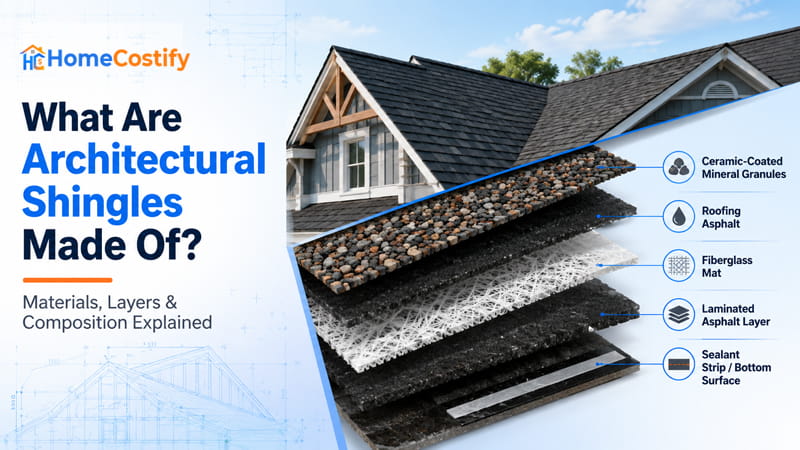
Architectural shingles combine architectural shingle materials into a layered roofing product instead of relying on one waterproof substance. Fiberglass mat, roofing asphalt, ceramic-coated mineral granules, a laminated layer, and a sealant strip make up the finished assembly. Each occupies a different position once the shingle is manufactured.
| Material | Primary Function |
|---|---|
| Fiberglass Mat | Structural reinforcement |
| Roofing Asphalt | Waterproof barrier |
| Ceramic-Coated Mineral Granules | Surface protection |
| Laminated Layer | Added thickness and profile |
| Sealant Strip | Wind-resistant bonding |
Ceramic-coated granules cover the exposed surface. Roofing asphalt surrounds the fiberglass mat. A laminated layer adds thickness, and a sealant strip sits near the lower edge where adjacent shingles bond after installation. This layered structure is known as architectural shingle composition.
Fiberglass, asphalt, ceramic-coated granules, laminated construction, and sealant strips make up the finished product. Matching material lists do not guarantee matching project costs. Roof size, installation labor, product grade, and regional pricing all feed into architectural shingles cost alongside material composition.
Understanding the Layered Composition of Architectural Shingles
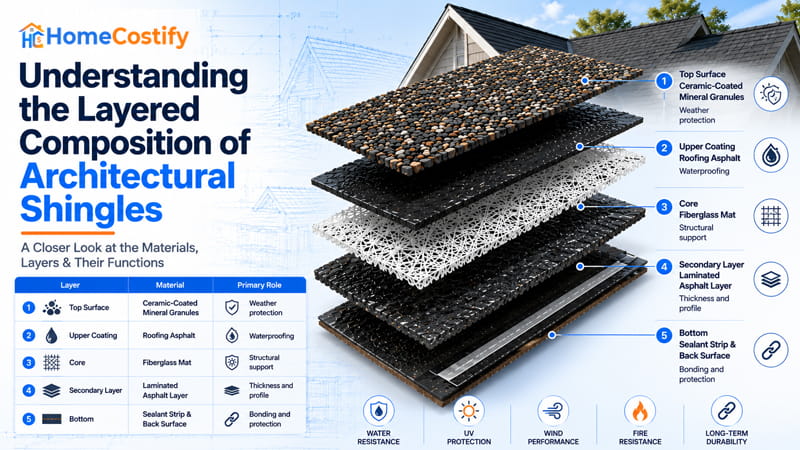
Architectural shingles appear as a single roofing product after installation. Cut through one shingle, and architectural shingle composition comes into view with mineral granules across the top, fiberglass near the center, laminated asphalt below, and the back surface underneath.
Manufacturers offer different architectural shingle dimensions, yet layer order follows the same basic construction from top to bottom.
| Layer | Material | Primary Role |
|---|---|---|
| Top Surface | Ceramic-Coated Mineral Granules | Weather protection |
| Upper Coating | Roofing Asphalt | Waterproofing |
| Core | Fiberglass Mat | Structural support |
| Secondary Layer | Laminated Asphalt Layer | Thickness and profile |
| Bottom | Sealant Strip & Back Surface | Bonding and protection |
Viewed from the edge, every layer appears in a clear top-to-bottom order. Mineral granules form the exposed face. Roofing asphalt surrounds the fiberglass core, and a laminated asphalt layer sits beneath the primary body of the shingle. Sealant and the back surface complete the underside. Top-to-bottom order places architectural shingle materials in predictable locations across the finished shingle.
Surface Layer: Ceramic-Coated Mineral Granules
Granules cover the exposed face seen from ground level. Ceramic coating locks color into each particle, giving architectural shingles their finished appearance. Sunlight, rain, hail, and airborne debris strike this surface before reaching lower layers.
Asphalt Coating
Beneath the granules sits a coating of roofing asphalt wrapped around the fiberglass mat. Granules embed into this coating across the exposed face. Water encounters asphalt before reaching the structural center, creating the primary moisture barrier within the layered assembly.
Fiberglass Mat Core
Fiberglass forms the structural center of the shingle. Asphalt coats both sides of the mat, leaving reinforcement enclosed within the assembly. Flexibility and dimensional stability originate from this central layer.
Laminated Asphalt Layer
A second asphalt section bonds beneath the primary body of the shingle. Extra thickness creates the shadow lines associated with architectural roofing products. Edge profiles appear deeper because two bonded sections overlap across part of the shingle.
Bottom Surface
Underside construction includes a sealant strip and a release surface. Heat activates the sealant after installation, bonding neighboring shingles along overlapping courses. Within this finished stack, architectural shingle composition places every layer in a defined order, and architectural shingle materials occupy fixed positions from top surface to underside.
The Main Materials Used in Architectural Shingles
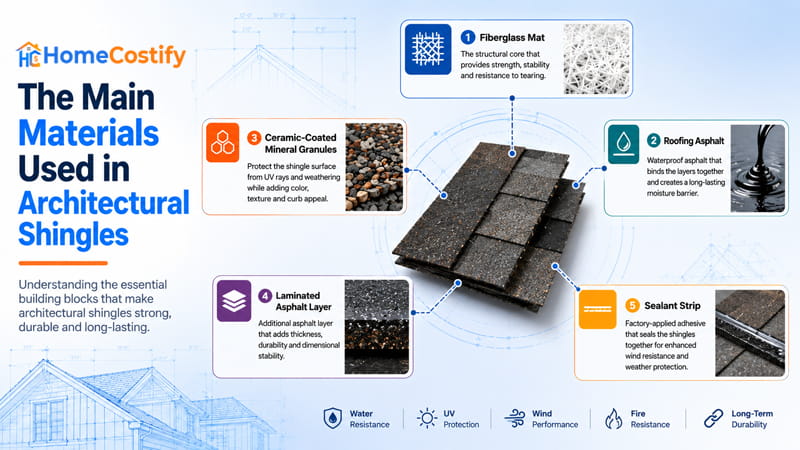
Five materials make up an architectural shingle. Fiberglass forms the core. Asphalt surrounds it. Mineral granules cover the exposed face, laminated asphalt creates the raised profile, and a sealant strip sits underneath.
| Material | Location | Main Purpose |
|---|---|---|
| Fiberglass Mat | Core | Structural reinforcement |
| Roofing Asphalt | Surrounds fiberglass | Waterproof barrier |
| Ceramic-Coated Mineral Granules | Surface | UV and weather protection |
| Laminated Asphalt Layer | Upper body | Thickness and dimensional profile |
| Sealant Strip | Underside | Bonding adjacent shingles |
Fiberglass Mat
Fiberglass mat sits at the center of modern architectural shingles. Thin, nonwoven glass fibers form a flat reinforcing sheet surrounded by asphalt. Fiberglass forms the structural core found inside most architectural shingle materials, hidden beneath the weather-facing layers.
Glass fibers absorb very little moisture. Low water absorption reduces swelling associated with cellulose-based reinforcement. Fire resistance comes from the glass itself, giving fiberglass an advantage over older paper-based materials.
Organic felt served as the reinforcing layer in older shingles. Fiberglass gradually replaced felt across modern residential roofing because glass fibers offered a more stable reinforcing foundation.
Architectural shingle composition places fiberglass between asphalt layers, leaving the reinforcing sheet hidden inside the finished product.
How the Fiberglass Mat Reinforces the Shingle
Asphalt coats both faces of the fiberglass mat, enclosing the reinforcing sheet inside the shingle. Fiberglass limits stretching within the bonded assembly as asphalt flexes under normal roof movement.
Fiberglass resists internal tension. Asphalt forms the weatherproof coating and anchors mineral granules at the surface. Both materials perform separate engineering functions inside the finished shingle.
Roofing Asphalt
Roofing asphalt forms the outer coating around fiberglass inside modern shingles. Its formulation differs from paving asphalt because roofing products face rain, sunlight, and seasonal temperature changes instead of vehicle traffic. Asphalt covers the largest area within modern architectural shingle materials, surrounding the reinforcing mat from edge to edge.
The coating surrounds fiberglass and extends toward the exposed surface. Mineral granules press into fresh asphalt during production, leaving part of each granule visible above the surface. Adhesion begins with asphalt, not fiberglass.
Flexibility changes with temperature, though roofing asphalt retains enough body to stay bonded around fiberglass and mineral granules during normal service.
How Asphalt Creates a Waterproof Barrier
Rain reaches asphalt before any internal layer. A continuous coating directs water across the surface, reducing contact with fiberglass beneath. That arrangement forms a central part of architectural shingle composition.
Mineral granules stay anchored because asphalt grips their embedded surfaces. Architectural asphalt shingles use this combination to protect the fiberglass core without relying on paving asphalt, whose formulation serves a completely different purpose.
Ceramic-Coated Mineral Granules
Ceramic-coated mineral granules cover the exposed face of an architectural shingle. Crushed mineral particles receive a ceramic finish before bonding with roofing asphalt, creating the rough texture visible from ground level. Mineral granules are the only part of architectural shingle materials left exposed after the roof is complete.
Surface texture comes from those mineral particles, not the asphalt underneath. Visible architectural shingles colors originate from the ceramic coating covering each granule. Asphalt serves as the bonding layer beneath that colored surface.
How Mineral Granules Protect the Roof Surface
Sunlight, rain, hail, and airborne debris strike mineral granules before reaching asphalt. The ceramic-coated surface absorbs that exposure, leaving the underlying asphalt covered during normal weather conditions. That layered arrangement forms part of architectural shingle composition.
Granules gradually wear from years of outdoor exposure. Asphalt stays beneath the mineral layer until granule loss exposes sections of the coating. Roof inspections commonly identify worn areas through granule loss long before fiberglass appears.
Laminated Asphalt Layer
A laminated asphalt layer adds a second bonded asphalt section above the main shingle body. Bonding two asphalt sections creates the raised profile associated with laminated architectural shingles. The laminated section gives architectural shingle materials their raised profile without adding another exposed surface.
Flat single-layer shingles contain one asphalt body. Laminated construction places an additional bonded section above it, producing deeper shadow lines and a thicker profile when viewed from the roof edge.
How Lamination Adds Strength and Dimension
The bonded layer changes material distribution across the shingle body. Profile depth increases because two asphalt sections overlap across selected areas instead of forming one flat surface. That arrangement forms part of architectural shingle composition.
Dimensional shingles display a textured profile that differs from traditional three-tab shingles. The added asphalt section changes the finished shape without altering the exposed mineral granule surface.
Sealant Strip
A sealant strip lines the underside of every shingle as a narrow band of asphalt-based adhesive. Factory application places that strip in a fixed position before the shingle reaches the roof. The sealant strip stays hidden beneath overlapping courses, making it the least visible part of architectural shingle materials.
The adhesive sits below the exposed surface, covered by overlapping shingles once installation is complete. Roof inspections rarely expose the strip unless shingles are lifted or removed.
How the Sealant Strip Secures Adjacent Shingles
Roof temperatures gradually soften the adhesive after installing architectural shingles. Contact develops where overlapping shingles meet, forming a continuous bond along the strip. That bond reduces wind uplift by limiting edge movement during normal weather exposure.
This adhesive contact forms one part of architectural shingle composition. Asphalt coating blocks water above, fiberglass reinforces the body, and the sealant strip secures neighboring shingles along the underside.
How Architectural Shingles Are Manufactured
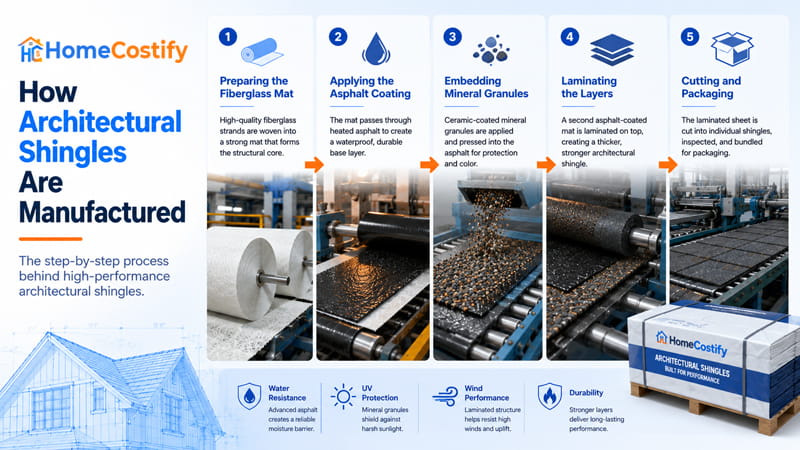
Industry guidance from the Asphalt Roofing Manufacturers Association (ARMA) describes a fiberglass sheet coated with asphalt, covered with colored mineral granules, finished with adhesive elements, and prepared for packaging. Across architectural shingle materials, every addition changes the form of the moving sheet before cutting begins.
Preparing the Fiberglass Mat
Production starts with a continuous fiberglass sheet moving across the manufacturing line. Fine glass fibers form a flexible reinforcing base with uniform thickness from edge to edge. Flat sheets leave this section ready for asphalt coating without carrying exposed roofing surfaces.
Applying the Asphalt Coating
Warm asphalt covers both faces of the fiberglass sheet, surrounding the reinforcing fibers inside a continuous coating. Mineral stabilizers blend into the asphalt before reaching the moving sheet, producing a dense roofing body.
Embedding Mineral Granules
Ceramic-coated mineral granules settle across the exposed asphalt surface under controlled pressure. Colored particles embed into the coating before cooling locks them into place. Exterior texture emerges at this point, revealing much of the finished architectural shingle composition before lamination begins.
Laminating the Layers
An additional asphalt section bonds onto selected areas of the shingle blank, forming the raised profile associated with dimensional roofing products. Clean bonding patterns produce uniform shadow lines across finished shingles.
Roofing professionals evaluating the best architectural shingles frequently include manufacturing consistency among their product considerations, alongside material quality and finished construction.
Cutting and Packaging
Large roofing sheets pass through cutting equipment that separates repeating shingle patterns from the continuous material. Finished pieces move into bundles prepared for shipping and storage. Every bundle carries the completed architectural shingle composition, ready for delivery from the factory to roofing suppliers.
How Material Composition Affects Architectural Roof Performance
Roof performance develops from the interaction among multiple materials, not from one layer alone. ASTM describes modern shingles as a fiberglass-reinforced product coated with asphalt, surfaced with mineral granules, finished underneath with anti-stick materials, and fitted with factory-applied sealant.
Even so, architectural shingles lifespan, architectural shingle repair cost, and architectural shingle replacement cost depend on climate, installation quality, roof design, ventilation, and long-term maintenance alongside material selection.
| Performance Factor | Material Contribution |
|---|---|
| Water Resistance | Asphalt coating |
| UV Protection | Ceramic-coated mineral granules |
| Wind Performance | Lamination and sealant |
| Fire Resistance | Fiberglass reinforcement |
| Dimensional Stability | Layered construction |
Water Resistance
Rain reaches the roof surface before touching any internal layer. Continuous asphalt coverage blocks moisture from traveling toward the fiberglass core through normal exposure. A complete architectural shingle composition leaves few direct paths for water once overlapping shingles cover the roof field.
UV Protection
Daily sunlight strikes mineral granules long before reaching asphalt below. Ceramic coatings absorb prolonged exposure across the roof surface, delaying direct weathering of the asphalt layer. Surface texture changes gradually across years of outdoor exposure, leaving lower roofing layers covered for much longer.
Wind Performance
Air pressure concentrates along roof edges and exposed tabs during strong wind events. Raised laminated sections create a thicker roofing profile, and factory-applied sealant bonds overlapping shingles after normal roof temperatures activate the adhesive. Inside architectural shingle composition, lamination and adhesive contact resist edge separation across finished roof courses.
Fire Resistance
High temperatures reach the roof surface before penetrating deeper layers. Fiberglass reinforcement forms a stable base without relying on combustible organic felt found in older roofing products. Material selection contributes to fire-performance ratings established through standardized testing.
Dimensional Stability
Layered construction distributes roofing materials across a thicker shingle body from edge to edge. Mineral granules, asphalt, fiberglass, laminated sections, and hidden adhesive occupy fixed positions inside architectural shingle materials, producing a uniform roofing profile across completed roof slopes. Consistent material placement supports a finished roof shape under normal service conditions.
How Modern Architectural Shingle Materials Have Evolved
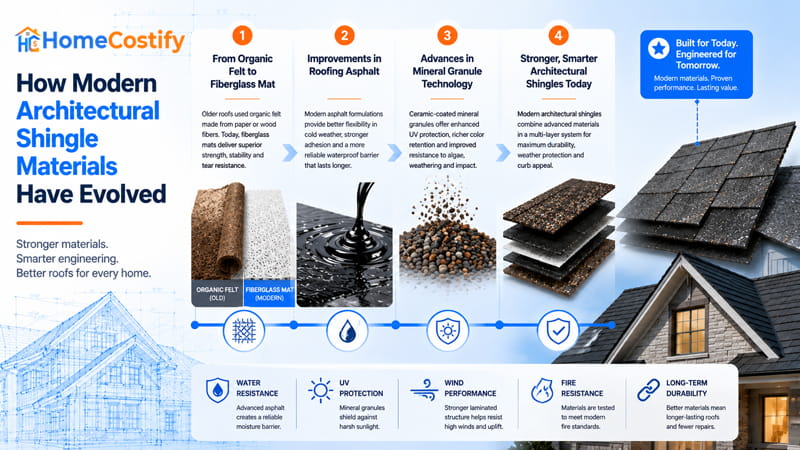
Modern architectural shingles reflect gradual refinement across the materials inside each shingle, not a complete redesign of the roofing product. Small changes in reinforcement, asphalt coating, and surface protection shaped the layered construction used today.
From Organic Felt to Fiberglass Mat
Earlier asphalt shingles used organic felt as the reinforcing base beneath the asphalt coating. Fiberglass gradually replaced felt after manufacturers sought reinforcement with lower moisture absorption and stronger dimensional stability. Fire performance advanced as well, placing fiberglass at the center of current roofing construction without changing the familiar appearance from above.
Improvements in Roofing Asphalt
Roofing asphalt changed alongside fiberglass reinforcement. New formulations produced stronger bonding around glass fibers and a smoother coating across both sides of the reinforcing sheet. Inside architectural shingle composition, asphalt and fiberglass developed into a closely matched pairing, reducing variation across the finished shingle body.
Advances in Mineral Granule Technology
Mineral granules evolved through refinements in ceramic surface coatings instead of dramatic visual changes. Colored finishes retain their appearance longer under prolonged sunlight, and ceramic protection delays direct exposure across the asphalt surface.
Refinement at the outer roofing surface completed another step in modern architectural shingle materials, matching advances already established beneath the exposed face.
Conclusion
A finished roof reveals only the outer surface, yet layered engineering sits beneath every shingle. Anyone asking what are architectural shingles made of reaches an answer extending beyond asphalt alone.
Fiberglass reinforcement, protective coatings, surface granules, laminated construction, and factory-applied adhesive form one integrated roofing assembly.
Product selection gradually narrows as construction details replace marketing descriptions. Layered composition becomes one of the first technical details separating similar roofing products.
Frequently Asked Questions
What is the difference between architectural shingles and regular shingles?
Architectural shingles use laminated construction with a thicker layered profile. Regular three-tab shingles have a flatter appearance with uniform rectangular tabs.
Are architectural shingles asphalt or fiberglass?
Both. Fiberglass forms the reinforcing core, and asphalt surrounds that reinforcement as the primary waterproof coating across the shingle body.
How can I tell if I have architectural shingles?
Check the roof surface for layered sections, irregular shadow lines, and a raised dimensional profile. Flat, evenly spaced tabs usually indicate three-tab shingles.
What is another name for architectural shingles?
Architectural shingles are commonly called dimensional shingles or laminated shingles. Product packaging and manufacturer literature frequently use either name.
What do architectural shingles look like on a roof?
Architectural shingles display a textured profile with irregular shadow lines. Many roofing designs resemble natural wood shakes from ground level without using wood.