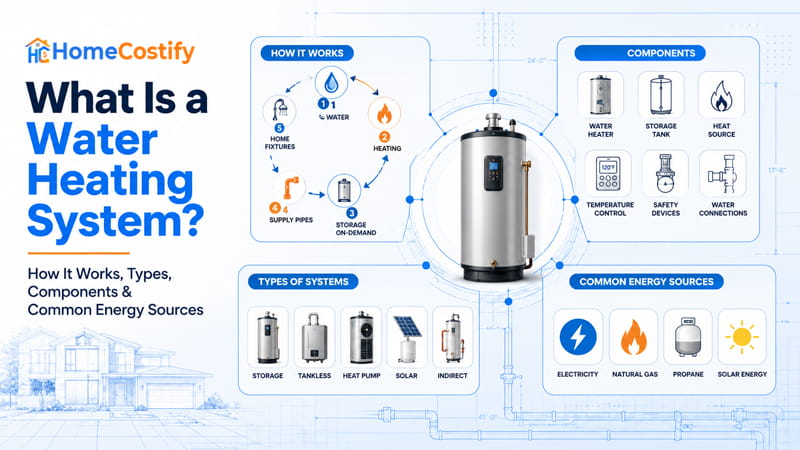
Preparing breakfast, washing greasy dishes, taking a warm shower, and finishing the weekly laundry all call for heated water. A water heating system meets those daily needs quietly, making kitchens, bathrooms, and laundry spaces ready whenever warm water is needed.
Hidden supply lines carry heated water behind finished walls, leaving little visible evidence of the plumbing serving those familiar routines. Cold taps quickly interrupt cooking, cleaning, bathing, and laundry, revealing how closely daily life connects with a dependable hot-water supply.
A residential water heating system covers the plumbing subsystem responsible for producing and delivering heated water across the house. Coverage extends beyond the water heater found in a utility closet, basement, or mechanical room.
Piping, controls, and distribution work as a single hot-water service. The heating unit accounts for one element of that service.
What Is a Water Heating System?
A water heating system every plumbing element required to move heated water from its heating source to the fixtures where people use it. Production and delivery belong to the definition as a single residential service, not as separate plumbing tasks.
The U.S. Department of Energy uses the term domestic hot water system for the equipment and distribution serving household hot-water use.
Residential plumbing is divided into distinct subsystems, each assigned to a different purpose. Fresh-water supply brings potable water indoors. Drainage carries wastewater away. Vent piping protects proper drainage flow. A household water heating system occupies the portion dedicated to hot-water service, giving that plumbing discipline its own clearly defined place.
The word system describes a unified plumbing service instead of an isolated piece of equipment. Heated water reaches household fixtures through a continuous residential process beginning at the heating source and ending at the point of use. Both responsibilities stay within the definition, even though different products or energy sources perform the heating task.
Fuel type, storage method, installation style, and equipment selection can vary from one house to another. None of those differences changes the meaning of the term. A water heating system still identifies the residential plumbing subsystem assigned to household hot-water production and delivery.
Why Every Home Needs a Water Heating System
A water heating system exists to supply heated water wherever health, sanitation, food preparation, and everyday living require temperatures beyond the cold-water supply. Everyday tasks lose an expected standard of cleanliness, food safety, and personal comfort without a dependable source of warm water.
Handwashing removes dirt and soap residue with greater effectiveness. Warm baths reduce discomfort for infants, older adults, and anyone sensitive to cold temperatures. Greasy cookware releases cooking residue with less scrubbing after contact with higher temperatures. Clothing, towels, and bedding wash away body oils and stubborn stains under warm or hot wash cycles.
Higher temperatures improve kitchen cleanup after preparing oily meals. Cooking utensils rinse free of grease, food-contact surfaces stay cleaner, and stubborn residue lifts away with less effort. Fresh clothing, clean towels, sanitary cookware, and comfortable bathing all begin with dependable access to warm water.
Where a Water Heating System Fits Within a Home Plumbing System
Inside a home plumbing system, the water heating system sits between the water supply system and the fixtures where people use water every day. Potable water enters the residence first, passes into the heating stage, and then continues toward its final destination. That position places the subsystem between incoming supply and everyday use.
| Plumbing Subsystem | Primary Responsibility |
|---|---|
| Water Supply System | Delivers clean water into the home |
| Water Heating System | Produces and supplies hot water |
| Plumbing Fixtures | Deliver water where it is needed |
| DWV System | Removes wastewater and sewer gases |
Each subsystem performs a different task inside the plumbing layout. None replaces another, and each occupies a specific position along the flow path serving the residence.
Water Moves From the Water Supply System
Municipal utilities and private wells supply potable water before it enters the water supply system serving the residence. Cold water reaches the heating stage before continuing toward plumbing fixtures. When installed, a water treatment system conditions the incoming supply before the heating stage begins.
Heated Water Is Delivered to Plumbing Fixtures
Bathrooms, kitchens, and laundry rooms serve as the primary destinations for heated water. Faucets, bathtubs, showers, sinks, dishwashers, and washing machines receive hot water through plumbing fixtures serving those spaces.
Used Water Leaves Through the DWV System
After leaving a fixture, wastewater enters the DWV system and follows a separate drainage path. Sewer gases travel upward through plumbing vent piping, and wastewater continues toward the building drain without returning to the incoming supply.
How a Residential Water Heating System Works
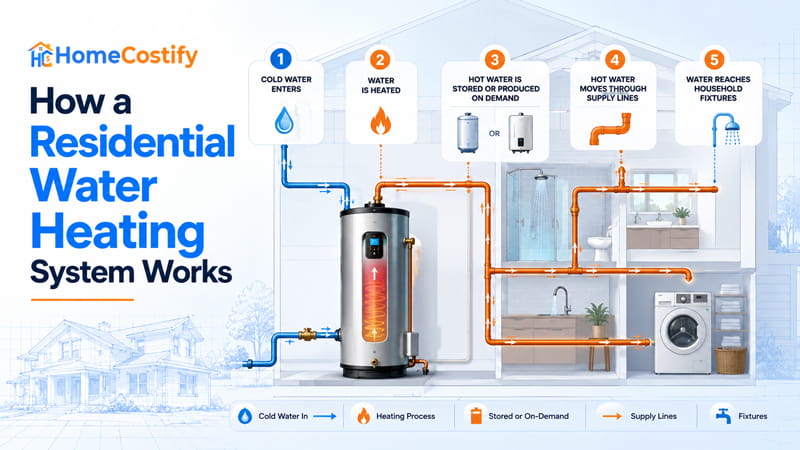
A residential water heating system follows a continuous operating cycle with five distinct stages. Cold water enters first, thermal energy raises its temperature, distribution carries it toward points of use, and the cycle concludes after household use has finished.
| Stage | Primary Action |
|---|---|
| 1 | Cold water enters |
| 2 | Water is heated |
| 3 | Hot water is stored or produced on demand |
| 4 | Hot water moves through supply lines |
| 5 | Water reaches household fixtures |
The stages form a fixed operating order instead of independent events. Completion of one stage supplies the starting condition for the next, so the process advances in a single direction from beginning to end.
Cold Water Enters the System
Municipal utilities and private wells supply potable water before entry into the residential subsystem. The operating cycle starts once fresh water reaches the heating section prepared for temperature change.
No thermal energy has been transferred at this point. The liquid still matches the temperature delivered from the original source, making this entry stage the foundation for everything that follows.
Water Is Heated
Thermal energy moves into the incoming supply during the second stage. A water heating system raises temperature until it reaches a level suitable for household use.
Gas, electricity, solar energy, and heat pumps accomplish that objective through different technologies, although every design follows the identical principle of transferring heat into water. Once the target temperature has been reached, the heating phase ends and the process advances to the next point.
Hot Water Is Stored or Produced on Demand
A home water heating system continues with one of two operating methods after heating has finished. Stored designs hold heated water inside a storage tank until a fixture calls for it. On-demand designs wait for household demand before heating begins.
Both methods pursue the identical objective: placing usable hot water in position before distribution starts. Availability changes, yet the operating sequence continues in the same chronological order.
Hot Water Travels Through Supply Lines
Distribution starts after heating or on-demand production has finished. A household water heating system feeds the main hot-water line before branch piping supplies bathrooms, kitchens, laundry rooms, and similar destinations.
Kitchens, bathrooms, laundry rooms, utility sinks, and similar destinations draw from that distribution path whenever a faucet or appliance opens. Movement ends once the requested volume reaches the point of use.
Used Water Leaves the Plumbing System
Normal household use marks the final phase of the operating cycle. A water heating system completes its task after water leaves a fixture and enters the drainage path as wastewater.
From that point forward, a different plumbing subsystem carries the flow away from occupied spaces. The heating sequence concludes there, leaving drainage outside the operating process described in this section.
Major Components of a Water Heating System
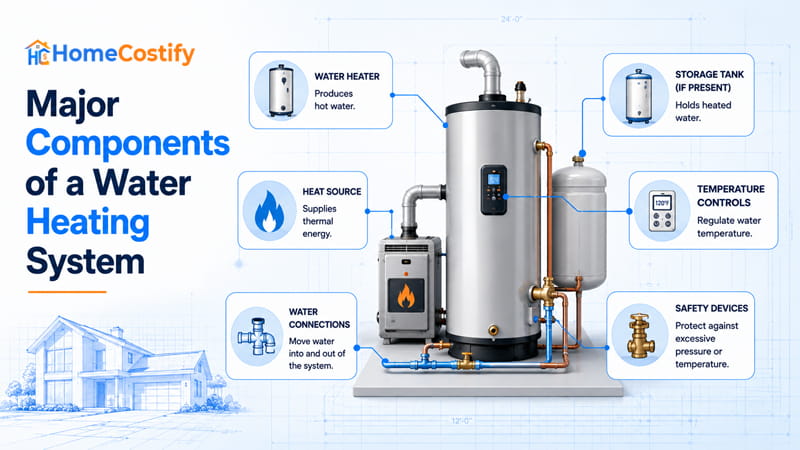
A water heating system brings multiple plumbing components into one working assembly instead of relying on a single device. Core parts remain recognizable from one installation to another, even though equipment designs and configurations differ. The following sections introduce those principal components before examining them individually.
| Component | Primary Function |
|---|---|
| Water Heater | Produces hot water |
| Storage Tank (if present) | Holds heated water |
| Heat Source | Supplies thermal energy |
| Temperature Controls | Regulate water temperature |
| Safety Devices | Protect against excessive pressure or temperature |
| Water Connections | Move water into and out of the system |
Manufacturers package these components in different configurations, but the core parts stay largely consistent. Every component performs its own responsibility within the equipment.
Water Heater
The water heater serves as the primary heating appliance within the equipment assembly. Temperature increases inside this unit before water continues to the next operating function. Its responsibility stays limited to heating, leaving storage, regulation, protection, and plumbing connections to other components.
Storage Tank (When Present)
A residential water heating system sometimes includes a storage tank holding heated water until household demand occurs. The stored volume remains available without waiting for another heating cycle. Some product designs omit this reservoir, although storage remains a common configuration across residential installations.
Heat Source
Every heating appliance requires an energy input before temperature can rise. Electricity, natural gas, solar energy, and heat pump technology all supply thermal energy through different methods. Fuel choice changes from one installation to another, yet the objective stays identical: delivering heat to the appliance.
Temperature Controls
Temperature controls regulate the selected operating temperature inside the equipment. Thermostats monitor temperature and adjust the heating cycle within the chosen setting. Stable regulation limits unnecessary temperature variation during normal operation.
Safety Devices
Protective devices guard the equipment against unsafe operating conditions. Pressure relief valves and related safety hardware respond to excessive pressure or abnormal temperature before equipment damage occurs. Their protective function remains separate from normal heating control.
Water Connections
A home water heating system uses separate connection points for entry and exit. An inlet admits cold water into the equipment, and an outlet carries heated water toward the distribution piping. These ports link the appliance with the surrounding plumbing without serving as storage or heating devices.
Key functions performed by major components include:
- Heating incoming water.
- Storing heated water when a storage vessel is present.
- Supplying thermal energy.
- Regulating operating temperature.
- Protecting equipment from excessive pressure or temperature.
- Directing water into and out of the equipment.
A household water heating system includes these major components within one operating unit. Each part serves a separate responsibility without replacing another.
Types of Residential Water Heating Systems

A residential water heating system falls into five major categories based on the way heat reaches household water. Storage, tankless, heat pump, solar, and indirect designs follow separate operating concepts, although each category serves the same residential purpose.
| System Type | Heating Method | Water Storage |
|---|---|---|
| Storage | Water heated inside a tank | Yes |
| Tankless | Water heated during use | No |
| Heat Pump | Transfers heat from surrounding air | Yes |
| Solar | Uses solar energy with backup heating | Usually |
| Indirect | Receives heat from a boiler | Depends |
The U.S. Department of Energy groups residential equipment into storage, tankless, and heat pump categories, with solar and indirect designs representing additional methods for producing household hot water.
Storage Water Heating Systems
An insulated storage tank holds heated water until a faucet or appliance requests it. Heating takes place before normal household demand, leaving a ready reserve available for later use. The stored volume gradually decreases as occupants draw from the tank.
This water heating system appears in a large share of U.S. homes. A prepared reserve supplies bathrooms, kitchens, and laundry rooms during periods of repeated household demand.
Tankless Water Heating Systems
Opening a hot-water fixture activates a home water heating system built around tankless technology. Production begins only after household demand starts, with output following active flow rather than stored volume.
This operating concept suits homes where occupants prefer water produced at the moment of use. Available volume no longer depends on tank capacity, although output continues to follow the equipment’s rated flow capability.
Heat Pump Water Heating Systems
Warmth drawn from surrounding air supplies the energy used by a household water heating system built around heat pump technology. Existing warmth from surrounding air passes into the storage tank through a refrigeration cycle. Air becomes the primary energy source, leaving combustion or electric resistance outside the central operating principle.
Garages, basements, utility rooms, and other spaces with sufficient surrounding air commonly accommodate this category. Climate, available space, and airflow influence installation choices. Transferred heat supplies household hot water without direct heat generation inside the unit.
Solar Water Heating Systems
Roof-mounted collectors capture sunlight and convert solar radiation into usable heat. A water heating system using this design transfers that captured energy into household water before normal use begins. Bright weather supplies much of the required thermal input under favorable conditions.
Cloud cover, seasonal daylight, and nighttime conditions reduce available solar gain, so backup equipment commonly accompanies this category. Auxiliary heating continues supplying household demand whenever collected sunlight alone cannot satisfy daily use.
Indirect Water Heating Systems
An existing boiler supplies thermal energy for a residential water heating system using an indirect design. A heat exchanger transfers warmth from the boiler loop into domestic water without requiring a separate burner or electric heating element inside the storage tank.
Homes already equipped with boiler-based space heating frequently adopt this configuration. A shared energy source serves both space heating and domestic hot-water production, reducing the need for another dedicated heating appliance dedicated solely to water heating.
Common Energy Sources for Water Heating Systems
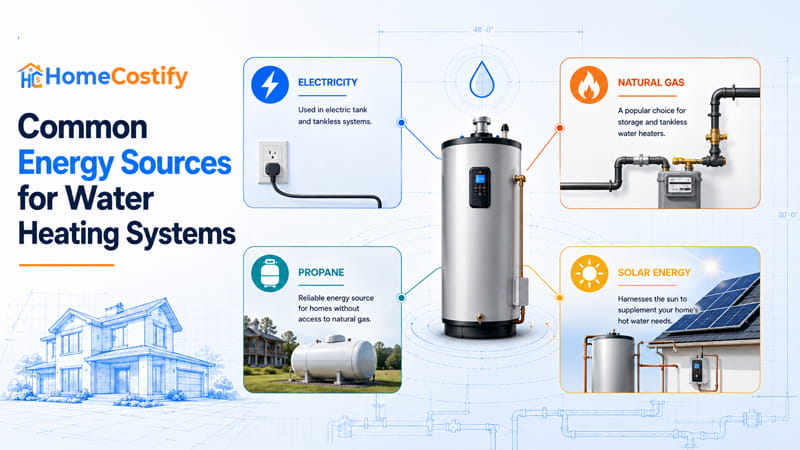
A water heating system draws thermal input from four primary energy sources used across U.S. homes. Electricity, natural gas, propane, and sunlight each supply the heat required for domestic hot-water production, even though the origin of that heat differs from one source to another.
| Energy Source | Common Residential Use |
|---|---|
| Electricity | Tank and tankless systems |
| Natural Gas | Storage and tankless systems |
| Propane | Rural homes without natural gas |
| Solar Energy | Supplemental residential heating |
Electricity
Electrical power supplies thermal input through the home’s electrical service. Availability across urban, suburban, and rural communities makes this source suitable for a wide range of residential installations. Utility power reaches the property before entering the heating equipment.
Natural Gas
Underground utility pipelines deliver fuel to a home water heating system where natural-gas service reaches the property. Public gas networks serve large portions of the United States, making pipeline fuel a familiar residential option. Thermal output comes from the supplied fuel after it enters the equipment.
Propane
Rural properties and remote locations frequently obtain fuel from on-site propane storage. Delivery trucks refill the storage vessel as needed, allowing homes outside public gas networks to continue using gas-fired equipment. Propane serves the heating function without requiring pipeline access.
Solar Energy
Sunlight supplies renewable thermal input for a household water heating system equipped with solar collectors. Captured solar gain contributes heat during favorable weather conditions. Auxiliary heating remains available whenever cloud cover, seasonal daylight, or nighttime conditions limit solar production.
Storage vs. Tankless Water Heating Systems
A water heating system built around storage and a tankless configuration achieves the same household objective through two distinct production methods. Stored capacity characterizes one category. Instant production characterizes the other. The primary distinction centers on when usable hot water becomes available.
| Feature | Storage | Tankless |
|---|---|---|
| Water Storage | Yes | No |
| Heating Method | Stored before use | On demand |
| Hot Water Availability | Ready for use | Produced during demand |
| Space Requirement | Larger | More compact |
Prepared capacity forms the foundation of the storage design. An insulated reservoir holds a ready volume available for kitchens, bathrooms, and laundry rooms as soon as a fixture opens.
Drawn volume gradually declines during use until another heating cycle restores the reserve. A home water heating system following this concept centers on maintaining stored availability rather than producing output at the moment demand begins.
No stored reserve occupies the tankless design. Opening a faucet, shower, or appliance starts production, matching output with active household use.
Available volume follows current demand instead of previously heated storage. Continuous operation continues as long as flow remains within the equipment’s rated capacity.
Both categories share key characteristics:
- Produce warm water for everyday domestic activities.
- Connect to the home’s plumbing network.
- Operate with electricity, natural gas, propane, or solar-assisted equipment.
- Serve kitchens, bathrooms, laundry rooms, and other indoor fixtures.
Benefits and Limitations of Residential Water Heating Systems
A water heating system offers clear household advantages, yet every design operates within practical boundaries shaped by equipment capacity, available energy, and operating conditions. Viewing both sides together builds realistic expectations without assuming identical results from every installation.
| Benefits | Limitations |
|---|---|
| Reliable household hot water | Requires an energy source |
| Improved comfort and hygiene | Output varies by design |
| Supports multiple household activities | Needs periodic inspection over time |
Daily routines benefit from dependable access to warm water without waiting for every use to begin from room temperature. Dishwashers, washing machines, and bathing fixtures operate under conditions expected by their manufacturers.
Larger homes can supply multiple fixtures during routine use, provided equipment capacity matches household demand.
Key advantages include:
- Ready access to heated water for routine domestic use.
- Supports appliance operation requiring warm or hot settings.
- Serves multiple fixtures during normal occupancy.
- Fits apartments, single-family houses, and larger residential properties.
A household water heating system still operates within measurable limits. An external energy source powers every design, regardless of equipment category. Available output follows equipment capacity, so simultaneous fixture use can reduce delivered volume or temperature.
Product configurations differ, producing different operating characteristics across residential installations.
Practical limitations include:
- Requires electricity, gas, propane, solar backup, or another heat source.
- Output follows equipment capacity.
- Simultaneous demand can reduce available supply.
- Operating characteristics vary across equipment designs.
Conclusion
Supplying heated water for bathing, cooking, cleaning, laundry, and other household tasks requires a complete plumbing function instead of a single appliance. Incoming supply, temperature control, distribution, and drainage serve separate purposes before daily use reaches a faucet, shower, or appliance. Storage, tankless, heat pump, solar, and indirect designs follow different operating methods toward the identical household objective.
Basic familiarity with residential hot-water systems gives homeowners useful context when reading product information, reviewing contractor recommendations, or planning future renovation projects.
Technical terminology becomes easier to interpret, equipment categories feel less confusing, and plumbing decisions can be evaluated with clearer expectations before work begins.
FAQs About Water Heating System
What are the different types of water heating systems?
The five primary residential categories include storage, tankless, heat pump, solar, and indirect systems. Each category uses a different heating method but serves the same household objective.
What is a water heating system called?
Residential plumbing commonly uses the term domestic hot water (DHW) system to describe the subsystem responsible for producing and supplying heated water for household fixtures and appliances.
What are the 4 classes of water heaters?
Common classifications include storage, tankless, heat pump, and solar water heaters. Some technical references add indirect systems as a separate category, so classification can vary by source.
Which type of water heater is most efficient?
Heat pump water heaters generally achieve the highest residential energy efficiency by transferring existing heat from surrounding air rather than generating thermal energy directly.
Which type of water heater lasts the longest?
Service life varies with equipment design, operating conditions, water quality, installation quality, and routine inspection. No category consistently delivers the longest lifespan under every residential condition.