Roof replacement sits near the top of the list when it comes to major exterior projects. Material choice influences appearance, maintenance demands, weather resistance, and long-term ownership costs. Metal Roofing has gained traction across the United States as more houses move away from traditional asphalt products and toward roofing systems designed for decades of service.
The trend appears in coastal communities, snow-prone regions, and fast-growing suburban neighborhoods where owners expect more than a short replacement cycle.
The category covers far more than shiny panels attached to a roof deck. Steel, aluminum, copper, and zinc each behave differently over time. Profile selection matters too.
Standing seam panels, corrugated panels, metal shingles, and tile-inspired designs all bring different strengths to the table. Fastener systems, local climate, and installation quality shape the final result just as much as material selection.
Steel, aluminum, copper, and zinc do not behave the same way once they are exposed to years of sun, rain, snow, and temperature swings. Cost differences can be substantial as well. Panel design, fastening methods, and local weather patterns add another layer to the decision. Looking at each factor separately rarely tells the full story.
What Is Metal Roofing?
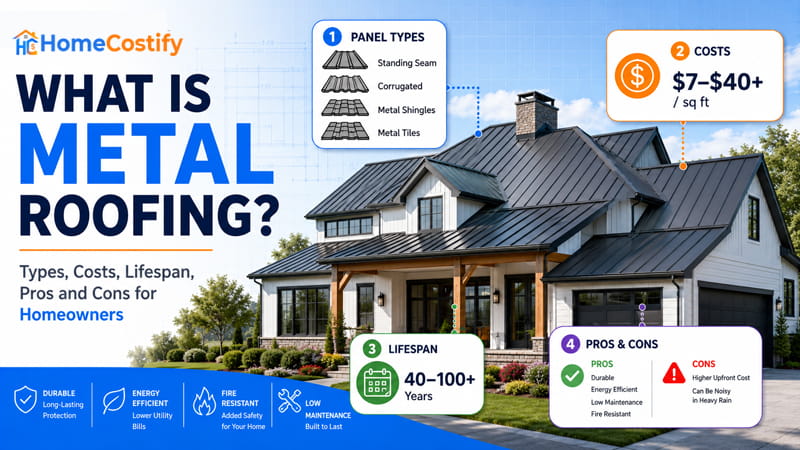
Metal Roofing refers to a roof system constructed from formed metal panels, shingles, or tiles rather than asphalt-based products. The category includes multiple metals, multiple panel designs, and multiple attachment methods. A roof built from steel may look entirely different from one built from copper, even though both belong to the same family of roofing products.
Public perception has changed considerably over the last few decades. Older generations often associate metal roofs with barns, agricultural buildings, or industrial structures. Current products occupy a much broader range of architectural styles.
Some resemble traditional shingles. Others mimic clay tile, slate, or cedar shake. A standing seam system creates a completely different appearance with tall vertical lines running from ridge to eave.
Material selection represents only one part of the equation. A complete roof assembly includes panels, trim components, fasteners, flashing, underlayment, and ventilation details.
The strongest panel on the market cannot compensate for poor installation practices or an improperly designed assembly. Looking at the roof as a system creates a clearer picture of how it will perform ten, twenty, or fifty years from now.
Types of Metal Roofing Materials
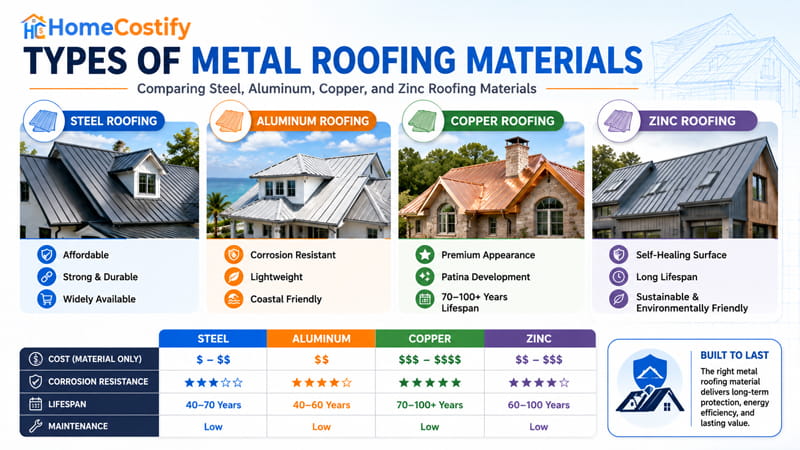
The panel profile usually gets most of the attention during the shopping process. What sits beneath the finish deserves just as much attention. Steel, aluminum, copper, and zinc each respond differently to weather exposure, maintenance habits, and the passage of time.
Those differences often shape the ownership experience more than appearance alone.
Steel Roofing
Steel Roofing dominates the residential market across much of the country. Availability plays a major role. Contractors can source steel panels from a wide range of manufacturers, and buyers usually encounter more profile and color choices than they would with specialty metals.
Most residential products fall into two categories: galvanized steel roofing and Galvalume Roofing. Galvanized products receive a zinc coating. Galvalume products use an aluminum-zinc alloy coating that has become increasingly common in residential construction.
Both approaches focus on corrosion resistance, though performance can vary based on coating weight, finish quality, and environmental exposure.
Price also contributes to steel’s popularity. A steel roof generally costs less than comparable copper or zinc systems while still delivering decades of service. That balance between cost and lifespan keeps steel near the top of many residential roofing shortlists.
Aluminum Roofing
Salt exposure changes the conversation quickly. Materials that perform well inland may age differently near coastlines where airborne salt settles onto exterior surfaces throughout the year. Aluminum Roofing occupies a strong position in these environments because it does not rust the way steel can when protective layers become damaged.
Weight is another characteristic worth noting. Aluminum panels place less load on a structure than many competing materials. The difference becomes more noticeable on larger roof areas or projects with structural limitations.
Regional demand often reflects these traits. Coastal areas in states such as Florida, South Carolina, and parts of California frequently see aluminum systems selected for projects where corrosion resistance ranks near the top of the priority list.
Among all major metal roofing materials, aluminum maintains one of the strongest reputations in marine environments.
Copper Roofing
Copper Roofing occupies a different corner of the market. Price alone separates it from many other residential options. The material appears most often on historic buildings, custom homes, architectural accents, churches, and high-end residential projects where appearance carries substantial weight.
Fresh copper displays a bright metallic finish. Time changes that appearance. Exposure to the elements gradually produces the well-known patina associated with aging copper roofs.
The transformation can take years and creates a look that many architects intentionally seek.
Service life often enters the discussion as well. Copper systems have remained in place on some buildings for generations. Few residential roofing materials carry the same historical track record.
Zinc Roofing
Zinc Roofing remains less common in North America than steel or aluminum, though interest has increased in certain architectural circles. The material develops a protective surface layer that naturally evolves as the roof ages. Minor scratches and imperfections often become less noticeable over time because of this weathering process.
Longevity frequently appears among the reasons buyers investigate zinc. Projects designed with long ownership horizons sometimes place zinc on the shortlist alongside copper.
Cost usually lands somewhere between mainstream steel products and premium copper systems.
Visual appearance also differs from other metals. Zinc develops a distinctive finish that continues to change gradually over the years, creating a character that many modern and contemporary designs embrace.
Which Metal Roofing Material Is Best?
No single material fits every project. Climate, budget, design goals, and ownership timelines all influence the decision.
| Material | Relative Cost Level |
|---|---|
| Steel | Low |
| Aluminum | Moderate |
| Zinc | High |
| Copper | Premium |
Steel often makes sense where affordability and product availability rank high on the priority list. Aluminum stands out in coastal environments. Copper attracts buyers seeking a premium architectural appearance and exceptionally long service life.
Zinc appeals to those interested in distinctive aesthetics and long-term ownership. The best choice depends less on finding a universally superior material and more on matching the material to the project itself.
Types of Metal Roofing Panels
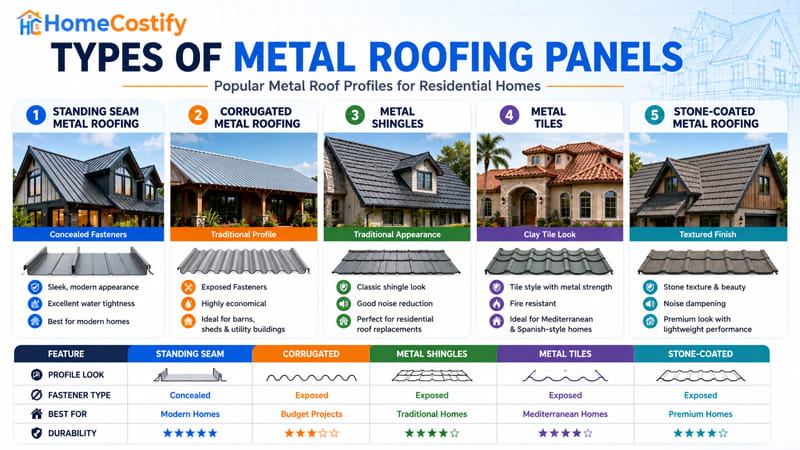
Confusion usually starts when buyers compare products that share a similar appearance but use different materials underneath. Two roofs may look nearly identical from the street yet age differently over the next several decades.
Profile selection affects appearance, water shedding, maintenance access, and installation methods. Material selection influences corrosion resistance, lifespan, and cost.
Standing Seam Metal Roofing
Tall vertical seams have become a familiar sight on custom homes, mountain retreats, and contemporary designs. Standing Seam Metal Roofing uses interlocking panels connected by raised seams that run from the ridge to the eave.
Fasteners remain hidden beneath the panels, creating a cleaner finished surface than systems that leave screws exposed.
The concealed attachment method changes more than appearance. Long metal panels expand and contract as temperatures fluctuate throughout the year.
Standing seam systems accommodate that movement more effectively than many exposed-fastener alternatives. Panel movement occurs beneath the surface rather than around visible screw penetrations.
Architects and builders frequently select Standing Seam systems for projects where clean lines matter. The profile pairs well with modern architecture, though it also appears on farmhouses, cabins, and traditional homes.
Initial costs often land above other profile types. The visual appeal and long service life keep demand strong across many regions of the country.
Corrugated Metal Roofing
Few roof profiles have been around longer than Corrugated Metal Roofing. The repeating ridges and valleys create a recognizable appearance that traces its roots back to agricultural and industrial construction.
Barns, workshops, and storage buildings helped make the profile popular long before it appeared on residential projects.
The design remains common because it performs well without driving costs into premium territory. Manufacturing is relatively straightforward compared with more complex panel systems. Installation tends to move faster as well, especially on simple roof layouts.
Residential interest has grown in recent years. Farmhouse-inspired architecture, rural homes, and certain modern designs frequently incorporate corrugated panels as part of the exterior aesthetic. The profile carries a practical reputation that continues to appeal to budget-conscious buyers.
Metal Shingles
Not every house looks right beneath long vertical panels. Some architectural styles feel more natural with a roof that resembles traditional shingles. Metal Shingles fill that gap by combining the familiar appearance of conventional roofing with the lifespan associated with metal products.
From the ground, many people struggle to distinguish metal shingles from asphalt, slate, or cedar-inspired alternatives.
Manufacturers produce a wide range of textures, colors, and stamped patterns designed to mimic other roofing materials. The visual flexibility expands the number of homes where metal products feel appropriate.
Interest in Metal Shingle Roofing remains strong among buyers who want a traditional appearance without committing to asphalt-based products. The finished look blends easily into established neighborhoods where standing seam panels may appear too contemporary.
Metal Tiles
Mediterranean and Spanish-style homes often rely on curved roof designs that would look out of place beneath standard panels. Metal Roof Tiles replicate the appearance of clay tile while weighing substantially less.
Weight becomes a consideration on larger structures. Traditional clay products can place significant loads on the roof framing system below. Metal alternatives deliver a similar visual effect without introducing the same structural demands.
The profile also appears in regions where tile roofs dominate local architecture. From street level, the difference is often difficult to spot.
Stone-Coated Metal Roofing
Texture changes the character of a roof. Smooth painted panels create one appearance, while granular finishes create something entirely different. Stone-Coated Metal Roofing combines a metal base with a textured stone surface designed to resemble traditional roofing materials.
The granular finish softens the visual appearance and adds depth that painted panels cannot always replicate. Some products resemble asphalt shingles. Others imitate shake, tile, or slate.
Residential applications dominate this category. Buyers drawn to traditional curb appeal often place stone-coated systems on the shortlist when comparing roofing options.
Exposed vs Concealed Fastener Systems
Fastener placement creates another distinction between roof systems. Some products leave screw heads visible after installation. Others hide attachment points beneath adjoining panels.
| Feature | Exposed Fastener | Concealed Fastener |
|---|---|---|
| Cost | Lower | Higher |
| Maintenance | Higher | Lower |
| Appearance | Traditional | Modern |
| Lifespan | Good | Excellent |
An Exposed Fastener system secures panels directly through the face of the metal. Screws remain visible after installation. This approach keeps costs lower and appears on many corrugated and agricultural-style roofs.
A Concealed Fastener system hides attachment points beneath overlapping panels or seams. Standing seam products typically fall into this category. Material movement occurs with fewer visible penetrations across the roof surface, which contributes to their popularity on residential projects.
Metal Roofing Costs
Two houses with similar square footage can receive roofing estimates that differ by tens of thousands of dollars. The difference often surprises buyers who assume roof size tells the entire story. Geography, labor markets, roof design, material selection, and installation complexity all influence the final number.
A simple roof in a region with moderate labor rates usually costs less than a complex roof filled with dormers, valleys, skylights, and steep slopes. Product selection changes the equation again. Steel and copper may belong to the same category, but they rarely occupy the same price range.
Average Metal Roofing Costs by Material
National averages provide a useful starting point for budgeting, though local pricing can move above or below these ranges.
| Material | Average Installed Cost Per Sq. Ft. |
|---|---|
| Steel | $7–$14 |
| Aluminum | $10–$20 |
| Zinc | $15–$25 |
| Copper | $20–$40+ |
A typical Metal Roofing Cost varies considerably depending on the material selected. Steel usually occupies the entry point for residential projects, while copper sits at the opposite end of the spectrum. Metal Roofing Prices rise as materials become less common and manufacturing requirements become more specialized.
Questions about Metal Roofing Price often focus on material alone. Labor frequently represents a substantial portion of the total project budget. The Cost of Metal Roof installation includes more than the panels visible from the street.
Factors That Affect Metal Roofing Costs
Material selection remains one of the largest variables. Steel generally enters the market at a lower price point than aluminum, zinc, or copper. Roof size follows close behind. Larger surfaces require more panels, trim pieces, underlayment, and labor hours.
Roof pitch also influences project pricing. A steep roof slows installation and increases safety requirements. Complex roof designs create another layer of labor. Valleys, dormers, skylights, and intersecting rooflines demand additional cutting, flashing, and detailing.
Local labor markets shape estimates as well. The same product installed in two different states may produce noticeably different pricing. That reality explains why a published Metal Roof Cost should be treated as a budgeting tool rather than a final quote.
Disclaimer: The figures above represent typical installed cost ranges across the United States and should be used for budgeting purposes only. Actual metal roofing costs can vary based on location, labor rates, roof complexity, material availability, and product specifications.
Metal Roofing Lifespan
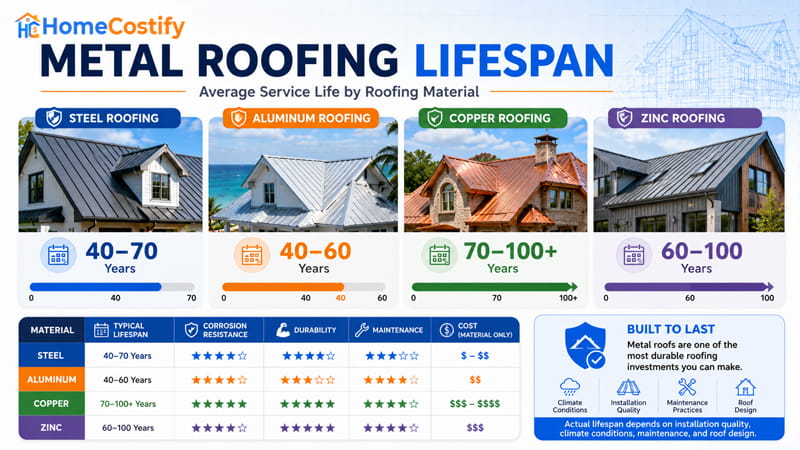
Age tells only part of the story. Two roofs installed in the same year can reach very different outcomes several decades later. Climate exposure, installation quality, maintenance practices, and material selection all influence how a roof ages over time.
Average Lifespan by Material
| Material | Typical Lifespan |
|---|---|
| Steel | 40–70 Years |
| Aluminum | 40–60 Years |
| Copper | 70–100+ Years |
| Zinc | 60–100 Years |
Steel systems cover a broad range because coatings, installation quality, and environmental conditions vary from one project to another. Copper and zinc occupy the upper end of the lifespan spectrum. Aluminum performs particularly well in coastal environments where corrosion resistance becomes a larger factor.
What Affects Metal Roofing Longevity?
Climate exposure shapes aging patterns. Salt air, heavy snowfall, extreme heat, and frequent freeze-thaw cycles place different stresses on roofing materials. Installation quality carries similar weight. Small mistakes during installation can shorten the service life of an otherwise high-quality roof.
Ventilation also plays a role. Excess heat and trapped moisture create conditions that accelerate wear on roofing components and related assemblies. Maintenance habits matter too. Regular inspections make it easier to identify loose fasteners, damaged sealants, or isolated problem areas before they spread.
Industry Research on Metal Roofing Lifespan
Research published by the Metal Construction Association indicates that properly installed steel standing seam systems can remain in service for more than sixty years. That places them among the longest-lasting roofing products commonly used on residential and commercial buildings.
Note: Actual service life depends on climate conditions, installation quality, roof ventilation, maintenance practices, and material selection.
Advantages of Metal Roofing
A roof faces the same weather every day, but not every roofing material responds the same way. Years of sun exposure, seasonal temperature swings, heavy rain, snow accumulation, and strong winds gradually reveal the strengths and weaknesses of a roofing system. Some differences become noticeable within a few years. Others may not appear until decades later.
That longer perspective explains why metal continues gaining attention across a wide range of climates and architectural styles. Cost often drives the initial conversation, yet long-term ownership tends to revolve around lifespan, maintenance demands, weather performance, and energy use. Several characteristics contribute to that reputation.
Long Lifespan
Roof replacement is not something most people want to schedule twice. A roof installed during one stage of life may still be in place decades later if the material and installation quality align with local conditions.
Steel, aluminum, copper, and zinc generally remain in service far longer than many conventional roofing products. The difference becomes easier to appreciate as neighboring roofs begin reaching the end of their replacement cycle.
Energy Efficiency
Summer sun can push roof-surface temperatures surprisingly high, especially in southern states. Some roofing systems absorb a large share of that heat throughout the day. Others reflect a greater portion back into the atmosphere before it enters the building envelope.
Research published by Lawrence Berkeley National Laboratory found that increasing roof reflectivity from roughly 10–20 percent to around 60 percent can reduce cooling-energy consumption by more than 20 percent. Reflective metal roof systems fall among the roofing products designed to take advantage of that effect.
Fire Resistance
Wildfire risk varies from one region to another. Homes located in parts of California, Colorado, Idaho, Montana, and several western states face a different set of concerns than homes in areas where wildfire exposure remains limited.
Metal panels do not ignite the way combustible roofing materials can. Roof-system ratings still depend on the complete assembly, but the roofing surface itself does not contribute fuel to a fire.
Wind Resistance
Strong wind exposes weaknesses quickly. Loose shingles, lifted edges, and poorly secured components often appear after major storms pass through an area.
Roofing systems engineered for high-wind conditions approach the challenge differently. Certain standing seam products carry wind ratings that exceed what many traditional roofing systems can tolerate.
Sustainability
Millions of tons of roofing waste leave job sites every year. Much of it ends up in landfills after a replacement project is completed. Metal follows a different path.
Recycled content frequently appears in manufacturing, and the material itself remains recyclable long after its first installation. A roof removed decades from now may still enter another production cycle rather than a landfill.
Low Maintenance
No roof completely eliminates maintenance. Sealants age. Flashing details require periodic inspections. Debris can accumulate in valleys and gutters regardless of the roofing material overhead.
Metal systems generally avoid some of the recurring issues associated with cracked, curled, or deteriorated shingles. Fewer repair events over time often become part of the ownership experience.
Disadvantages of Metal Roofing
A roof can perform exceptionally well in some areas and still come with compromises in others. The same pattern appears across nearly every roofing material on the market. Some trade-offs become obvious during the quoting stage, while others tend to surface years after installation.
Looking at both sides of the equation creates a more realistic picture of long-term ownership.
Higher Upfront Cost
Price often becomes the first obstacle. A metal roof usually costs more upfront than basic asphalt shingles, and the difference can be substantial on larger homes. Material selection explains part of that gap.
Labor requirements, roof complexity, and installation methods contribute as well. Buyers focused solely on initial cost may find other roofing products easier to justify.
Denting From Impact
Not all metal panels respond the same way to impact. Thicker gauges generally hold up better than thinner products, though no material is completely immune to dents. Hail frequently enters the discussion in regions where severe storms occur on a regular basis.
Panel profile also influences the outcome. Deeply ribbed designs often conceal minor dents more effectively than flatter surfaces.
Oil Canning
A perfectly flat metal panel does not always remain visually flat after installation. Subtle waviness can appear across broad sections of a panel, particularly under certain lighting conditions.
The industry refers to this effect as oil canning. Structural performance remains unchanged in most cases. Appearance tends to drive the concern.
Expansion and Contraction
Metal responds to temperature changes throughout the year. Panels expand during warmer periods and contract as temperatures fall. Roof systems are engineered with this movement in mind, though the movement itself never disappears.
Longer panel lengths place greater emphasis on proper detailing, fastening methods, and installation practices.
Specialized Installation Requirements
Installation quality carries more weight than many buyers realize. A premium product can still produce disappointing results when installation details are overlooked. Flashing transitions, panel alignment, fastening patterns, and trim work all require attention. Small mistakes may remain hidden for years before creating noticeable problems.
Some commonly reported Metal Roofing Problems trace back to workmanship rather than the material itself. Comparing contractor experience often proves just as important as comparing products. The roof system and the installation crew work together. One rarely succeeds without the other.
How to Choose the Right Metal Roof
Two houses can sit on the same street and require completely different roofing solutions. Architecture, climate exposure, budget constraints, and ownership goals all influence the decision. The strongest choice rarely comes from selecting the most expensive product on the market.
Consider These Factors:
- Budget
- Climate
- Appearance
- Lifespan expectations
- Maintenance preferences
Start With Your Budget
Budget shapes the conversation early. Some homeowners enter the planning stage with a fixed spending limit, while others place greater emphasis on long-term ownership costs. Steel generally sits at the lower end of the metal roofing price spectrum.
Aluminum, zinc, and copper move progressively higher. The goal is not to find the most expensive product. The goal is finding a roof that makes sense financially both today and years from now.
Match the Roof to Your Climate
Weather conditions influence roofing performance every day. A roof installed along the Gulf Coast faces different challenges than a roof located in Arizona, Colorado, or Minnesota. Salt exposure, heavy snowfall, hail activity, humidity levels, and temperature swings all affect material selection.
Climate often narrows the list of suitable options long before appearance enters the discussion.
Consider the Architectural Style of the Home
A roof occupies a large portion of a home’s exterior, making visual compatibility difficult to ignore. Standing seam panels often complement contemporary and modern designs. Metal shingles blend more naturally into neighborhoods dominated by traditional architecture.
Tile-inspired profiles frequently appear on Mediterranean and Spanish-style homes. The strongest choice usually feels like part of the original design rather than an afterthought.
Think About How Long You Plan to Stay
Ownership timelines influence priorities. A homeowner planning to remain in the same property for several decades may evaluate materials differently than someone expecting to move within a few years.
Copper and zinc sit near the upper end of the lifespan spectrum, while steel and aluminum still deliver decades of service under the right conditions. The longest-lasting option is not always necessary, but expected ownership length deserves a place in the decision-making process.
Decide How Much Maintenance You Can Tolerate
Every roof requires some level of attention over time. The difference lies in how often that attention becomes necessary. Fastener systems, panel profiles, installation quality, and local weather conditions all contribute to future maintenance requirements.
Some homeowners do not mind periodic inspections and minor upkeep. Others prefer a roofing system that demands as little involvement as possible after installation.
The question is not which metal roof works best for everyone. A coastal property may point toward aluminum. A budget-focused project may lean toward steel.
A custom luxury home may justify copper or zinc. The strongest choice reflects the house, the climate, the budget, and the owner’s long-term plans rather than a single feature or specification.
Best Metal Roofs for Different Climate Zones in the USA
Climate influences roofing performance long after installation day is over. A roof that performs exceptionally well in one part of the country may face a very different set of challenges somewhere else.
Salt exposure, heavy snow, extreme heat, hurricane-force winds, and wildfire risk all place different demands on roofing materials and panel systems. Selecting the right combination of material and profile often produces better long-term results than focusing on appearance alone.
Coastal Areas
Salt air creates one of the harshest environments for roofing materials. Corrosion becomes a larger concern as ocean breezes carry moisture and salt particles inland throughout the year. For that reason, aluminum remains one of the most common recommendations for coastal applications.
Unlike steel, aluminum does not rust in the traditional sense. The material develops a protective oxide layer that helps limit further deterioration. Pairing aluminum panels with a Standing Seam profile adds another layer of protection because fewer exposed penetrations exist across the roof surface.
Homeowners searching for the best Metal Roofing option near the coast often narrow the list quickly. Aluminum combined with a standing seam profile frequently rises to the top.
Snow Regions
Heavy snow introduces a different challenge. Weight accumulation and freeze-thaw cycles place continuous stress on roofing systems throughout winter.
Smooth panel surfaces encourage snow to slide off more easily than textured roofing materials. Standing seam steel systems have become particularly popular in northern climates because the profile sheds snow efficiently while maintaining excellent structural strength.
A properly engineered Metal Roof can perform exceptionally well in regions where snowfall remains a regular part of winter. Roof pitch still plays a major role, but standing seam steel systems continue to appear on homes throughout the Northeast, Midwest, and Rocky Mountain regions.
Hurricane Zones
Coastal storms test roofing systems in ways that ordinary weather never will. Wind uplift becomes a major concern once hurricane-force gusts begin pushing against roof edges and panel seams.
Not every roofing system carries the same wind-performance ratings. High-wind-rated standing seam systems often receive consideration in hurricane-prone states such as Florida, Louisiana, Mississippi, and portions of Texas.
Panel attachment methods matter as much as material selection. A properly engineered Metal Roofing system designed for high-wind exposure generally performs differently than a basic panel system selected without regard for local conditions.
Hot Climates
Summer temperatures can remain extreme for months across portions of the Southwest and Sun Belt. Roof surfaces absorb solar radiation every day, influencing attic temperatures and cooling demand.
Reflective cool-roof coatings have become increasingly common in these environments. Many modern Metal Roofing products are available with finishes designed to reflect a larger portion of incoming solar energy.
Light-colored panels often outperform darker colors from a heat-reflectance perspective. Roofing design, attic insulation, and ventilation still influence overall performance, though reflective roofing systems frequently become part of the conversation in hot climates.
Wildfire-Prone Areas
Wildfire exposure has changed roofing priorities in many western states. Flying embers can travel significant distances ahead of the main fire front, creating ignition risks for vulnerable roofing materials.
Class A fire-rated roof assemblies often receive priority in these regions. Metal panels themselves are non-combustible, making them attractive for projects located in wildfire-prone areas.
Material selection remains important, but the roof assembly should always be evaluated as a complete system. Underlayment, decking, flashing details, and installation quality all contribute to overall fire performance.
Metal Roofing Maintenance Guide
One reason Metal Roofing continues attracting long-term homeowners is the relatively modest maintenance burden compared with some roofing alternatives.
That does not mean maintenance can be ignored entirely. Small issues are usually easier and less expensive to address before they develop into larger repairs.
Annual Inspection
A yearly inspection creates an opportunity to identify loose trim, damaged flashing, clogged drainage paths, or visible panel damage. Many contractors recommend scheduling inspections after severe weather events as well.
Cleaning Debris
Leaves, branches, and organic debris often collect in valleys, behind chimneys, and inside gutters. Moisture tends to linger in those areas when debris remains in place. Periodic cleaning reduces that risk.
Checking Fasteners
Exposed-fastener systems require occasional attention because fasteners can loosen over time. Expansion and contraction cycles contribute to gradual movement in some applications.
Inspecting Sealants
Sealants do not last forever. Areas around penetrations, flashing transitions, skylights, and vents should be reviewed periodically for signs of deterioration.
Monitoring Corrosion
Most modern coatings perform extremely well, but coating damage can expose underlying metal. Scratches, impact damage, and edge wear deserve attention before corrosion becomes more widespread.
A consistent Metal Roof Maintenance routine usually involves observation rather than major repair work. Preventive inspections often reveal concerns before they become costly problems.
Comparing Metal Roofing to Other Popular Roofing Materials
Different roofing materials solve different problems. Each comes with its own strengths, appearance, lifespan expectations, and maintenance requirements.
- Asphalt Shingles: Lower upfront cost but generally shorter lifespan.
- Architectural Shingles:Thicker and more dimensional than basic asphalt shingles.
- Luxury Shingles: Designed to mimic premium materials such as slate.
- Clay Tile Roofing: Long lifespan with substantial structural weight.
- Concrete Tile Roofing: Durable but heavier than many alternatives.
- Slate Roofing: Exceptional longevity with premium pricing.
- Synthetic Slate Roofing: Slate appearance with reduced weight.
- Wood Shingles: Traditional appearance with ongoing maintenance demands.
- Wood Shakes: More textured appearance than wood shingles.
- Composite Roofing: Manufactured from blended materials and engineered polymers.
- Solar Shingles: Combine roofing and energy generation in a single product.
Conclusion
A roof does far more than cover a house. Material selection, profile design, fastening systems, weather exposure, maintenance expectations, and ownership goals all influence long-term performance.
The strongest Metal Roofing decision rarely comes from focusing on a single factor. Steel, aluminum, copper, and zinc each bring different strengths. Standing seam, corrugated panels, shingles, tiles, and stone-coated systems serve different purposes as well.
Evaluating material type, roof profile, fastening method, climate compatibility, maintenance expectations, and lifetime ownership costs creates a more complete framework for decision-making. Appearance and upfront price deserve consideration, but they rarely tell the entire story.
A roofing system that aligns with the property, local conditions, and long-term plans often delivers the best overall result.
FAQs About Metal Roofing
Is the Biggest Problem With Metal Roofs?
The largest concern for many buyers is upfront cost. Installation expenses typically exceed basic asphalt shingles, particularly when premium materials or standing seam systems are selected.
Is Metal Good for Roofing?
Yes. Metal Roofing remains one of the longest-lasting residential roofing categories and performs well across many climate conditions when properly installed.
Is It Cheaper to Have a Metal Roof?
Initial costs are usually higher. Lifetime ownership costs may look different because replacement cycles often occur less frequently than with some alternative materials.
What Is Better Than a Metal Roof?
No single roofing material is universally better. Climate, budget, appearance goals, maintenance preferences, and expected ownership length all influence the answer.
Which Is Better Cement Sheets or Metal Sheets?
Metal panels generally offer greater longevity, broader design options, and stronger resale appeal. Project requirements and local building conditions still influence the final decision.